An accent nail is supposed to interrupt the set, not make every finger shout over the others. The fun is in the little disagreement between a calm base and one detail that refuses to behave, but there is a point where extra length, texture, and pattern stop adding personality and start competing for the same spotlight. Knowing that line is the whole game.
A good edit does not make a manicure boring; it gives the strongest idea room to land. Keep the base shade that carries the mood, choose the detail you would miss most, and cut anything that merely repeats the same message. That tradeoff leaves space for color, shape, and finish to feel deliberate instead of decorative for decoration’s sake.
Every fall accent idea in one maximal set
These very long nails mix black, teal, burgundy, white, pink, and mustard with stripes, dots, and graphic panels, making the variety itself the main feature. The shared autumn-leaning palette stops the designs from looking completely random, but the length and pattern count still make this a high-attention statement. It is playful, expressive, and definitely not pretending to be minimal.
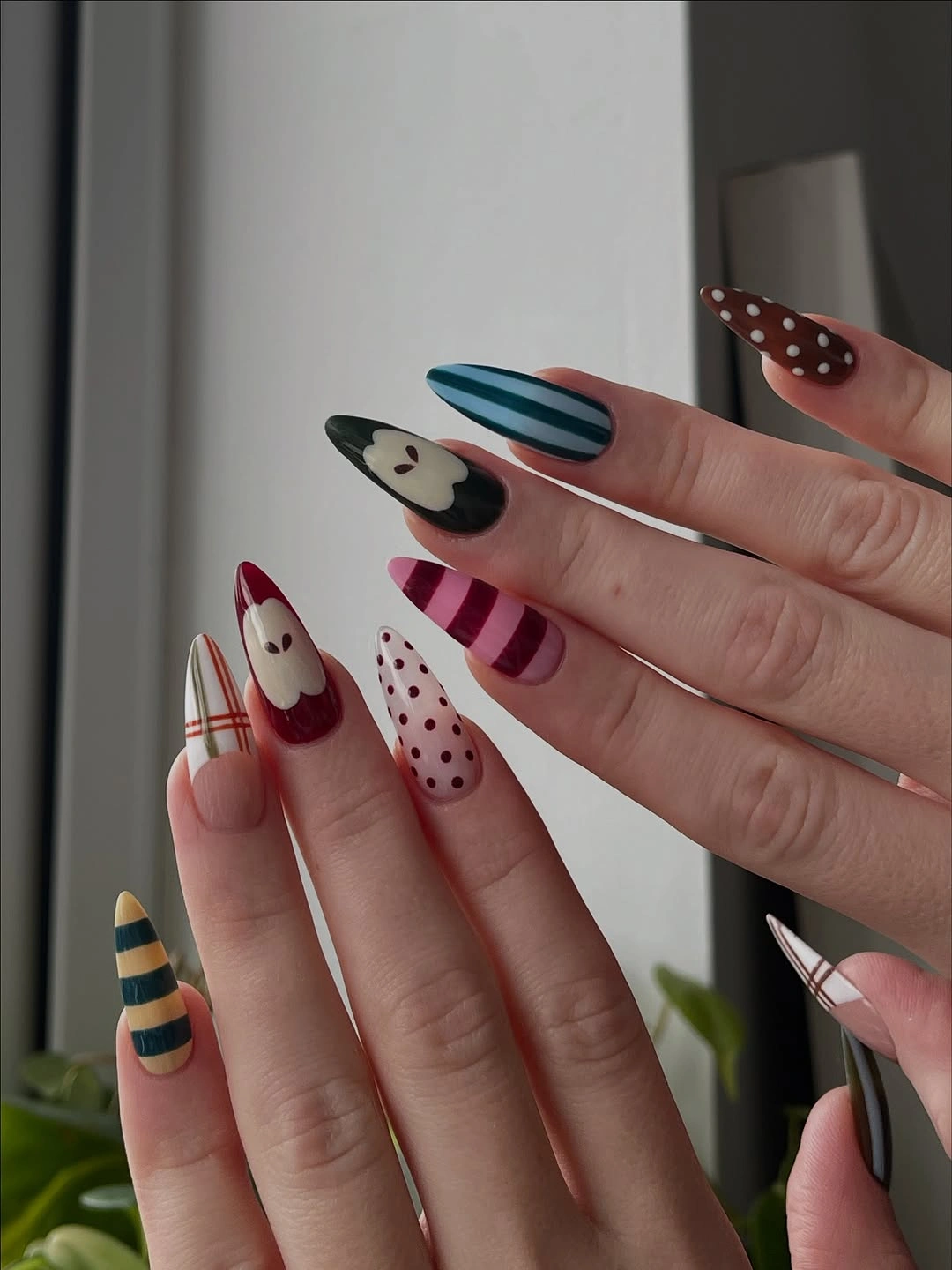
The easiest way to borrow the idea is to choose one accent language instead of copying the entire mix. Keep burgundy or teal on most nails, then add either dots, stripes, or one pale graphic panel to a single finger. Shortening the shape will also lower the visual volume, but the more important edit is removing competing motifs so the chosen accent can actually be seen.
This manicure works because a repeated autumn palette gives the eye a loose connection between very different surfaces. The honest tradeoff is that every additional pattern increases the chance of visual competition, especially on a long point. If you love maximal nails, keep the variety; if you want daily wear, let one color and one accent decision do most of the talking.
Blush neutrals with one sparkling focal nail
Long almond nails move through pale pink, taupe, brown, and burgundy, with thin dark curves and one taupe accent that looks softly sparkling. The colors stay close enough to feel deliberate, while the single textured surface gives the mixed set a clear place to land. Compared with the first image, this is more tonal and easier to edit without losing its personality.
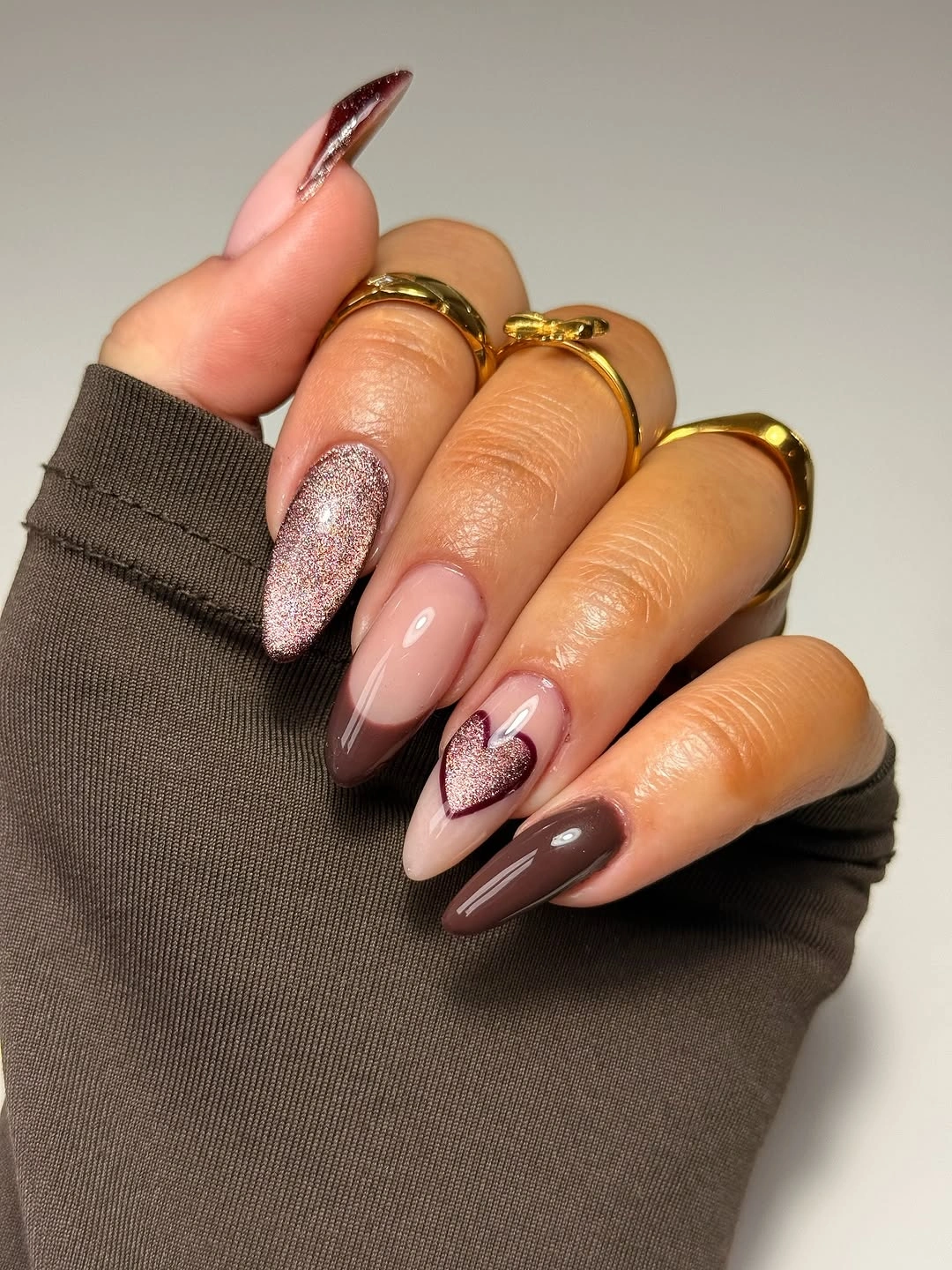
To simplify it, keep the pink and burgundy relationship, then choose either the fine curve or the sparkling accent rather than using both everywhere. A medium almond will preserve the long color flow with less edge upkeep, and cocoa can replace the deepest brown if you want a warmer result. The set feels cohesive when the strongest texture remains isolated.
The design shows how a mixed manicure can stay calm when the palette repeats its warmth and the accents vary in scale. Pale pink supplies open space, burgundy adds depth, and the small sparkle breaks the surface without becoming the whole story. The tradeoff is that a single focal nail may feel too subtle from far away, so keep its contrast clear rather than adding more decoration to compensate.
Dark brown solids with cream linework
Most nails here are glossy dark brown, while cream accents carry thin black botanical curves and small abstract forms. The pale nails create a clean contrast against the solids, and the rounded shape keeps the deep color from feeling severe. It is a straightforward accent-nail structure: one dark base, one light canvas, and just enough linework to make the difference feel intentional.
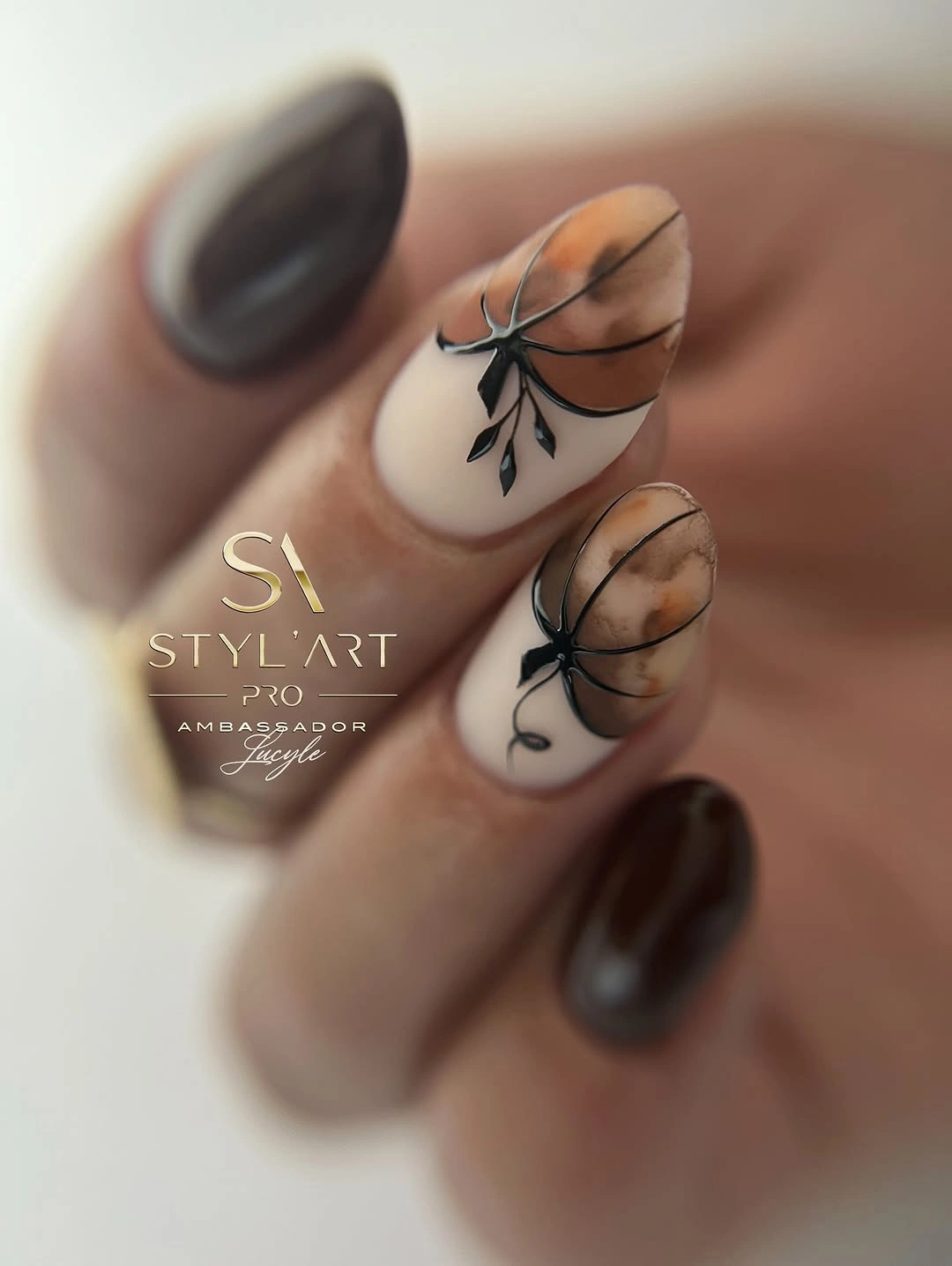
For an easier everyday version, keep the dark brown on four nails and place the linework on one cream accent. A shorter rounded shape will make the contrast more compact, while a warm cocoa or espresso shade can soften the black-brown impression. Avoid adding glitter to the pale nail; the open surface is what gives the fine curves their authority.
This is the kind of accent design that makes a dark manicure feel lighter without sacrificing its fall mood. Brown provides repetition, cream offers visual rest, and the black marks connect the two without crowding the pale base. The honest limitation is that delicate linework can look uneven if it is forced into too many small spaces, so fewer stronger curves are the fairer tradeoff.
Quiet taupe-brown color with almost no art
These long coffin nails rely on muted taupe-brown color and a pale nude area near the cuticles rather than visible decoration. The length is doing most of the expressive work, while the restrained palette keeps the manicure from feeling loud. It is a good reminder that an accent can be tonal: a shift in depth or surface can be enough when the silhouette is already strong.
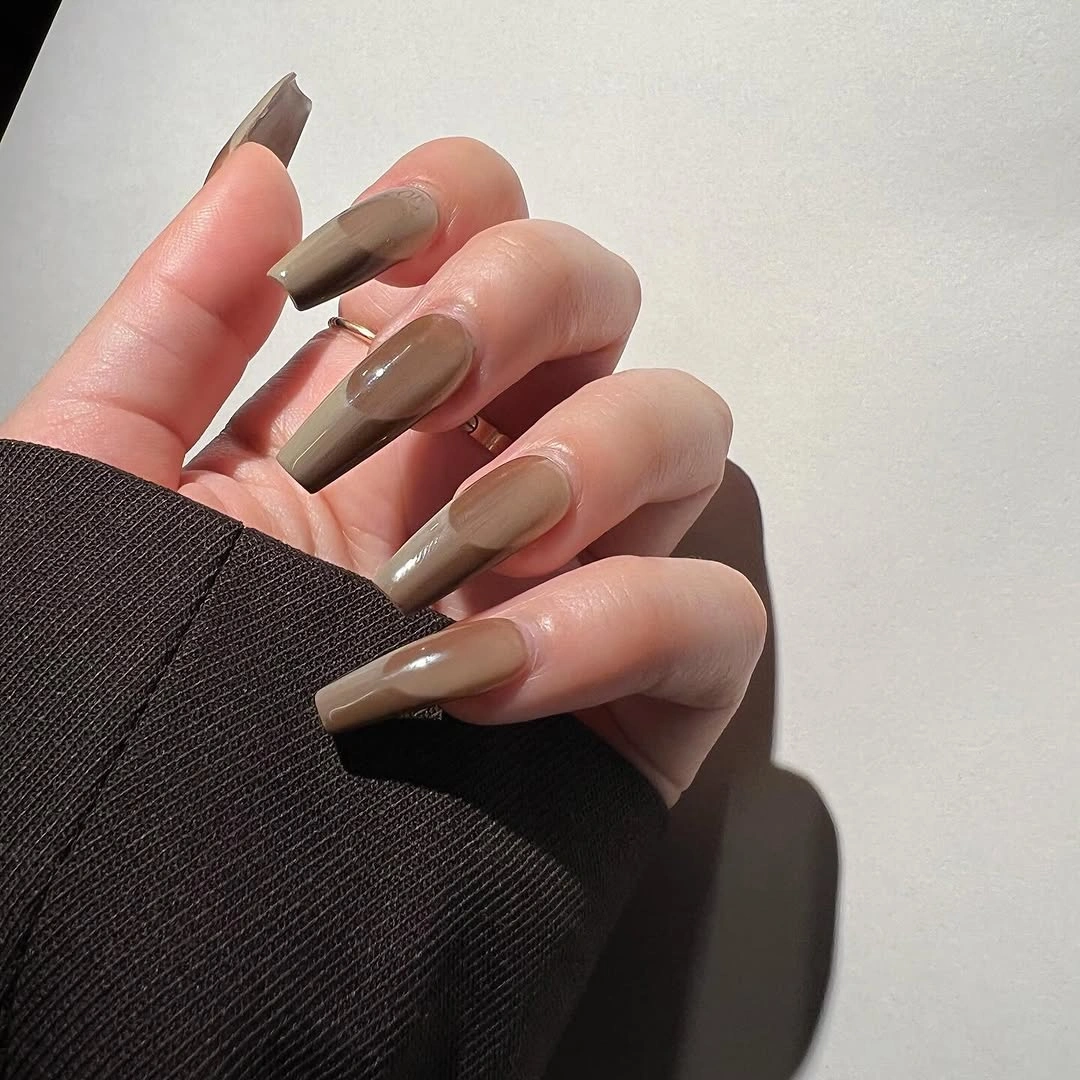
If you want a more obvious accent, keep most nails taupe and make one a slightly lighter nude or deeper cocoa. Shortening the coffin will lower the commitment while preserving the clean color relationship, and a soft matte-looking finish could make the change feel even more understated if the visual result supports it. Do not add random art just to make the set busier; the quiet contrast is the point.
The tradeoff is clear here: a long shape gives a simple color more presence, but it also makes grow-out and edge wear more visible. That may be perfect for someone who likes a clean statement and regular maintenance. For a lower-upkeep version, let the color shift remain subtle and choose a shorter edge that does not make every small change part of the design.
Burgundy, nude, and patterned brown accents
Long almond nails combine burgundy solids, nude pink, brown patterned accents, and white nails with black and gold-looking curves. The burgundy repeats across the hand and gives the more decorative fingers a shared anchor, while the pale nails stop the set from becoming one continuous dark field. There is a lot happening, but the color hierarchy keeps the mix readable.
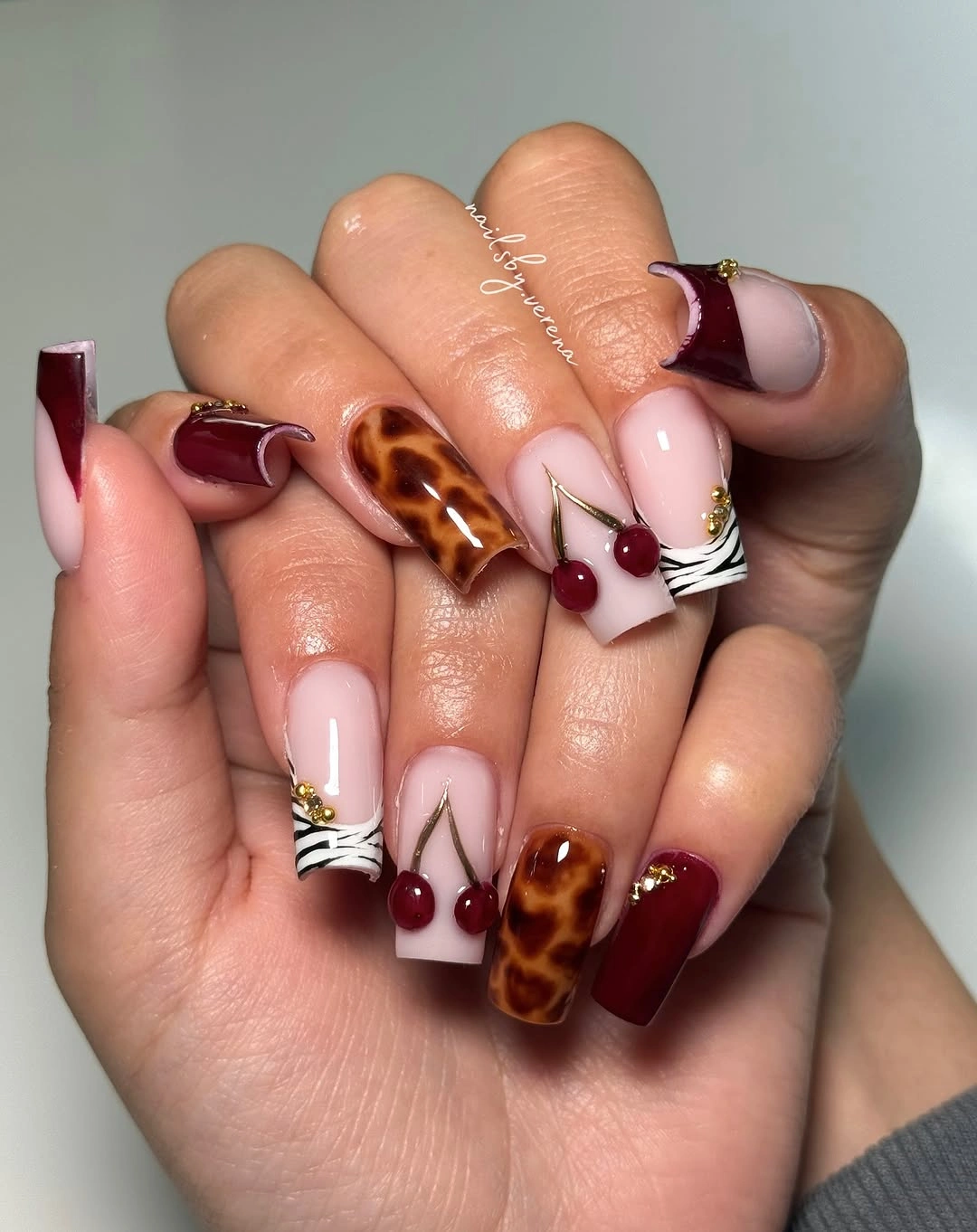
To make the formula easier to wear, keep burgundy on most nails and choose only one secondary accent language. You might use the brown pattern on one nail and leave the white nail plain, or keep the white linework and remove the pattern entirely. The length can stay almond, but reducing the number of competing surfaces will make the focal point clearer; the same editing logic helps when browsing fall manicure ideas.
This is a good example of using repetition to support variety. Burgundy supplies the base note, nude and white create breathing room, and the brown and black details add contrast in smaller doses. The honest limitation is that patterned and metallic-looking accents can compete with rings or clothing, so the fair compromise is to keep the palette and reduce the number of decorated nails.
Olive solids with tiny warm accent marks
Short rounded-square nails alternate solid olive green with pale accents carrying tiny red, yellow, and green marks. The deep green does most of the visual work, so the warm details feel like small interruptions instead of a second full pattern. The compact shape keeps the mixed colors wearable and makes the accent concept easy to translate into a shorter manicure.
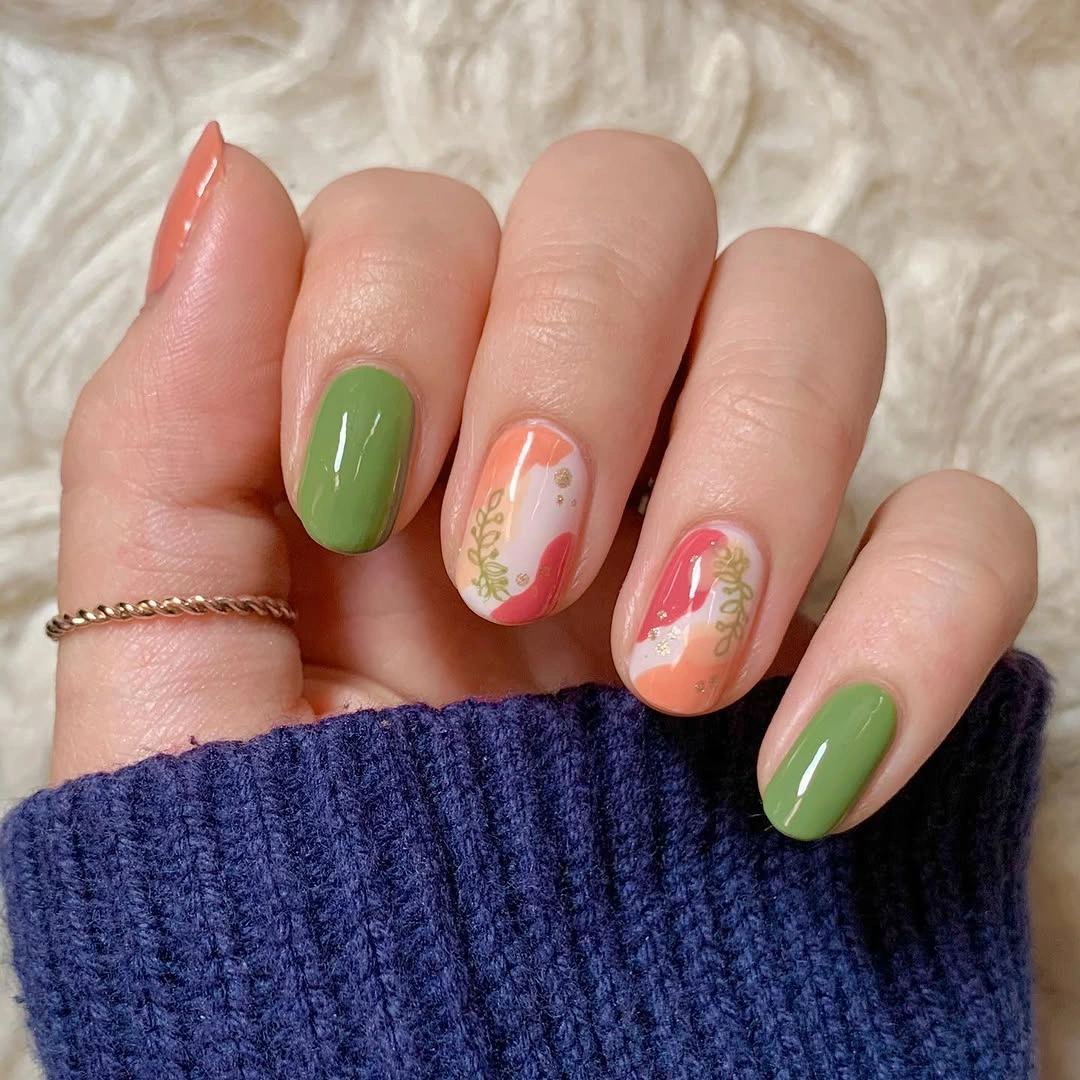
For an even cleaner version, use olive on four nails and keep one pale nail with the warm detail. The accent marks should remain small and separated, because enlarging them would make the pale surface compete with the solid green. A moss or forest shift can bring the palette closer to fall while keeping the same relationship between deep base and light accent.
The set succeeds by reserving decoration for a small area and repeating one strong color everywhere else. That makes the color mix feel planned even though the accent marks are varied. The limitation is that tiny marks may not read from a distance, so choose this direction when the pleasure is in the close-up detail rather than a dramatic first glance.
Charcoal solids with pale graphic linework
Deep charcoal or black nails surround pale almond accents marked with curved black lines and abstract forms. The dark solids create a firm frame for the light nails, while the pale surfaces keep the linework from disappearing into the base. It is a monochrome accent strategy that feels sharper than the warm brown options but still has enough negative space to stay readable.
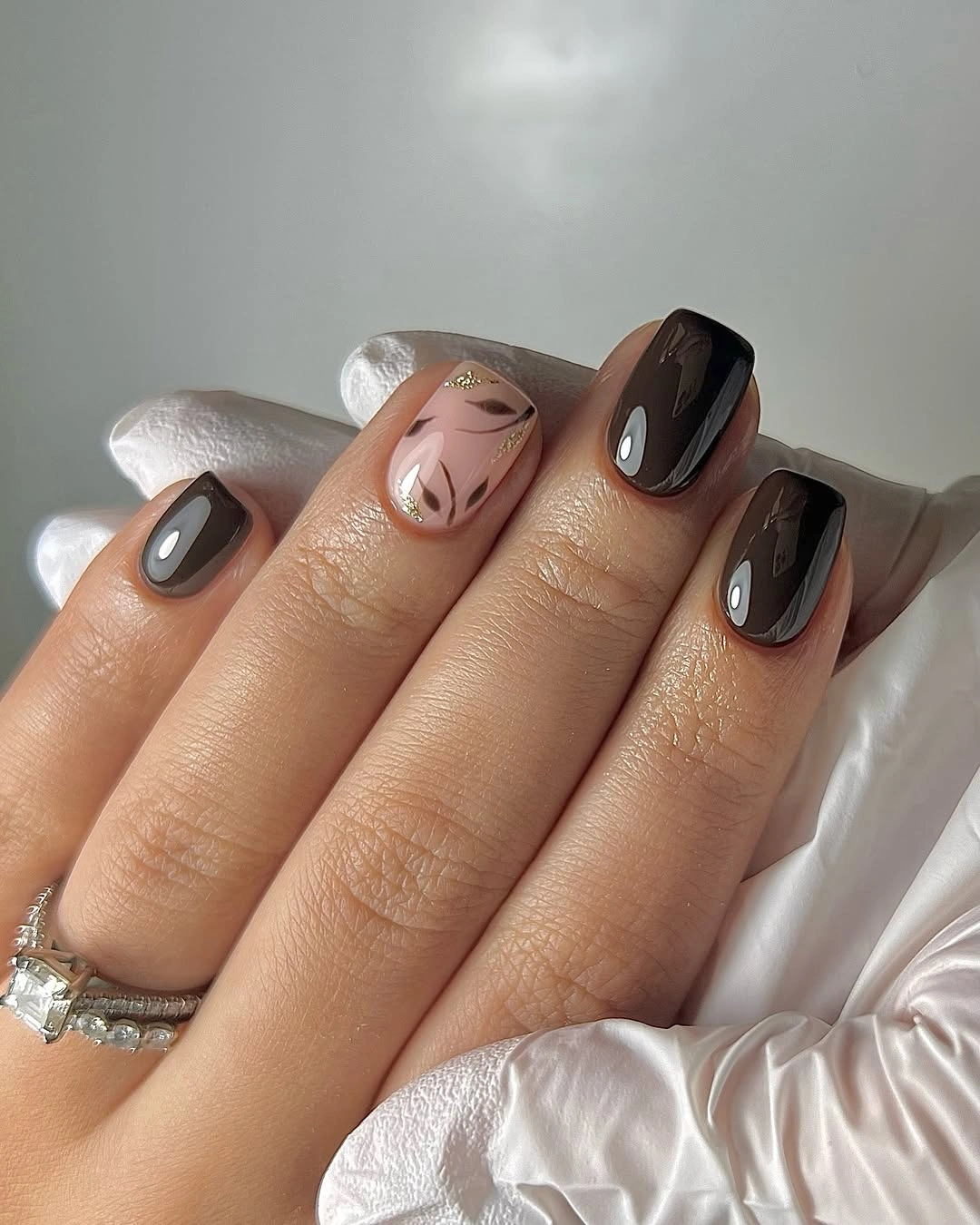
If the contrast is too stark, use deep espresso or soften the pale base toward blush nude. One outlined accent can replace two, especially if the nails are shorter, and the remaining fingers can stay solid charcoal. The idea depends on separation, so keep the graphic line on a light canvas rather than adding pale marks over the dark nails.
This is where a dark manicure benefits from giving the accent a different value instead of a different color. Charcoal supplies repetition, pale pink provides light, and the thin lines connect them through shape rather than temperature. The tradeoff is that monochrome geometry exposes uneven edges, so a relaxed curved mark is more forgiving than a perfectly measured border.
Deep red with pale marble and bright gold
Long almond nails pair glossy deep red solids with pale nails carrying soft marbled color and one bright gold-looking accent. The red gives the hand a strong base, while the pale surfaces provide the breathing room needed for the reflective point to feel special. This design is dramatic, but its accents are grouped into clear roles instead of scattered randomly.
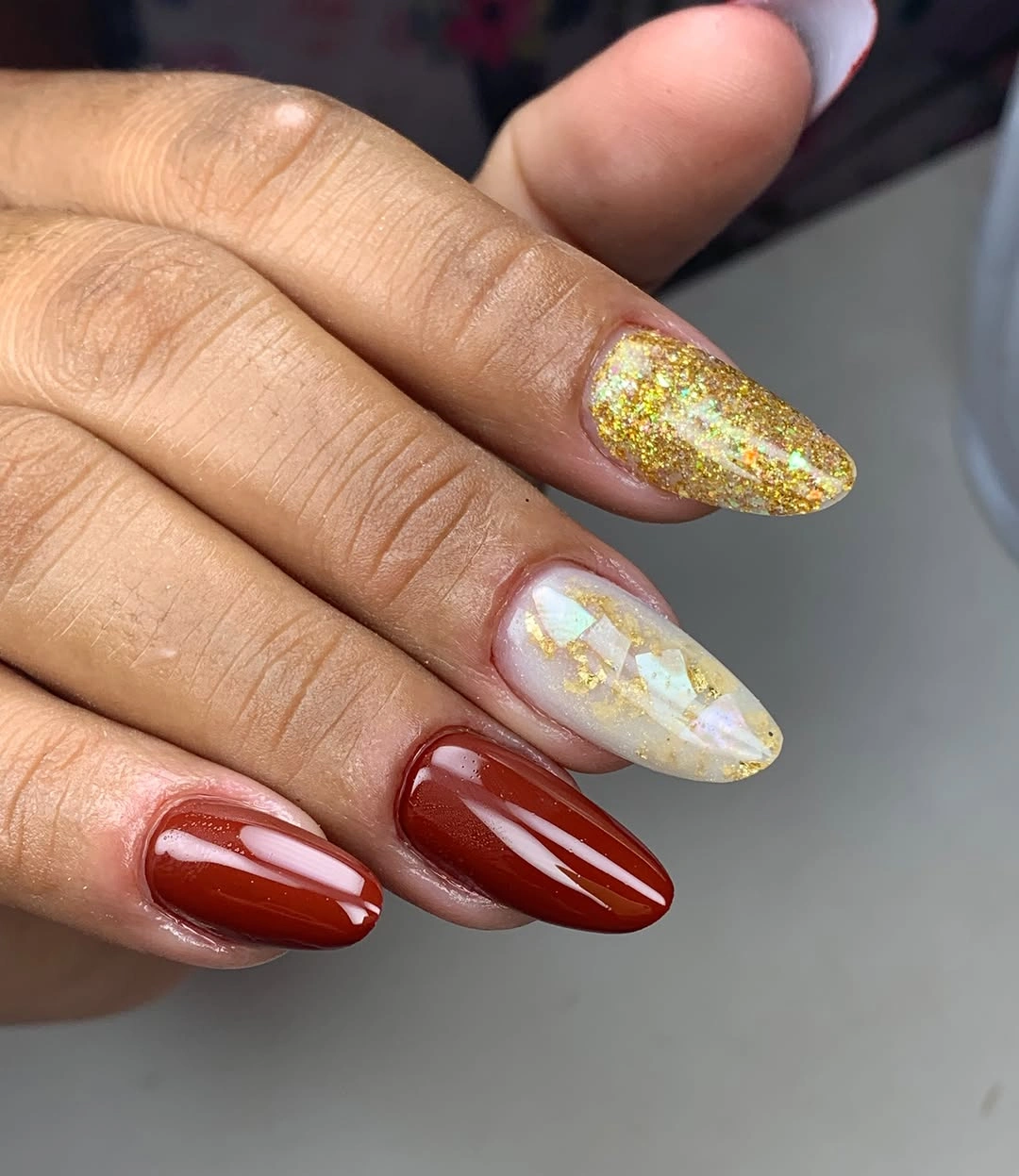
To simplify the manicure, keep the red on most nails and use an ivory accent on one finger, reserving the bright detail for another only if the length feels comfortable. A shorter almond will reduce the visual intensity, and a warm bronze or brown accent can soften the contrast. The key is not adding another pattern to the pale nails; their open surface is already doing useful work.
The design balances depth, lightness, and shine in a clear sequence. Red creates repetition, pale marble interrupts the block, and the bright accent lands last as the focal point. The honest tradeoff is that reflective surfaces and a long almond shape ask for more upkeep, so the strongest wearable edit is one deep color, one pale accent, and one concentrated bright detail.
Burgundy curved tips for an easy short set
Short rounded nails use pale pink centers with dark red or burgundy curved tips and tiny warm metallic-looking marks. The tip reads as an accent border rather than a full block because most of the nail stays light, and the compact shape keeps the contrast friendly. It is one of the most wearable structures in the folder because the design has a clear focal decision without demanding dramatic length.
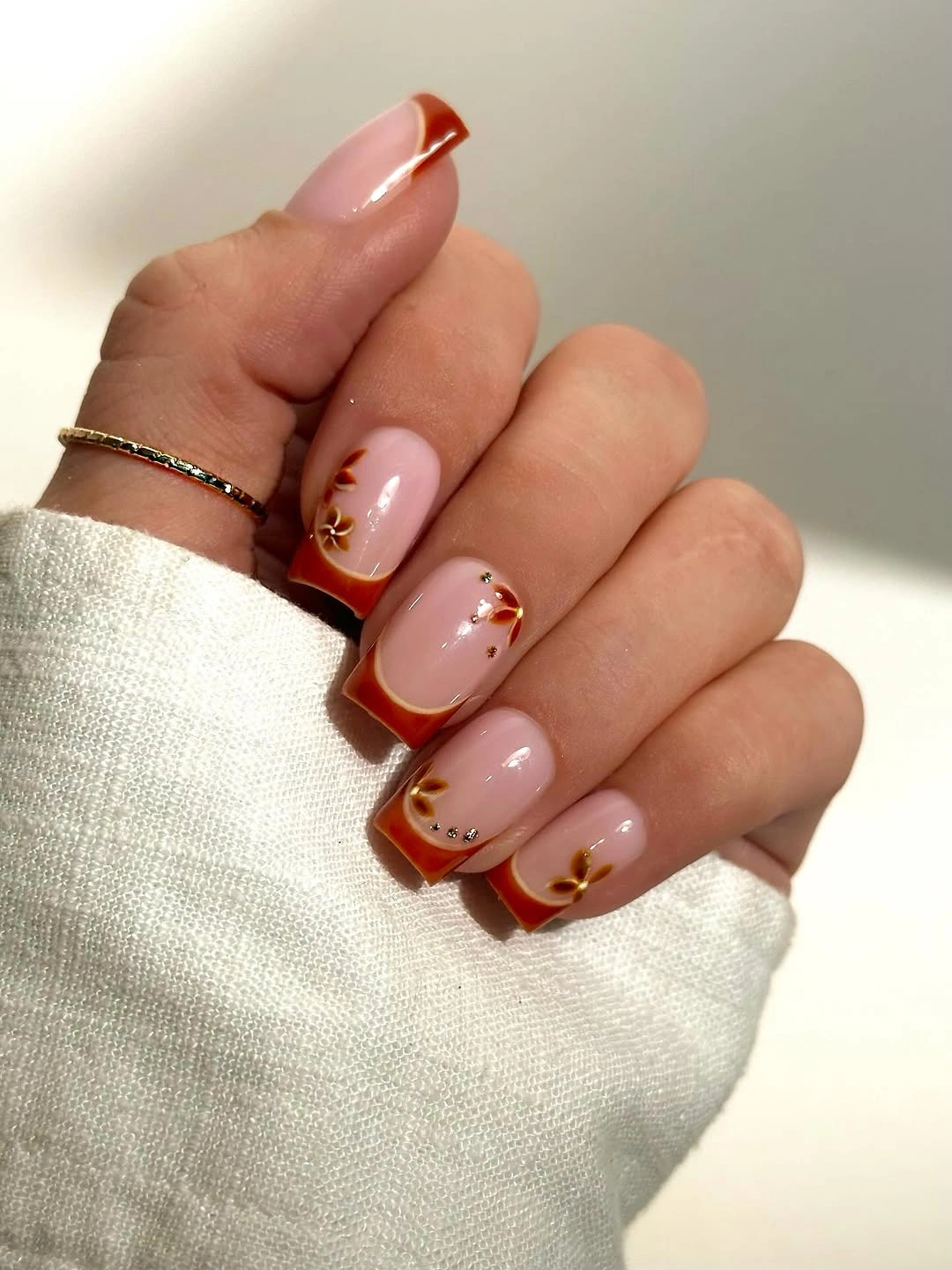
For a simpler version, keep the curved burgundy tip on two nails and leave the rest pale pink. A warm red or cocoa edge can shift the temperature, while a single small bright mark preserves the sense of detail. The important part is the pale center; if the dark tip expands too far, the manicure loses the light, easy quality that makes it practical.
This look proves that an accent nail can be defined by a boundary rather than a picture. Burgundy supplies seasonal depth, pink creates open space, and the small bright marks add just enough punctuation. The tradeoff is subtlety: the design will not command attention like a glitter cluster, but it is much easier to pair with everyday clothes and to maintain on a short rounded shape.
Plum matte nails with miniature autumn art
Short square nails combine dark purple and pale bases, silver sparkle at some tips, and tiny orange-black autumn drawings on the lighter nails. The dark palette gives the miniature art contrast, while the short shape keeps the playful details proportional. This is a fun accent-nail idea, but the humor comes from scale and color rather than from a large, literal illustration.
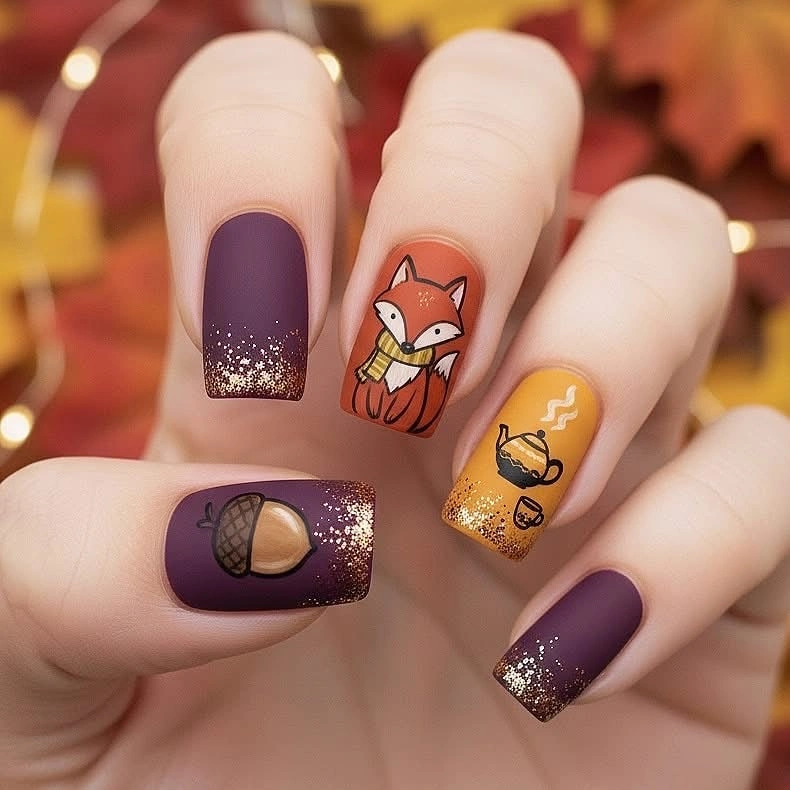
To edit it down, keep the plum on most nails and choose one small seasonal drawing plus one sparkle accent. A deeper burgundy can replace purple if you want a warmer fall direction, while a shorter square will make the miniature detail even more compact. Avoid adding several characters or objects; one clear accent will say more than a crowded collection of tiny marks.
The design works because dark solids create a calm backdrop for pale illustrated nails, and the silver-looking tips add a second kind of emphasis without changing the main palette. The honest limitation is that tiny art can become hard to read as the nail grows, so the practical choice is to preserve the color contrast even if the exact illustration becomes less obvious.
Blush nude with fine metallic-looking lines
Pale square nails carry brown and gold-looking curved strips or thin outlines, creating a detailed accent effect without using a full dark base. The light background keeps the narrow lines visible, while the small bright details add warmth and polish. This is a quieter kind of accent nail because the interest comes from boundaries and repetition rather than a large motif.
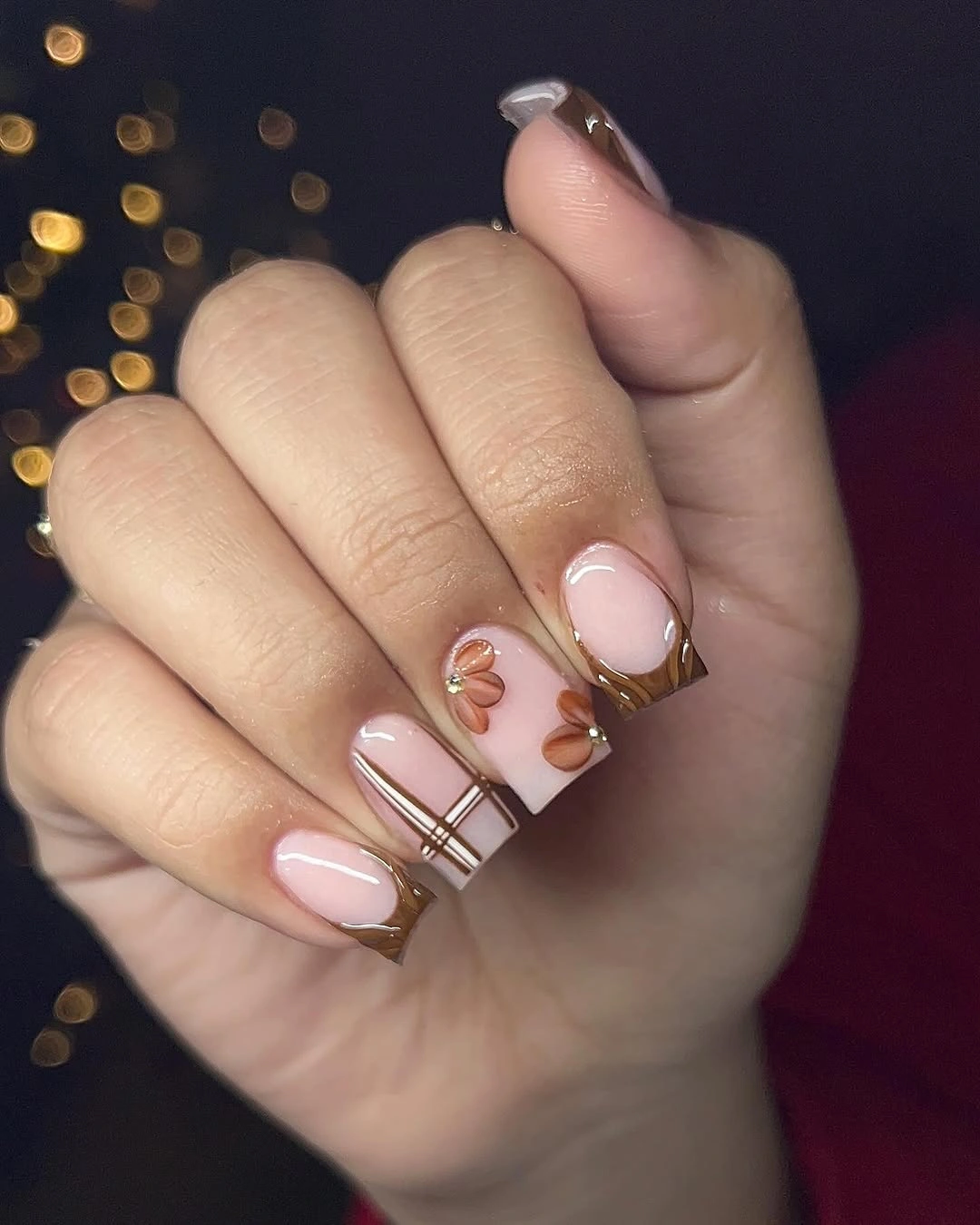
For a simpler version, keep the lines on two pale nails and leave the others plain blush or warm nude. Brown can replace the deepest outline if you want less contrast, while one bright detail near the edge is enough to preserve the focal point. The design will feel more balanced if the lines remain narrow and the center of the nail stays open.
This manicure shows how small accents can make a pale base feel finished without turning it into an illustration. Blush supplies the quiet field, dark lines create structure, and warm bright details keep the palette from becoming flat. The tradeoff is precision: fine lines reveal growth and uneven edges, so a slightly loose curve is a better everyday choice than a rigid geometric grid.
Autumn clusters on a translucent coffin base
Long coffin nails combine pale translucent-looking bases with warm botanical pieces, gold sparkle, and red-orange accents. The light foundation lets several fall colors appear without creating one solid block, but the number of details and the length make this a decorative statement with real upkeep. It is beautiful as a focal idea, though not pretending to be the quietest option in the batch.
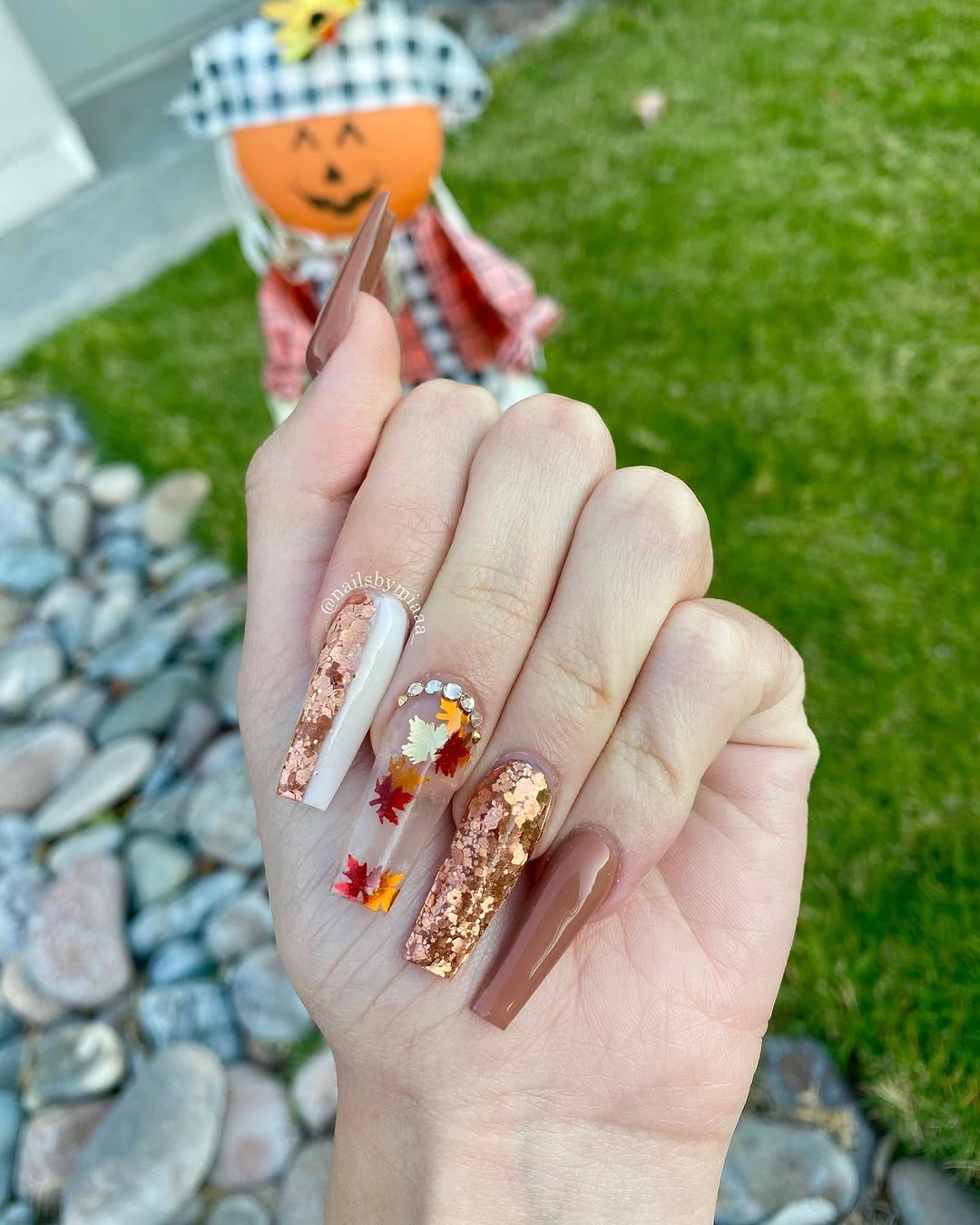
If you like the mood but want less competition, place the cluster on one accent nail and use plain amber, nude, or burgundy on the rest. A medium coffin will still give the cluster room to show, while removing one or two colors can make the set easier to style. The strongest edit is reducing the number of decorated surfaces, not swapping every shade for a paler version; it is the same reason fall burgundy nails with design can stay focused.
The design works because the transparent-looking base provides neutral space for the warm accents and the gold-looking detail gives the eye a bright endpoint. The tradeoff is density: many small pieces can look excellent close up but feel busy with a patterned outfit or jewelry. If daily wear matters, let one accent carry the season and allow the surrounding nails to stay quiet.
Orange green and burgundy motif mixing
Medium oval nails combine solid orange and burgundy with green plaid-like accents, pale leaf-like details, and gold-looking sparkle. The colors are recognizably autumnal, so several motifs can coexist without losing a shared mood, but the mix still asks the viewer to choose where to look first. The moderate length helps keep the variety more wearable than a very long maximal set.
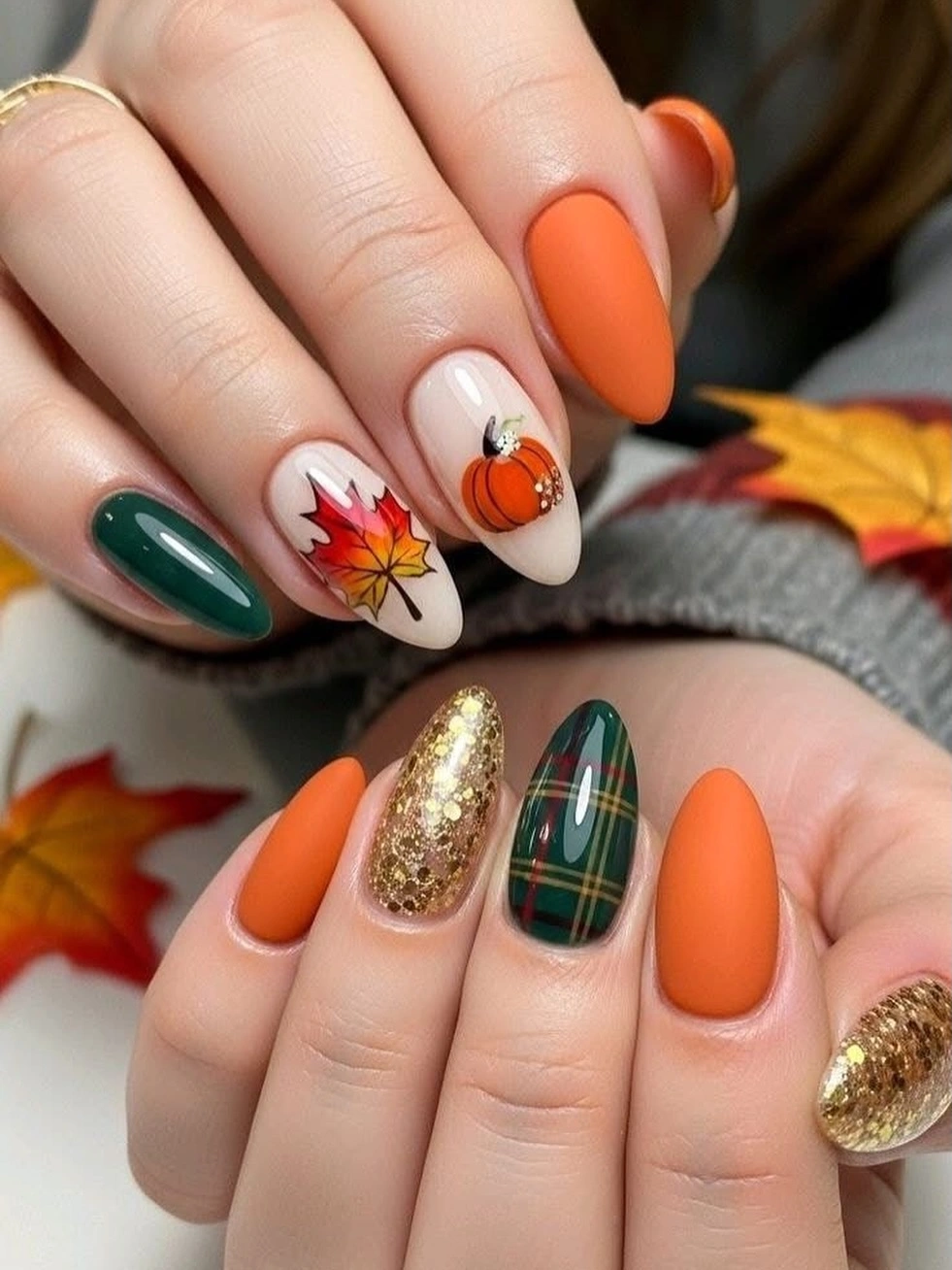
For a cleaner formula, keep two solid colors and select just one of the green pattern, pale leaf detail, or bright accent. A shorter oval would reduce the surface area, but the best simplification is deciding which motif actually matters to you. Repeating one color inside the chosen accent will preserve the connection without making every nail perform the same job.
This manicure is a good example of a palette doing organizational work. Orange brings energy, burgundy adds depth, green supplies a cooler interruption, and the bright accent catches the eye last. The limitation is visual competition, especially with rings or printed clothing, so the fair tradeoff is keeping the rich colors while reducing the number of pattern types.
Solid orange with one reflective accent
Most of these long almond nails are glossy orange, while one pale nail carries a concentrated gold or multicolor reflective-looking detail. The orange already has plenty of presence, so the single accent reads as a deliberate focal point rather than an invitation to add more decoration. The long shape stretches the saturated color and makes the clean contrast feel confident.
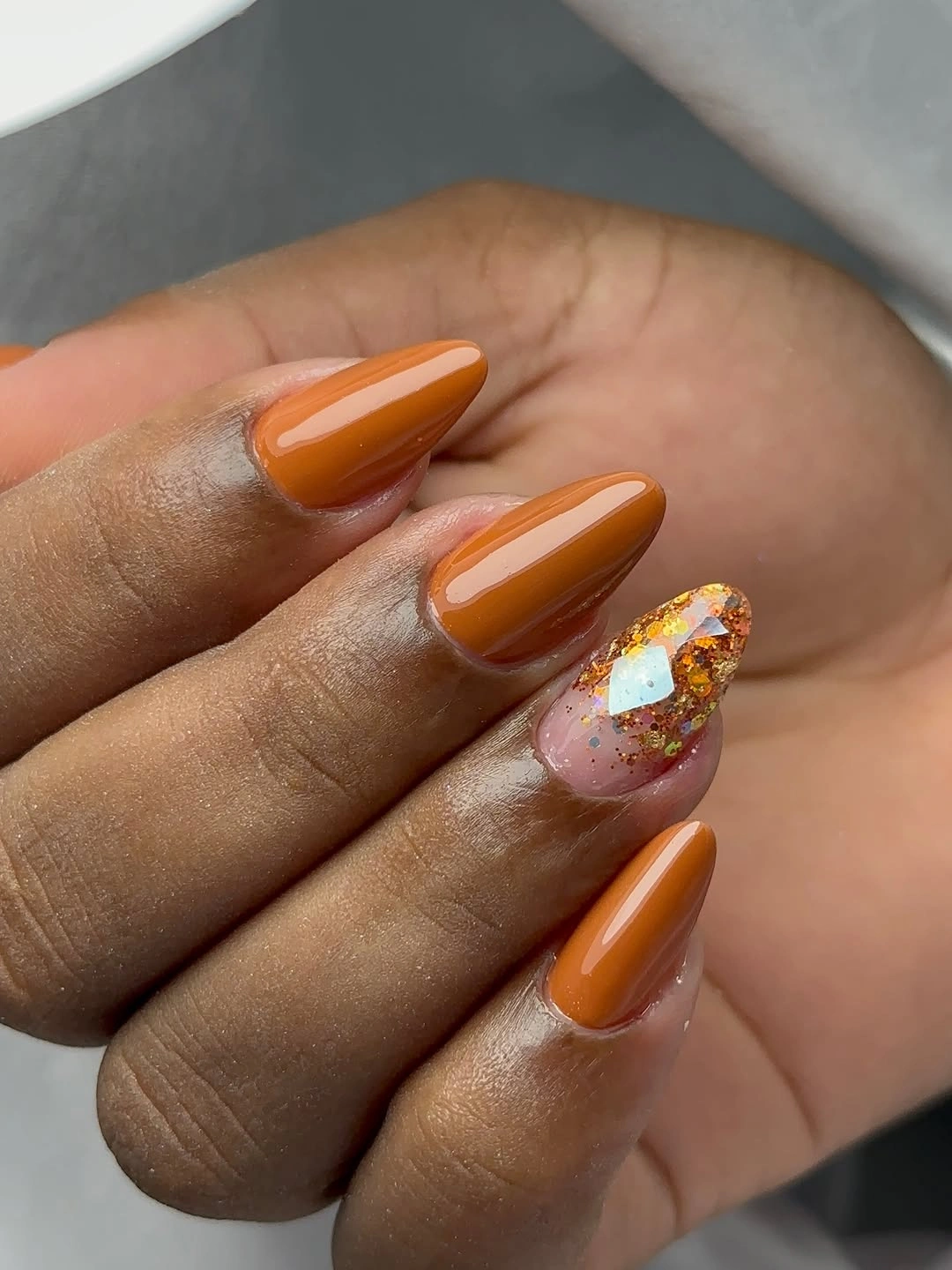
To make the set easier to wear, keep the orange on most nails and move the accent to one shorter almond finger. Muted pumpkin or terracotta can lower the brightness, but the same-color structure should remain simple. Adding a second competing print would weaken the clear visual order that makes the original feel sharp.
This design is a useful reminder that an accent nail can be effective because it is the only interruption. Orange establishes warmth and repetition, the pale surface creates value contrast, and the bright detail supplies a small change in finish. The tradeoff is that long saturated nails draw attention to their edges, so the clean silhouette needs to be part of the maintenance plan.
Brown and nude with narrow curved accents
Long stiletto nails use chocolate brown, pale nude, cream, and dark red areas with fine black or burgundy curves near the tips and sides. The close warm palette keeps the design quiet even though the shape is dramatic, and the narrow marks make the accents feel elongated rather than crowded. This is a calmer alternative to the multi-pattern images because the color changes are carefully contained.
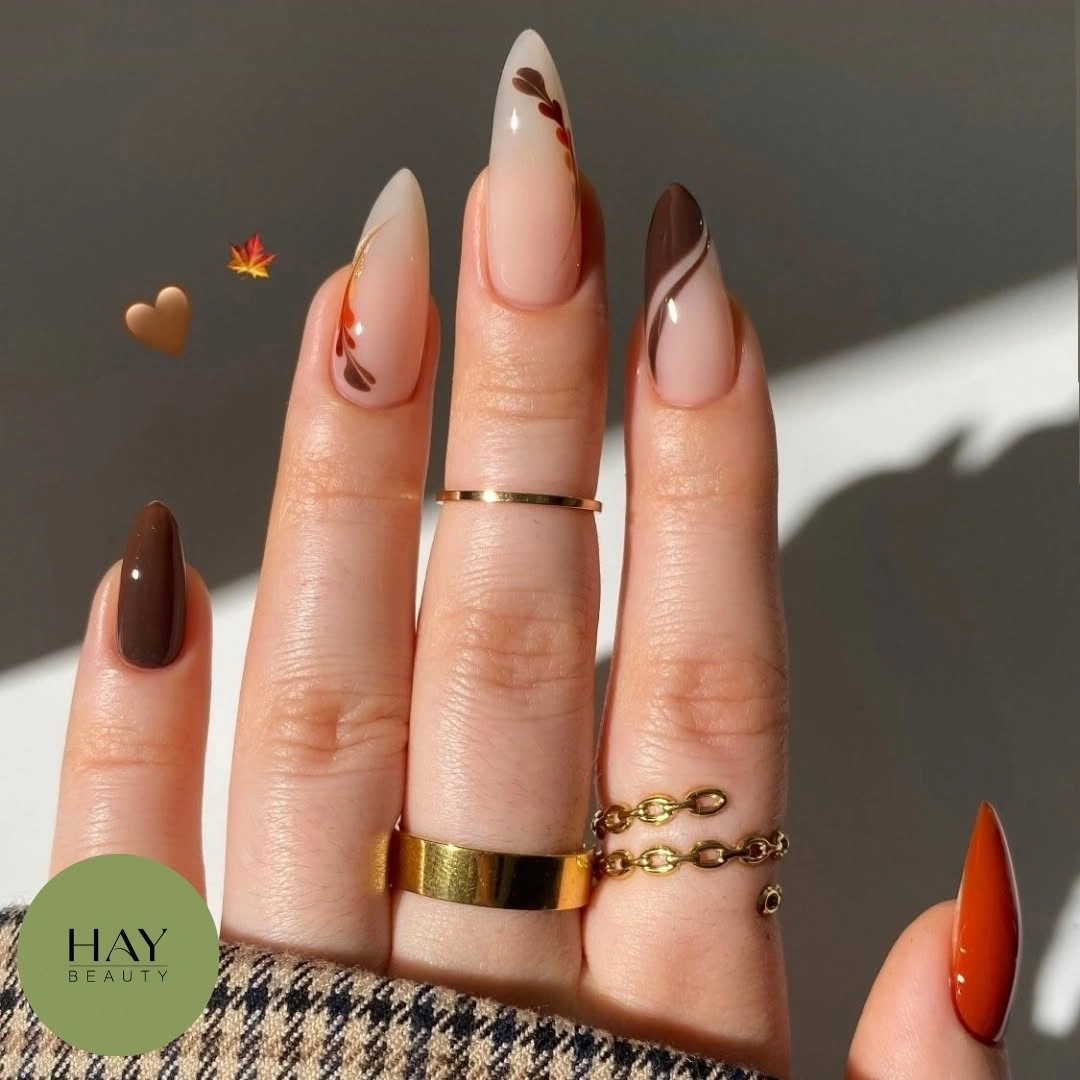
For an easier version, use brown as the main shade and place one curved line on a shorter almond. A warm cream base will soften the contrast, while a deeper burgundy line can bring more fall depth without adding a new motif. Preserve the open pale areas, because they are what keep the long point from looking visually heavy.
The manicure works through proportion: the long shape supplies drama, the neutral colors lower noise, and the narrow curves provide just enough movement. The honest tradeoff is that stiletto length can make even a quiet design feel high commitment. If that is not practical, shorten the tip before adding any new decoration, because the silhouette is the main feature here.
Burgundy solids with one bright clustered accent
Most medium almond nails are deep burgundy, while one nude accent carries a small bright clustered detail near the center or cuticle. The dark base makes the accent immediately visible, and the medium length gives the focal point enough room without turning the manicure into a long statement. This is a clear four-solid-one-accent arrangement, and it does not over-explain itself.
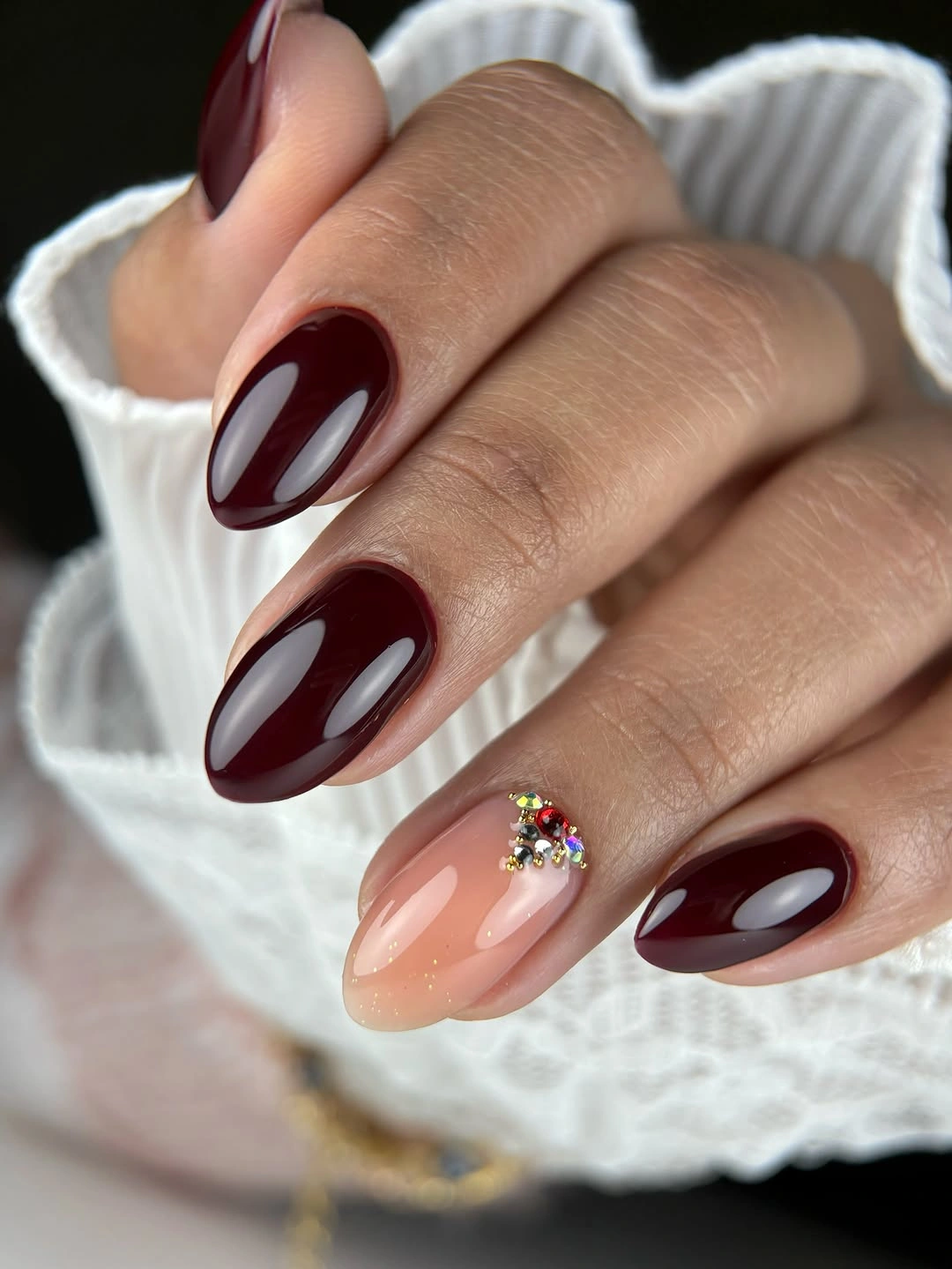
If the accent feels too colorful, keep only one bright tone inside the cluster and leave the rest nude. A brown-red base can soften the burgundy while preserving the contrast, and a shorter almond would keep the same visual hierarchy with less upkeep. The best edit is concentrating decoration, not spreading smaller marks across every nail.
This is probably the easiest formula to copy from the batch: choose one rich base, one light canvas, and one focal accent. Burgundy supplies repetition, nude creates a visual pause, and the bright cluster gives the eye a reason to move. The tradeoff is that a single accent can feel bold against a very plain set, so choose it when you actually want that one nail to be noticed.
Peach nude with cool green botanical accents
Short-to-medium rounded nails pair peachy nude solids with pale accents carrying green, yellow, and black leaf-like marks. The warm nude base softens the cooler green detail, while the pale nails keep the tiny accents visible and separate from the solids. The rounded edge makes the palette feel friendly and wearable rather than sharp or formal.
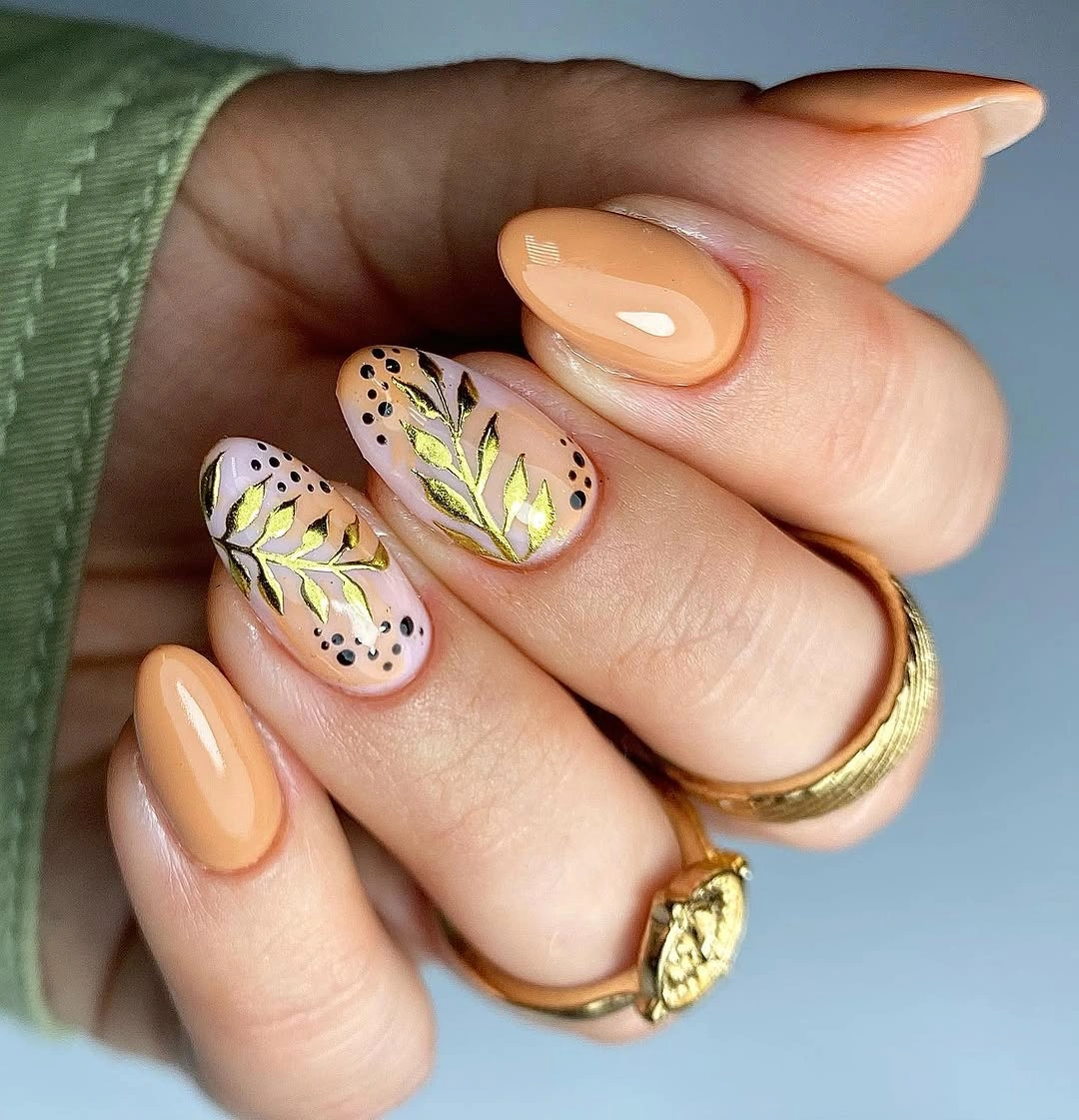
For a simpler version, keep one green accent nail and leave the rest peach nude. A muted apricot or warm beige can replace the base without changing the color relationship, and reducing the number of marks will make the pale accent feel cleaner. The design is strongest when green remains a supporting note instead of becoming another full block.
The manicure works because the warm neutral and cool detail are close enough in intensity to cooperate. Peach supplies softness, pale space holds the art, and green creates the small unexpected shift. The limitation is that fine green marks can disappear if the base and accent are too close in value, so a slightly lighter pale nail may be necessary for clear contrast.
Reflective red with one white seasonal accent
Most medium square nails are reflective-looking red, while one white accent carries a red seasonal mark with a dark outline. The red surface already has strong energy, so the pale nail isolates the accent and gives it room to be read. This is a bold monochrome structure with one clear interruption, rather than a set where every finger competes for attention.
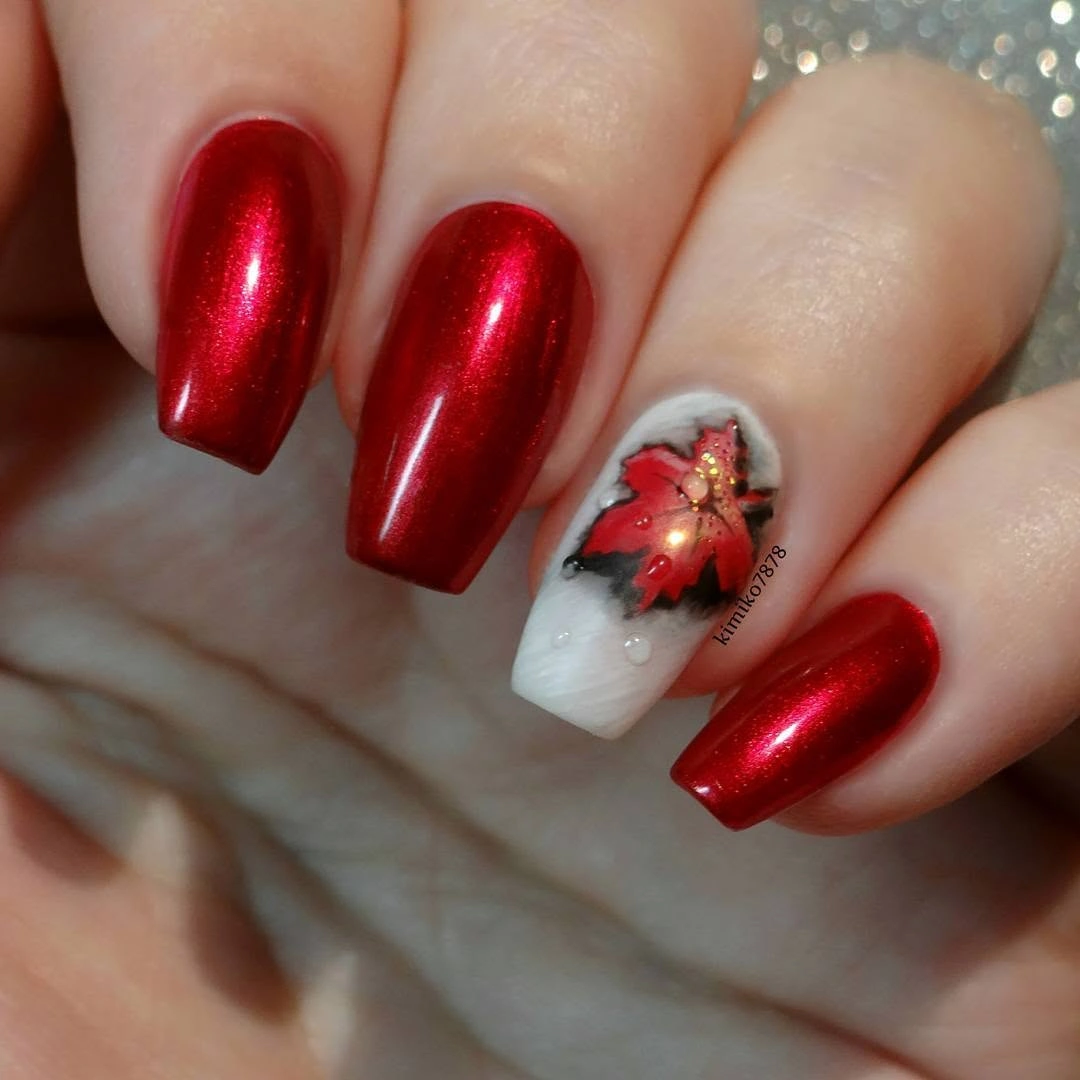
To soften the effect, use a deep cherry or burgundy instead of the brightest red and keep the white accent plain around one small mark. A shorter square will lower the visual intensity without removing the reflective contrast. Do not add several more motifs; the strength comes from the white nail acting as a clean break in the red field.
The color relationship is direct and easy to understand: red supplies repetition and shine, white supplies value contrast, and the dark outline gives the accent definition. That makes the idea effective even if the exact seasonal mark changes. The tradeoff is that reflective red and crisp white both show edge wear, so the manicure rewards careful upkeep more than a softly blended design would.
Chocolate brown with pale botanical accents
Medium almond nails are mostly solid chocolate brown, while pale accent nails carry small black and brown botanical lines. The dark neutral feels less heavy because decoration moves onto a light canvas, and the repeated linework connects the accents without making them identical. It is a middle ground between a plain brown set and a fully illustrated manicure.
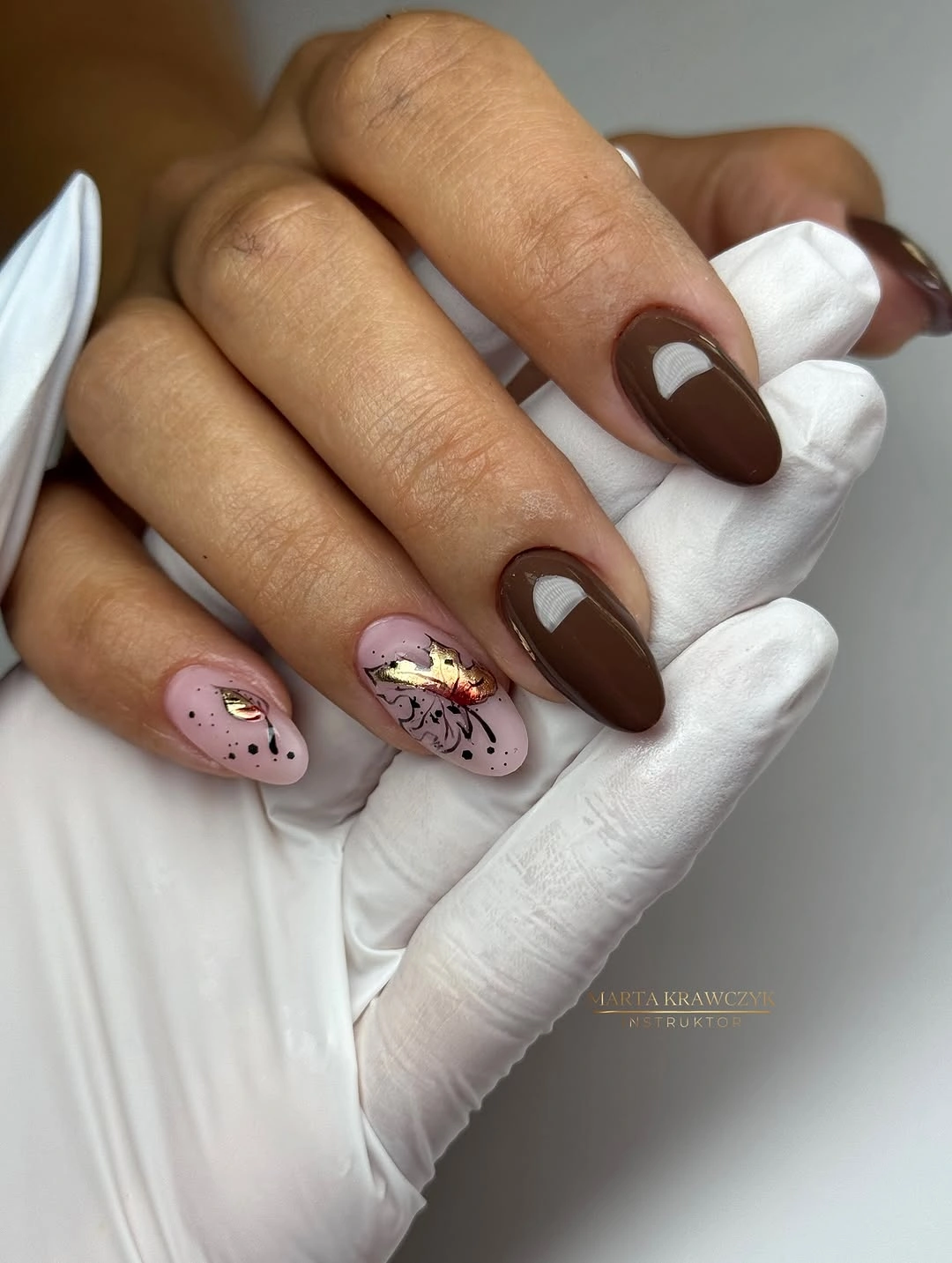
For a more understated version, keep the art on one pale accent and leave the remaining nails brown. A softer cocoa or reddish brown can shift the mood, while a shorter almond will reduce the amount of dark surface without losing the clean contrast. The pale accent needs enough open space to stay legible, so fewer lines will usually look better than tighter detail; the same restrained base appears in brown fall nails when the color is allowed to lead.
This set is persuasive because the accent has a practical job: it lightens the dark base and gives the eye one area of detail. Brown creates fall depth, pale pink supplies balance, and black lines keep the connection visible. The honest limitation is that small botanical marks can blur visually as the nail grows, so preserve the overall color relationship even if the exact linework needs to be simplified.
Milky nude nails with dark curved tips
Long almond nails use milky nude centers with dark red or orange tips and thin black or red marks curving inward over the pale base. The open center makes the strong tips feel lighter, but the long point keeps the manicure dramatic. It is an accent-nail idea built from negative space: the pale area is not empty, it is what controls the contrast.
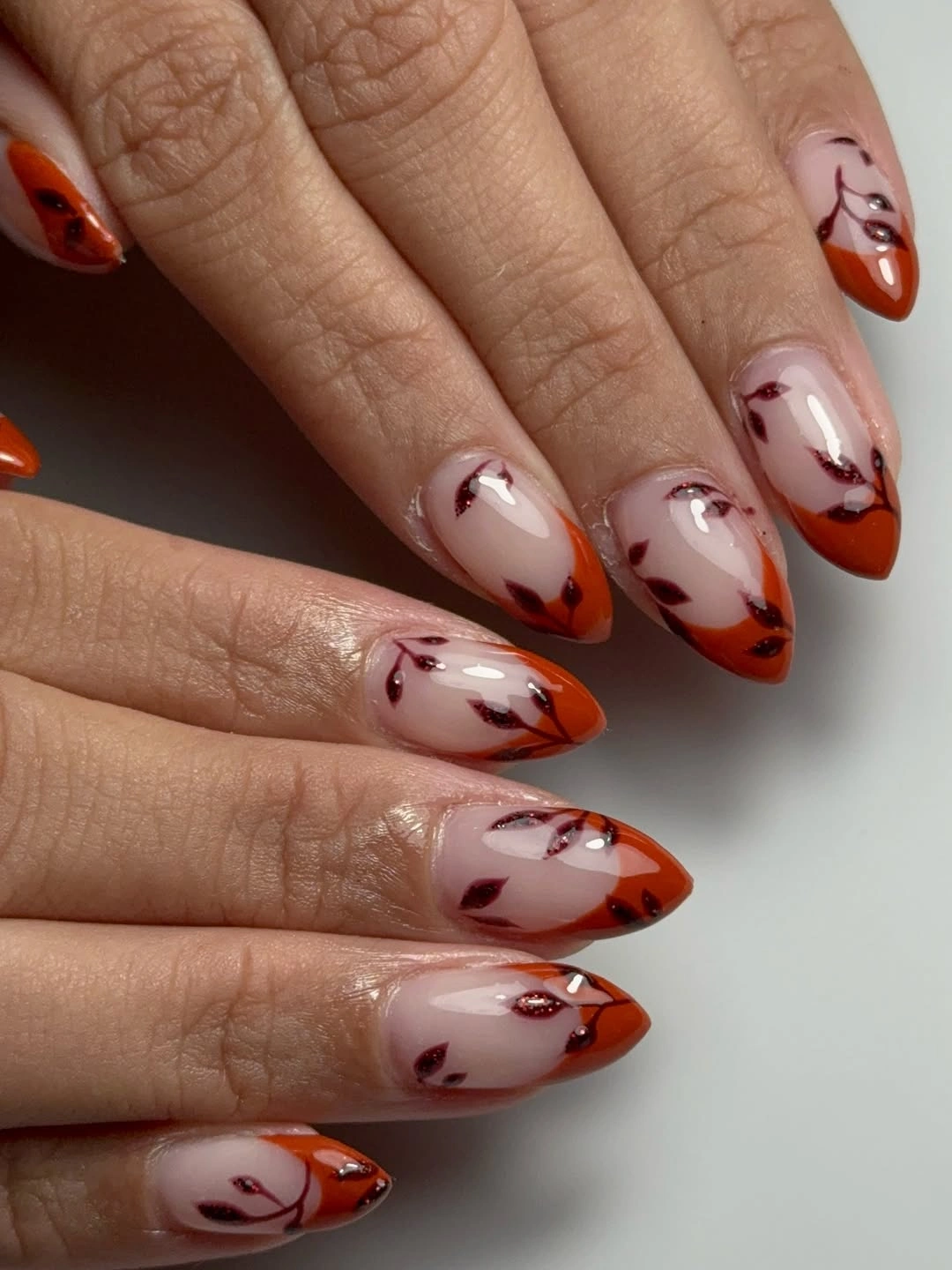
To make the structure more practical, keep the dark tip on two nails and repeat one thin curved line on a shorter almond. Brick red or muted orange can soften the color, while a warm nude base will blend more naturally with medium skin. Avoid filling the pale center, because doing so would remove the visual pause that makes the tips readable.
The manicure works through direction and contrast. The almond point pulls the eye forward, dark tips provide the seasonal weight, and the milky base keeps the whole hand from looking covered. The tradeoff is that long pointed edges and pale centers can show growth clearly, so a medium length is a fair compromise when the visual idea matters more than maximum drama.
Orange solids with tactile seasonal accents
Medium-to-long almond nails combine peach and orange solids with orange textured-looking seasonal shapes and a ribbed accent detail. Related orange tones keep the smooth and tactile surfaces connected, while the moderate length gives the unusual details enough room to show. It is playful, but the palette is controlled enough that the texture remains the clear point.
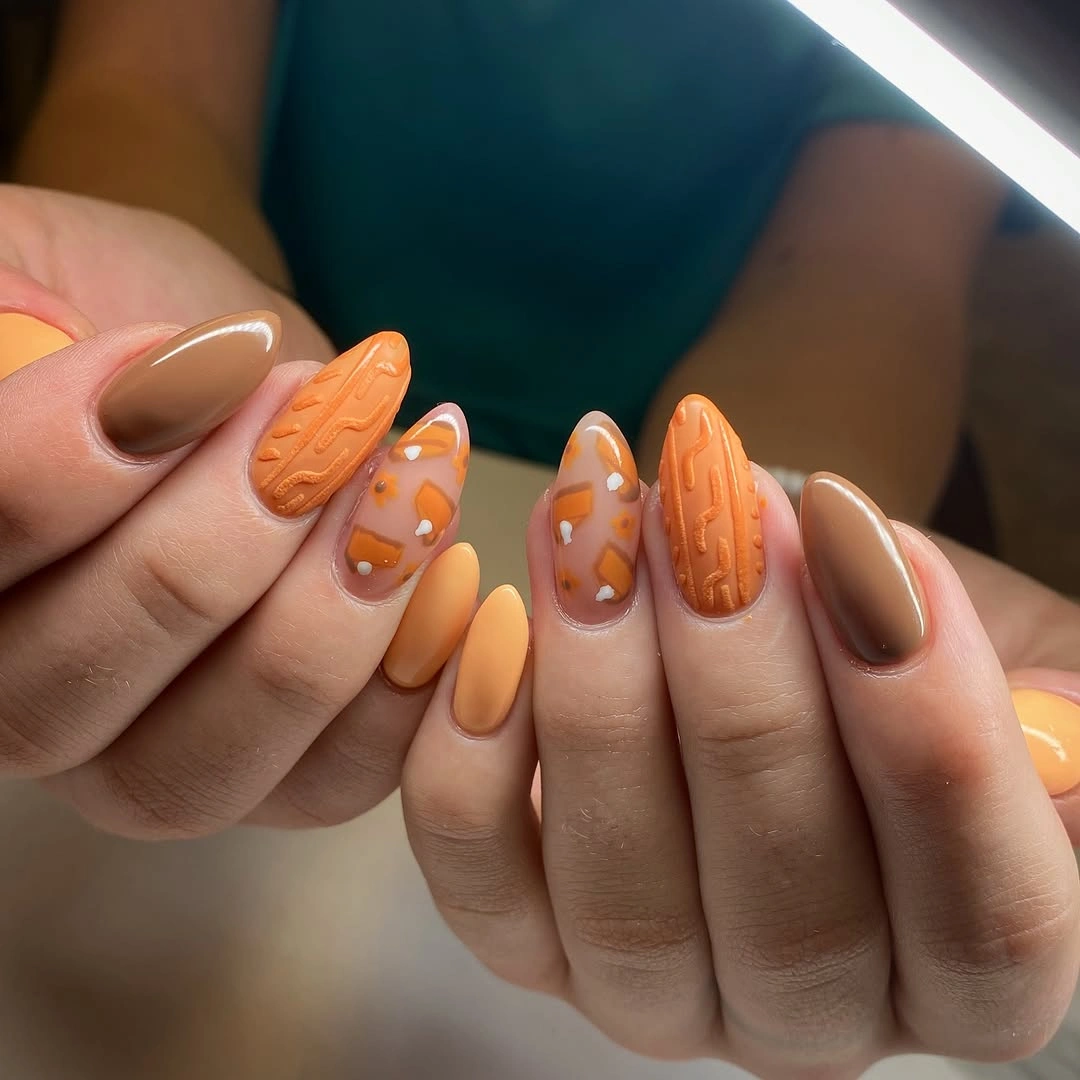
If the full set feels too literal or high maintenance, keep one textured accent and use plain peach or orange on the rest. A shorter almond will make the raised-looking details less dominant, and a muted pumpkin base can shift the mood toward everyday fall color. The key is preserving the contrast between smooth solid nails and one unusual surface.
This design finishes the batch with a fair tradeoff rather than a blanket verdict. Smooth orange supplies warmth and repetition, the pale accents provide space, and tactile-looking details create the playful surprise. The limitation is practical bulk or texture if the raised effect is real, so concentrating it on one nail keeps the idea expressive without making every finger part of the experiment.