Medium length is the point where a manicure can feel both useful and expressive, yet that middle ground is easy to lose. A design becomes tiring when the shape asks for too much attention, or when a small decorative idea is forced to carry the whole hand. The better starting question is not what looks most impressive in a close-up, but what kind of visual pause you want to live with every day.
Before choosing a set, notice what your hands already communicate: the width of your nail bed, the amount of free edge you comfortably keep, and whether you prefer a clear outline or a softer transition. Then choose one main decision and let the remaining details support it. That simple order makes a manicure feel edited, even when your taste leans colorful or ornate.
Wine Tips With Tiny Gold Jewelry Details
The first direction keeps the medium-long shape soft with a translucent pink nude base and deep wine tips that stop short of covering the whole nail. Tiny gold studs and a small floral-looking accent add a jewelry effect near the cuticle, so the darker edge feels framed instead of heavy. That balance is what makes the set read as fall medium length nails rather than a plain dark French manicure.
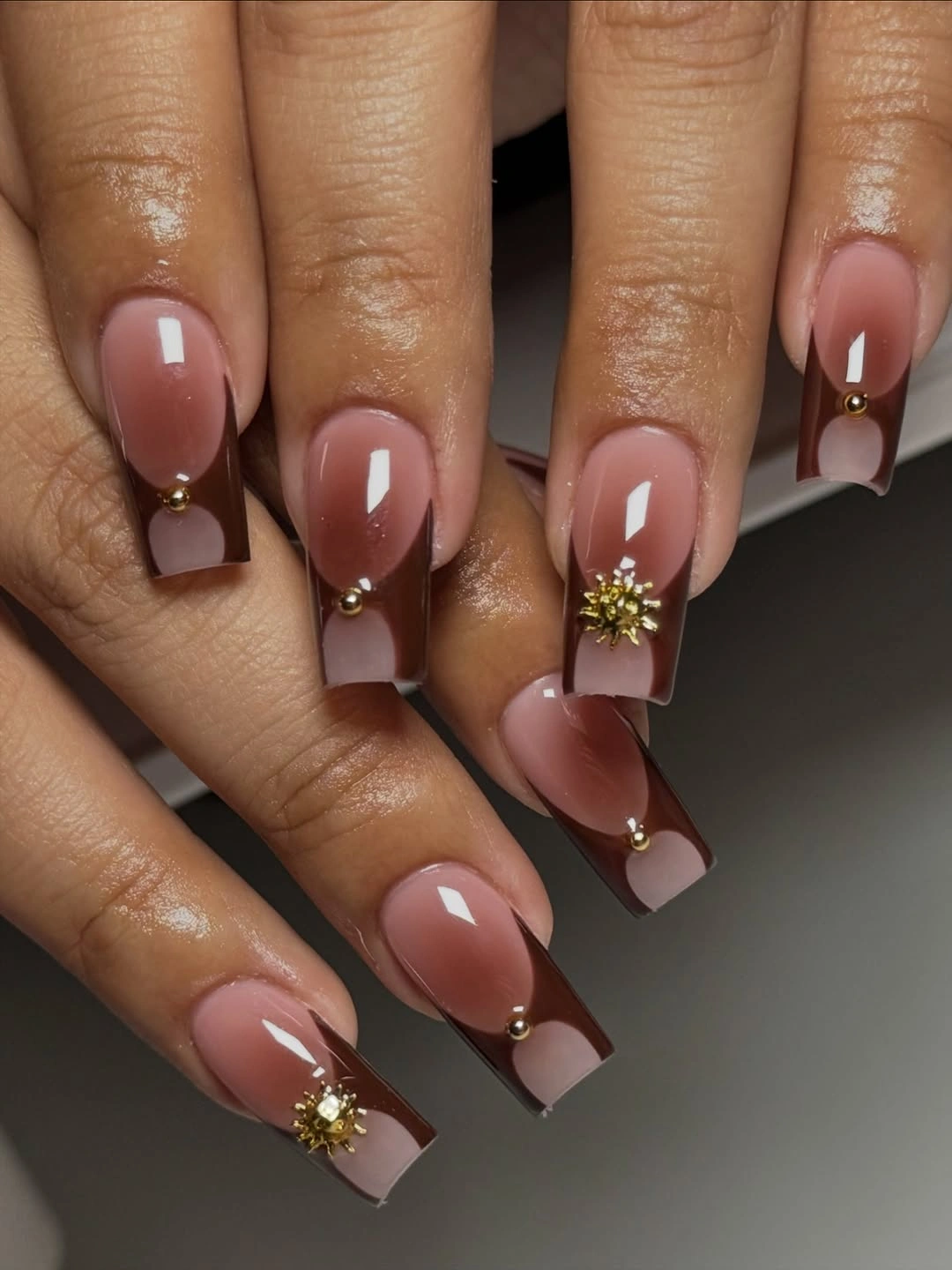
What makes the arrangement work is the difference in visual weight: the wine sits at the far edge, while the pink body leaves light space through the center of each nail. The gold details are sparse enough to guide the eye without turning every finger into a focal point. For a calmer appointment, keep the wine tips on all nails but place the gold accent only on the ring finger and thumb.
The practical tradeoff is that small raised-looking decorations can attract more attention to snagging or wear than a flat line would. Medium length is a helpful compromise because it leaves room for the flower-like detail without creating the same leverage as a very long set. If you shorten the shape, use a narrow wine edge and one tiny gold point so the proportions stay clean.
Turquoise Edges And Zebra Lines Share Pink
This manicure uses a pink base as a quiet grid for several stronger decisions: turquoise sections, a deep maroon panel, black-and-white zebra striping, and pale graphic lines. The nails are medium-long and squared, so the free edge gives each color block enough room to stay legible. Because the motifs vary, the repeated pink center is more important than any single accent.
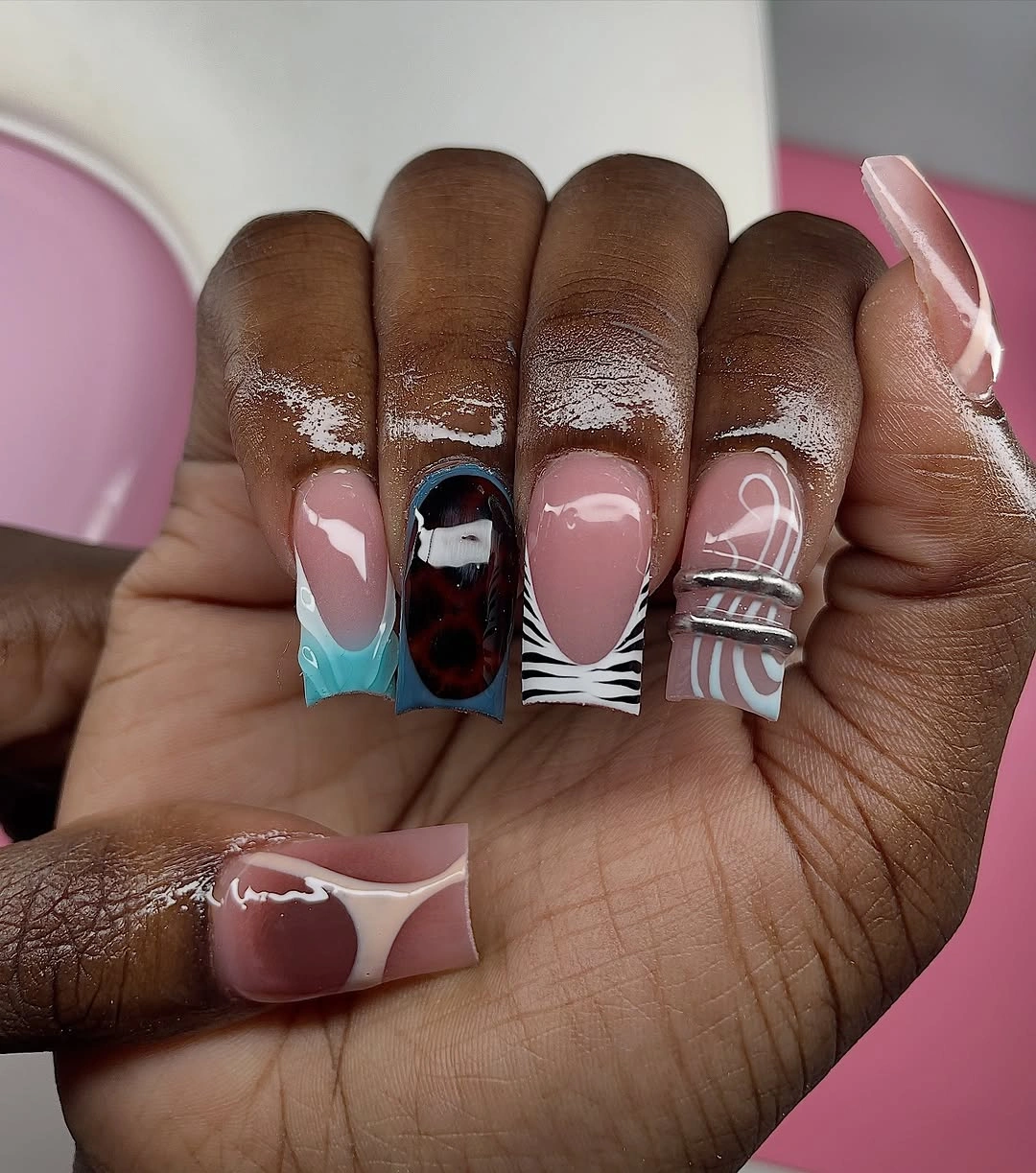
The visual logic is a controlled mismatch rather than a random collection. Turquoise cools the hand, maroon brings the fall depth, and white lines repeat the lightest note across the busier fingers. If the full mix feels too loud, choose turquoise tips for three nails, keep one zebra accent, and replace the remaining maroon panel with the same pink base.
A shorter medium shape can carry this idea well, but tiny stripes should not be forced onto a surface that cannot hold their spacing. Keep the strongest color near the edge and let one pattern do the talking. The result will still belong to the same fall medium length nails mood, only with a clearer focal order and less visual maintenance between appointments.
Cool Turquoise Meets Zebra And Warm Pattern
Here the medium-long square outline is paired with turquoise tips, black-and-white zebra details, and a small warm animal-like pattern over a pink base. The turquoise reads as the immediate focal color, while the patterned nails interrupt it with narrow stripes and warmer contrast. That combination makes the manicure feel playful without losing the clear shape that holds the different accents together.
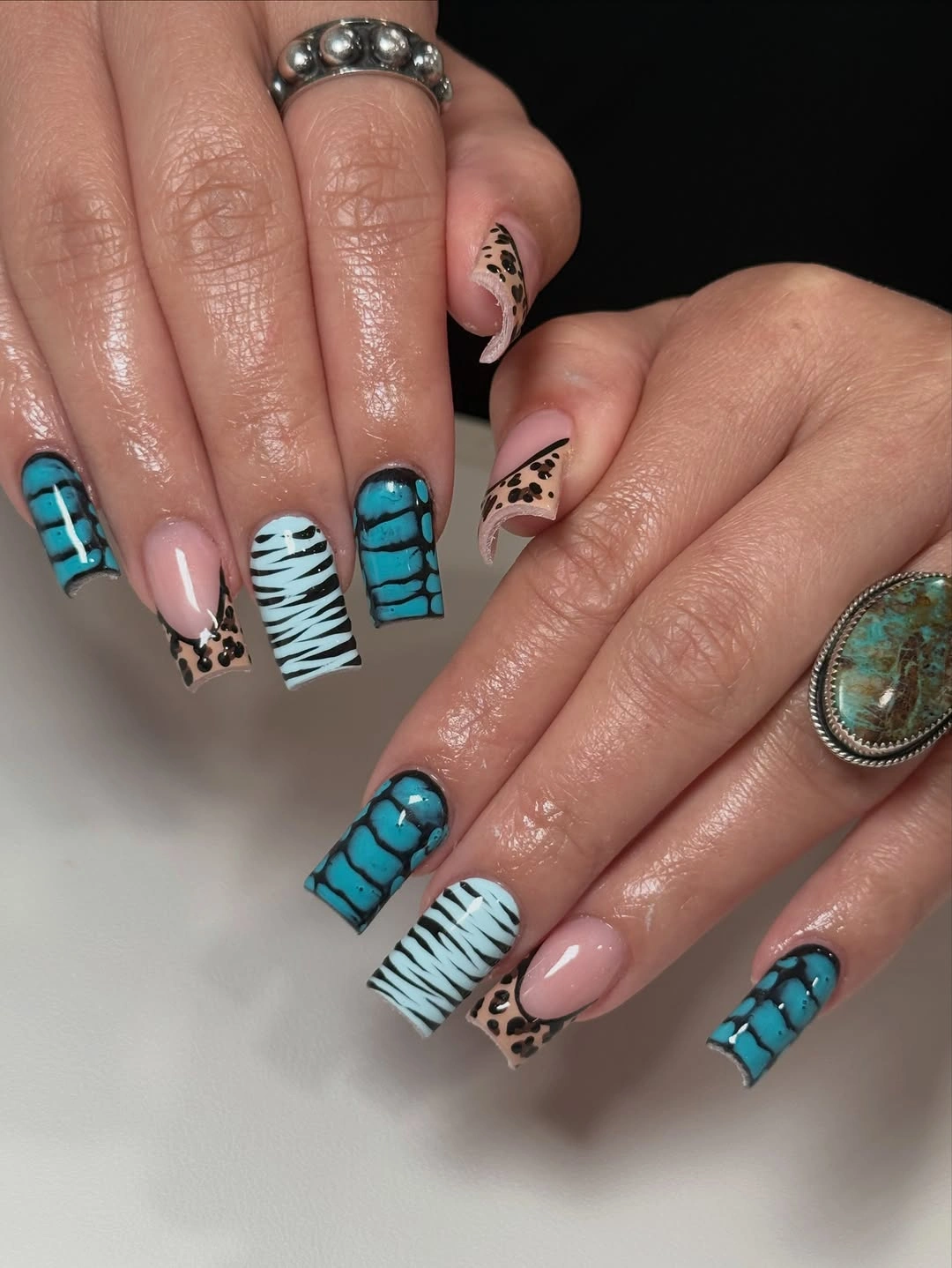
The reason the palette stays readable is that the cool color is repeated in a consistent place, close to the free edge, while the patterns are used as interruptions. Pink keeps the hand open and stops the zebra lines from becoming visually dense. You could adapt the idea by using turquoise on most tips, adding one zebra nail, and leaving the warm pattern as a tiny spot rather than a full accent.
Pattern scale matters more than adding another color. On shorter nails, broad turquoise edges and one high-contrast stripe will look sharper than several small marks crowded together. Medium length gives more flexibility, but the same editing principle helps: preserve the cool tip, reserve the pattern for one focal finger, and let the pink base do the quiet work.
Glossy Red Lets The Square Shape Speak
A saturated glossy red covers the medium-long squared nails from edge to edge, with no visible motif asking for attention. That simplicity makes the silhouette part of the design: the straight sides and crisp free edge give the color a graphic frame. It is a direct interpretation of fall nails medium length, especially for someone who wants seasonal impact without drawn art.
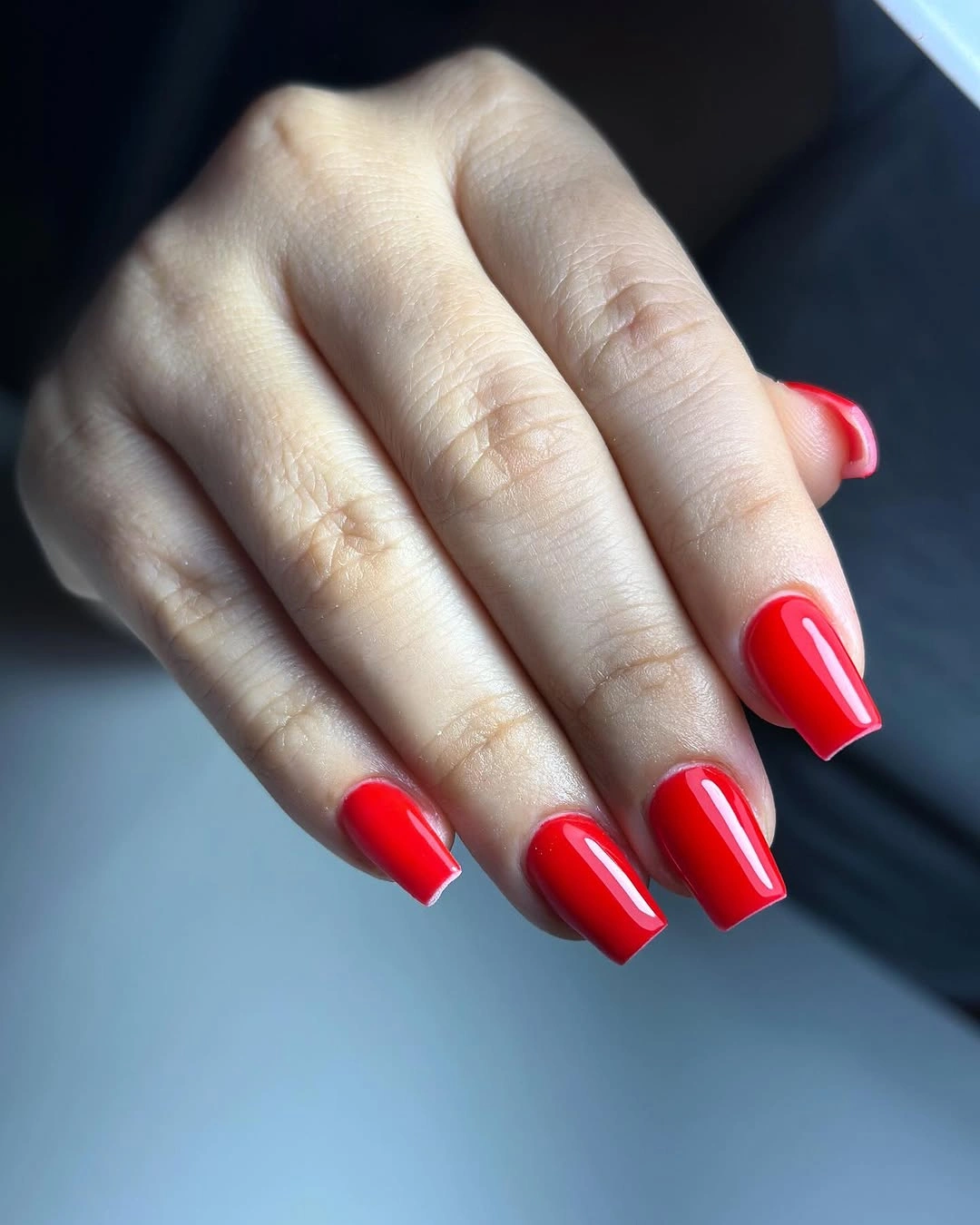
The solid surface works because the red has enough depth and shine to create its own contrast against the surrounding background. Nothing breaks the hand into competing sections, so the eye follows the length and the evenness of the edges. If a full medium length feels too assertive, keep the same color on a shorter square or soften the corners slightly while preserving the clean coverage, then compare the mood with fall nails with autumn designs for a warmer styling direction.
The honest limitation is that a single strong color makes small imperfections easier to notice. Uneven tips, visible growth, or a nick near the sidewall will stand out more than they would under a mixed pattern. A tidy edge and a shape that matches your routine matter here, because the polish is doing all of the visual work without an accent to distract from it.
Quiet Pink French Tips For A Clean Pause
Sheer pink and crisp white tips create a low-contrast manicure on a medium square shape. The white sits narrowly at the edge, leaving the center light and uncomplicated, while the squared outline gives the French detail enough structure to look deliberate. Among simple nails medium length fall options, this is the neutral route that lets jewelry, knitwear, or a patterned sleeve remain part of the overall styling.
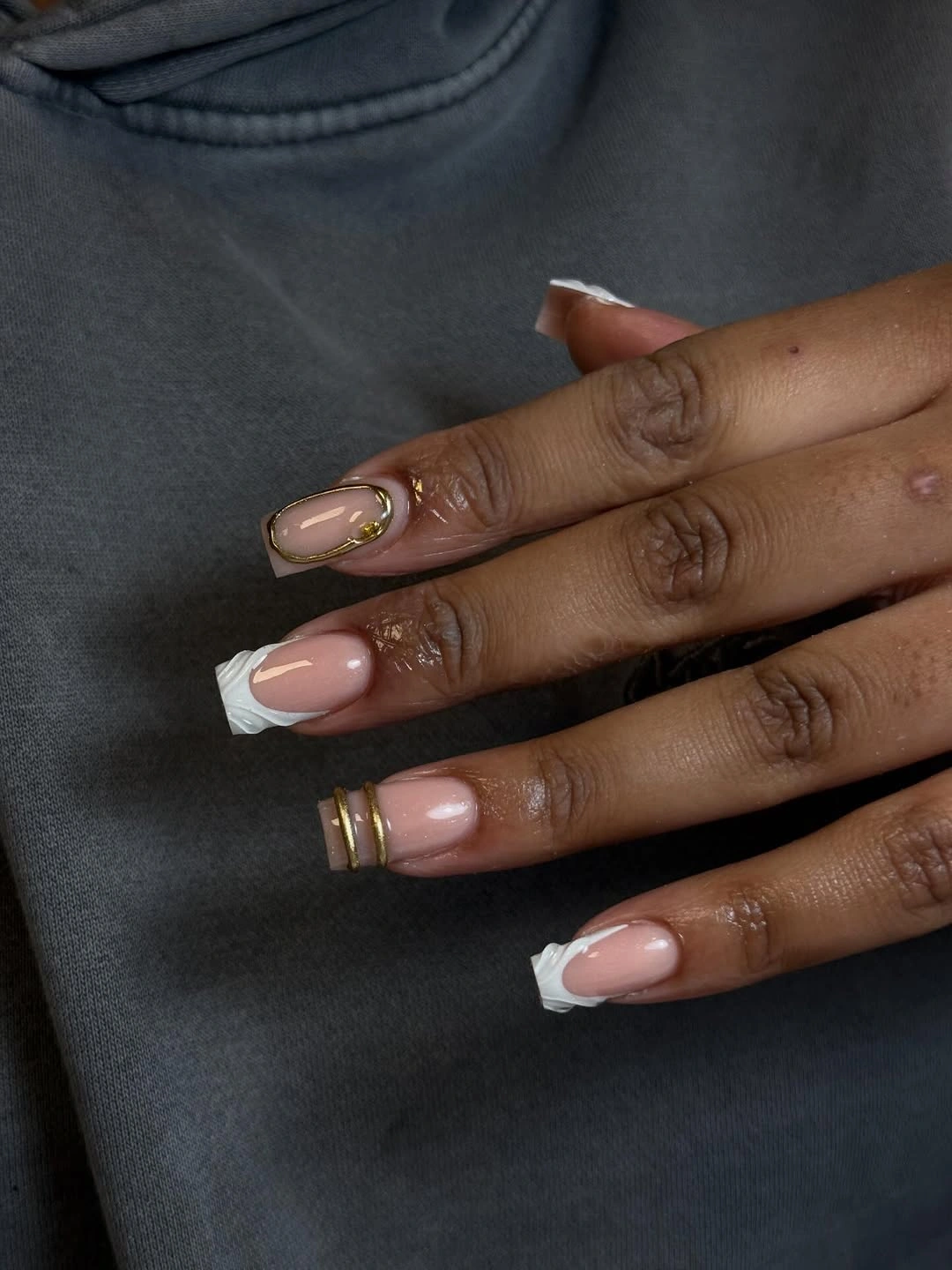
The design works through proportion rather than color drama. The pale base visually softens the length, and the white edge gives the hand a clear finish without introducing a new motif. For a shorter version, keep the square outline but reduce the width of the tip; if you want a seasonal adjustment, swap the white for a muted taupe while keeping the same restrained placement.
Because the palette is quiet, precision matters. A small difference in tip width or an uneven corner will be more noticeable than it would be under a busy design, and the pale base does not disguise edge changes. That is a manageable tradeoff for readers who prefer low-density color: the manicure asks for neat lines, but it gives back an easy, adaptable look.
Different Bright Tips On One Nude Grid
This set turns the French edge into a sampler, pairing a nude pink base with lime, red, zebra black-and-white, and cool blue accents on different medium-long square nails. Each tip makes a separate decision, yet the shared base and repeated length stop the hand from looking disconnected. The appeal is in seeing several ideas coexist without covering the whole nail in color.
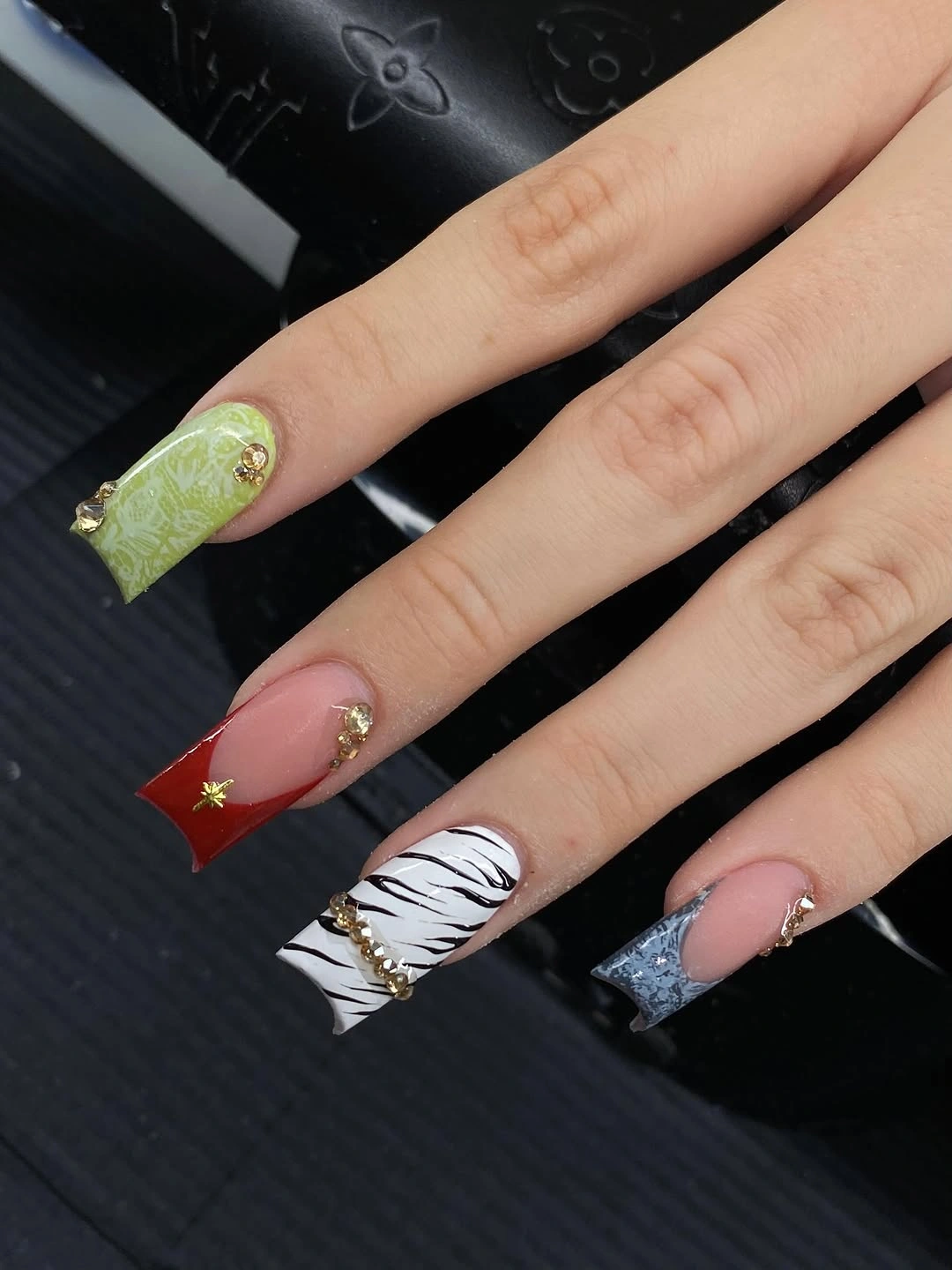
The neutral base is the organizing device. It leaves a consistent band of open space between the cuticle and the brighter edges, so the eye reads the colors as a family of tips rather than a stack of unrelated panels. For a more wearable edit, repeat one bright shade on three nails, keep the zebra as the single pattern, and use the other colors only as tiny line accents.
On medium length, the free edge has enough room for contrast, but the design can become crowded if every tip receives multiple lines. A shorter adaptation should simplify the number of bands before shortening the nail further. That preserves the visual idea – varied fall tips over a calm base – while making the manicure easier to read and easier to refresh when the edge grows out.
Stacked Color Bands Follow A Long Square Edge
Layered bands in blue, lime, coral, yellow, and pale tones curve across a pink nude base, giving the long square outline a sense of movement. The center of each nail remains open, so the bright detail gathers near the free edge instead of filling the entire surface. The repeated arcs make this look more rhythmic than a simple mismatched French set.
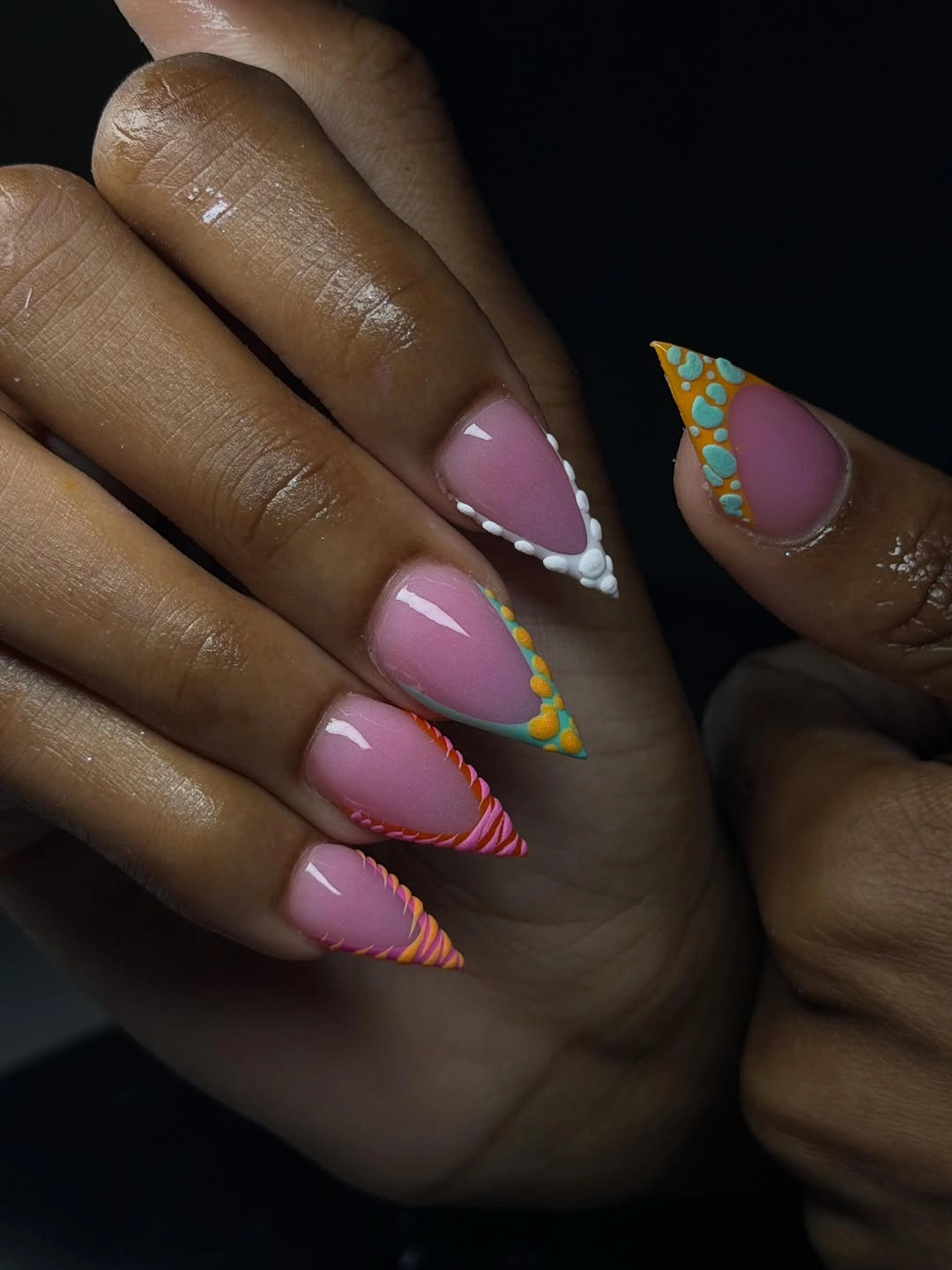
The bands work because they follow the contour of the nail and echo one another across the hand. Even when the colors change, the placement gives them a common job: they frame the end of the nail and draw the eye outward. If you want a softer medium length, keep two bands rather than the full stack and choose one warm color plus one cool color for clearer contrast.
Thin spacing is the main practical constraint. When several lines sit close together, a small shift in width can change the rhythm more than a color swap would, and shortening the free edge may remove the room needed for the full sequence. A two-band version is not a compromise in concept; it is the same contour idea edited for a surface that needs more breathing space.
One Navy Accent Framed With Fine Gold
Nude pink medium square nails become more dimensional through a single dark navy graphic accent, white edge work, and thin gold outlined shapes. Most fingers stay pale, so the blue nail has a clear focal role instead of competing with several equally strong colors. The gold details echo the jewelry nearby and add structure without turning the manicure into a glitter-heavy design.
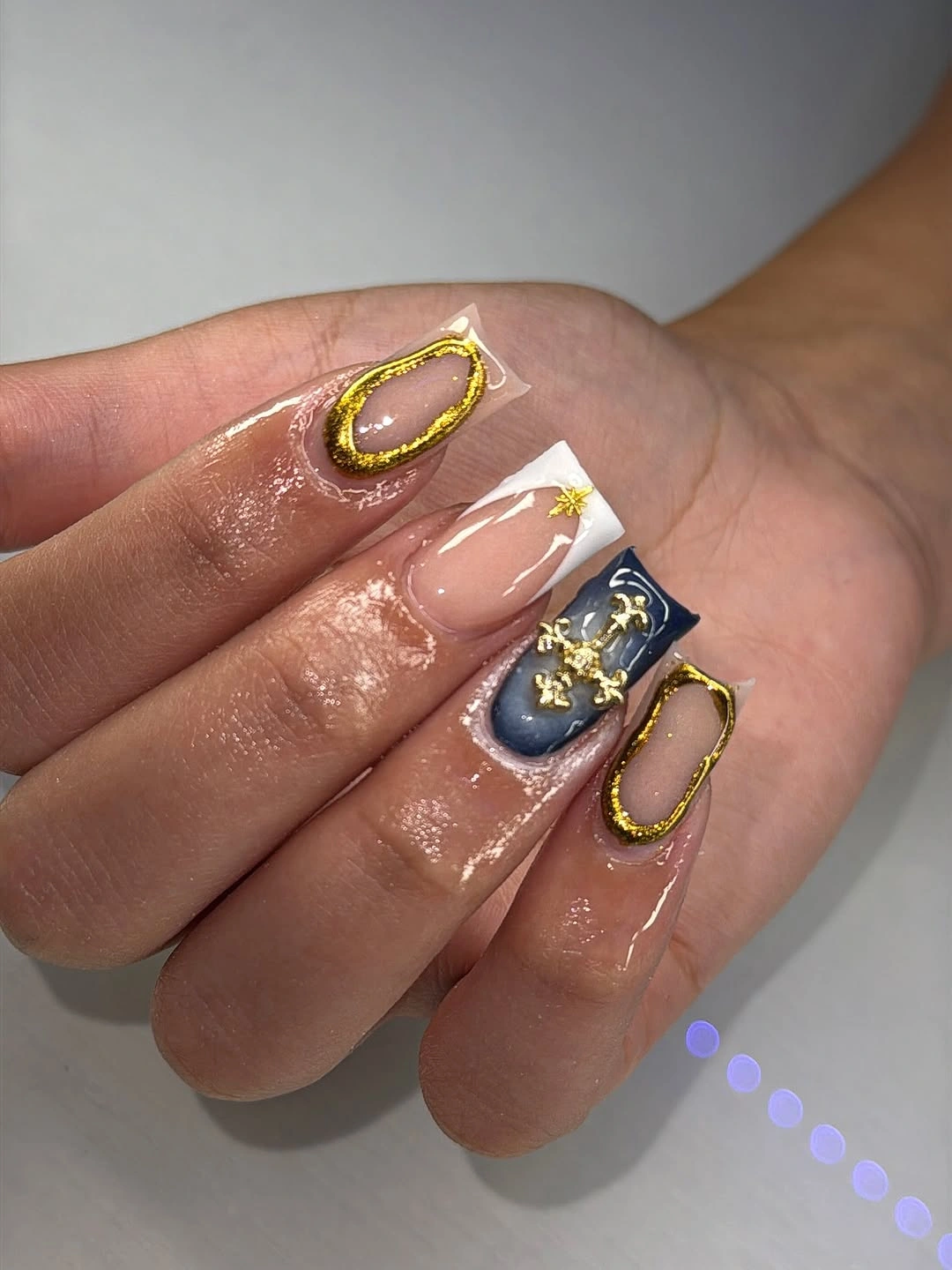
The contrast comes from placement as much as from color. A deep accent in the middle of a light set makes the hand pause, while the narrow gold contours keep the transition from feeling abrupt. You can borrow the idea with one navy nail, two white French edges, and one gold curve; repeating every accent would remove the quiet hierarchy that makes this set feel polished.
Fine outlines reward a steady hand and can reveal uneven spacing as the manicure grows. That is the realistic limitation of a design built on narrow borders rather than broad blocks. Medium length gives the contours room, but a shorter nail can still carry the same mood if the gold is reduced to one small line and the navy remains the only strong color.
Soft Pink Almond Nails With Warm Abstract Marks
Glossy pink nude almond nails carry a few brown, black, and white abstract details instead of a full patterned surface. The warm marks appear on selected fingers, including rounded or swirled shapes that soften the longer outline. This approach keeps the manicure decorative but still airy, making it a gentle direction for cute medium length nails fall styling.
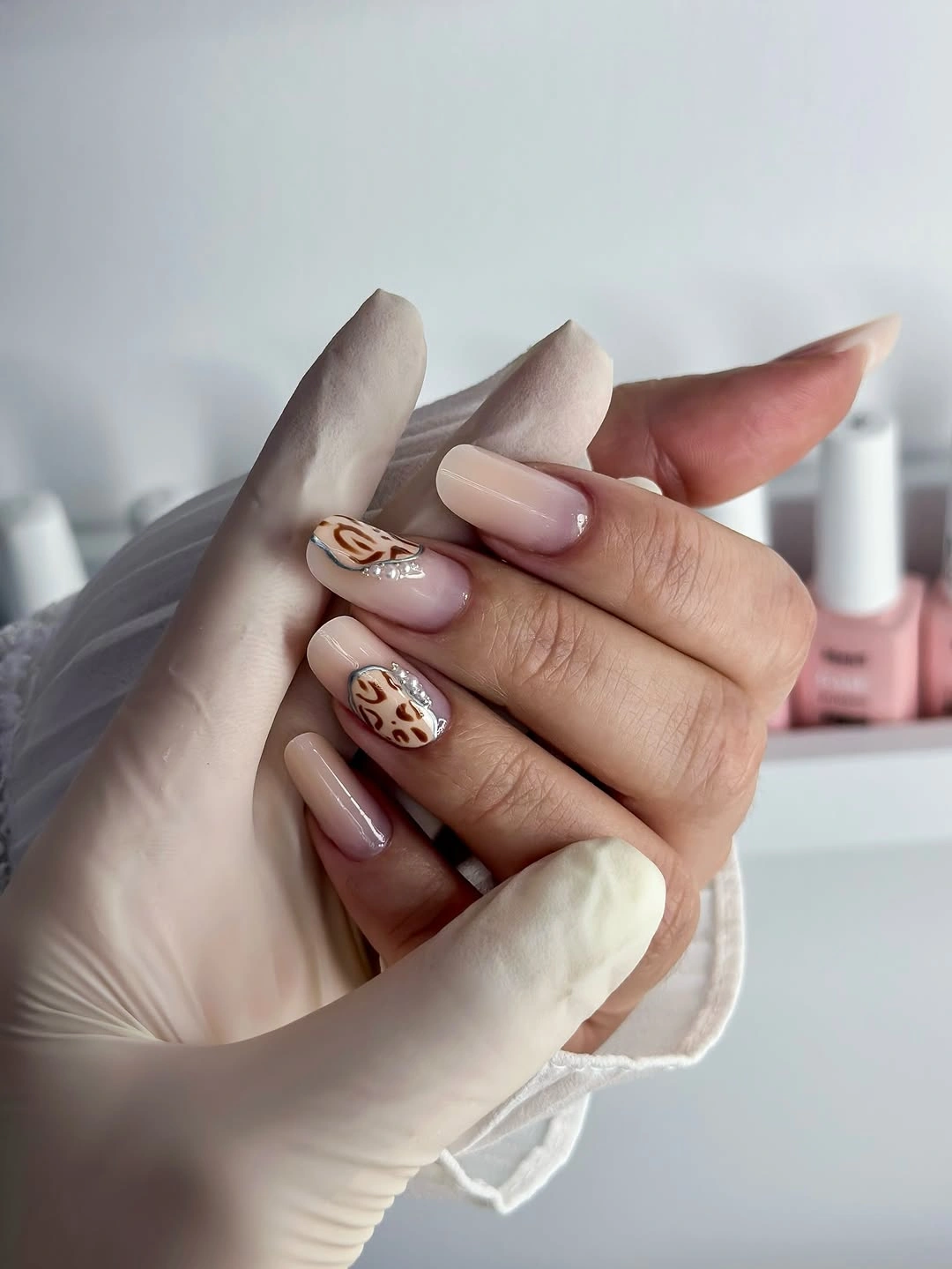
The arrangement works because the pale base remains dominant and the accents are allowed to vary in scale. Brown gives the pink a fall connection, while black and white sharpen the small focal areas without taking over the hand. For a shorter adaptation, keep one warm abstract accent and let the other nails stay pink; the almond curve will supply enough visual character on its own.
Small linework needs enough surface to remain readable, and a shorter nail may turn several tiny marks into visual noise. That is why editing the number of accents is more effective than trying to preserve every detail. Choose the mark with the clearest silhouette, keep its placement slightly away from the edge, and use the base color to maintain the calm rhythm.
Red French Edges With Denser Tip Accents
Long square nude nails receive vivid red French tips, then two fingers add denser red detail near the free edge. The base stays pink and open, while the strong color moves from a neat line to a more clustered accent, creating a gradual shift in intensity across the hand. It is a useful example of how fall nails medium length can feel festive without abandoning a clean base.
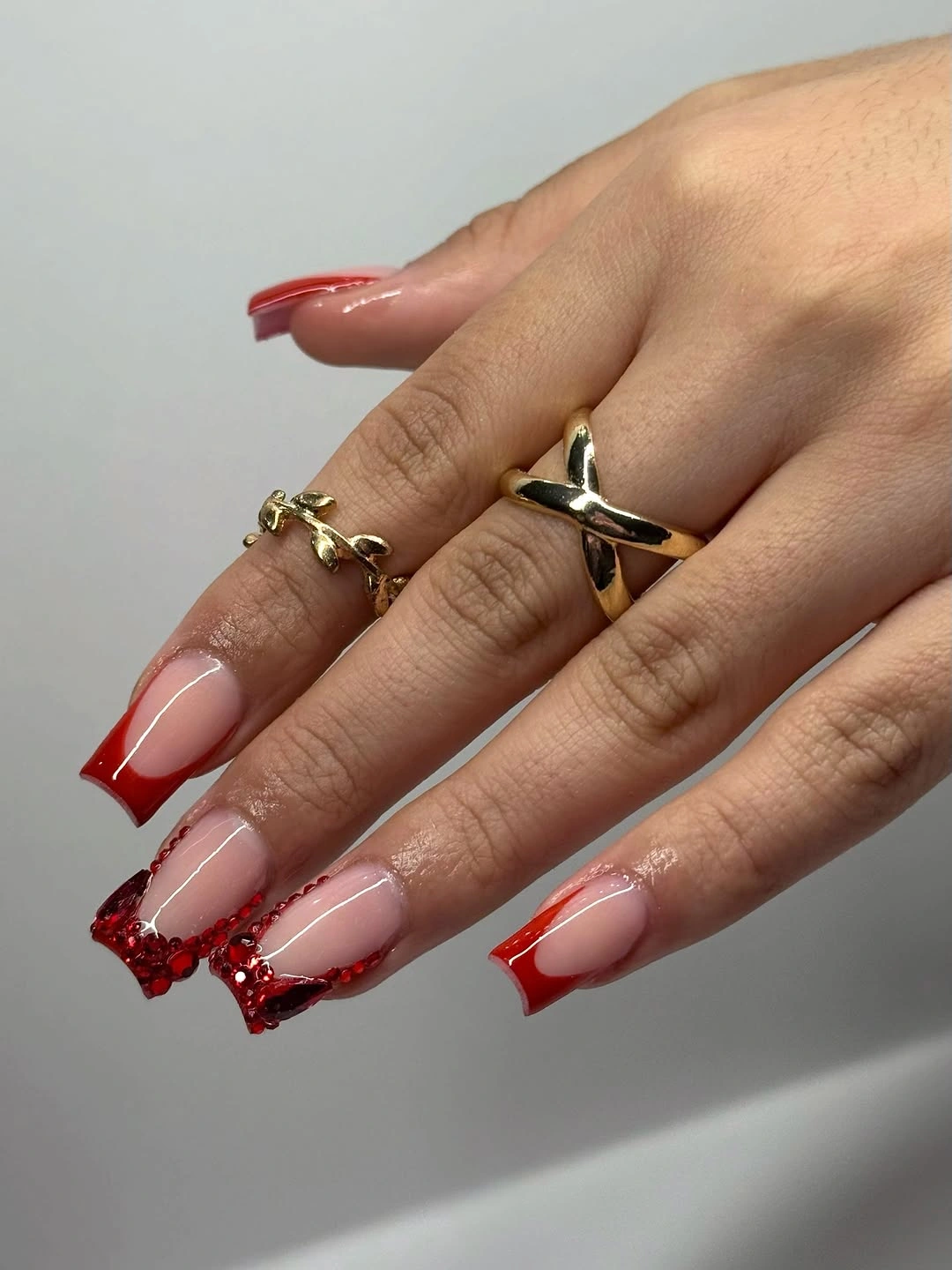
The manicure stays organized because red is the only saturated note and the denser accents are limited to a pair of nails. The eye understands the tips first, then notices the extra texture as a secondary layer rather than a separate story. If you want a calmer set, keep every nail on the red French edge and place the clustered detail on one ring finger only.
Long squared tips give the decorative areas room, but they also make the edge more prominent in daily movement. If the detail sits above the surface, it may require more care than a flat tip, so a shorter version can use a red outline or a small red dot instead. The main idea is selective density, not maximum decoration, and it survives that edit easily.
Green And Blue Curves Stretch The Almond Silhouette
Long almond nails use repeated curved bands in green, blue, white, and a little yellow over a pink base. The lines follow the contour of the tips and appear across most fingers, so the manicure creates movement through repetition rather than through separate illustrations. The open center keeps the design light even though the shape is long and pointed.
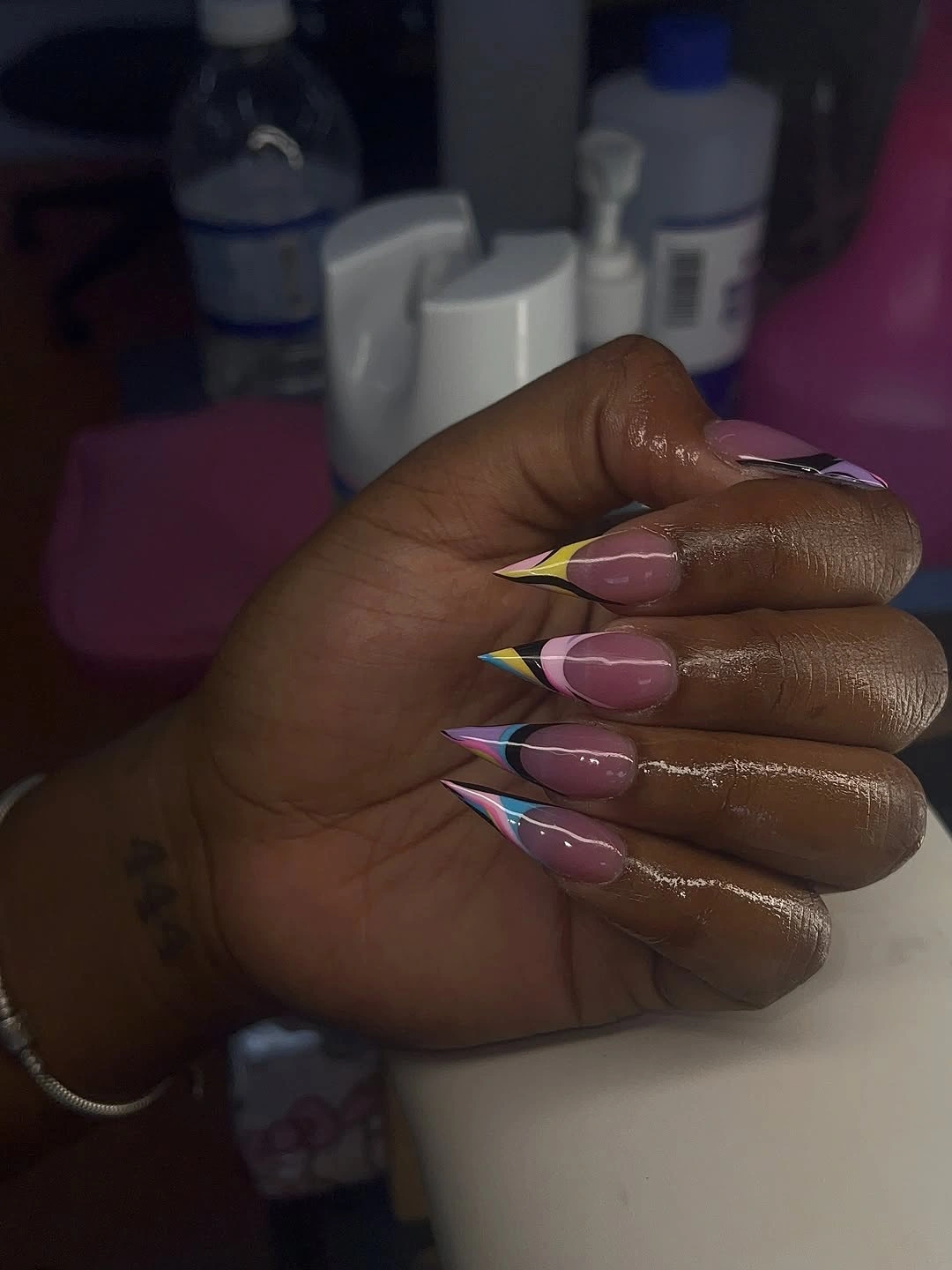
The bands also create a visual lengthening effect because they guide the eye along the same direction as the nail. Color changes keep the pattern lively, while the consistent curve prevents the set from looking fragmented. For a more moderate medium length, use two bands on each tip, repeat one green or blue shade, and let the almond outline carry the rest of the design.
Spacing is the part that determines whether this look feels crisp or crowded. Curves that sit too close together can blur at a shorter free edge, and uneven arcs will show because the same motion repeats across the hand. A reduced version is therefore practical, not merely simpler: fewer lines preserve the contour idea and make maintenance easier as the tips change.
White Waves Bring Motion To Mauve Squares
Mauve and nude medium square nails are crossed by repeated white wave-like lines, creating a soft graphic rhythm in a darker setting. The base colors remain muted, so the light linework becomes the defining detail rather than a bright palette. This is a useful fall medium length nails direction when you want movement but not a collection of obvious seasonal symbols.
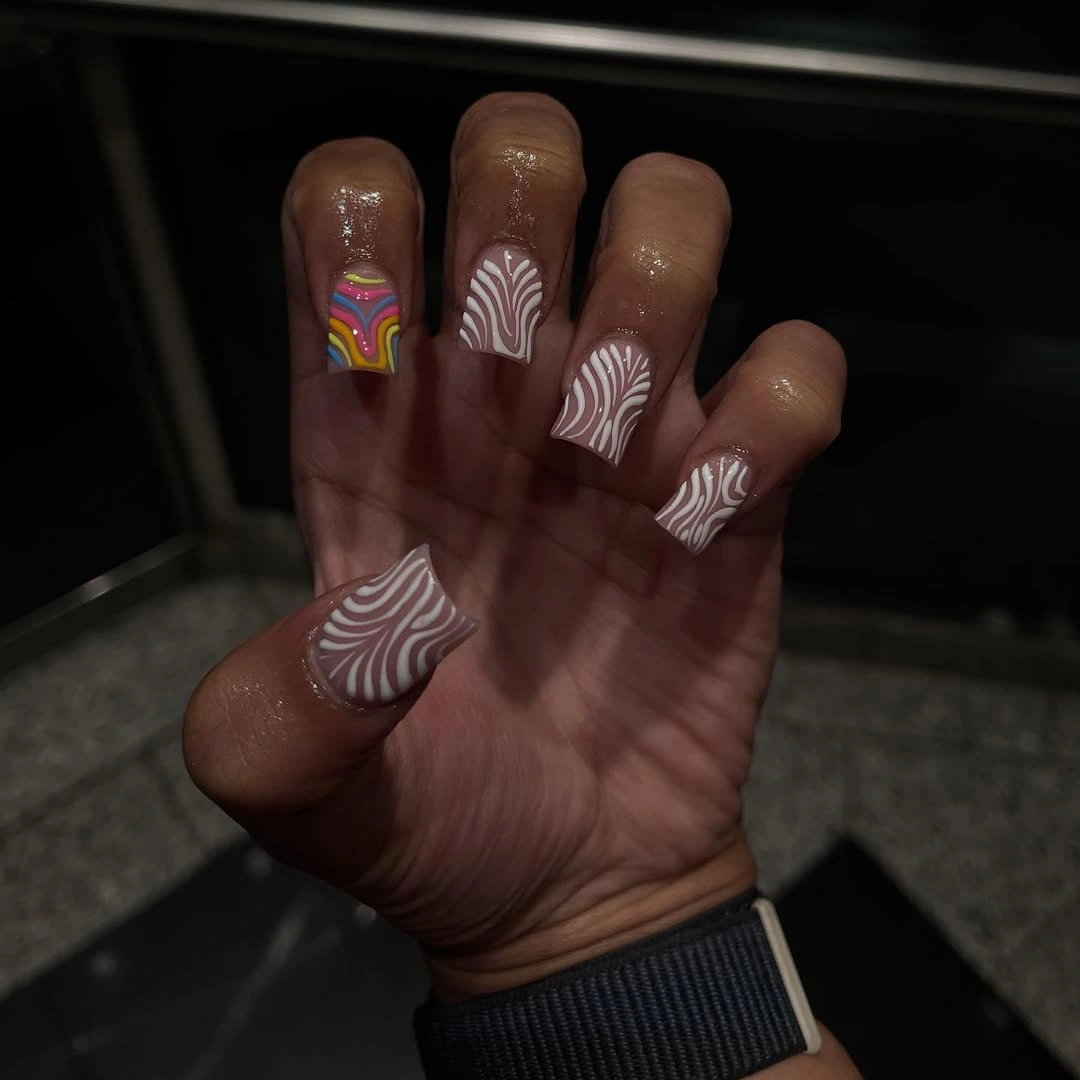
The repetition gives the hand cohesion: the lines are different enough to feel hand-drawn, yet they share the same flowing direction. White against mauve offers contrast without the hardness of black, and the square shape keeps the curves from making the nails look too delicate. On shorter nails, place one wave on two accent fingers and leave the rest mauve or pink.
Fine waves need room and even spacing, so the design benefits from a shape that has a stable, broad surface. If the free edge is shorter, reducing the number of lines will keep the marks visible and prevent them from merging into a pale patch. The quieter palette also makes this easier to pair with fall clothing, because the visual interest comes from line movement rather than loud color.
Bright Tip Patches With Dots And Stripes
Sheer nude square nails use the free edge as a small canvas for turquoise, pink, red, white, and blue patches, with dots, stripes, and wavy marks appearing on different fingers. The center of the nail remains open, so the set feels light even though the tips are colorful. The design is playful because the marks vary, but the shared placement gives them a common boundary.
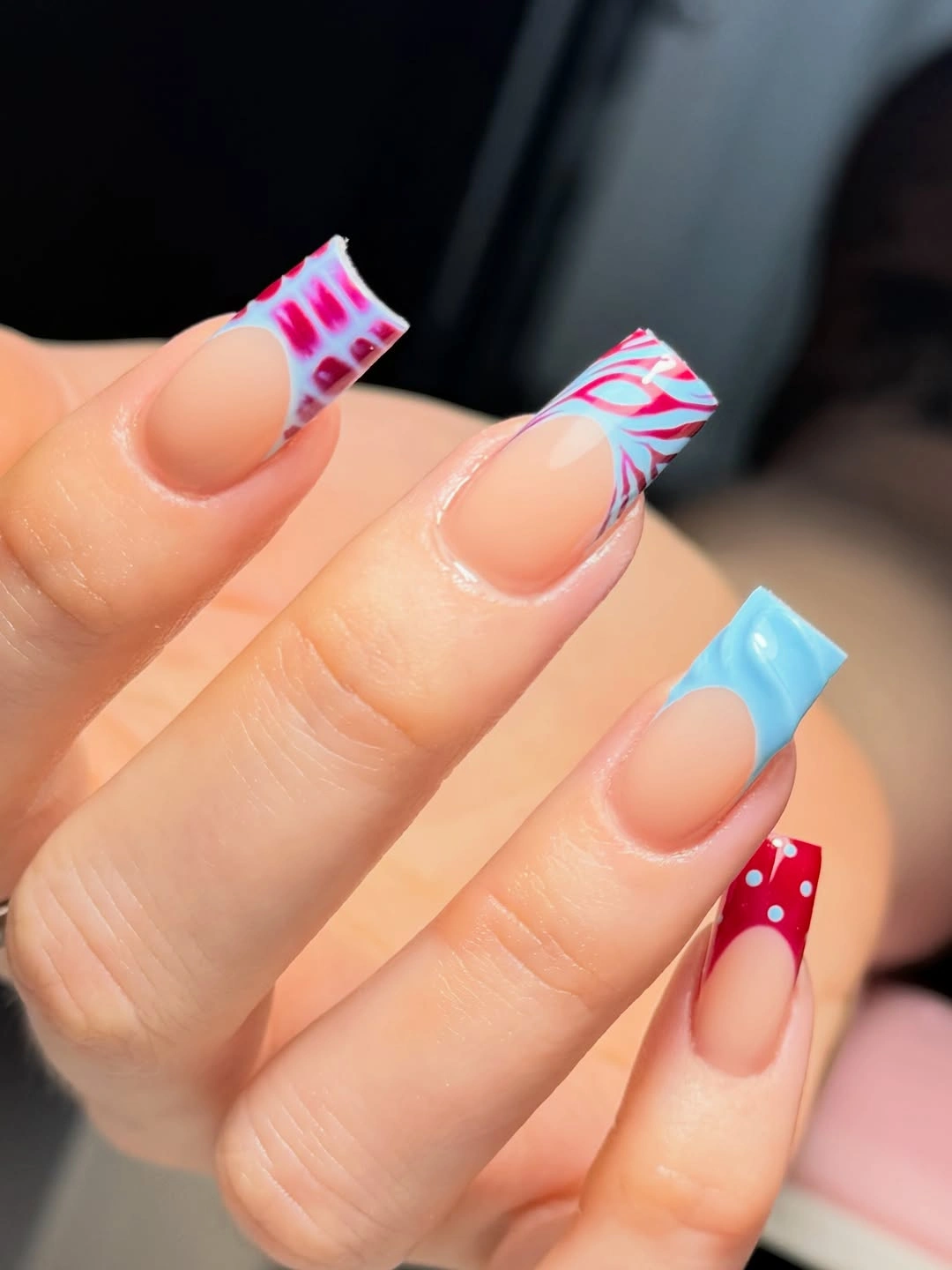
The open base is doing more work than it first appears. It separates the small motifs, leaves a consistent visual pause on every finger, and lets the bright accents feel like a group of ideas instead of a dense collage. For a medium-short adaptation, choose one cool tip color, one warm tip color, and a single dotted accent rather than trying to retain every line.
Small marks can lose their identity when the edge is shortened or when too many colors are placed beside one another. Preserve the larger color blocks first, then keep only the clearest dot or wave. That editing order maintains the character of the manicure while avoiding the common problem of decorative detail becoming a blur at the tip.
Lime French Tips With One Tiny Floral Accent
Medium almond pink nude nails are given a lively edge with lime green French tips, plus one leopard-like pattern and a tiny yellow flower. The lime repeats at the free edge, while the patterned and floral details sit on selected fingers, creating a clear order from color to motif. The result feels fresher than a dark fall palette while still carrying the seasonal contrast of a warm base and bright accent.
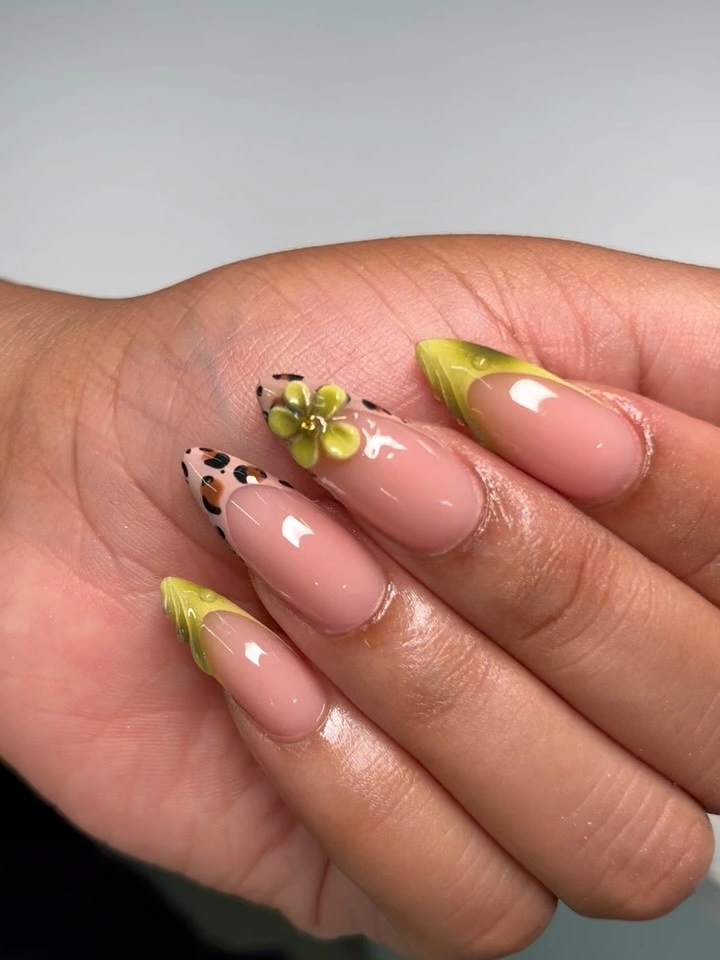
The set works because the green is contained rather than spread over the entire nail. Pink keeps the hand soft, the lime defines the shape, and the small yellow detail adds a warm note without introducing another large color block. If you prefer restraint, keep the lime tips and move the pattern to one nail; the flower can be omitted without losing the main idea.
Bright edges will draw attention to the shape and to any uneven tip width, while tiny details can become cramped as the nail gets shorter. A medium length gives the almond outline enough space, but a shorter version should enlarge one accent or remove it altogether. The strongest takeaway is the controlled use of lime, not the need to reproduce every decorative mark.
Deep Green And Red Share Pointed Graphic Accents
Long pointed nails combine deep green, red, pale blue, white, and fine line accents in a deliberately mixed set. Some fingers carry strong color blocks, while others use flame-like or curved white graphics, so the hand moves between saturated surfaces and open linework. The pointed shape makes the palette look dramatic, even when a single nail uses only a small amount of decoration.
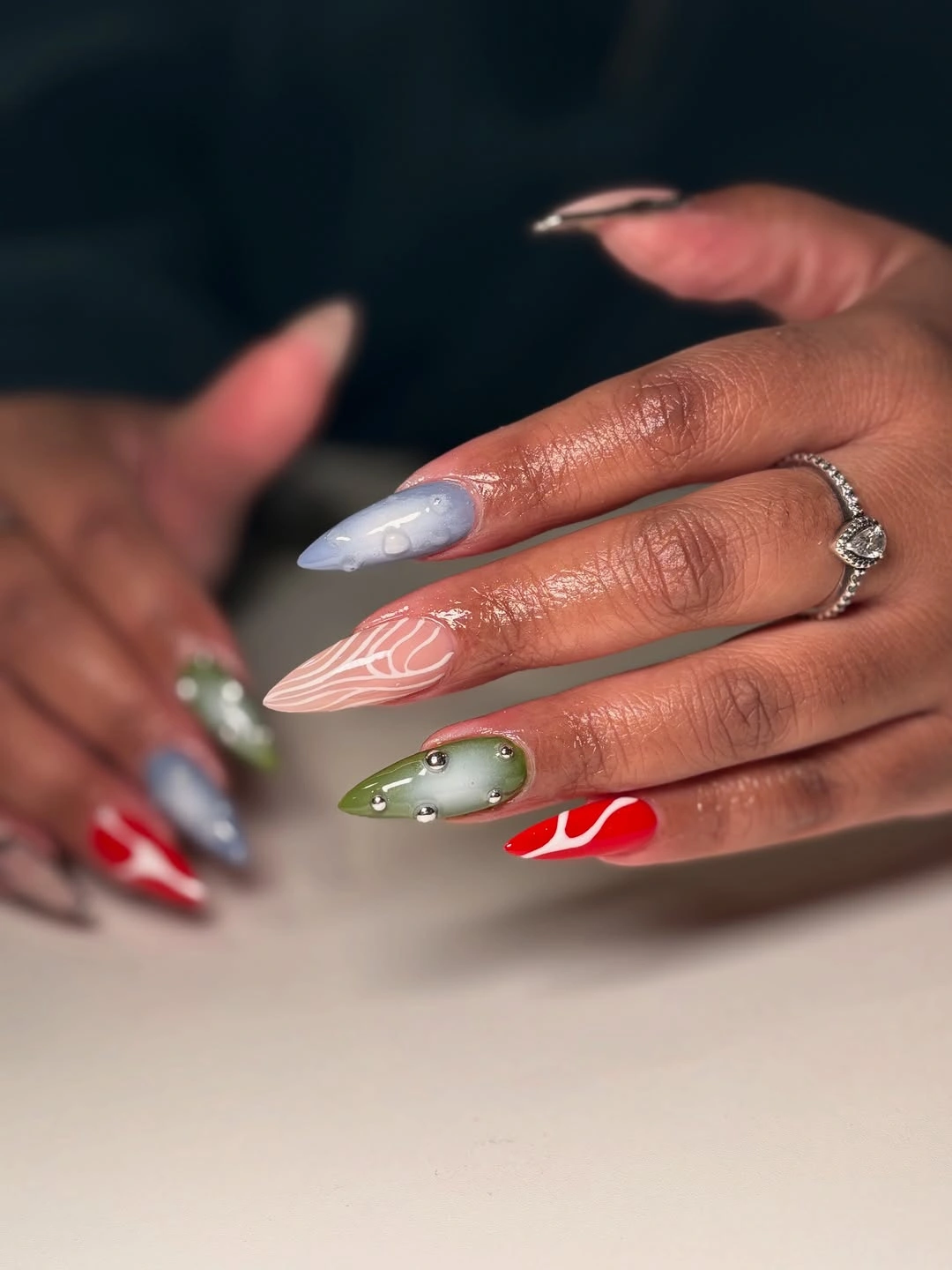
The contrast works because green and red supply the fall depth while pale blue and white interrupt the warmth. The set would feel heavier if every nail were dark, so the lighter lines act as visual breathing room. For a medium almond adaptation, keep one green solid, one red graphic, and one pale accent; the shorter shape will make the mix easier to wear.
Pointed length is part of the mood, not just a container for the colors. It gives the graphics a sharp finish and makes the hand look more assertive, but it can feel less practical for readers who work with their hands. Shortening the silhouette while preserving the two strongest colors is a sensible tradeoff that keeps the contrast and removes some of the daily inconvenience.
Green And White Arcs Keep Pink Nails Airy
Long almond nails use repeated green and white arcs over a translucent pink base, with the color held close to the contour of each tip. The center remains mostly clear, so the manicure looks precise and open rather than fully covered. Among medium length almond nails fall ideas, this is one of the most symmetrical ways to add seasonal green without making the hand feel dark.
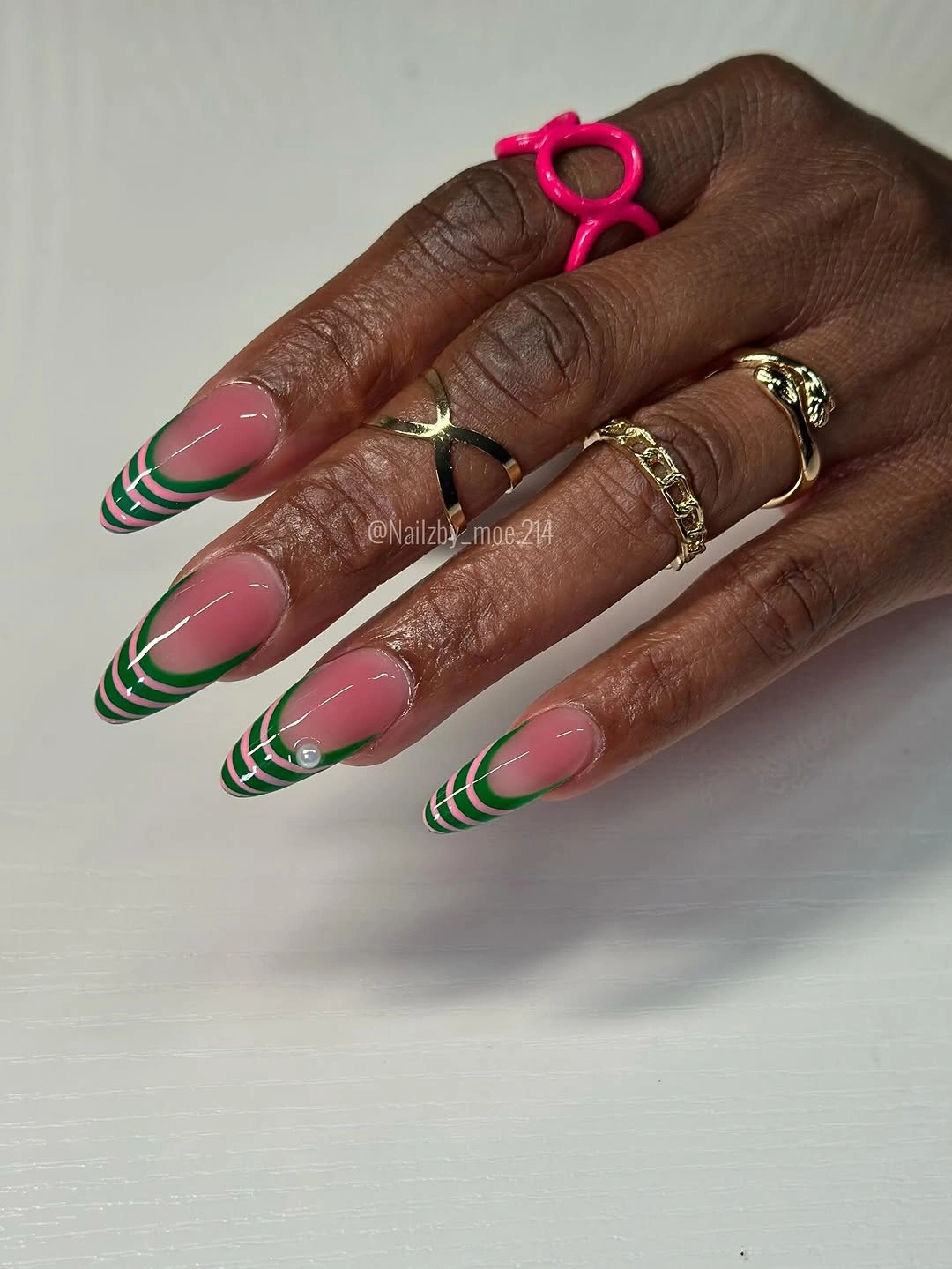
The arcs provide a clear progression from base to edge: pink first, then white, then green as the strongest line. That order lets the color frame the nail while the almond shape supplies the lengthening effect. A shorter adaptation can keep one green arc and one white line on each tip, or repeat the green only on the ring finger for an even quieter finish.
Contour work is unforgiving when the lines drift, especially because the same pattern appears on several nails. The benefit is that the design can be simplified without losing its identity; fewer arcs create more breathing space and remain easier to keep even as the tips grow. This is a good example of decoration that scales down through spacing rather than through a new motif.
Pink French Nails With A Small Pattern Break
Medium square pink nude nails stay close to a simple white French, with thin diagonal marks and one small patterned accent providing the change of pace. The decorative details are modest, so the main impression remains clean and pale rather than fully artistic. It is a practical answer for anyone who wants simple nails medium length fall styling with just enough contrast to avoid a basic salon repeat.
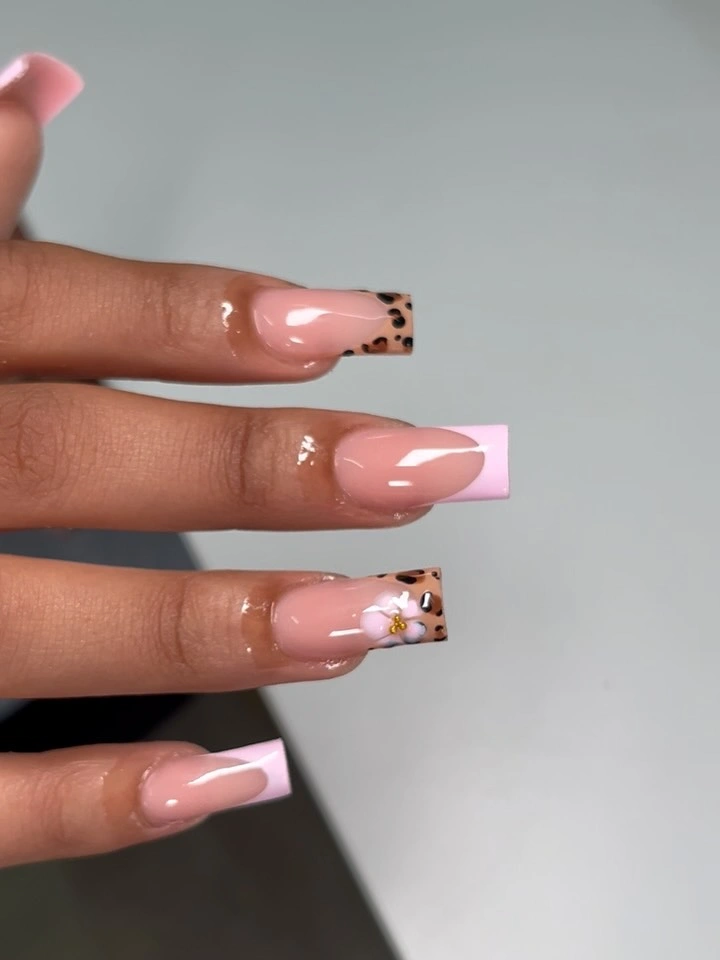
The layout succeeds through restraint. The white tips create consistency across the hand, while the tiny pattern gives the eye one place to pause without demanding a different design on every finger. For shorter nails, keep the French edge and transfer the pattern to one ring finger; the diagonal line can be removed if the surface feels crowded.
Because the accents are small, they should be selected for clarity rather than quantity. A tiny mark that is visible from normal distance will contribute more than several details that merge into the pale base. This edit also keeps the manicure adaptable for work or daily errands, proving that a fall reference can be expressed through placement and scale rather than a dark color. The same test helps when comparing broader fall nail art ideas: keep the detail that stays readable after the novelty wears off.
Muted Mixed Accents Stay Within A Cool Palette
Long almond nails combine brown, muted green, blue-gray, pale details, and silver-looking accents in a collected palette. One nail appears marbled or tortoiseshell-like, another uses an outlined green shape, and a reflective-looking accent adds a different surface quality. The manicure feels eclectic, but the subdued colors keep the mix connected rather than chaotic.
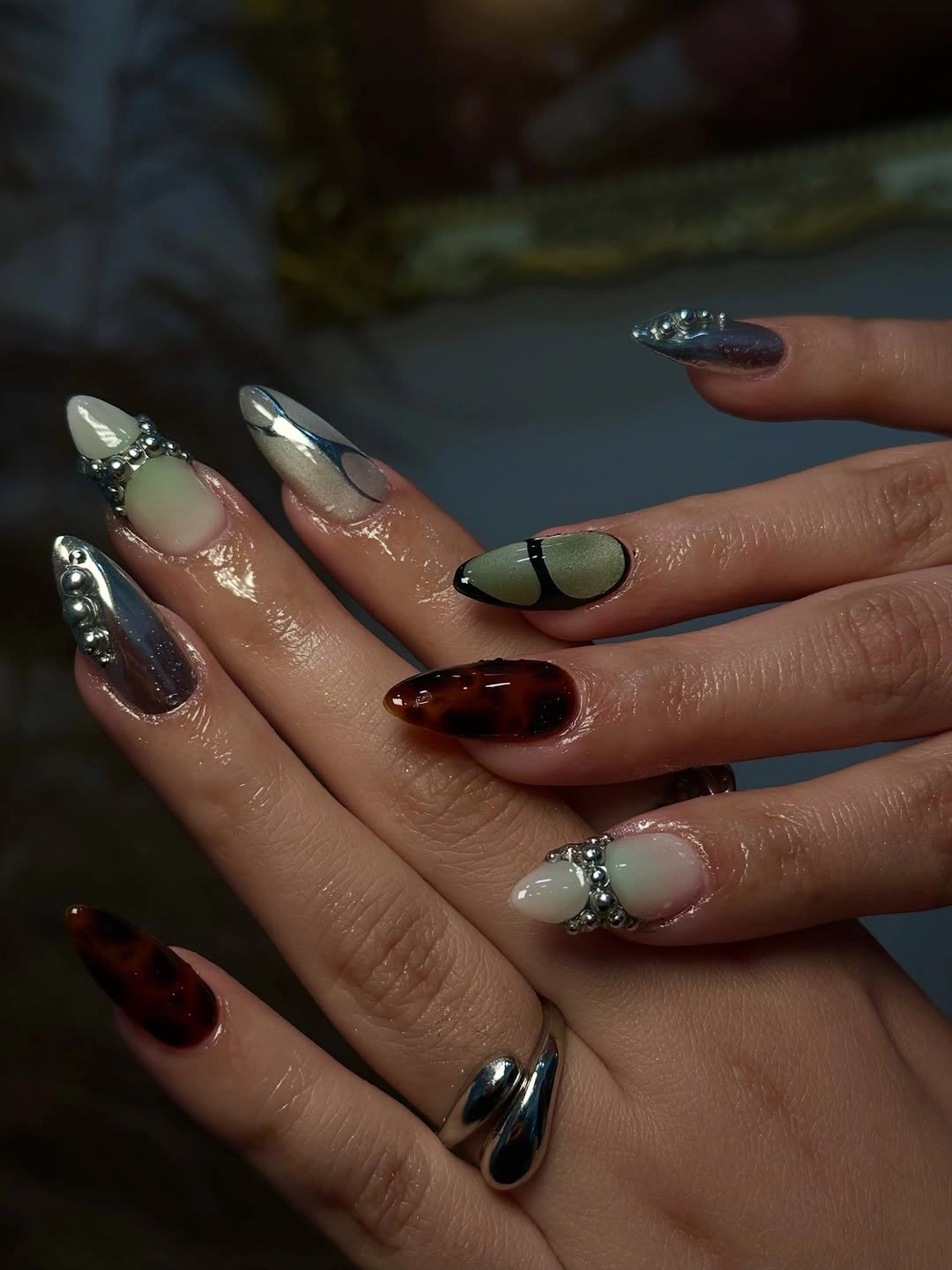
There is no single repeated motif to organize the set, so palette discipline becomes the main structure. Brown brings warmth, green and blue-gray cool the hand, and pale or reflective accents create small pauses between the darker surfaces. If the full combination is too dense for everyday wear, keep the brown pattern, one cool solid, and one light accent on a medium almond shape.
The tradeoff is visual richness versus maintenance simplicity. More surfaces and marks mean more details to protect and more changes to notice as the manicure grows, while a shorter length may reduce the room needed for the mixed arrangement. Editing by palette works better than adding a new pattern: preserve the three strongest tones and let the shape provide the rest of the interest.
Compact Pink French With One Gold Outline
Short-to-medium square nails use a pale pink base, narrow white French tips, and one fine gold outlined accent. The shape is compact, the color contrast is low, and the decoration is concentrated on a small portion of the hand, making this one of the most practical looks in the group. It shows how a medium length nail can feel styled without relying on length or dense art.
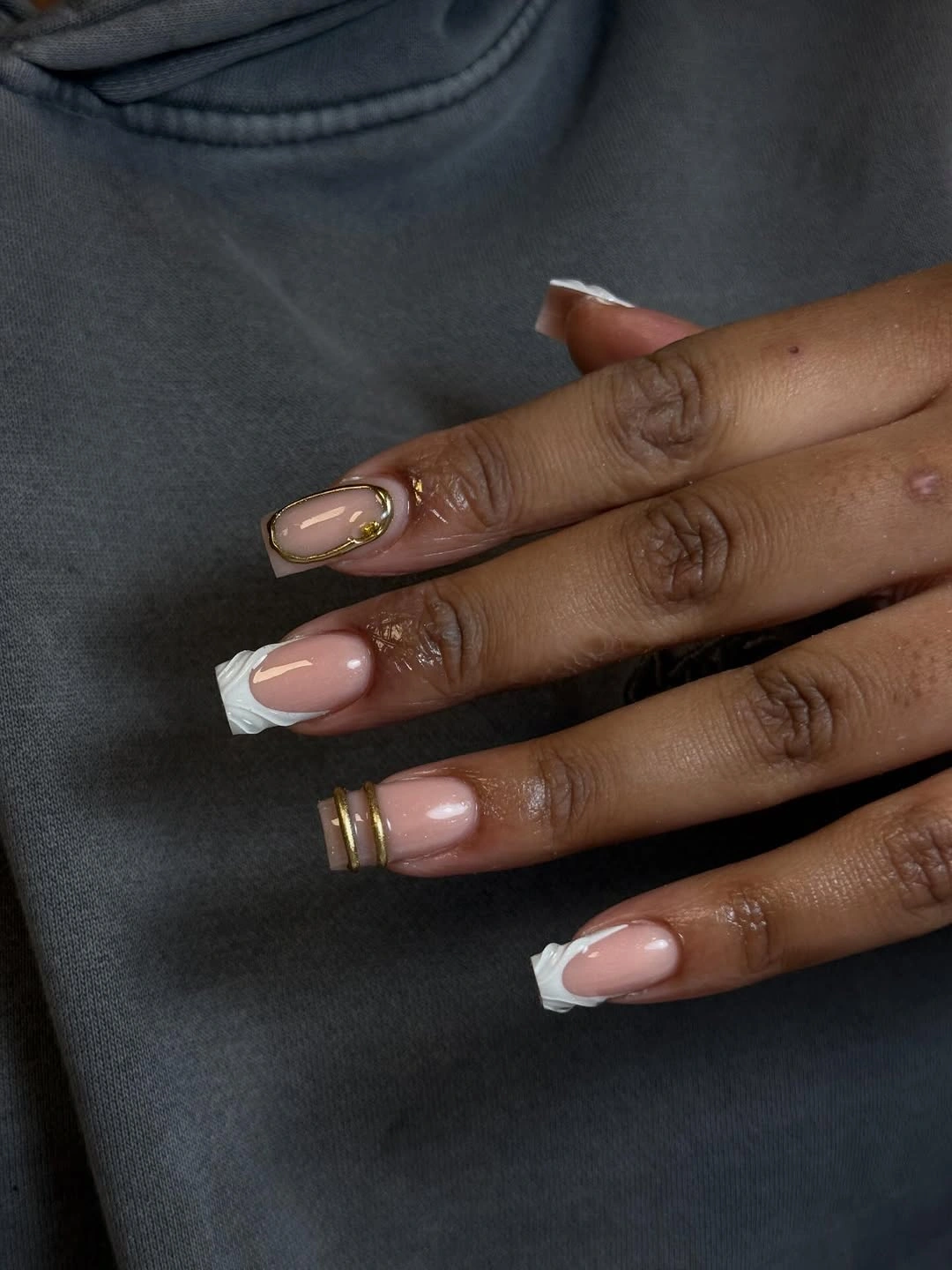
The white edge supplies the consistent finish, while the gold line adds a small change in temperature and texture. Because the accent is isolated, the manicure remains easy to pair with rings or patterned clothing, and the pale base keeps the hand visually light. For an even shorter shape, keep the white edge and replace the gold outline with a single gold dot.
The quiet palette does require tidy spacing around the cuticle and free edge, since there are no bold motifs to disguise small shifts. That is a fair limitation for a design that is otherwise easy to adapt and less demanding than a long patterned set. If you want a low-density fall direction, this balance of blush, white, and one warm line is a strong baseline.
Pink Space Balances Plaid And Gold Density
Medium-long nude pink nails reserve their strongest detail for a dark plaid accent, a dense gold sparkle-like nail, and a smaller ornate element. The surrounding fingers remain comparatively quiet, so the high-detail accents feel placed rather than scattered. This contrast makes the set more decorative than a French manicure while keeping the pink base visible across the hand.
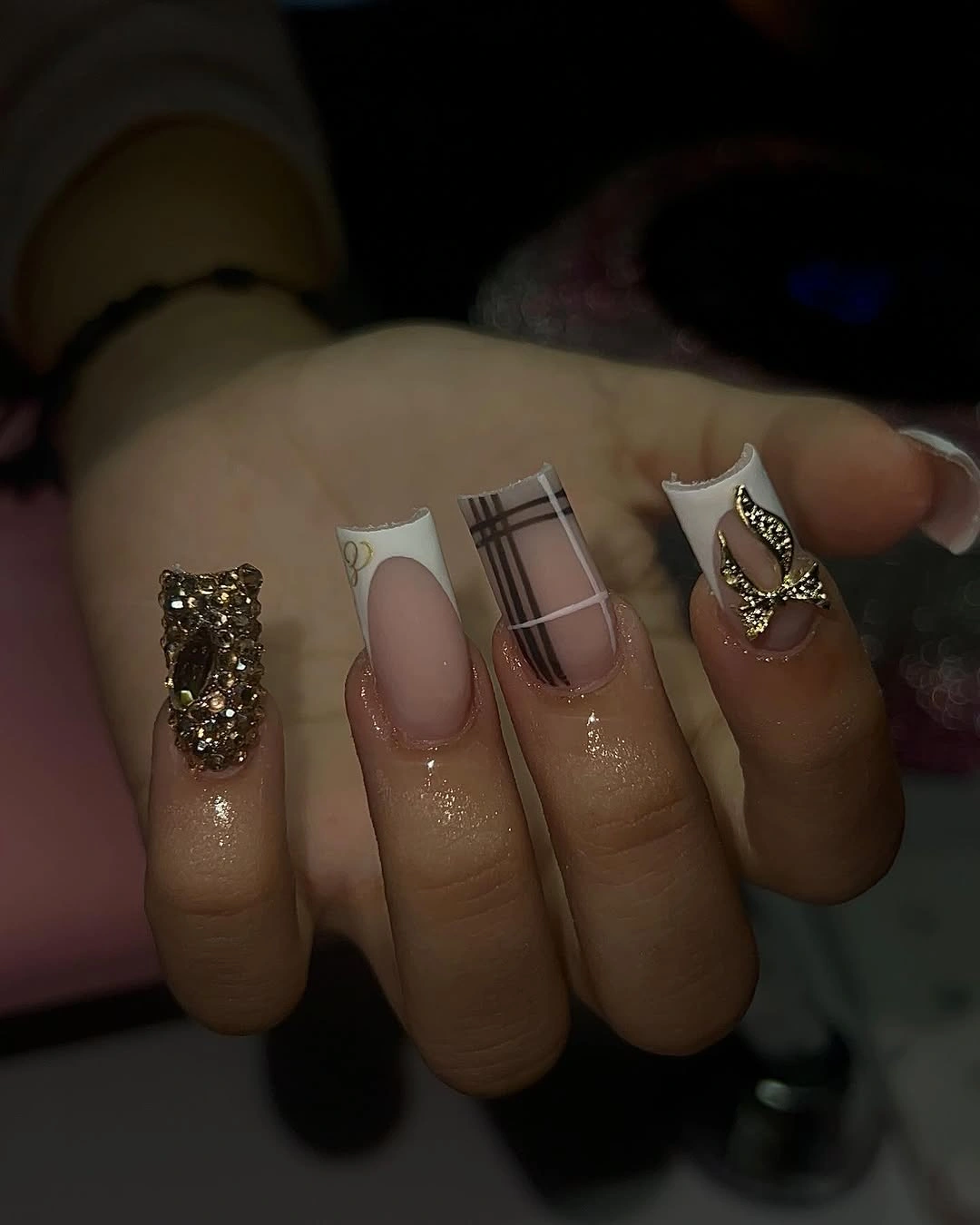
The visual balance depends on empty space. Plaid supplies structure, gold supplies concentrated shine, and the plain pink nails give the eye somewhere to rest before returning to the accents. If you want a simpler version, choose either the plaid or the dense gold detail as the main feature, then leave the other fingers pink with a narrow neutral edge.
Dense decoration can become the first thing you notice as it grows out or catches on daily objects, especially when it appears above the surface. A medium length reduces some leverage but does not remove that limitation. The look is easiest to live with when the detailed nails are limited to one or two fingers and the rest remain smooth, open, and visually quiet.
Blue Lilac Outlines Cool A Pink Almond Base
Long almond nails use pale pink bases with blue-lilac outlined tips and small star-like marks placed in the open center. The cool border gives the manicure a crisp edge, while the pink keeps the long shape soft rather than severe. This makes a useful fall alternative for anyone who wants color contrast without leaning on brown, orange, or red.
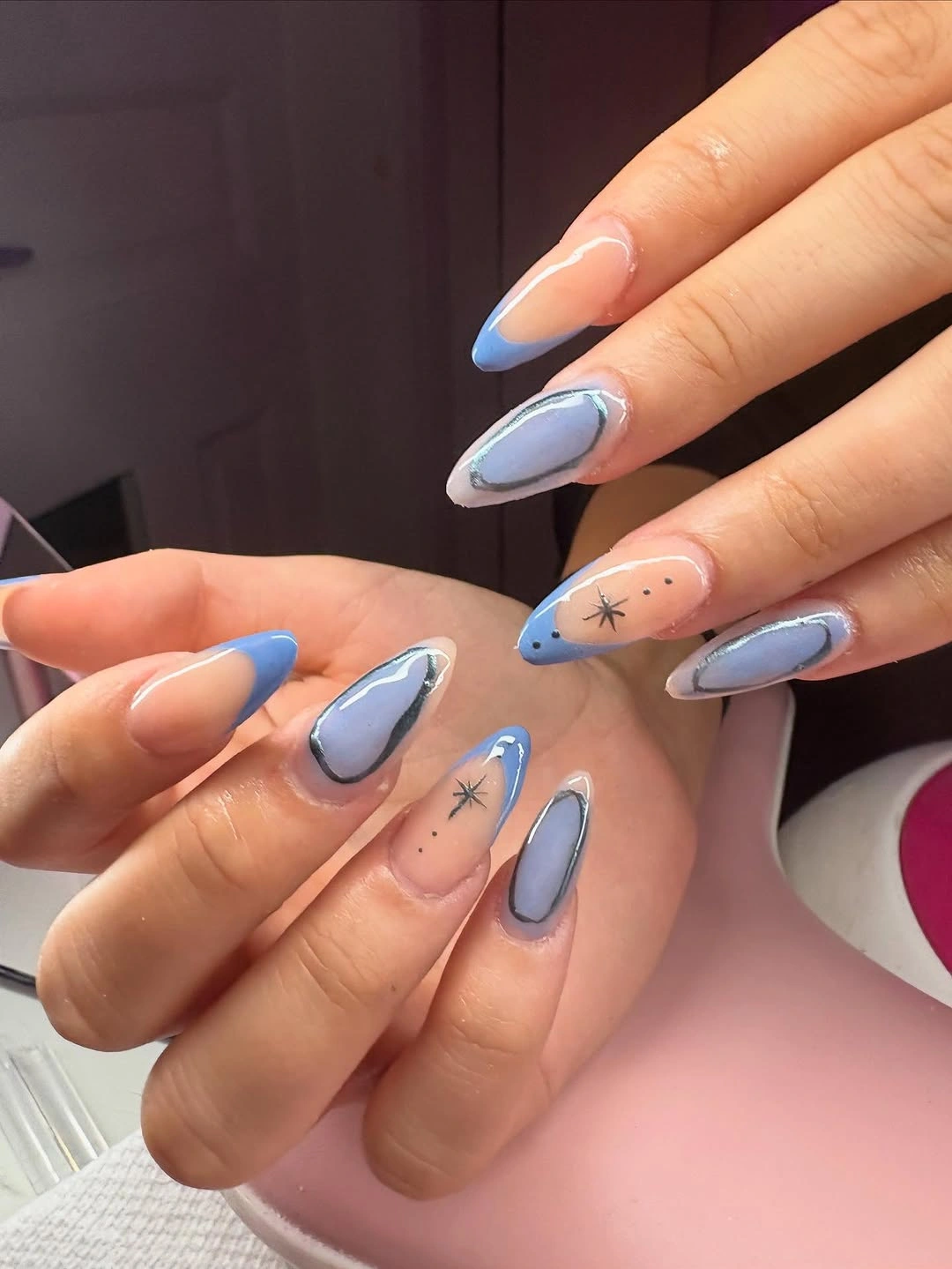
The design feels light because the outline does not cover the entire nail. Blue and lilac create a cool frame, and the small marks add a point of personality without changing the overall balance. For medium length, keep the border on the free edge and remove the smallest marks if they begin to compete with the shape or become difficult to read.
Thin outlined details are best judged from normal distance, not only from a close-up. If the lines become too delicate after shortening, a single broader blue-lilac curve will hold the same warm-cool contrast more clearly. The important decision is the cool frame around pink, which stays useful even when the exact decorative marks are edited down.
Muted Taupe Edges Close The Color Story
Medium square nude pink nails finish the sequence with taupe-gray French panels and narrow two-tone geometric edges. The palette is quiet, but the tip is not a plain single stripe: slim parallel sections give the free edge a graphic finish while leaving the base light. It is a calm direction for fall nails for medium length when you want seasonal depth without a bright accent.
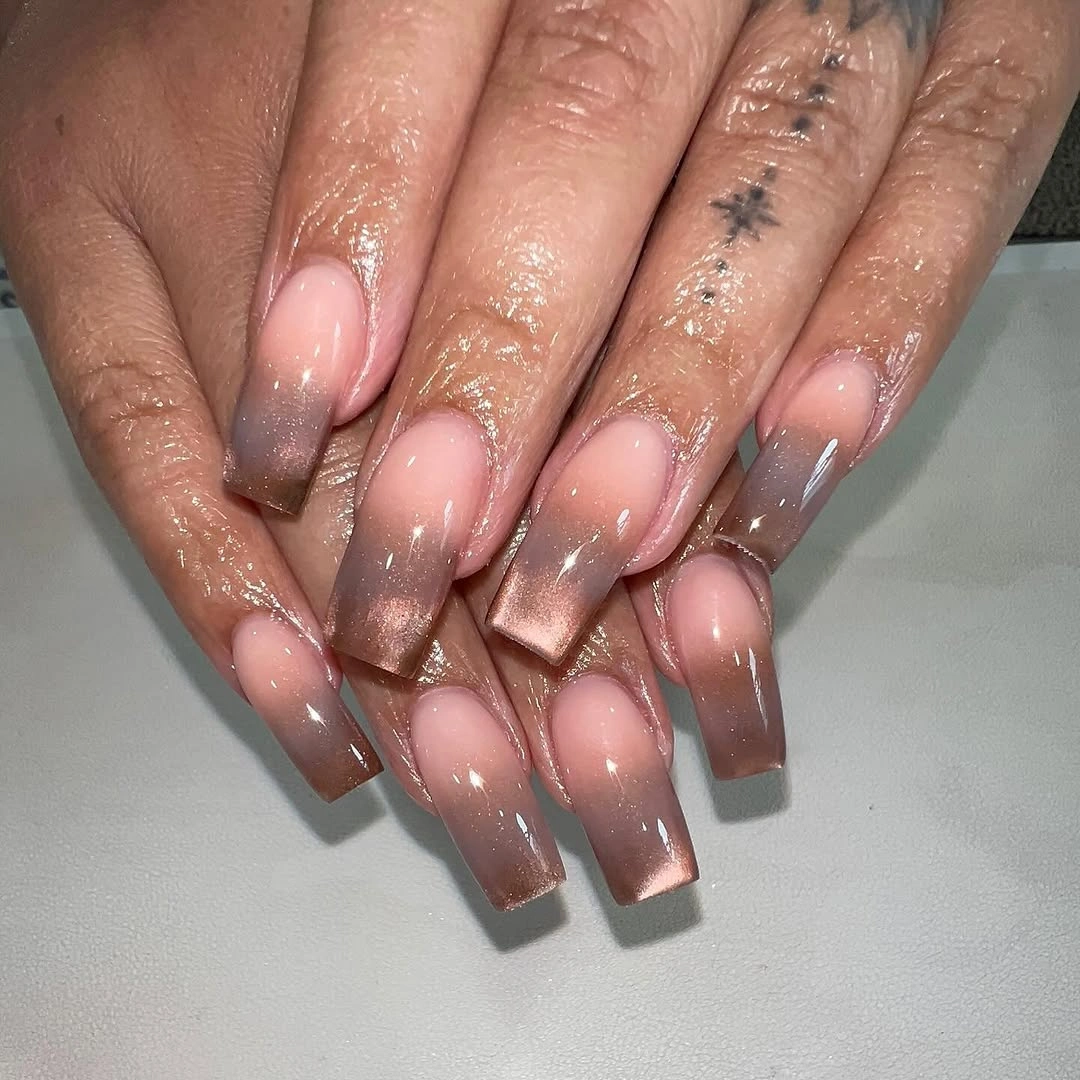
The design works through controlled spacing and contrast. Taupe adds more weight than white, the pink base keeps the result approachable, and the second narrow edge prevents the manicure from feeling flat. A shorter square can preserve the idea by using one taupe panel and one fine lighter line, provided the two widths remain even across the hand.
Neutral geometry looks simple, but clean edge placement becomes especially visible as the manicure grows. That is the realistic maintenance note: the design rewards neat lines and may show uneven spacing sooner than a mottled pattern. In return, it pairs easily with warm knits, metal jewelry, and brighter clothing, giving the medium shape a quiet finish that does not compete for attention.