The short coffin shape solves one problem and creates another: it gives the nail a crisp outline, but it leaves less room for detail to hide mistakes. When a line is too wide or an accent lands in the wrong place, the whole manicure can look crowded. The most useful starting point is not a color trend but the amount of visual pressure the shape can carry.
That makes the first decision surprisingly practical. Decide whether you want the edge to lengthen the nail, the surface to soften it, or one accent to pull the eye away from an uneven proportion; then remove anything that does not support that job. A short coffin set looks intentional when its empty space is protected, not when every nail is asked to perform.
Matte Peach Makes a Short Shape Feel Soft
The first manicure is intentionally quiet: every visible nail is a muted peach-beige with a soft matte surface and a short tapered-square outline. That warm nude undertone does the seasonal work without relying on a literal motif, while the clean silhouette gives the fingers a neat finish. The dark green sleeve behind the hand creates contrast, but the manicure itself stays focused on proportion and calm color.
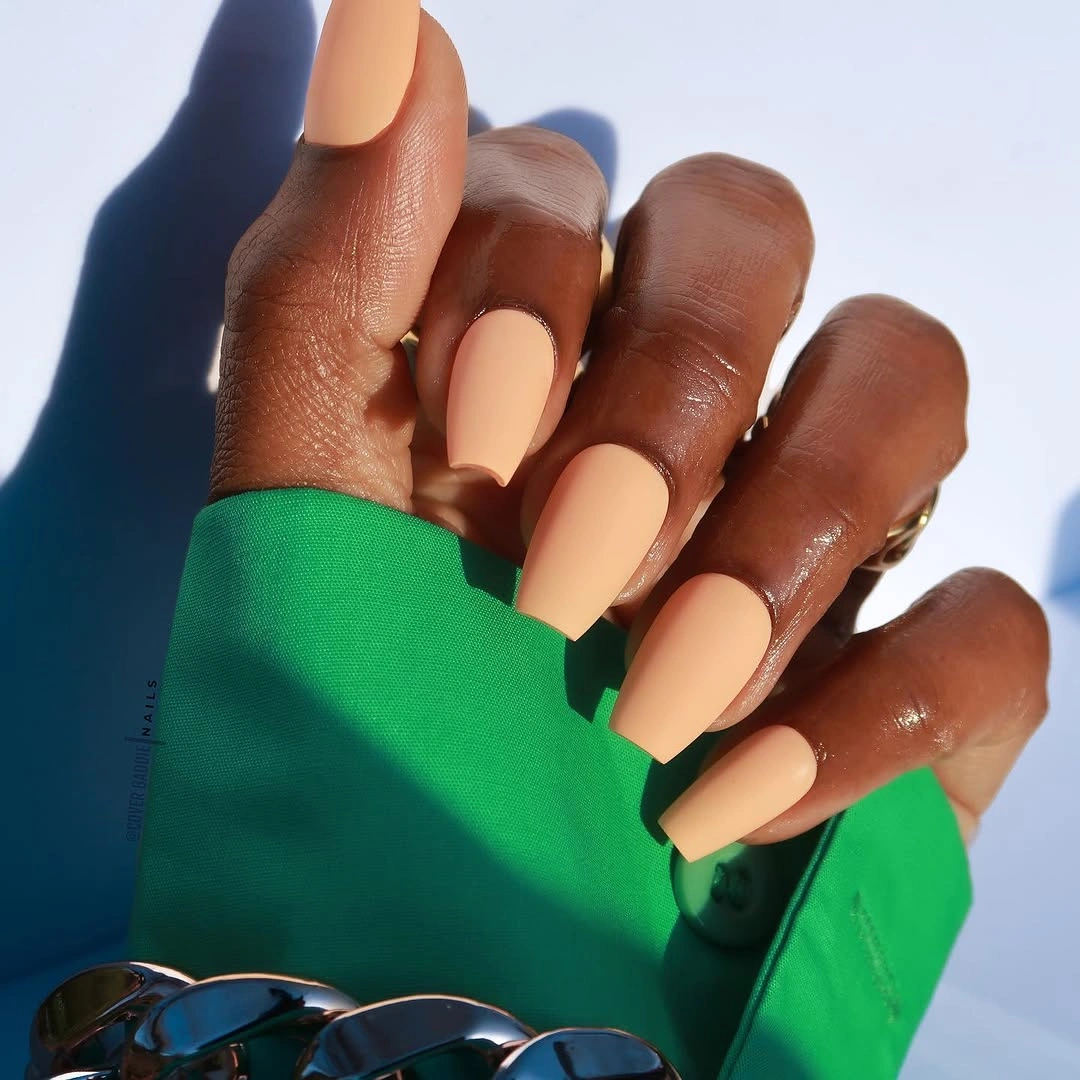
A matte nude like this works because the surface and the shade pull in the same restrained direction. There is no glossy reflection competing with the warm peach, so the eye notices the even edge and the compact length first. If the color looks too close to your skin tone, a slightly rosier or deeper peach can preserve the same soft relationship while making the nail outline easier to see.
Keep the finish smooth and the color placement clean if you want this idea to remain minimal. Matte surfaces can make dryness or uneven texture more noticeable than a glossy top layer, so the practical tradeoff is visual softness in exchange for less forgiving reflection. A short coffin shape keeps the look grounded; adding extra art would remove the very breathing room that makes the nude feel considered.
Small Warm Accents Wake Up a Nude Base
Here the short nude base is interrupted by small graphic decisions rather than a full painted pattern. White and warm red-brown lines, tiny square blocks, and clustered dots appear on selected nails, leaving enough sheer space around them to keep the manicure readable. The compact tapered shape matters because the details are placed as accents, not stretched into long decorative panels.
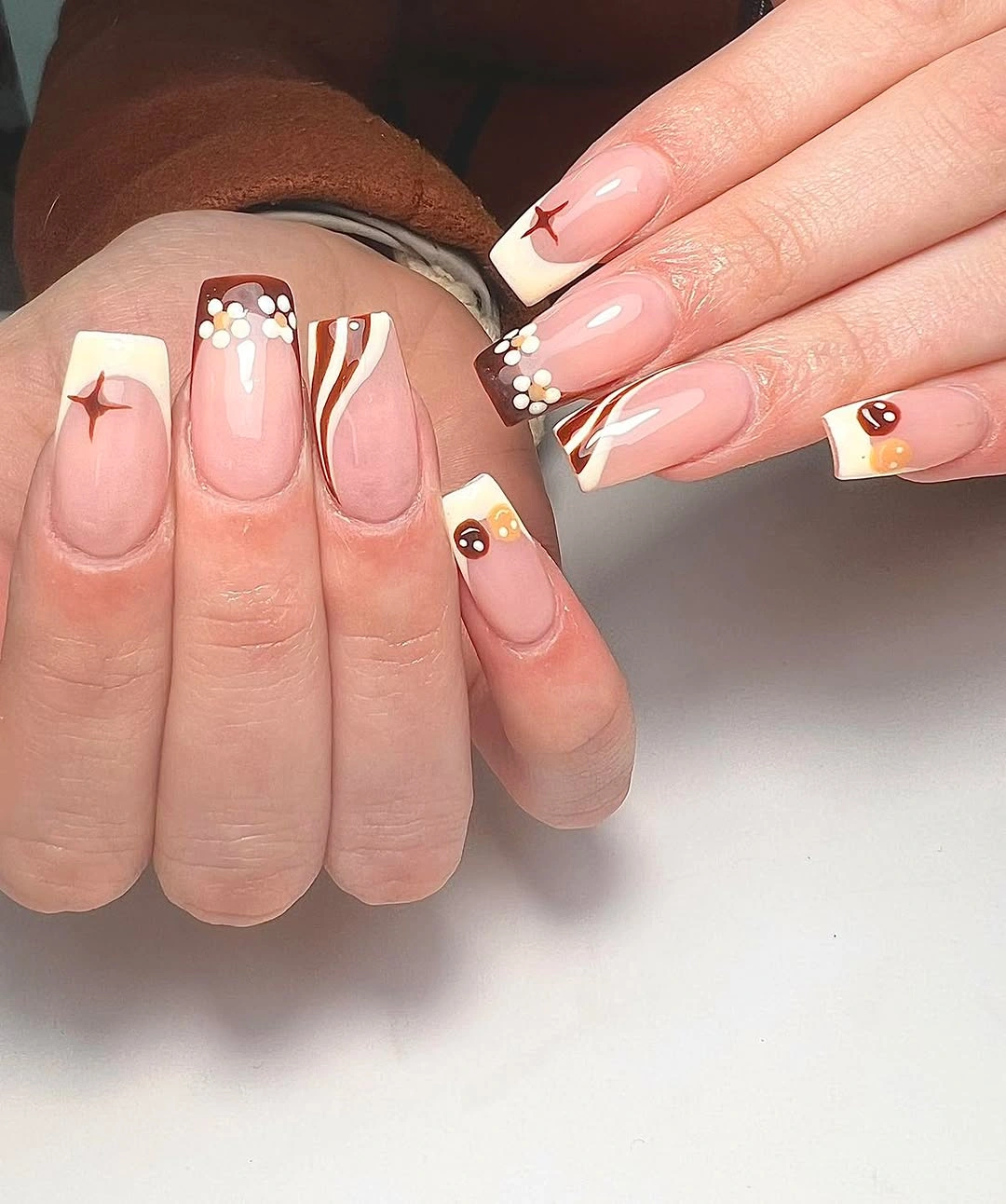
The design holds together through repetition of small marks, even though every finger does not carry the same motif. A dot cluster gives one nail a concentrated center, while a narrow line or block acts more like punctuation near the edge. That uneven distribution keeps the neutral base visible and makes the set feel planned rather than busy, a useful approach when you want short coffin nails with personality but not a dense illustration.
For a shorter or simpler version, keep the dot cluster on one accent nail and repeat only the warm line on two others. Tiny details need enough clear surface around them to stay recognizable, so shrinking every mark can make the manicure look muddy instead of delicate. The strongest adaptation is subtraction: preserve the contrast between nude space and a few warm signals, then let the compact shape do the rest.
Cool Gray-Lilac Finds Its Focus in Glitter
This short rounded-square manicure uses a cool gray-lilac on most nails and places fine silver glitter on one visible accent. The color is soft rather than bright, and the glossy surface gives the compact shape a polished outline without adding another motif. Because the glitter is concentrated instead of spread across every finger, it reads as a deliberate change in texture rather than a competing theme.
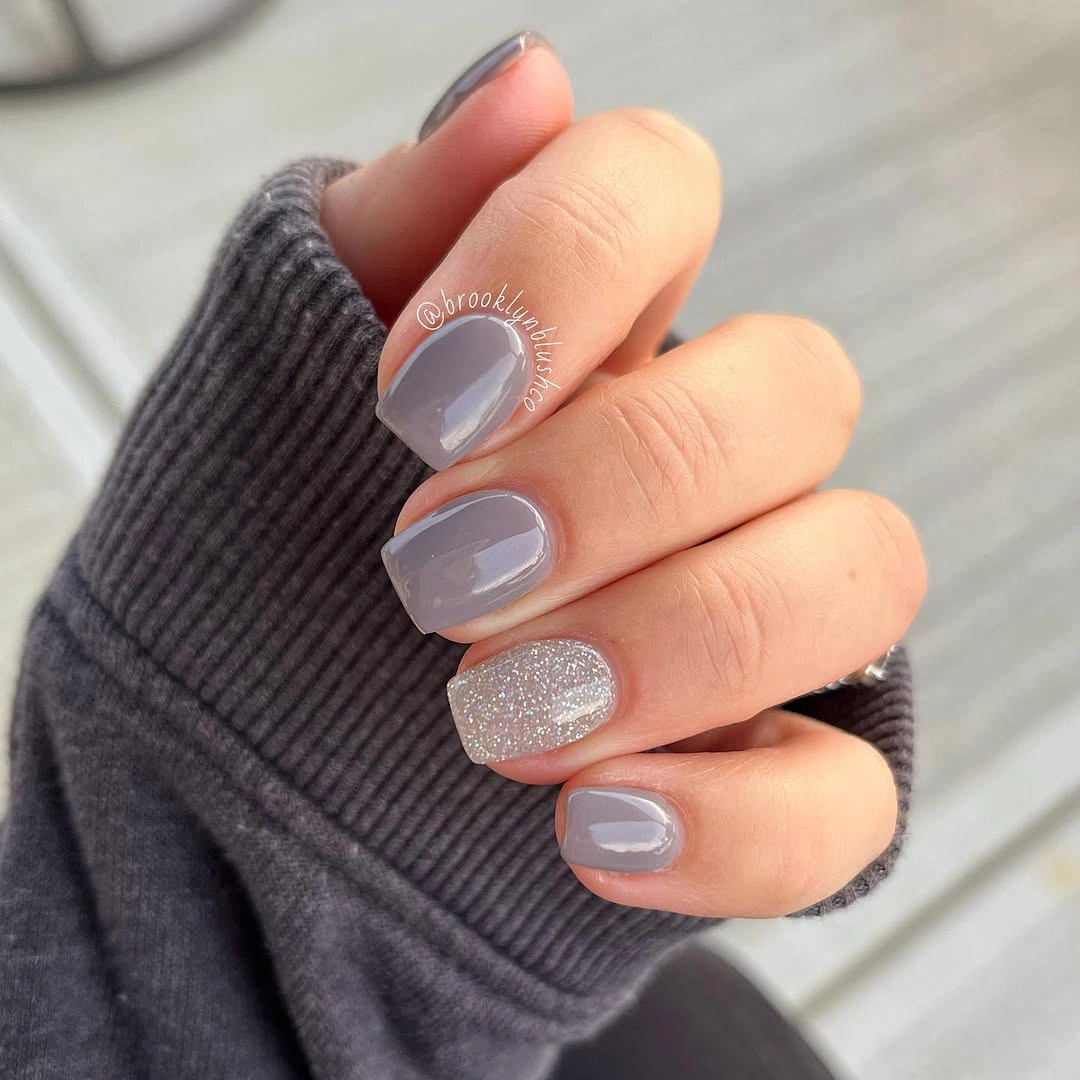
The isolated sparkle works as a visual stop inside an otherwise even color field. Gray-lilac can look flat when every nail has exactly the same surface, but a single fine glitter accent creates depth while keeping the palette cool and controlled. It is also a useful way to test square fall nail designs with a more decorative finish: the eye can compare the quiet creaminess of the solid nails with the reflective accent immediately beside them.
Keep the glitter fine if you want the result to stay close to this compact, wearable proportion. Chunkier particles or full coverage would shift the balance toward occasion dressing and could make a short nail look more crowded as it grows. A shorter rounded square can carry the same idea easily, provided the accent remains isolated and the gray-lilac is allowed to remain the main field.
Red Curves Leave Room for the Base to Breathe
The next manicure builds its identity from bright red curved strokes over a pale translucent base. The lines bend around the tips and side areas, creating abstract movement without covering the whole nail, while the short shape keeps that movement close and graphic. The visible contrast is strong, but the open background prevents the red from becoming a solid block that would visually compress the length.
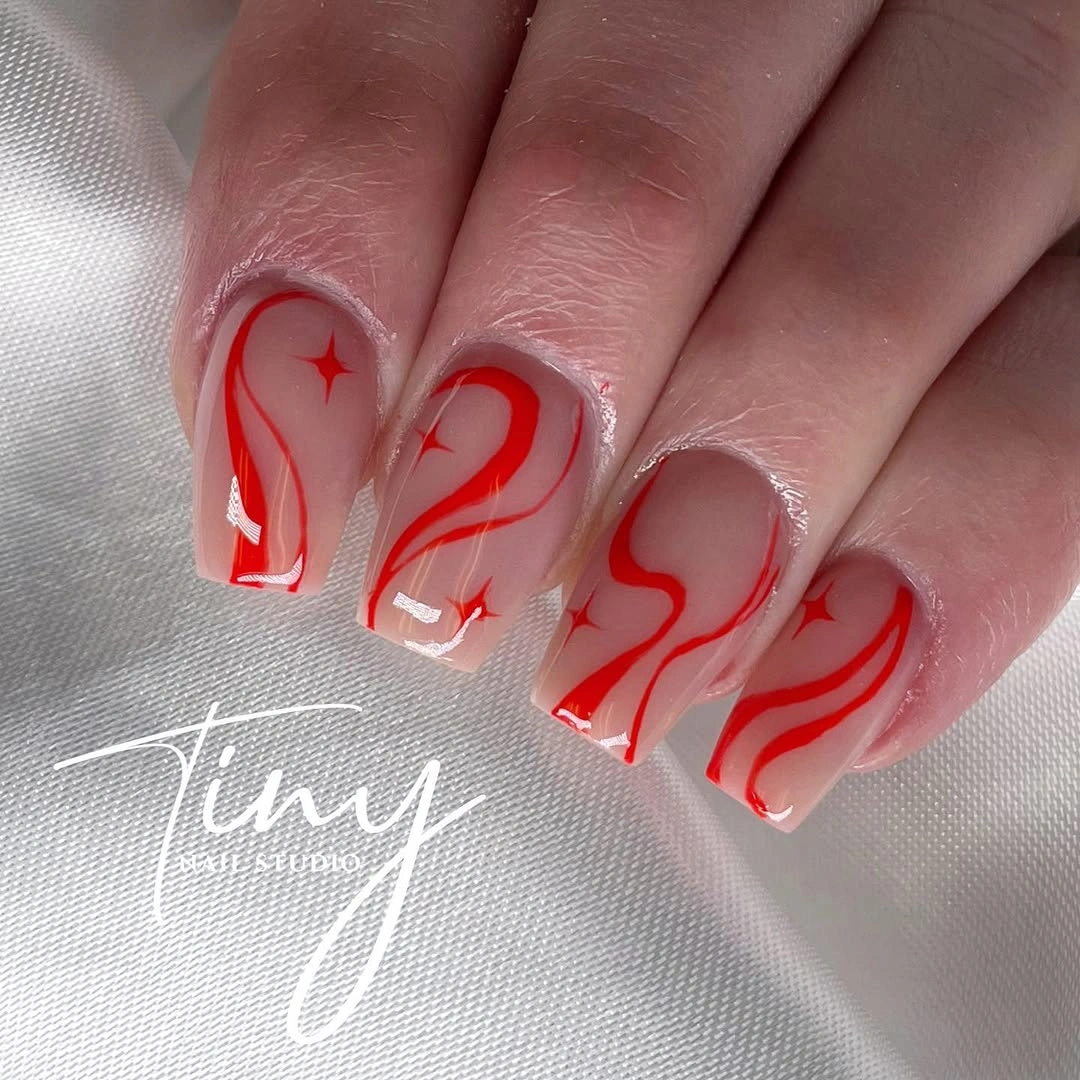
What makes the line work effective is the spacing between the curves. Each red path remains legible, and the pale center gives the eye a place to pause before following the next bend. That relationship is more important than copying every loop exactly; a similar design can use fewer strokes and still feel intentional if the lines have room around them and the red remains the clear focal color.
On a very short coffin nail, reduce the number of loops rather than forcing them into narrow strips. One clean curve near a tip or sidewall will preserve the idea, while too many turns can merge into an indistinct red patch. The open base also offers a practical advantage: small growth at the cuticle is less visually disruptive than it would be on an opaque full-color set, although the fine lines still benefit from careful placement.
Yellow Blocks and Stripes Create Immediate Contrast
Vivid lemon yellow gives this set its first strong burst of color, while other short square nails use narrow black-and-white vertical graphics with thin yellow details. The solid yellow fingers act as visual anchors, and the striped fingers add direction without changing the compact outline. Together they make a high-contrast fall interpretation that is energetic because the color blocks and line work are kept clearly separate.
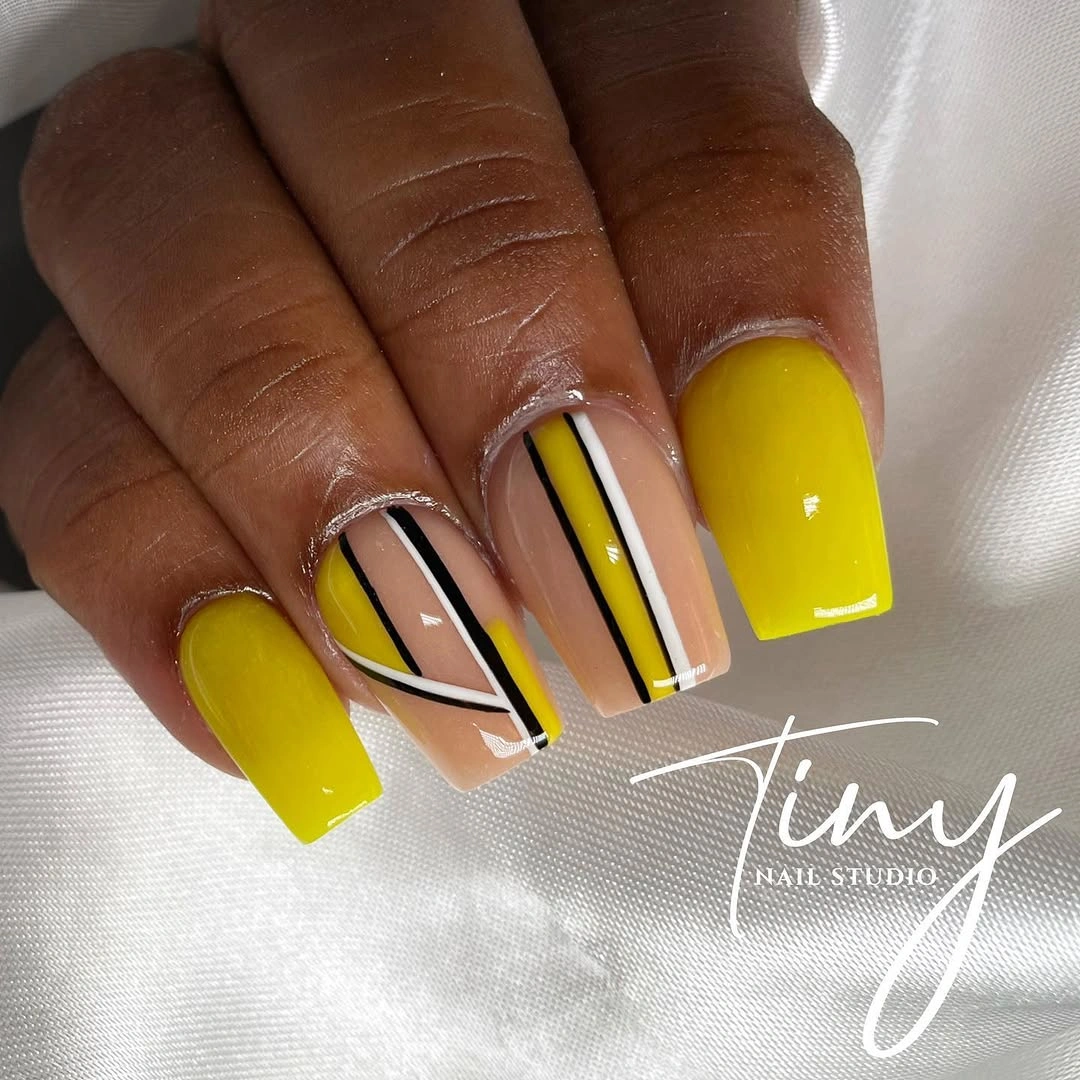
The vertical stripes are doing more than decorating the surface: they create a lengthening direction on a short nail. Black and white provide the strongest contrast, while yellow repeats the color from the solid nails and keeps the mix from splitting into unrelated halves. This is why the manicure can be loud without looking random; the eye moves between a block of yellow and a narrow graphic field linked by the same accent tone.
If the full combination feels too vivid for daily wear, keep yellow on two nails and use the black-and-white pattern on one accent finger. A shorter coffin shape will still benefit from the vertical direction, but the stripe spacing needs to stay generous so individual lines do not collapse. The honest tradeoff is intensity: this palette will command attention, so simplifying the number of graphic nails changes the mood more effectively than merely choosing a paler yellow.
Irregular Gold Edges Make Nude Space Look Designed
These short softly squared nails use a translucent nude base and thin metallic-gold fragments that trace irregular borders near the tips and edges. The lines are not a uniform French band, which gives the manicure a more abstract rhythm while keeping much of the base uncovered. That placement is the defining decision: the gold supplies structure, but the nude space remains large enough to keep the result light.
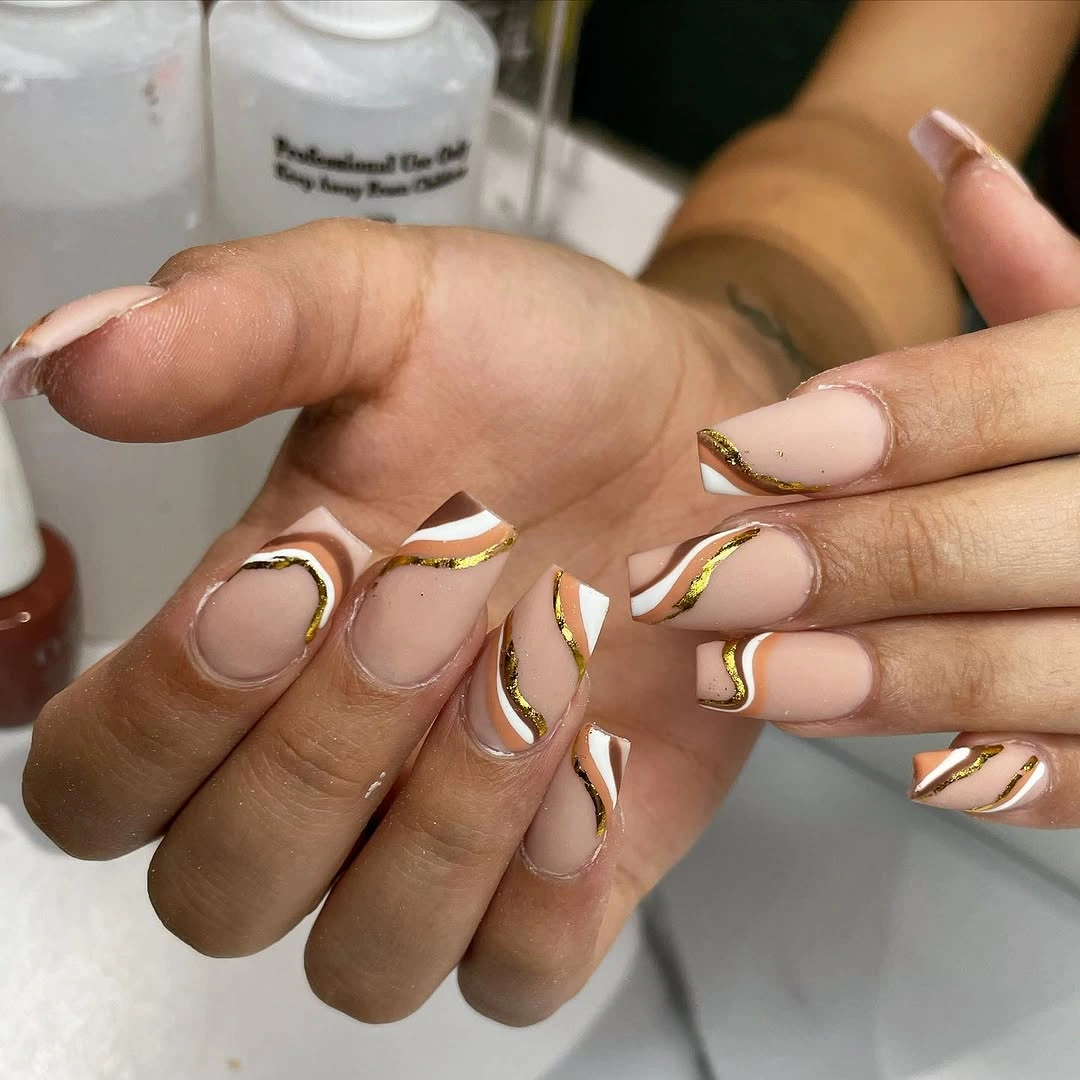
Gold edging works here because it follows the perimeter instead of filling the center. The eye reads the shape of each nail first, then notices where the metallic line breaks or changes direction, so the detail feels connected to the silhouette. A warm metal also echoes the peach and brown family already present in the collection without turning this manicure into a solid autumn color.
Keep the fragments uneven and separated when adapting the design. A completely outlined nail would lose the negative-space effect, while a heavy metallic border could visually shorten the compact shape. One or two broken gold paths are enough to make a nude base look deliberate, and the sparse placement gives the manicure a little more tolerance for grow-out than a precise full-coverage graphic would have.
Fine Sparkle Gives Pink Nude a Quiet Lift
This manicure stays close to a warm pink nude, then adds a soft champagne-like sparkle to selected tips or accent areas. The nails are short and rounded, so the color remains the main statement and the shimmer behaves like a change in surface rather than a separate illustration. It is a gentler turn than the gold line work, with less edge definition and more light catching through the finish.
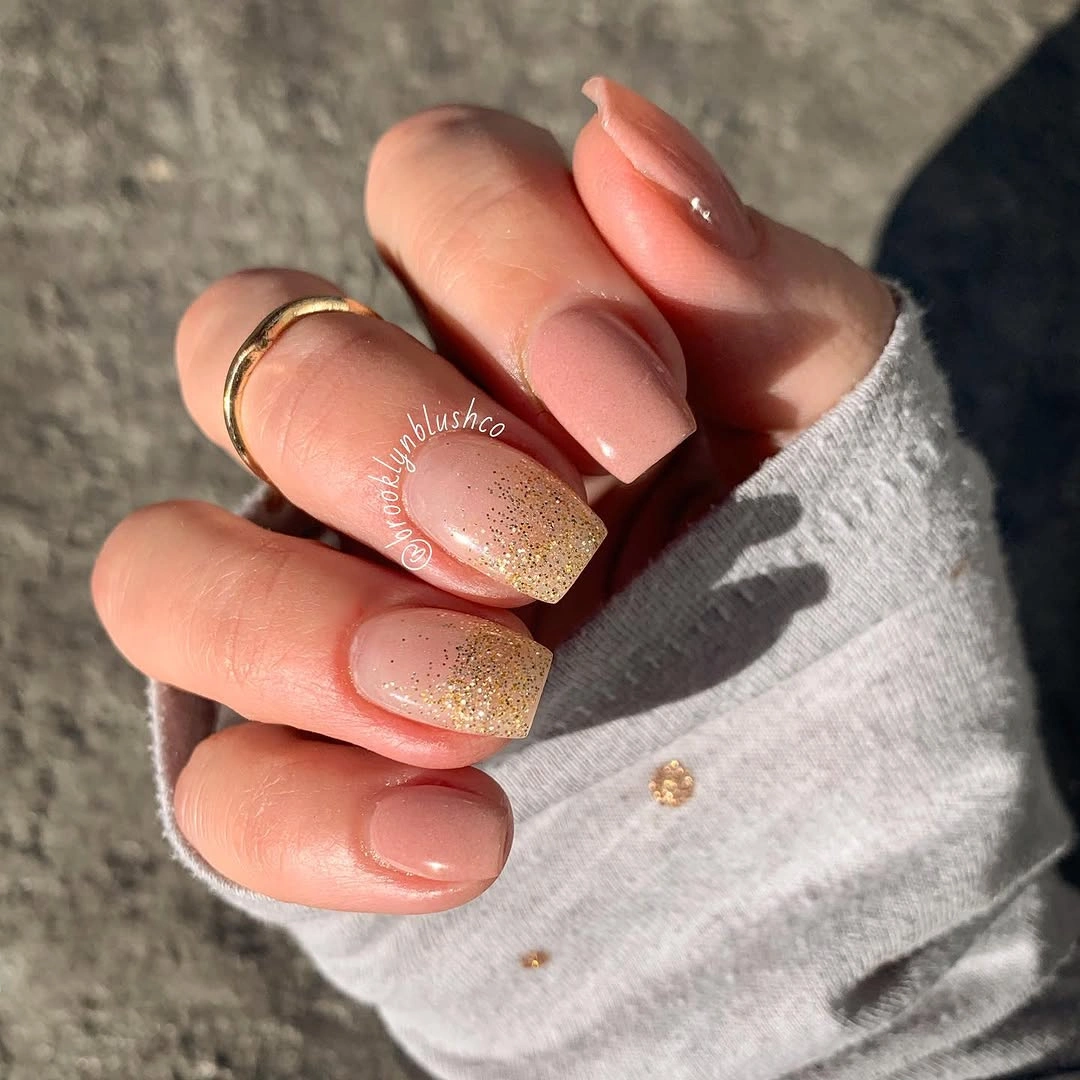
The restrained sparkle succeeds because it is fine enough to sit inside the nude palette. It gives the plain base a little evening interest without creating a hard focal point that would compete with the short shape. This is a useful distinction when planning simple fall short nails: decoration can come from texture and reflection, not only from motifs, lines, or contrasting blocks.
For an even cleaner version, keep the shimmer on one nail and leave the rest glossy pink nude. Fine particles are easier to blend into the base than a large glitter pattern, but they can still look uneven if the accent is applied too close to the edge. The compact length is an advantage here because the design asks for very little surface area; the practical limit is simply keeping the sparkle intentional rather than scattered.
Olive Green Carries the Set Without Extra Art
A glossy olive or moss green covers these short rounded-square nails from edge to edge. The shade is saturated enough to make the compact shape visible, yet muted enough to sit naturally within a fall palette, and the simple finish keeps the manicure from becoming decorative for its own sake. Jewelry and a white sleeve add context around the hand, but the nail decision is entirely the depth of the green.
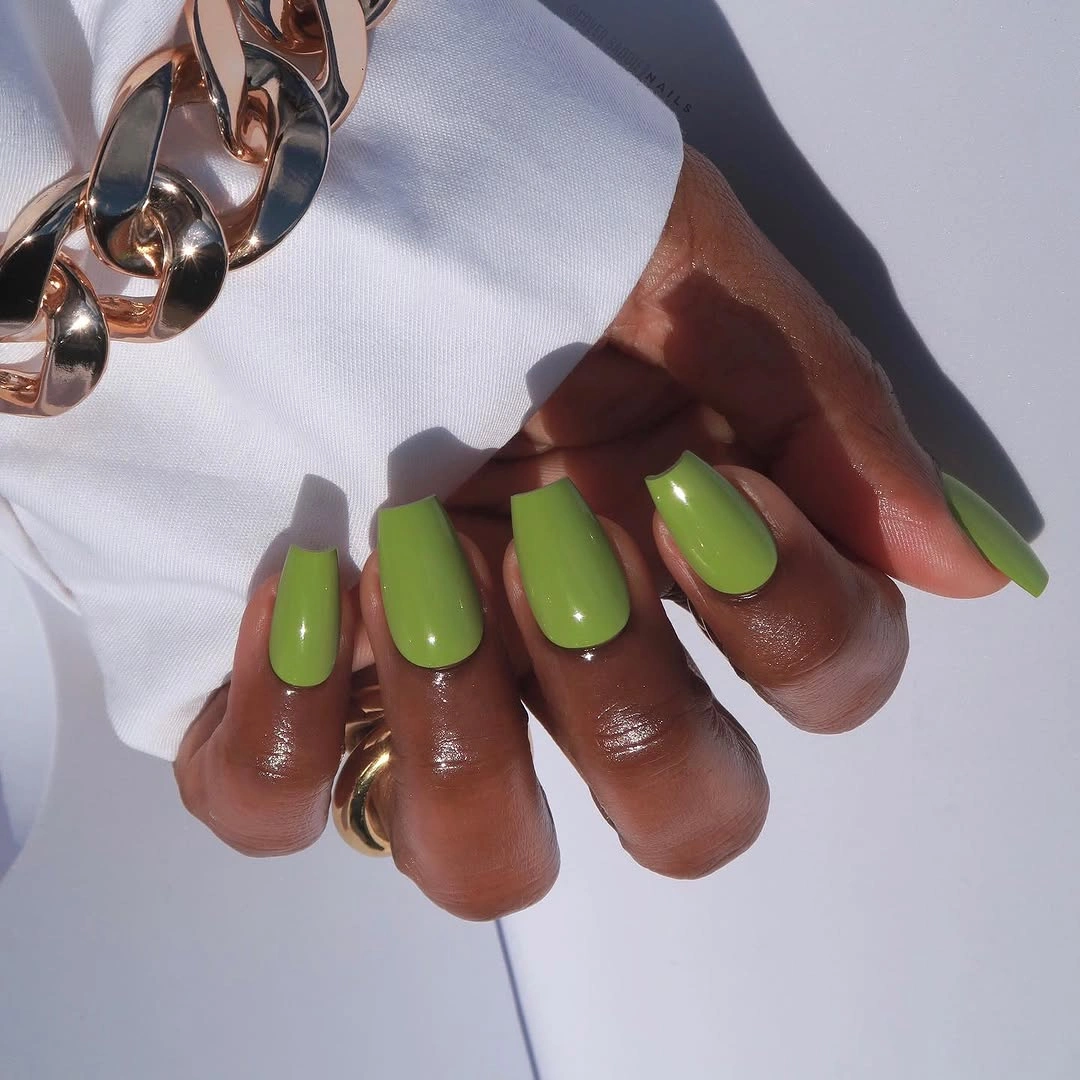
Solid olive works because it combines color presence with visual restraint. Unlike a bright primary shade, the green has a softened undertone that makes a full set feel grounded, while the glossy surface keeps the edges crisp. It is also a good reminder that short coffin nails do not need a motif to look complete; a thoughtful shade can provide the focal point if its undertone and finish are allowed to stay uninterrupted.
If a full olive set feels stronger than you want, use it on two or three nails and leave the others sheer nude or warm beige. That keeps the color relationship visible without making every finger carry the same weight. The main limitation is tonal: olive can shift greener or browner under different light, so checking the shade in daylight helps preserve the muted balance seen here.
Pale Blue French Edges Keep the Shape Airy
This short manicure combines pale sky-blue color with a nude base and crisp light tips. Some nails carry more blue, while others read closer to a French edge, but the rounded compact outline remains consistent and glossy. The cool color introduces a fresh pause after the olive set, and the partial coverage keeps it from becoming a heavy block on a small surface.
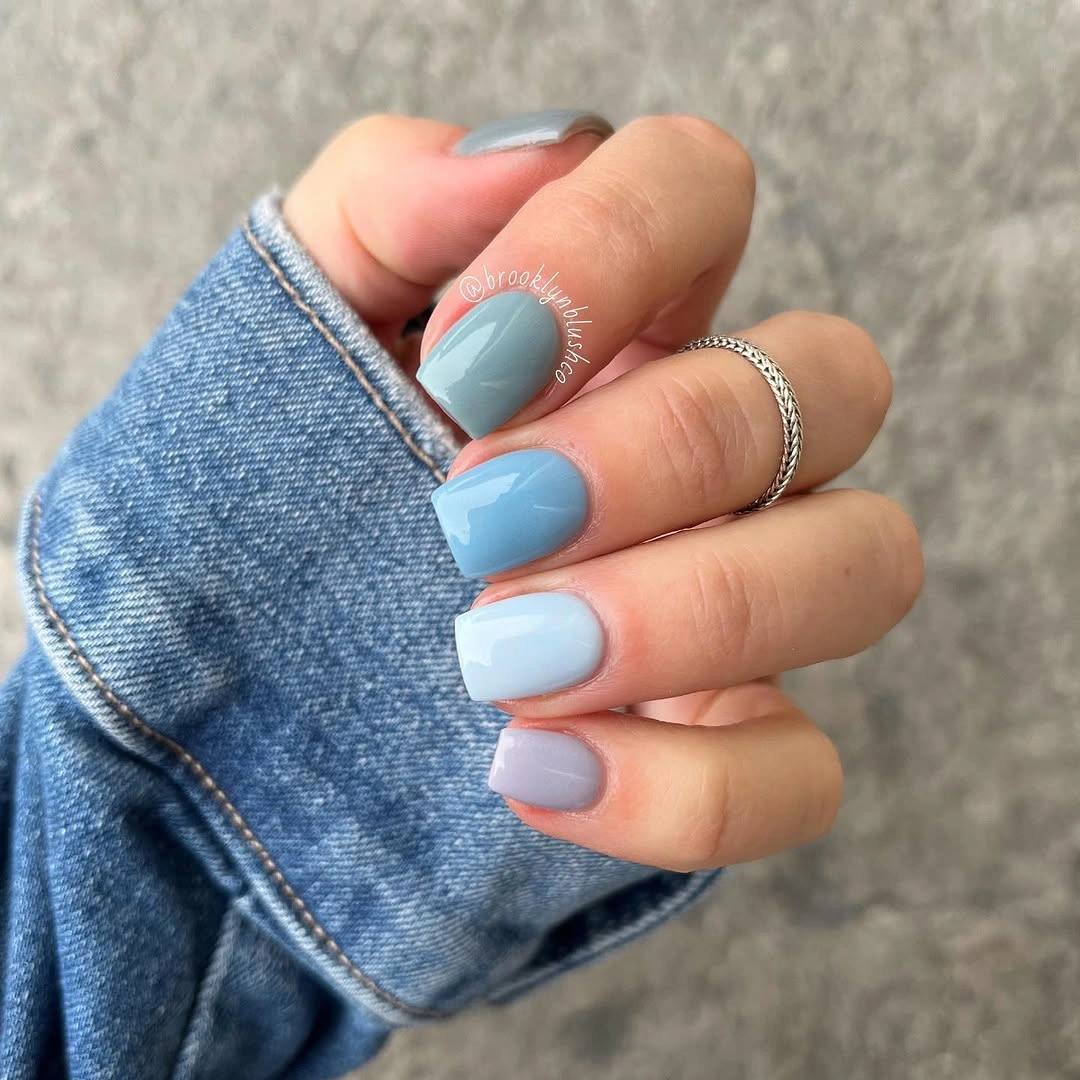
The blue works because it is placed in controlled sections rather than spread evenly across every nail. Nude space softens the contrast, and the lighter edge follows the curve of the nail so the design feels connected to its shape. A similar idea can lean more minimal by using one thin blue line per nail, or more colorful by making two fingers fully blue while keeping the others open.
When the nail bed is shorter than the reference, a narrow blue French edge is the safest adjustment. A wide tip can make the nail look visually shorter, especially when the blue is cool and saturated against a pale base. Leave the center clear and let the curve do the work; the result will keep the airy relationship between blue, nude, and the compact coffin outline.
A Crisp White French Tip Changes with Length
The white French manicure in this example has a longer, narrow tapered silhouette than most of the surrounding examples. A sheer nude base supports a clean white tip, and the gold ring echoes the small amount of warmth without adding nail art. Because the design is so reduced, the tip width and the way it follows the taper become more important than any decorative detail.
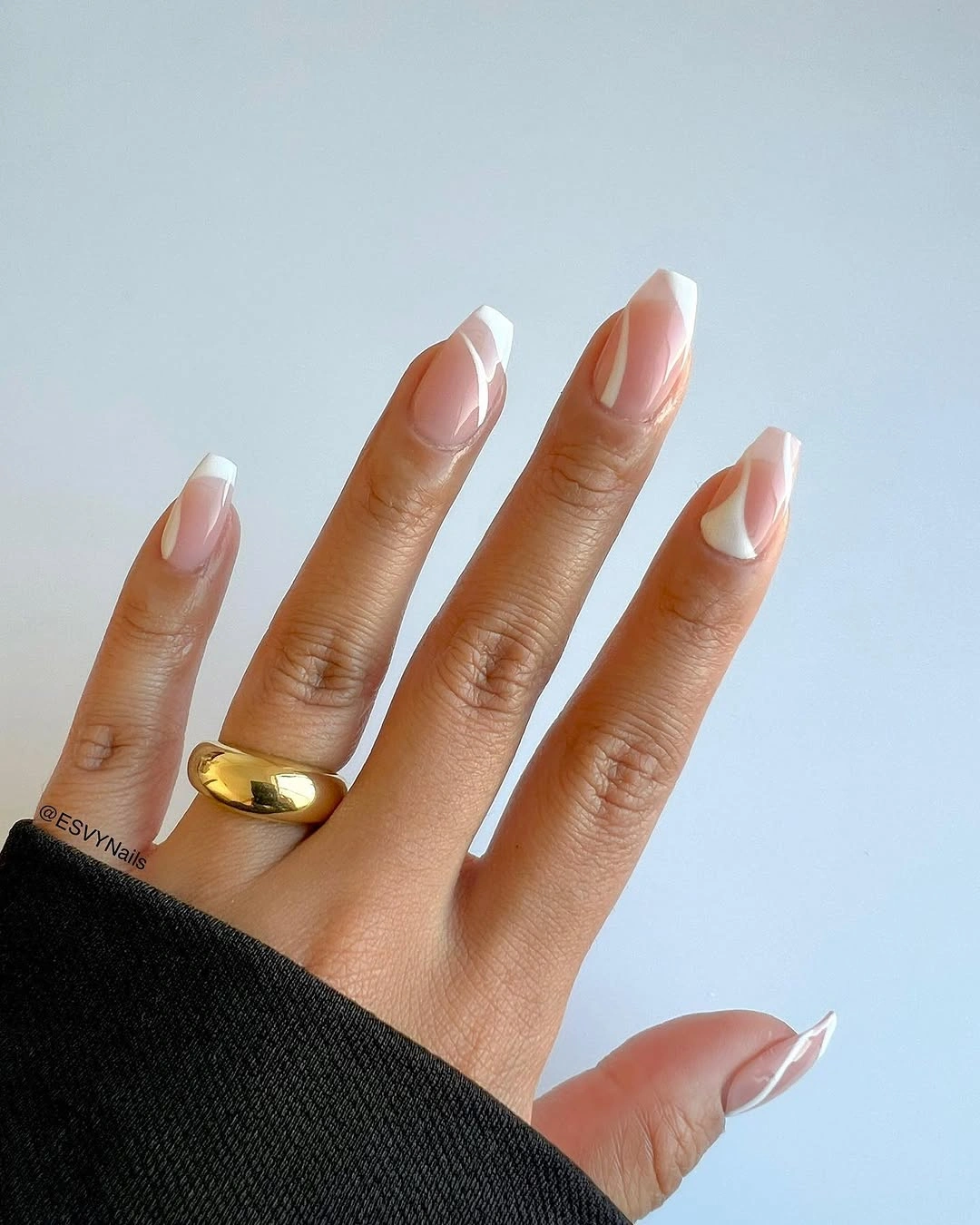
Length gives the white edge more room to curve and keeps the tip from taking over the nail bed. That does not mean the idea belongs only on long nails; it means the proportion needs to change when the canvas changes. On a short coffin shape, a thinner white band will preserve the same crisp contrast while avoiding a broad block that makes the square edge look wider.
The practical strength of a simple French design is its flexibility, but the limitation is precision at the edge. Uneven tips are more visible when there is no other detail to distract the eye, so a shorter version benefits from a clean, deliberately narrow line. Keep the base sheer and the white controlled if the goal is the same lengthening effect rather than a full white statement.
Warm Tip Details Bring an Angular French into Fall
This version keeps a sheer pink base and bright white angular tips, then adds small tan-gold or brown details near selected edges. The medium tapered silhouette gives the tip enough room to form a sharper shape than a rounded French, while the warm accents link the clean contrast to the season without filling the nail. It feels decorative, but the decoration remains concentrated.
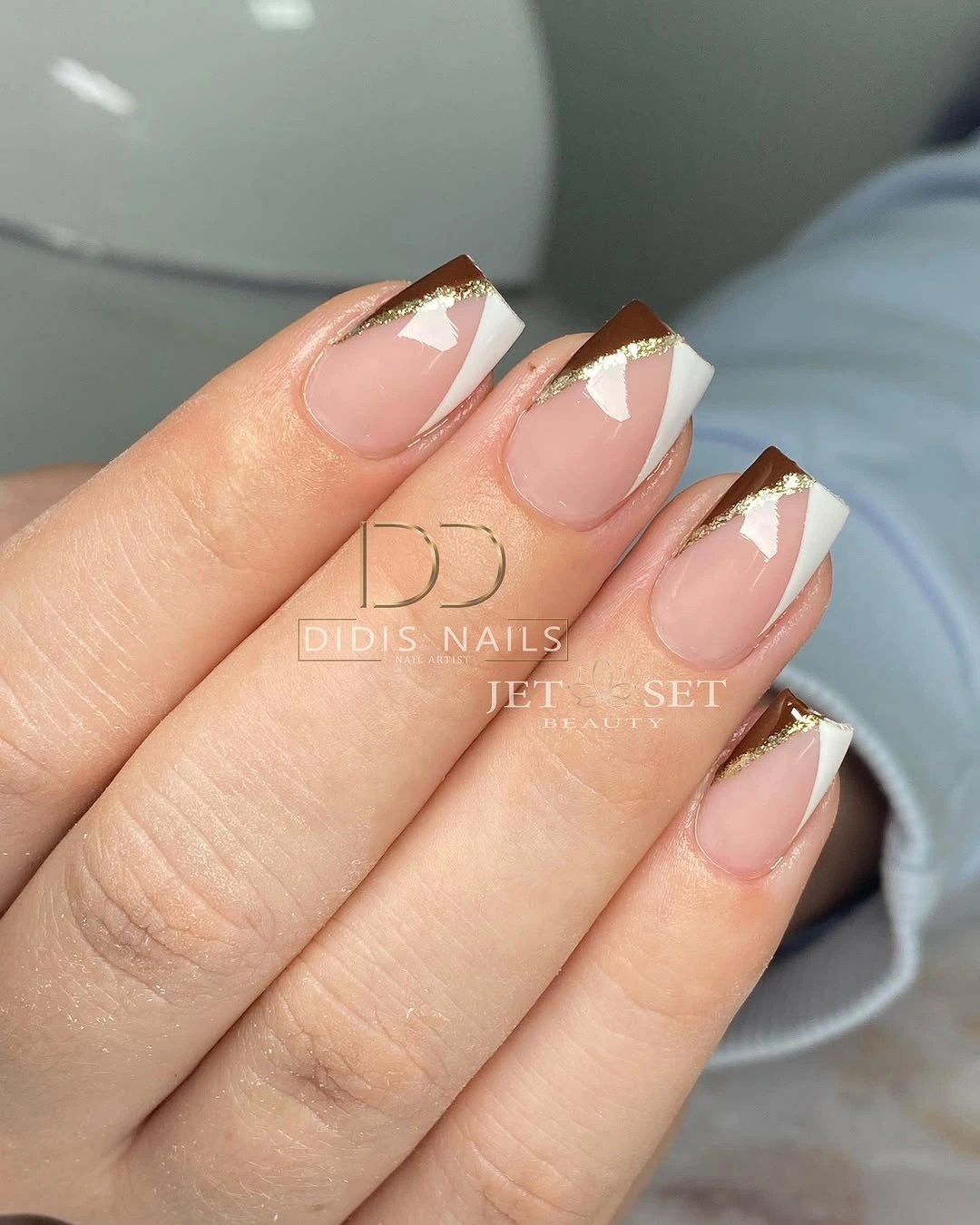
The small warm marks matter because they interrupt the expected white-and-nude pairing just enough to make it specific. They also repeat the warmth found in the peach and gold examples without borrowing their exact line placement. A thin border, a tiny block, or a small warm point can perform the same job as long as the white tip remains the first visual read.
For a short coffin adaptation, narrow the white edge and keep the warm detail close to one corner rather than spreading it across the full tip. Short nails need open areas to show the difference between the base and the tip, and a dense warm band can make the design look heavier than the reference. The most wearable version preserves the angular contrast but removes any accent that does not help define the edge.
Fine Red Lines Add Definition in Low Light
In this darker example, the nails still read as a pale nude base with slim red and warm metallic-looking lines near the tips and side edges. The shape is compact, and the details are delicate rather than broad, so the manicure relies on the contrast between a quiet field and a few concentrated marks. The warm lighting changes the mood, but it does not turn the design into a dark full-color set.
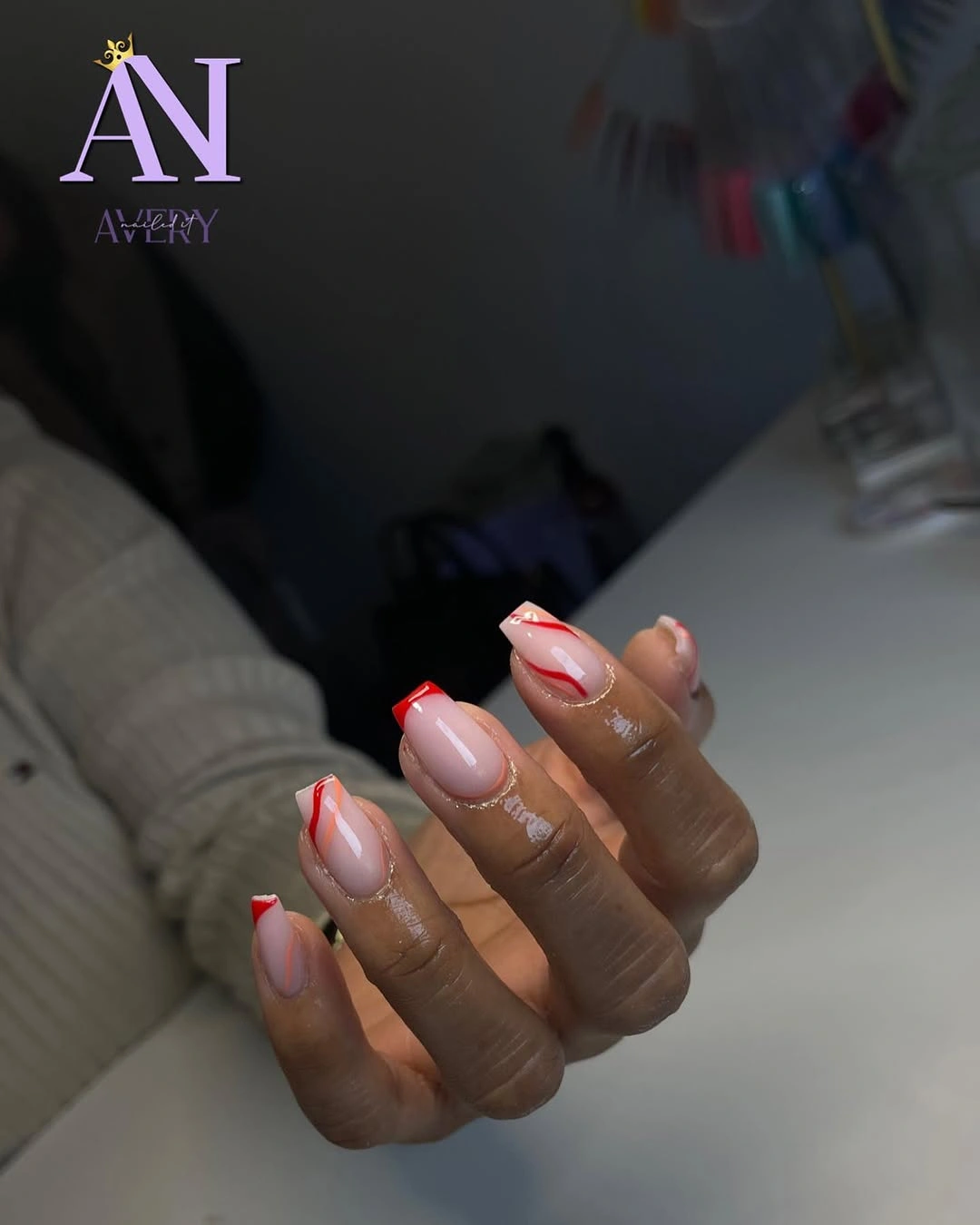
Low-density line work is useful when you want a graphic idea that remains calm. The red strokes give the eye a route around the nail, while the nude center keeps the design open and prevents the short silhouette from looking compressed. Because the lines are separated, the manicure can carry a little visual detail without needing long tips or a large central motif.
Keep each stroke thin and leave a visible gap between neighboring marks when recreating the balance. Broad dark bands would change the proportion and make the nails look shorter, while too many tiny lines could disappear under different lighting. A cautious approach is to use one warm line near the tip and one near the side on only a few nails, preserving the quiet contrast that defines the reference.
Red and Black Graphics Need Room to Separate
This is the most dramatic manicure in the first collection: longer squared nails combine glossy black and vivid red with curved graphic shapes and small heart-like details. The colors are high contrast, and each nail has a clear focal area, but the length provides room for the red and black fields to stay distinct. The design is not merely a color choice; it is a commitment to bold motif density and a longer silhouette.
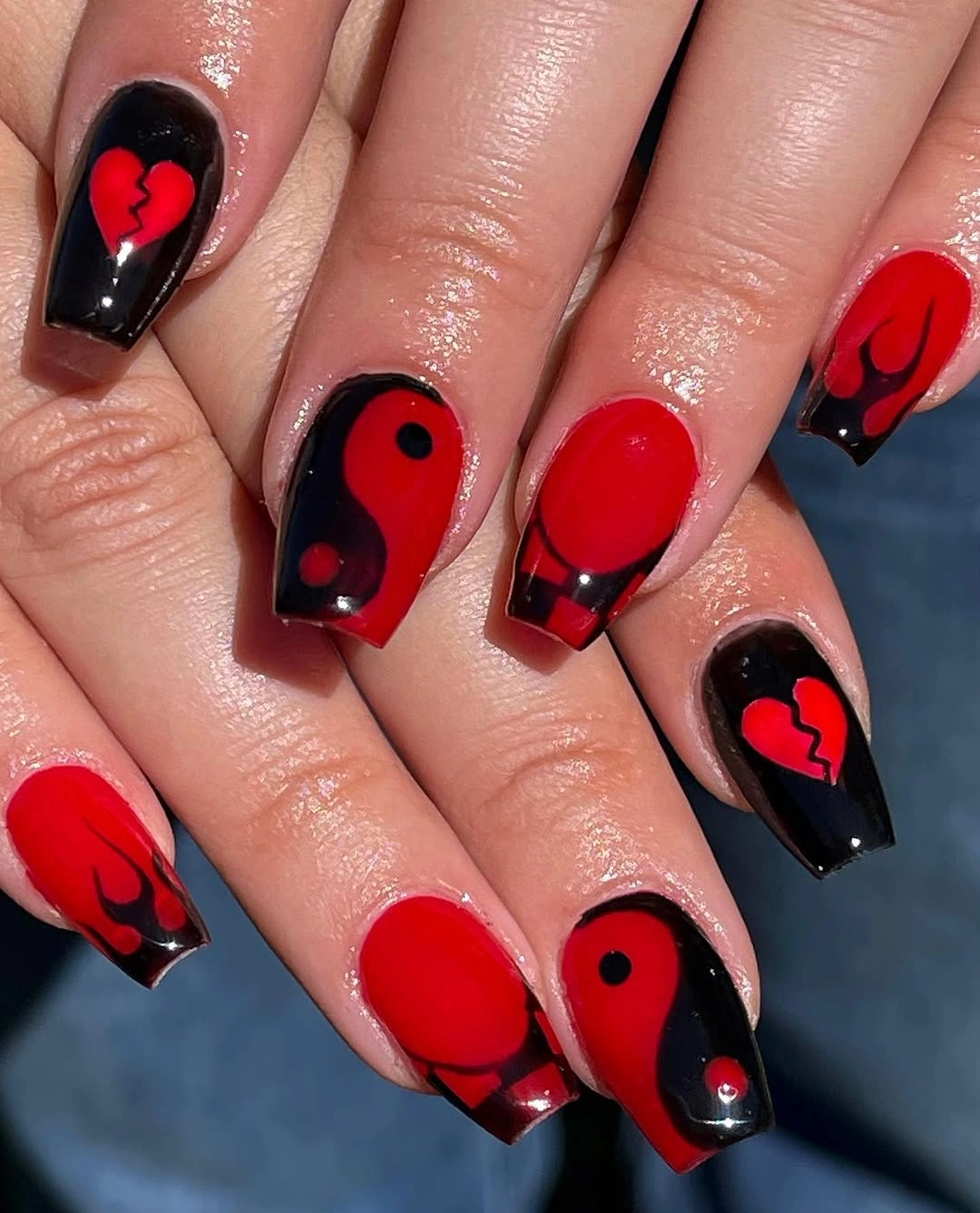
The strongest feature is the way red becomes an active shape against black rather than a simple accent stripe. Curves and dark borders create a sense of movement, while the repeated palette ties the different fingers together. On a shorter nail, the same relationship can survive if the graphic is moved to two accent nails and the rest are made solid red or black.
Shortening this design requires selective editing, not a smaller copy of every mark. Keep one red curve or heart-like detail where the nail has the most room, and remove secondary borders that would merge at a compact scale. The honest tradeoff is that the reference feels theatrical because of both contrast and length; reducing either one will make the result more wearable but also less intense.
Glossy Lilac Lets the Silhouette Speak
Long tapered nails in a uniform lavender-lilac shade create a calmer statement than the red-and-black graphics, even though the length remains noticeable. The color is glossy and largely undecorated, so the pointed outline becomes the main design element. There is no visible motif to distract from the relationship between the cool shade, the long shape, and the smooth repeated finish.
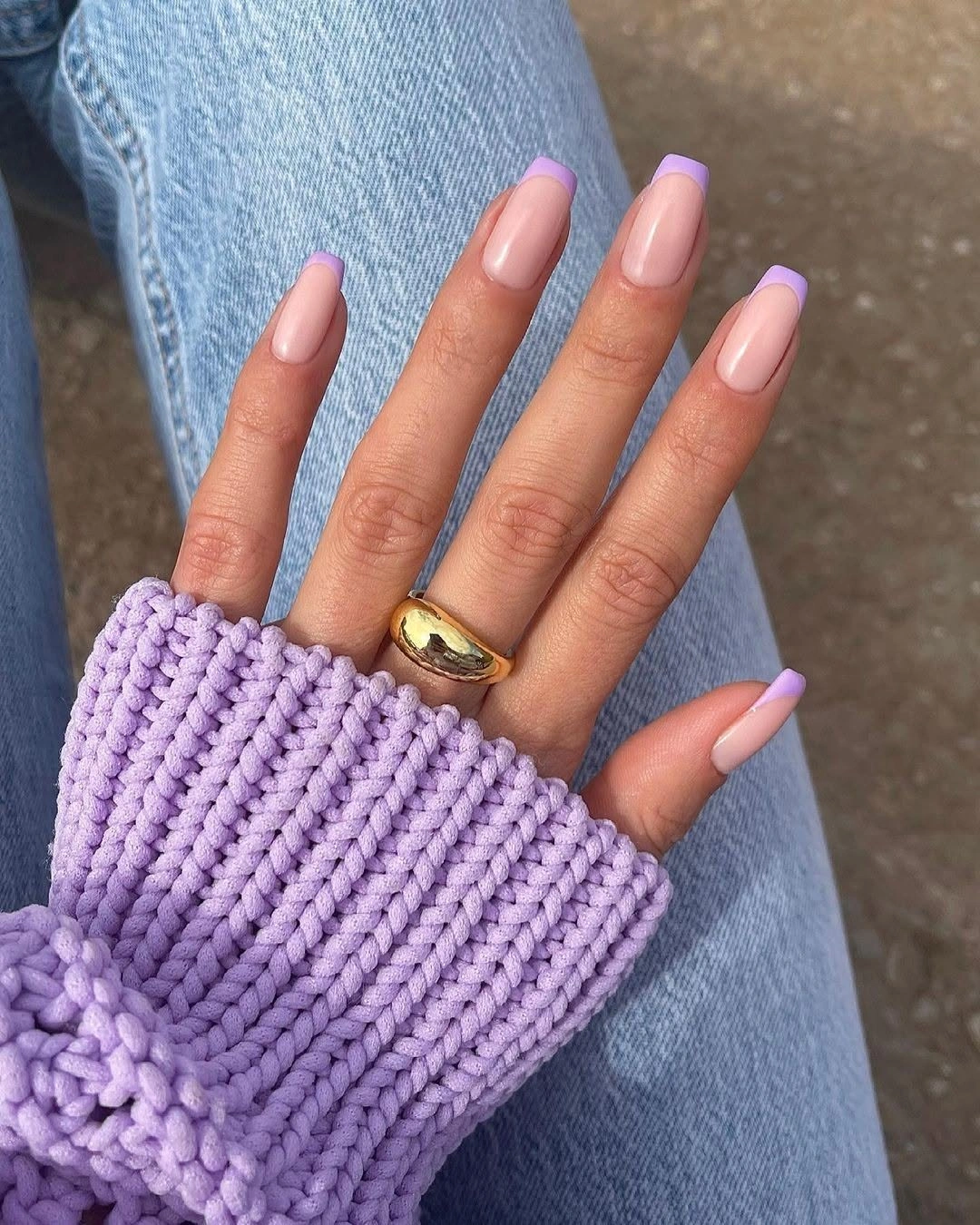
A single color can look deliberate when the silhouette is consistent from finger to finger. The glossy lilac reflects enough light to show the taper, while the lack of contrast details gives the eye a clear uninterrupted path along each nail. This is a useful option for someone who wants a fall manicure with color presence but does not want to manage line art, glitter placement, or multiple accent decisions.
If the length feels impractical, shorten the taper before changing the color. A medium almond or softly rounded shape will keep the lavender mood while reducing the maintenance implication of a long pointed tip. The key is not to add decoration to compensate for less length; the clean surface is what allows the lilac to feel composed rather than unfinished.
Electric Blue Outlines Make Nude Space Pop
These short rounded nails use a sheer nude center with bright cobalt-blue curved tips and tiny blue dots on selected fingers. The blue is much more saturated than the base, but it is restricted to the outline and a few small points, so the nude still occupies most of the surface. That distribution gives a compact shape a clear edge without turning the set into full blue color.
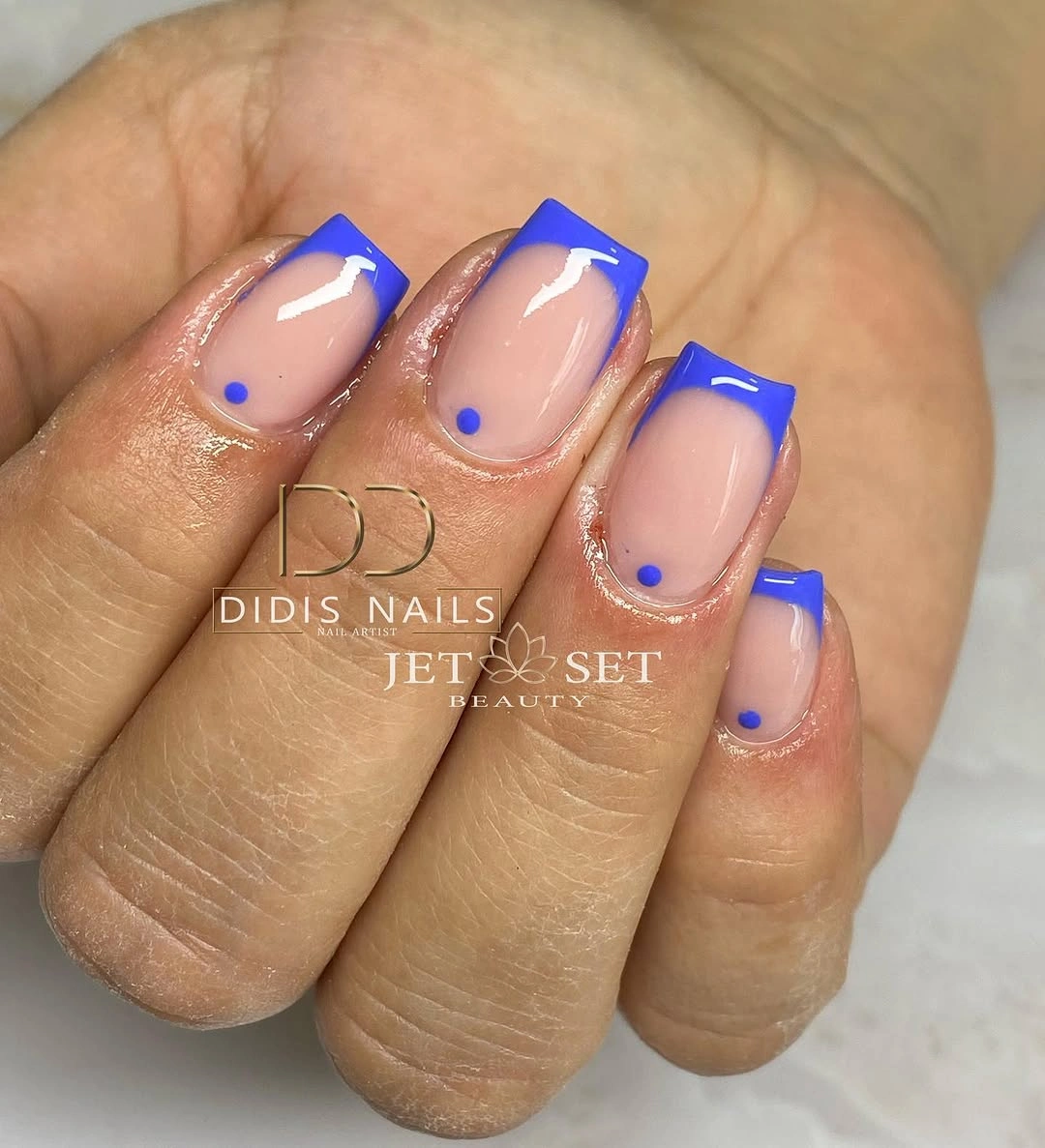
The outline creates a strong visual frame, and the dots act as small echoes of the same color rather than new focal points. Because the center stays pale, the eye can read the nail shape before it notices the blue detail. This is a convincing way to use a bright color on short coffin nails: let saturation provide definition, then use negative space to control the amount.
Keep the blue line narrow and place dots sparingly when adapting the idea. Too much blue near the sidewalls can visually widen the short nail, while too many dots can make the clean frame feel scattered. One curved tip and one small point are enough to carry the concept, especially if the rest of the manicure repeats the same nude base consistently.
Sheer Peach Turns Color into a Watercolor Accent
This manicure starts with a glossy translucent peach or pink base, then places soft blue-lilac patches on selected short squared nails. The accents look irregular and painterly rather than sharply outlined, and small reflective details appear without overtaking the color fields. The result is lighter than a full graphic set because the transparent base remains visible through the design.
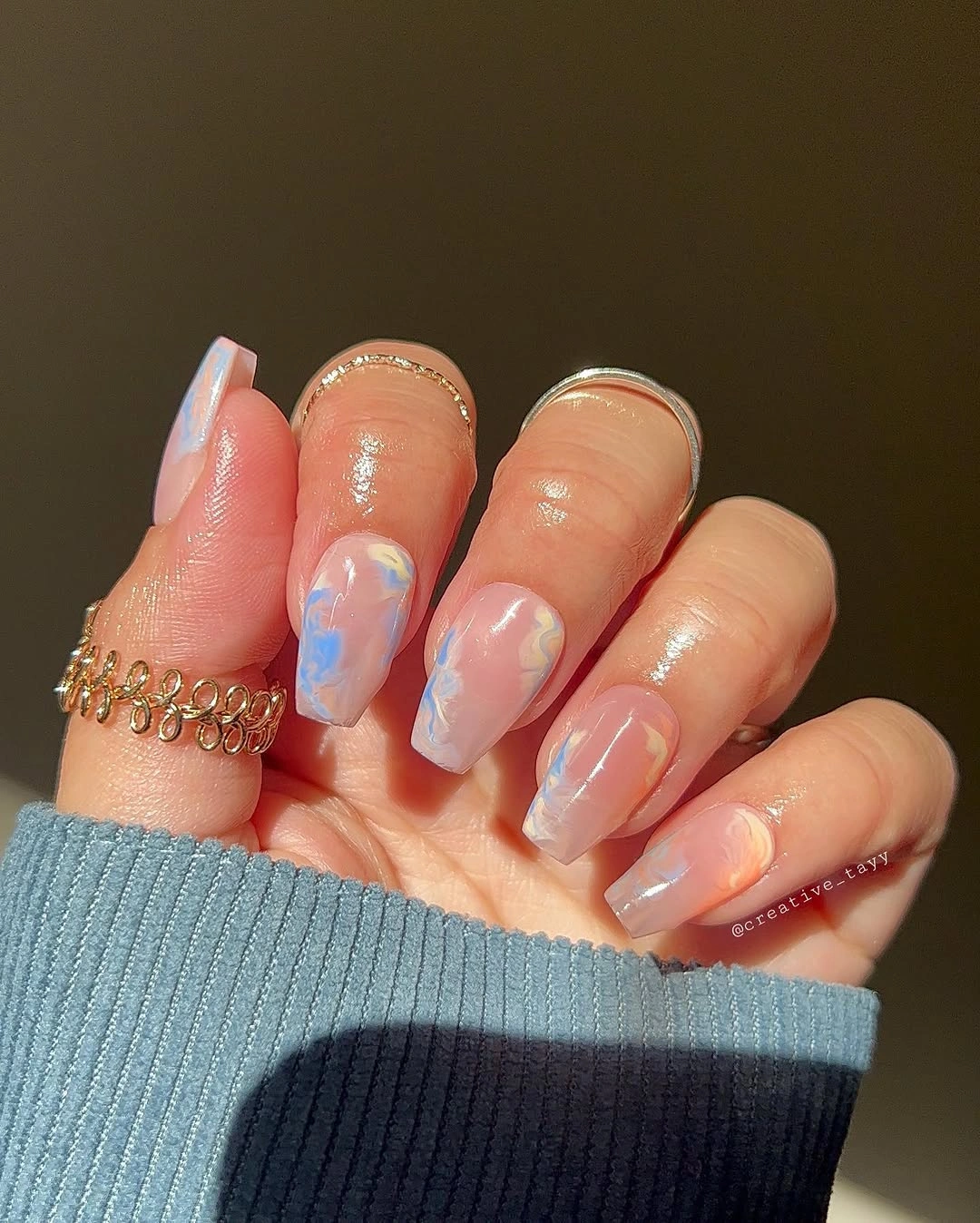
The appeal comes from the contrast between a warm sheer foundation and cool blurred patches. Because the edges of the color are soft, every nail can be slightly different without breaking the collection, and the compact shape keeps the watercolor effect from spreading too far. This is a good example of using variation as the design: the set feels coordinated through palette, not identical placement.
On a very short nail, use larger soft patches instead of trying to reproduce fine marbling. Tiny fragments can disappear or blend into an unclear gray, while a few rounded areas will preserve the warm-versus-cool relationship. Keep the peach base translucent and the blue-lilac accents limited; adding hard outlines would change the airy quality that makes this manicure distinct.
White Bands Give Pink French Nails a Graphic Spine
Here a pink base is crossed by white French bands with narrow red or pink edging, while one accent nail adds a small checker-like block near the side. The nails are short and softly squared, so the bands are placed to create order across a compact canvas. The design feels more structured than the watercolor set, but the pink base keeps the contrast friendly rather than severe.
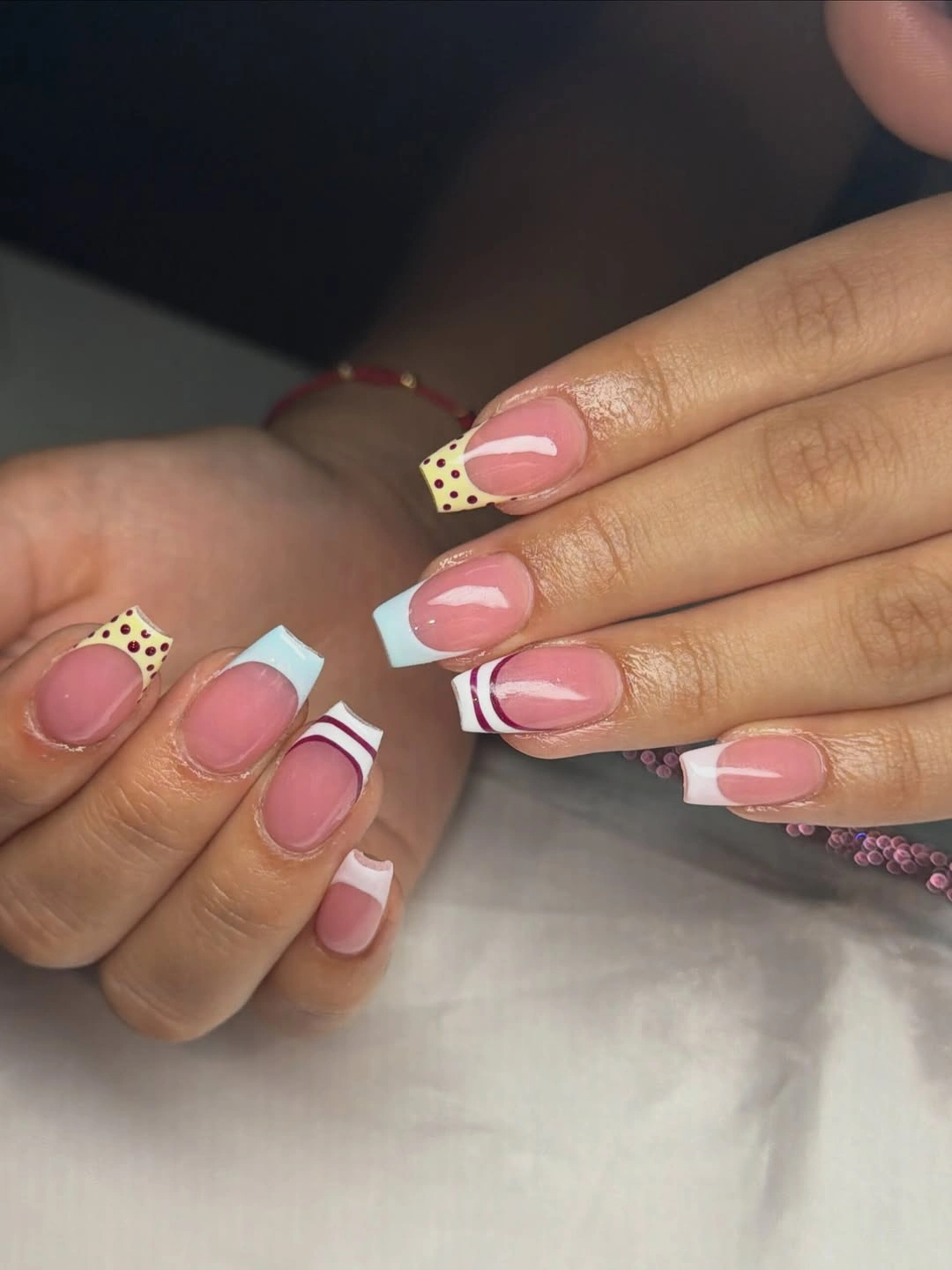
The repeated white bands form the manicure’s spine. Even though the checker detail appears only once, the eye sees it as a small variation inside a clear system of horizontal or curved divisions. That is why the accent does not make the set chaotic: the dominant relationship remains pink against white, with red or pink edging used as a fine supporting note.
For a shorter version, keep one checker accent and simplify the remaining nails to a single white band. Three competing lines can merge on a very compact surface, while one clean division will still create the graphic effect. The useful tradeoff is between detail and clarity; removing a mark often makes the pink base and the white structure look more intentional, not less finished.
Lavender Almond Length Makes a Solid Color Dramatic
A second lavender manicure appears here in a longer, more pointed almond shape with a smooth glossy surface and little visible decoration. The color is similar in family to the earlier lilac example, but the sharper silhouette changes the visual weight and makes the set feel more elongated. This comparison shows how much of a manicure’s character can come from outline alone.
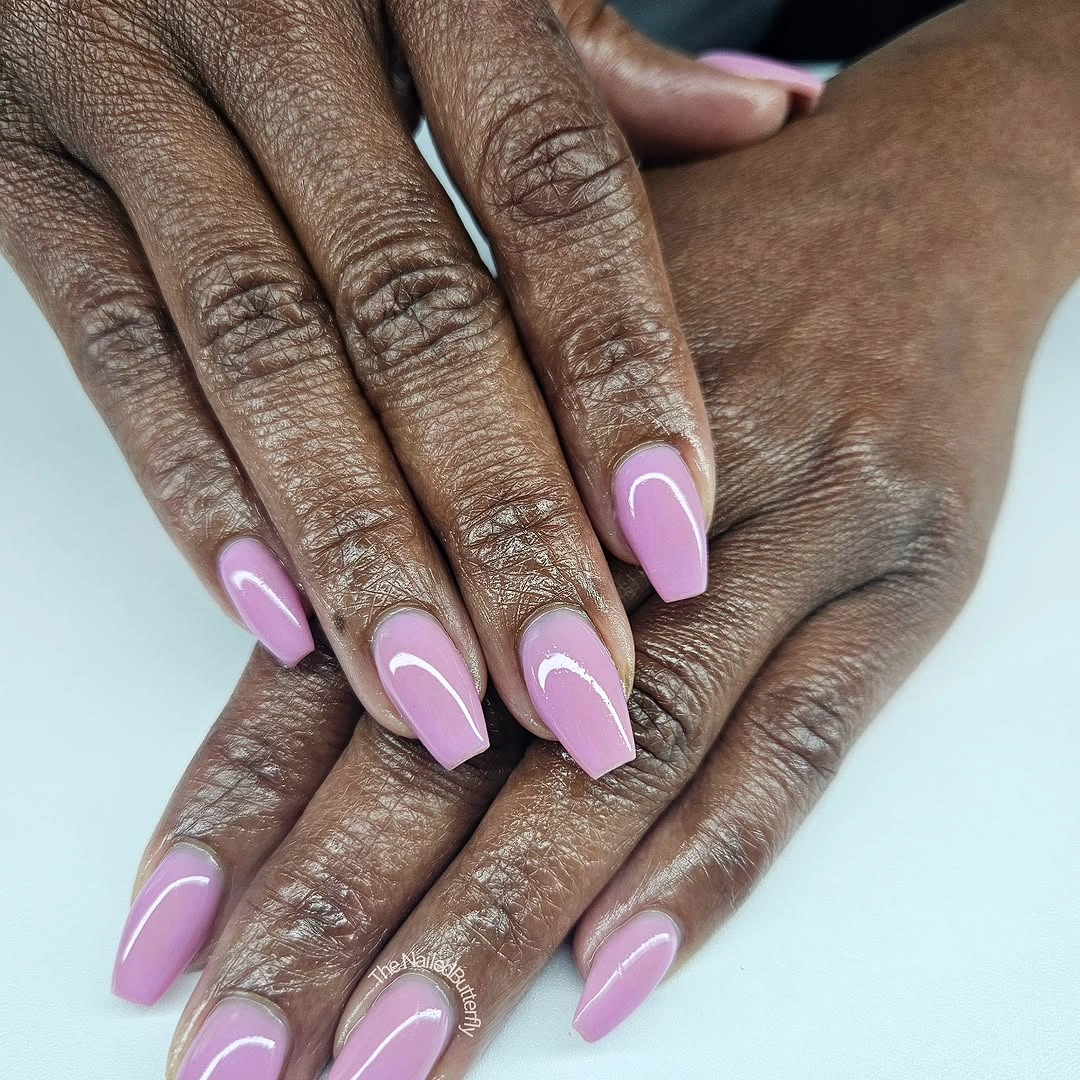
Because every nail repeats the same color and finish, the eye follows the tapered edges rather than searching for a motif. The clean surface allows the lavender to look intentional at a length where added art might compete with the shape. It is a useful reference for someone who likes a solid manicure but wants the silhouette to carry the editorial interest.
If you prefer short coffin nails, keep the lavender and translate the point into a softened tapered square. The color will become more compact and less dramatic, but the idea remains intact as long as the finish stays smooth and the set remains uniform. Adding extra accents would not replace the lost length; it would create a different design with a different visual job.
Black, Yellow, and Checks Build a Small Grid
Short squared nails in this example use a dark base with yellow line work, small checkerboard panels, and geometric blocks on selected fingers. The black-and-yellow palette is limited, but the repeated grid and angular details create a strong graphic identity. Some nails are less busy, which gives the checker elements enough space to read as structure rather than surface noise.
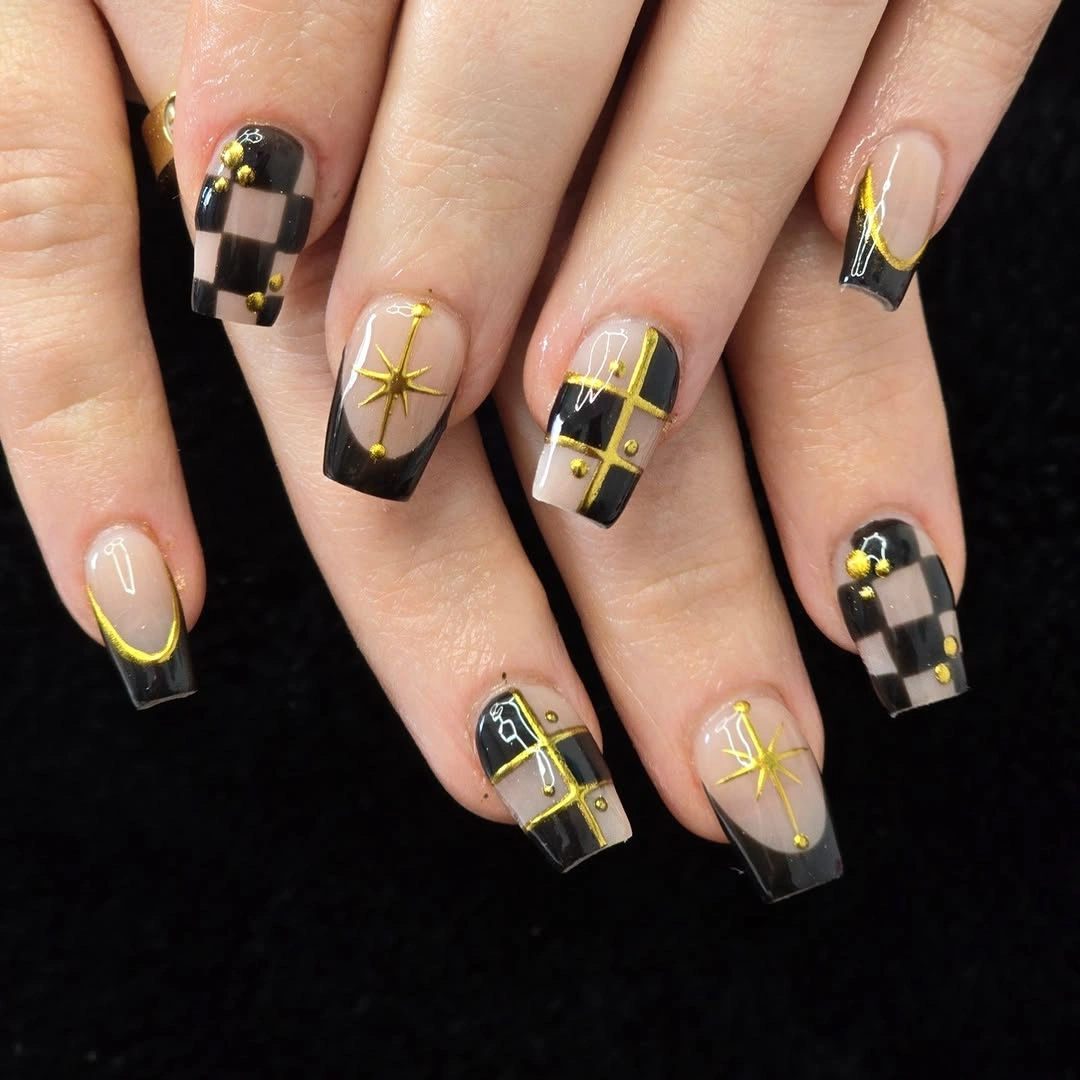
The design works through contrast and placement: yellow lines brighten the dark field, while the checker panels introduce a second rhythm of small blocks. Keeping the geometry on selected nails prevents every finger from competing at the same intensity. It is more deliberate than a random mix because the same two colors keep returning, and the short square shape reinforces the clean edges.
When adapting this idea, choose one checkerboard nail and use plain black or yellow on the rest. A small canvas cannot always support both a grid and several crossing lines without losing the difference between them. The practical advantage of a limited palette is that simplification remains recognizable; remove a pattern, not the color relationship that gives the manicure its visual logic.
Monochrome Micro-Motifs Make Nude Nails Playful
This medium tapered set begins with a sheer pink nude base, then adds black-and-white dots, checks, and curved line-art details near the tips and side edges. The motifs vary from nail to nail, but they share a monochrome palette and plenty of pale space. That combination makes the manicure feel playful without relying on a saturated color block or a long dramatic silhouette.
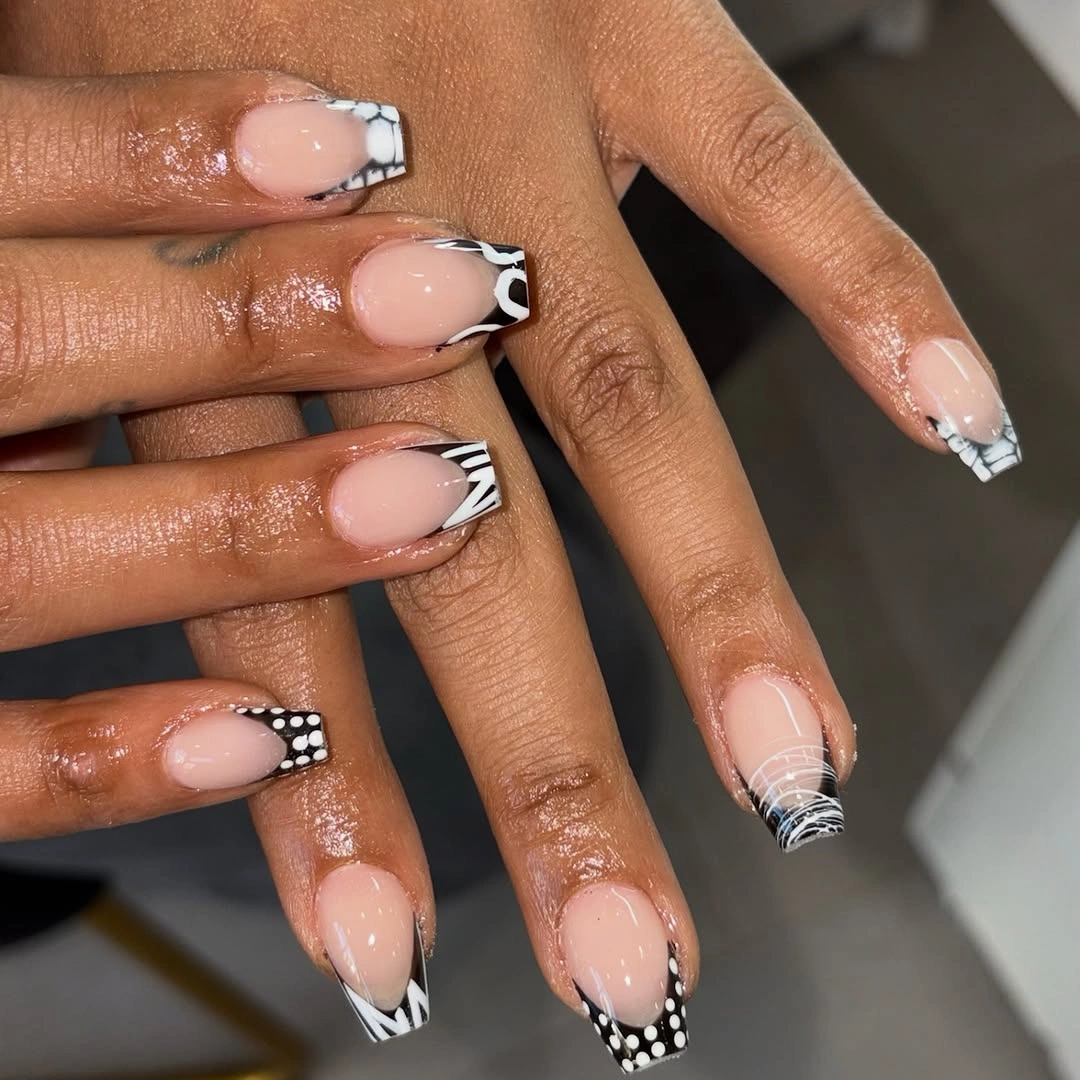
The important detail is not any single checker or dot; it is the repeat of black and white across different small gestures. One nail uses a grid, another a dotted edge, and another a curved graphic, but the shared contrast keeps the set coherent. This makes the example a useful reference for mixing accents when the palette is disciplined enough to carry the variation.
For short coffin nails, select one motif family instead of shrinking all three. Dots can be spaced along the tip, checks can occupy one accent nail, and curved lines can follow the edge, but using every option on a small surface may erase the open nude base. Keep the neutral center visible and let one clear black-and-white detail define each accent finger.
Red and Pink Curves Close the Collection Clearly
The final manicure returns to red, but places it over a pink nude base in curved sections separated by slim white or clear lines. The nails are short and rounded-square with a glossy surface, and the red remains dominant without covering the entire field. The design closes the collection by combining the strong color of earlier graphics with the open spacing used in the French and outline examples.
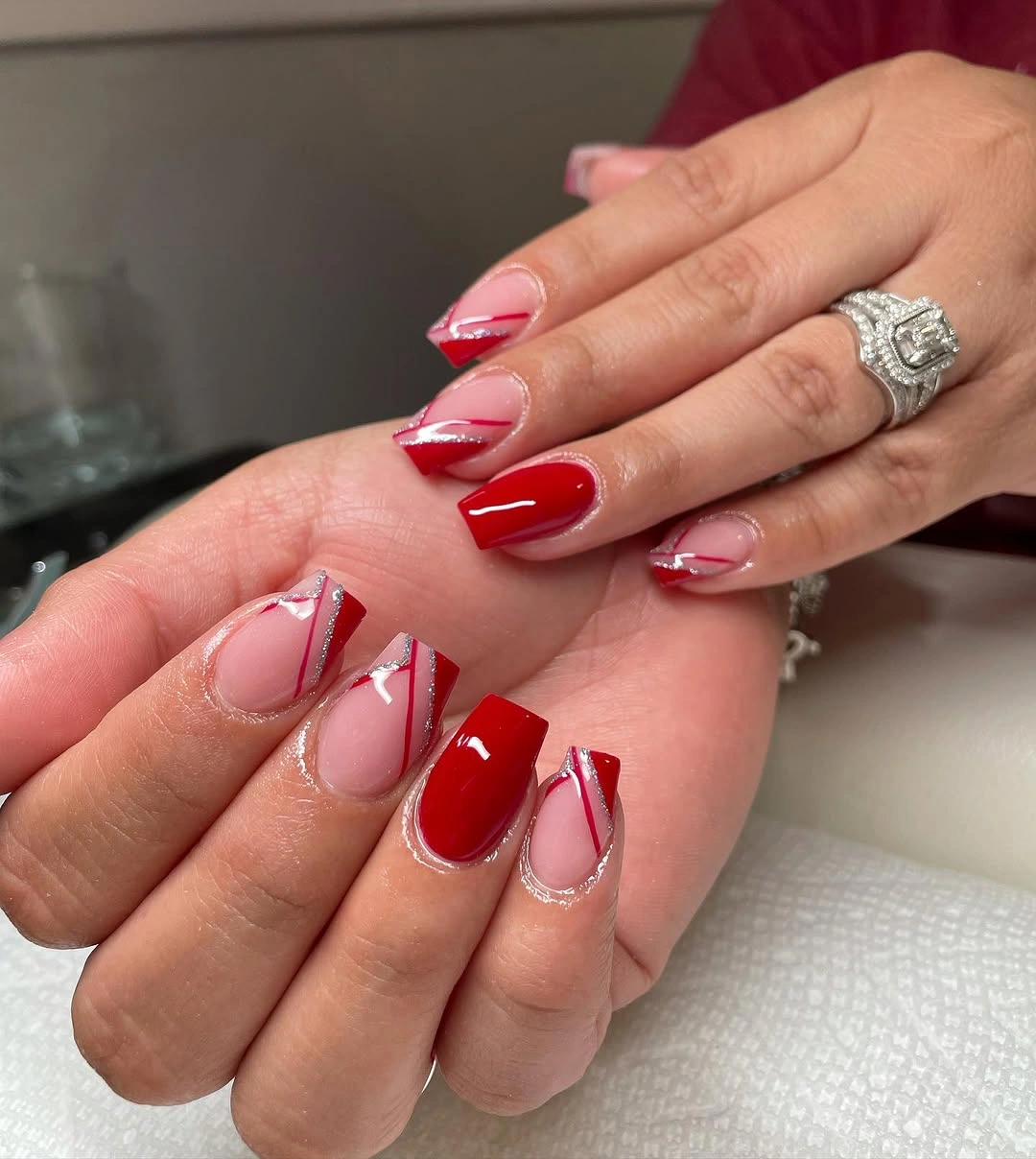
Those curved separations are what keep the red from reading as a simple solid set. The eye follows the pale line around each red section, which creates movement and lets the nude base soften the contrast. It is a more contained graphic idea than the long black-and-red manicure, but the same principle remains visible: a bold color gains balance when its edges are deliberately interrupted.
To make the design even more practical, narrow the red section on the shortest nails and leave a little extra pink space around the curve. The shape will remain readable, and the white or clear separation will continue to show where one color ends. That small adjustment keeps the manicure focused on contrast and proportion, which is the thread connecting the strongest fall short nails in this collection.