On a short nail, simplicity is not the same as leaving the surface unfinished. The eye should identify the main decision before it gets distracted by the second one. Clarity usually comes from a stable outline and one controlled change in color, finish, or spacing; if all three change at once, even a gentle palette starts to look noisy.
The useful test is to cover one accent mentally and ask whether the remaining nails still have a reason to exist together. If they do, the design has a foundation; if they do not, another detail will not rescue it. Build from the base outward, keep the open areas visible, and let the smallest accent earn its place.
Olive, Black, Nude, and Gold Start the Edit
The opening manicure mixes solid deep green, sheer nude, metallic gold blocks, and small warm details across compact rounded nails. No single finger carries the entire palette, yet the combination feels intentional because the colors sit within a muted range and the reflective accents repeat the warmth. The dark green gives the short silhouette a visual anchor while nude sections keep the set from becoming heavy.
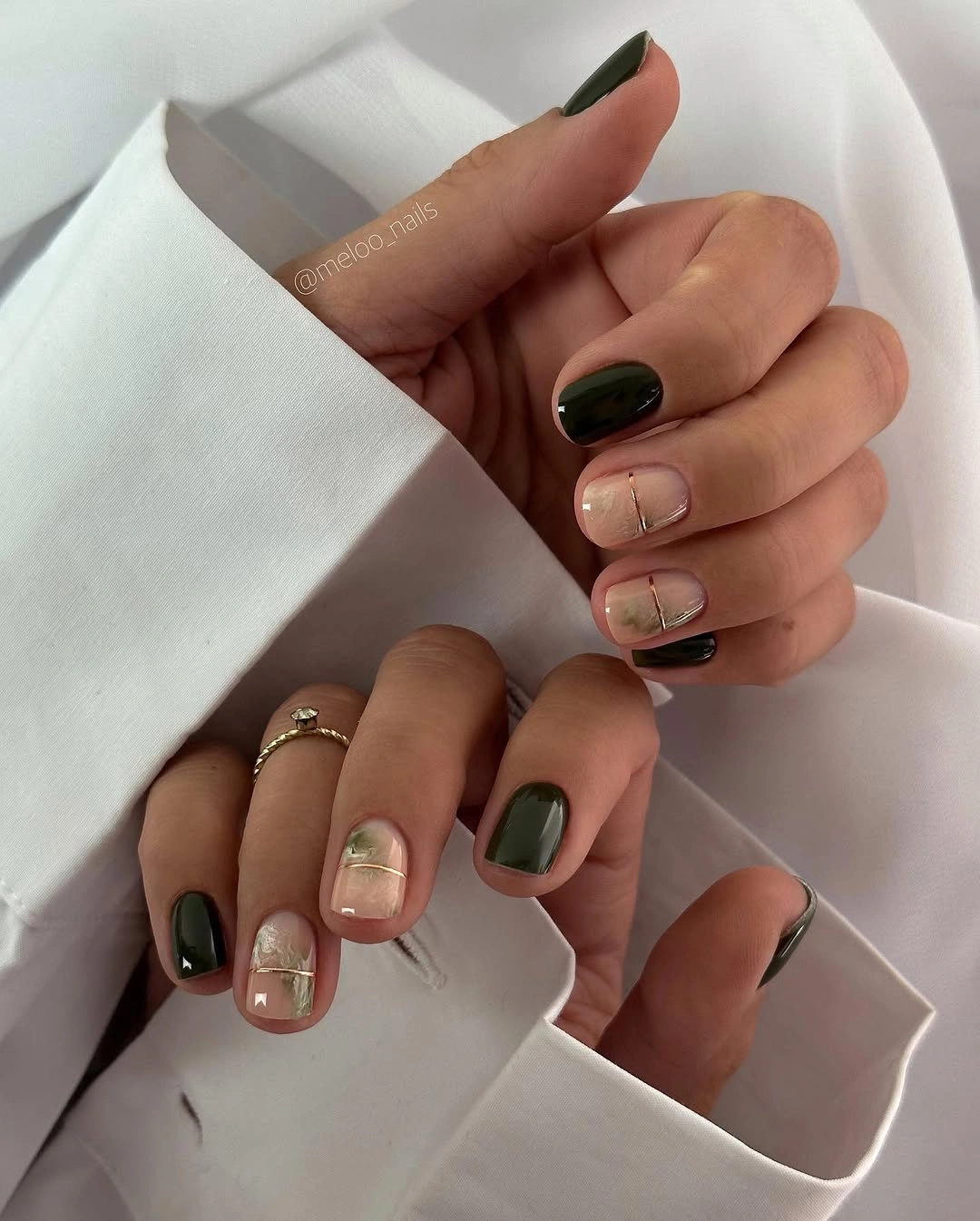
Different finishes help a restrained palette stay lively. The olive supplies depth, the nude opens space, and the gold catches light in small areas instead of covering the whole nail, so the mix has variation without a loud motif. This is a useful model for simple fall nail designs because the design looks collected from a few decisions, not built from many unrelated decorations.
To simplify it further, repeat the olive on two nails, use nude on most of the set, and reserve metallic gold for one accent. The short length will keep the palette compact, but the reflective detail can become visually dominant if it appears everywhere. Preserving the difference between quiet base nails and one brighter accent is more important than keeping every color from the reference.
Olive Swirls Give a Solid Color Movement
Most nails here are glossy olive green, but pale curved lines and lighter green shapes move across the surface so the set does not read as a plain solid. The short rounded-square outline remains visible, and the swirls stay within the same color family rather than introducing a sharp contrast. It is a clean abstract idea with enough variation to reward a closer look.
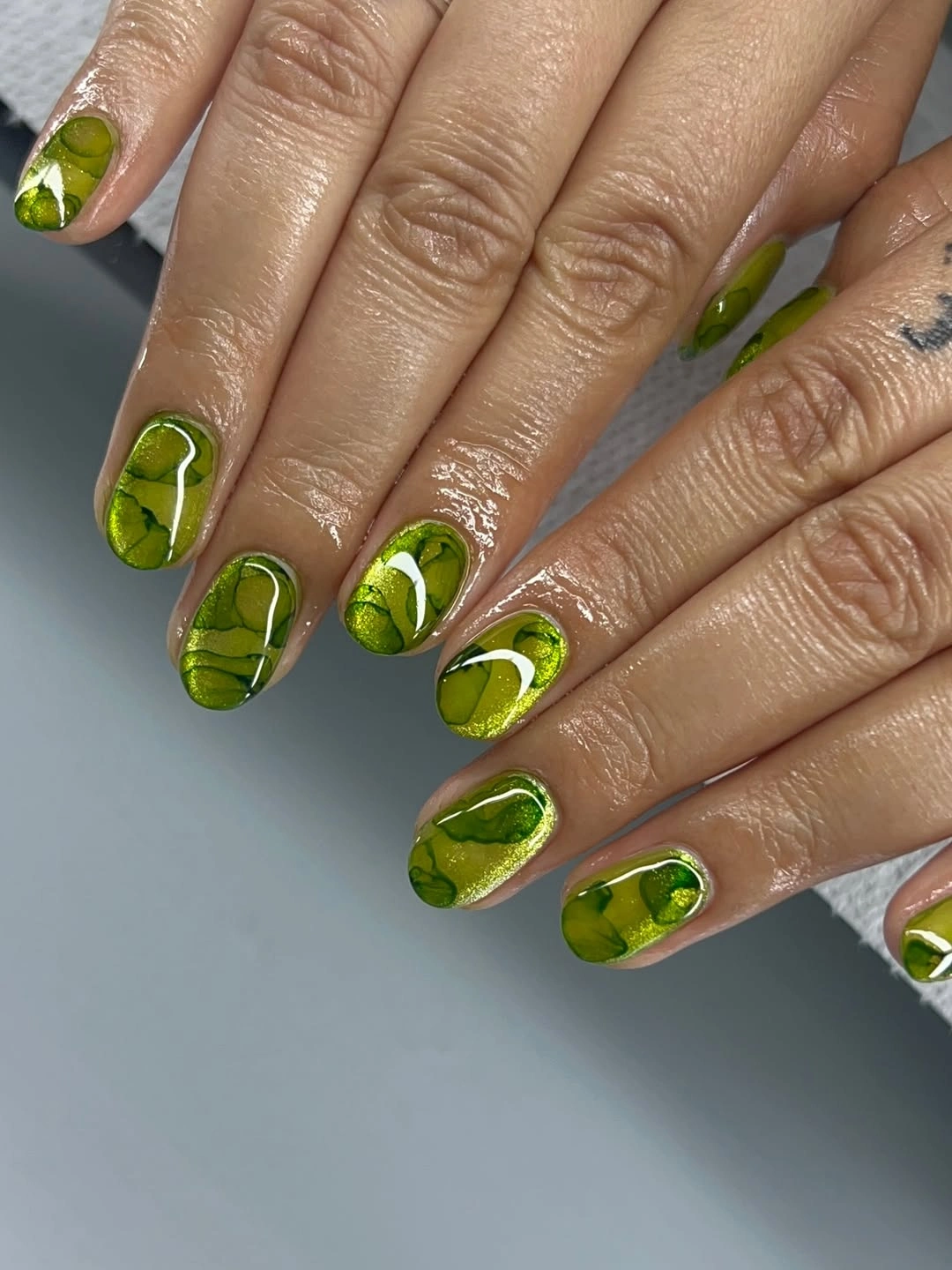
The lighter curves create direction through a compact shape. Because the base and the lines are related greens, the eye notices the movement before it notices a separate accent color, which keeps the manicure calm. This is the kind of detail that makes a simple nail set feel designed without requiring a large motif, a long tip, or a collection of different shades.
Leave generous green space between the curves when adapting the pattern. On very short nails, narrow swirls can merge into a dull patch, while a few broader bends will preserve the contrast between base and line. A glossy finish helps the color shifts stay visible, but the design can remain successful in a softer surface if the placement stays open and the olive remains dominant.
Neutral Finishes Keep Small Accents Connected
This short mixed manicure stays in a gentle neutral family, combining cream, blush, beige, metallic gold patches, tiny speckles, and a small white flower-like accent. The colors are close enough to feel soft, but the differences in finish and detail prevent the set from looking blank. Compact rounded nails give the mix a practical scale even when one accent carries a little more texture.
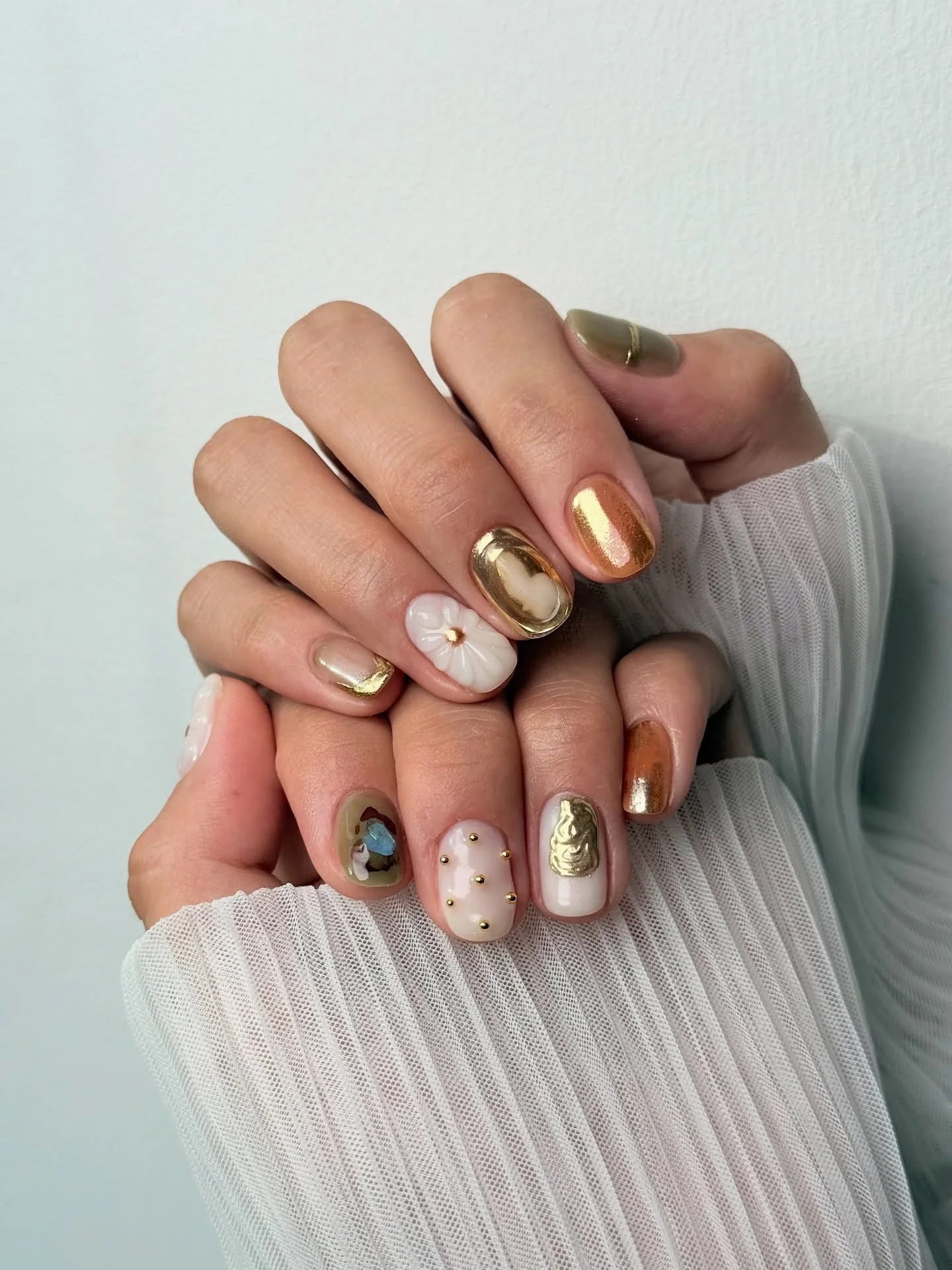
The repeated warmth is what makes the variety work. Gold appears as a reflective punctuation, pale tones provide the background, and the white accent adds a light focal point without pulling the manicure into a new color story. This approach is useful when you want simple fall short nails with interest that comes from small changes in surface rather than bold contrast.
For a cleaner adaptation, choose cream and blush as the main colors, then keep either the gold patch or the white flower-like detail, not both on every finger. Small textured accents need clear space around them to remain readable, especially as the nails grow. The result will feel simpler if the neutral base remains the majority and the decorative note is allowed to be genuinely occasional.
A Glossy Pink Set Needs No Extra Motif
Every visible nail in this example is a bright pink with a smooth glossy surface and a compact rounded-square outline. There is no contrasting art, metallic detail, or accent finger to direct the eye, so the manicure depends on even color placement and a tidy edge. Its simplicity is deliberate: the shade is strong enough to make the short shape feel complete without needing additional explanation.
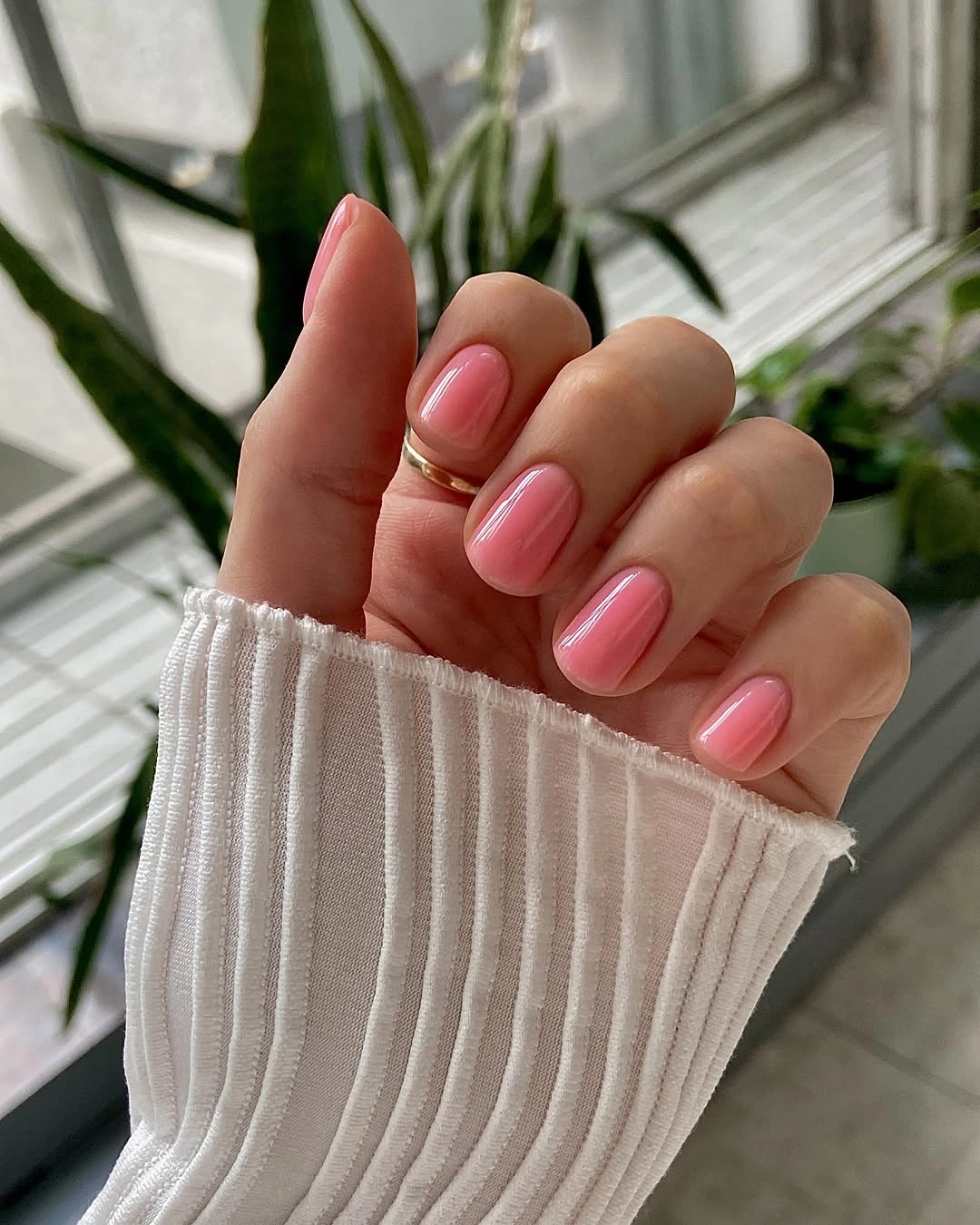
Uniform color creates a visual reset because there are no competing decisions from finger to finger. The glossy finish catches light along the curve and helps the compact outline stay crisp, while the pink brings warmth without the depth of burgundy or brown. This is a useful base for fall manicure ideas when you want the final result to remain bright and uncomplicated.
If you want a tiny seasonal shift, keep most nails pink and add one muted accent later rather than building a full mixed set at once. A single color also makes uneven edges more visible, so the practical focus should be clean placement and consistent length. The look succeeds precisely because nothing distracts from those two details, and adding more decoration is optional rather than necessary.
Olive Lines Tie a Nude Mix Together
Warm nude is the main field in this manicure, with olive-green sections, white curves, thin stripes, and small dark or metallic marks appearing on selected short nails. Several details are present, but the nude space remains generous and the olive tone repeats enough to connect the fingers. The compact shape keeps the design grounded, while the line work gives it a sharper edge than a purely tonal neutral set.
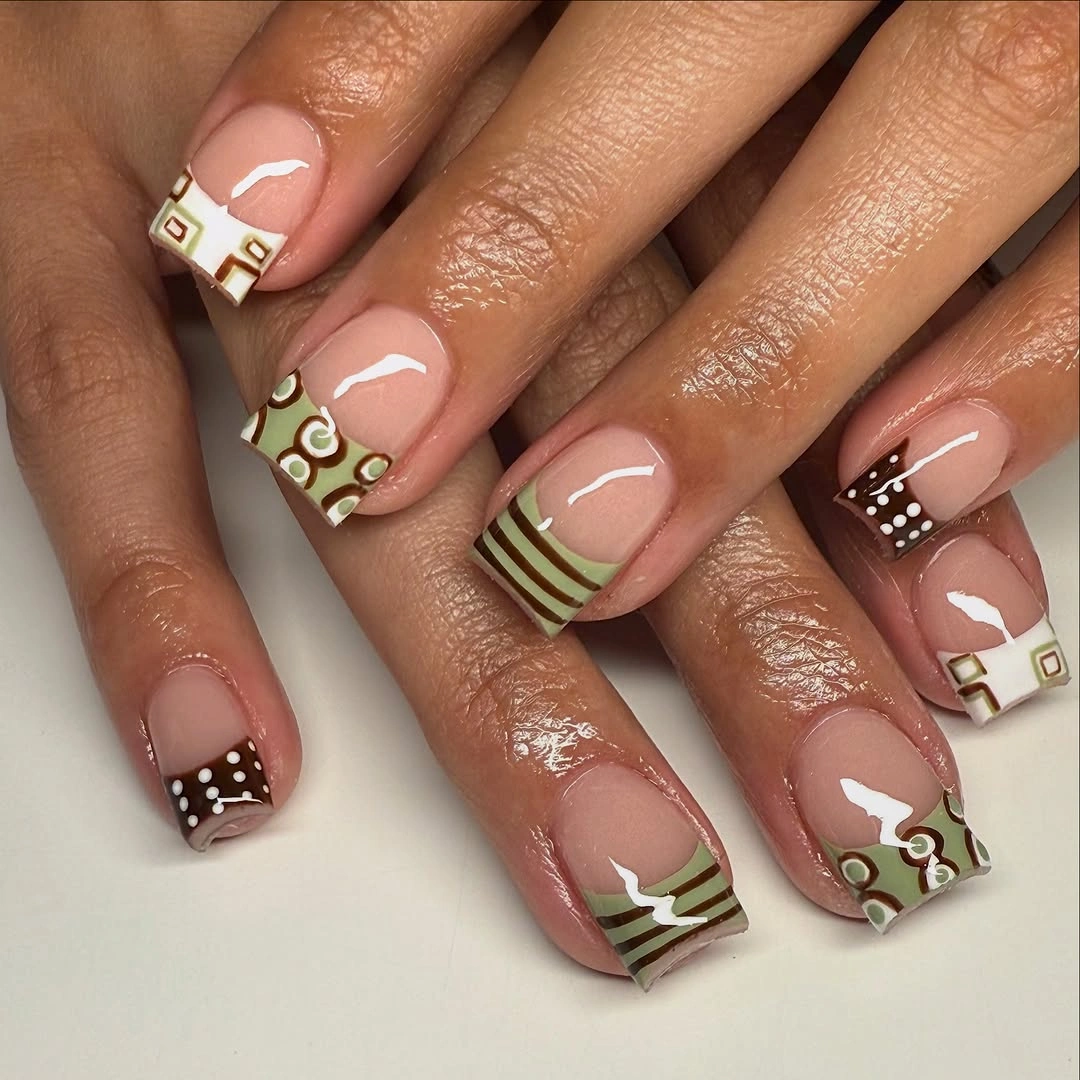
Thin lines do the organizing work here. They create a common rhythm between nails that use different blocks or marks, and the olive color acts as a bridge between the warm nude base and the cooler white details. This is a good example of how a mixed design can stay simple: the palette is not tiny, but the placement has enough breathing room to prevent visual clutter.
For a calmer result, keep nude on most nails and move olive to two fingers, using white only as a fine edge. The short surface will show the contrast more clearly when the lines are not packed together, and leaving out a small dark accent can make the set feel lighter without losing its fall character. Simplicity comes from choosing what not to repeat.
Cool Blue Blocks Need Tiny Light Details
This compact manicure combines blue edges or blocks with pale nude space and small reflective or pearl-like details on selected fingers. The cool blue provides the clearest color contrast, while the light accents keep the mix from looking flat or overly dark. Rounded short nails give the idea a practical shape, and the decoration remains concentrated rather than spread across every surface.
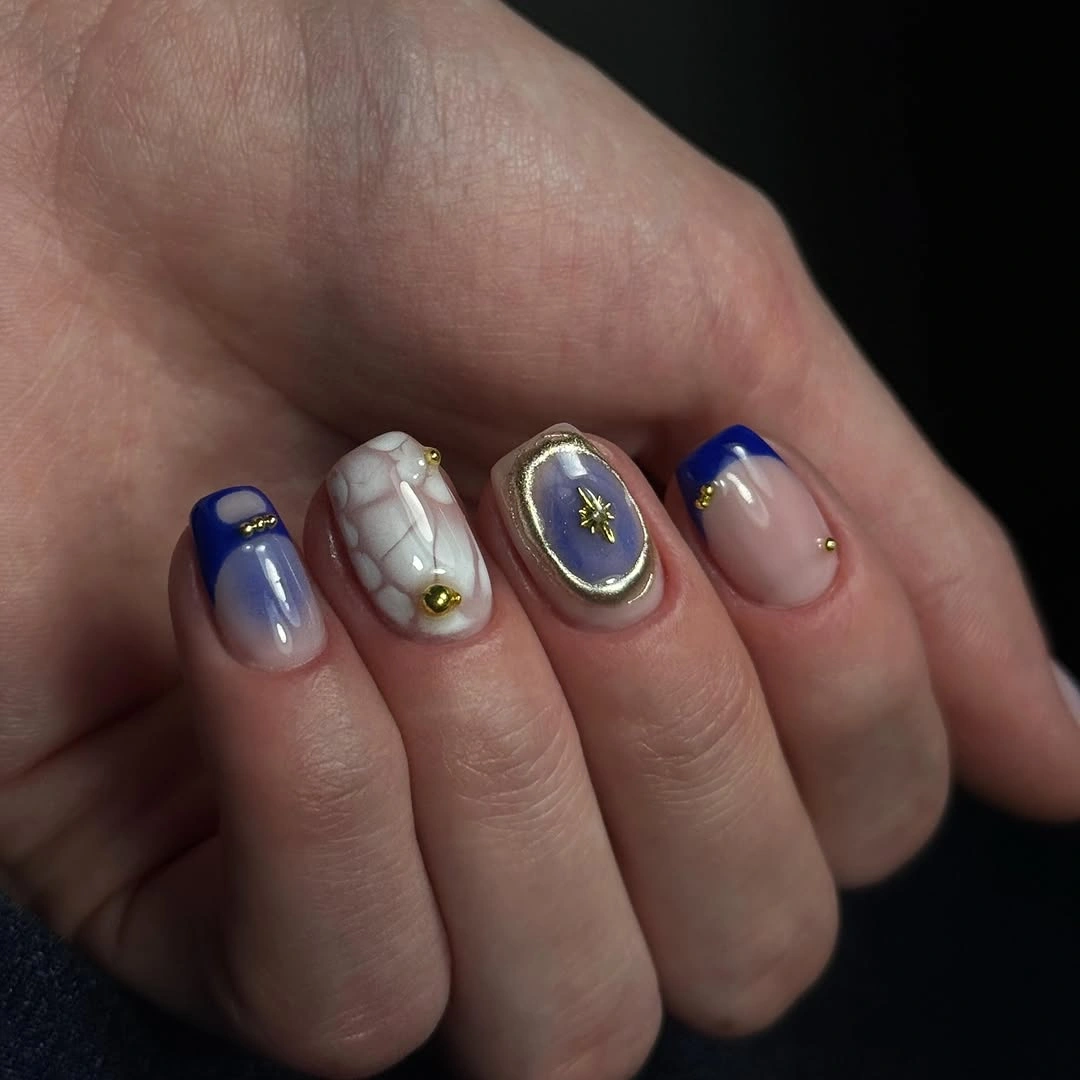
The set works because the small light details echo the pale base instead of introducing a third loud color. Blue becomes the visual signal, nude provides a pause, and the reflective points add a little change in texture near the center or edge. That balance keeps the manicure approachable even though the cool shade is more assertive than the neutral examples before it.
On a shorter nail, use one reflective accent and keep the blue placement simple. Several tiny embellishments can disappear into the same visual area, while a single point will remain legible and easier to maintain as the shape grows. If full blue feels too strong, a narrow blue French edge can carry the color relationship with more open space around it.
Brown, Burnt Orange, and Black Feel Grounded
Different nails in this set use deep brown, burnt orange, and black solid sections on a short rounded shape. There is very little visible ornament, so the seasonal mood comes directly from the relationship between warm and dark blocks. The colors are strong but familiar, and the clean surfaces keep the manicure from looking complicated despite the fact that each finger is not identical.
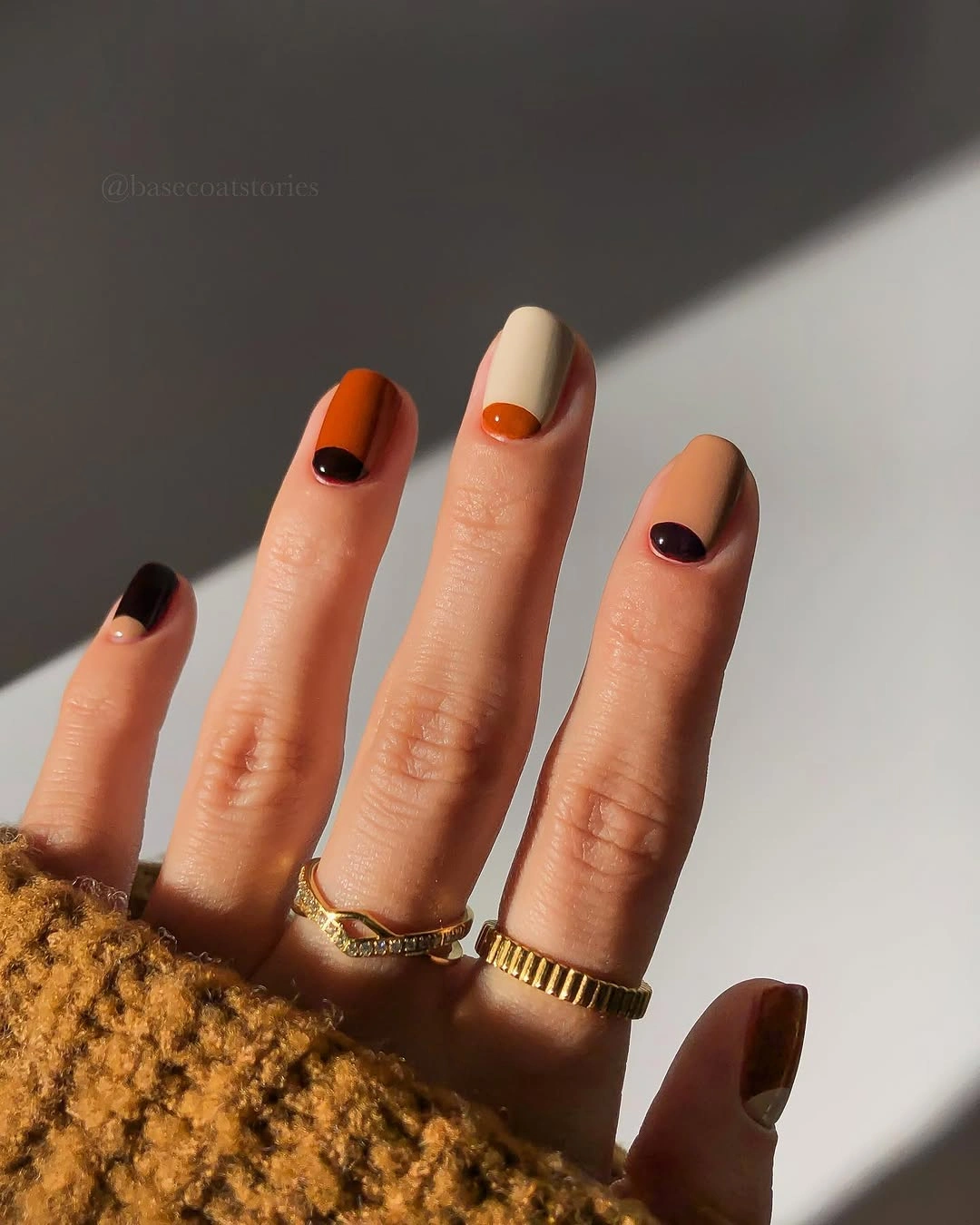
Color-blocking is effective here because each shade has a clear field of its own. Brown softens the black, orange brings warmth, and the repeated short length keeps the mix visually unified. This is a simple fall option for someone who wants richer color without line art, dots, or metallic accents, since the palette itself supplies enough contrast to make the set feel finished.
Use brown as the majority shade if you want the most wearable adaptation, then place burnt orange on one or two nails and keep black as a narrow detail or single solid. A full black-orange mix will read more dramatic, especially on a compact shape. The practical strength of the design is that simplifying the number of colors does not erase the idea; the warm-dark relationship remains intact.
Bright Yellow Meets Stripes and Tiny Dots
This playful manicure mixes bright yellow, pink, a black-and-white striped nail, and small dotted or animal-inspired marks on short nails. The colors are more expressive than the neutral designs earlier in the collection, but the repeated compact length gives the set a clear frame. Each finger offers a different accent, so the overall balance comes from color repetition rather than identical artwork.
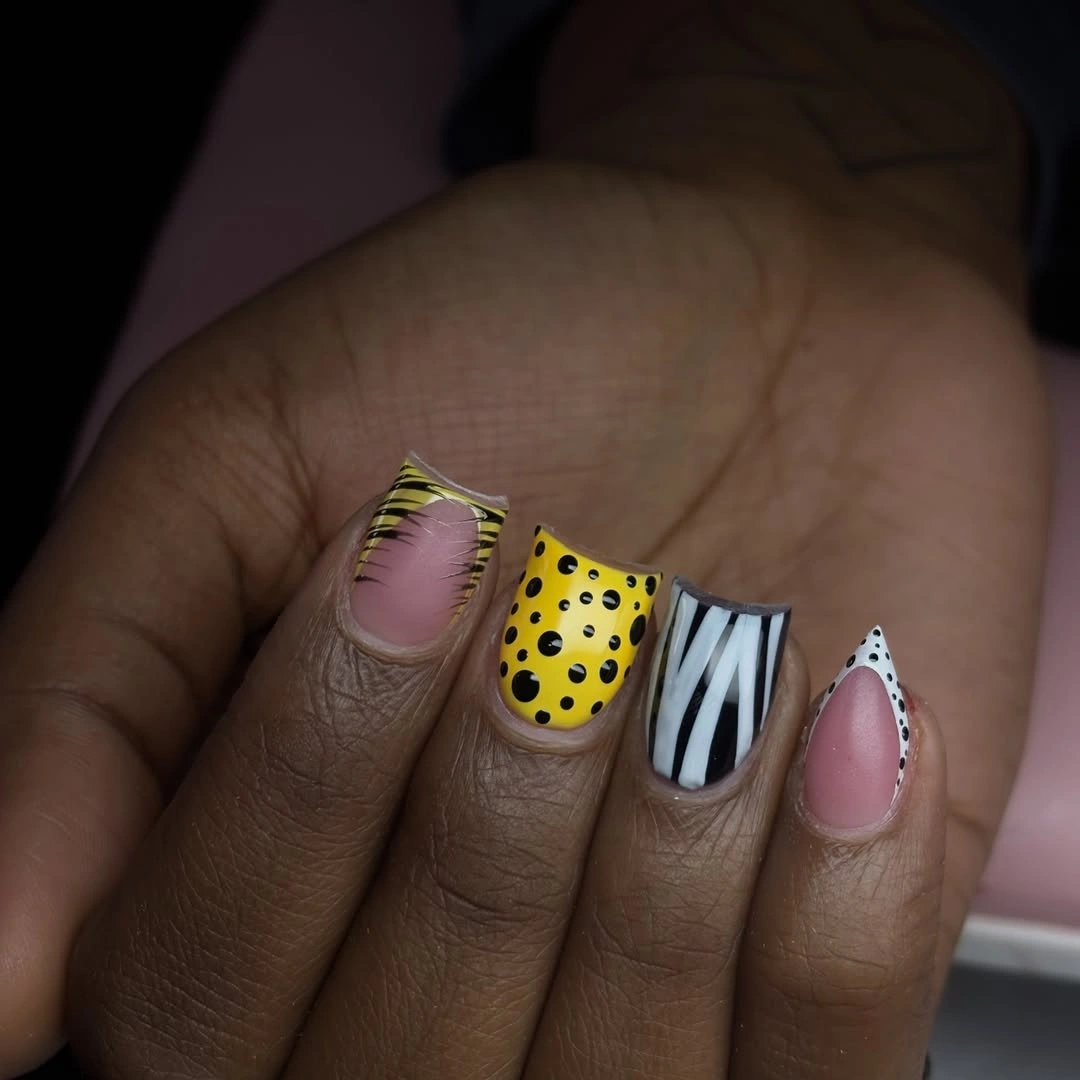
The yellow provides the strongest focal point, while pink softens the contrast and the black-and-white stripe supplies a graphic pause. Tiny dots or spotted marks add texture without needing to occupy a full nail, which keeps the mix playful instead of heavy. The design shows how a simple manicure can still be colorful if every detail has a distinct role and no single nail carries too many roles at once.
To make this version easier to wear, drop one motif and repeat either yellow or pink on two nails. The stripe should remain bold enough to read, but its spacing needs to stay open on a short surface, and tiny dots should be limited to one accent. The goal is not to mute the personality; it is to give the brightest elements enough room to keep their shape.
Pink, Red, and White Curves Stay Soft
A pale nude-pink base supports white curved details, a pink-red accent, and small dark outlines on selected short rounded nails. The contrast is gentler than the black-and-white manicure that follows, and the design relies on open pale areas to keep the curves visible. It feels graphic without becoming severe because the warm base absorbs some of the sharpness from the red and dark lines.
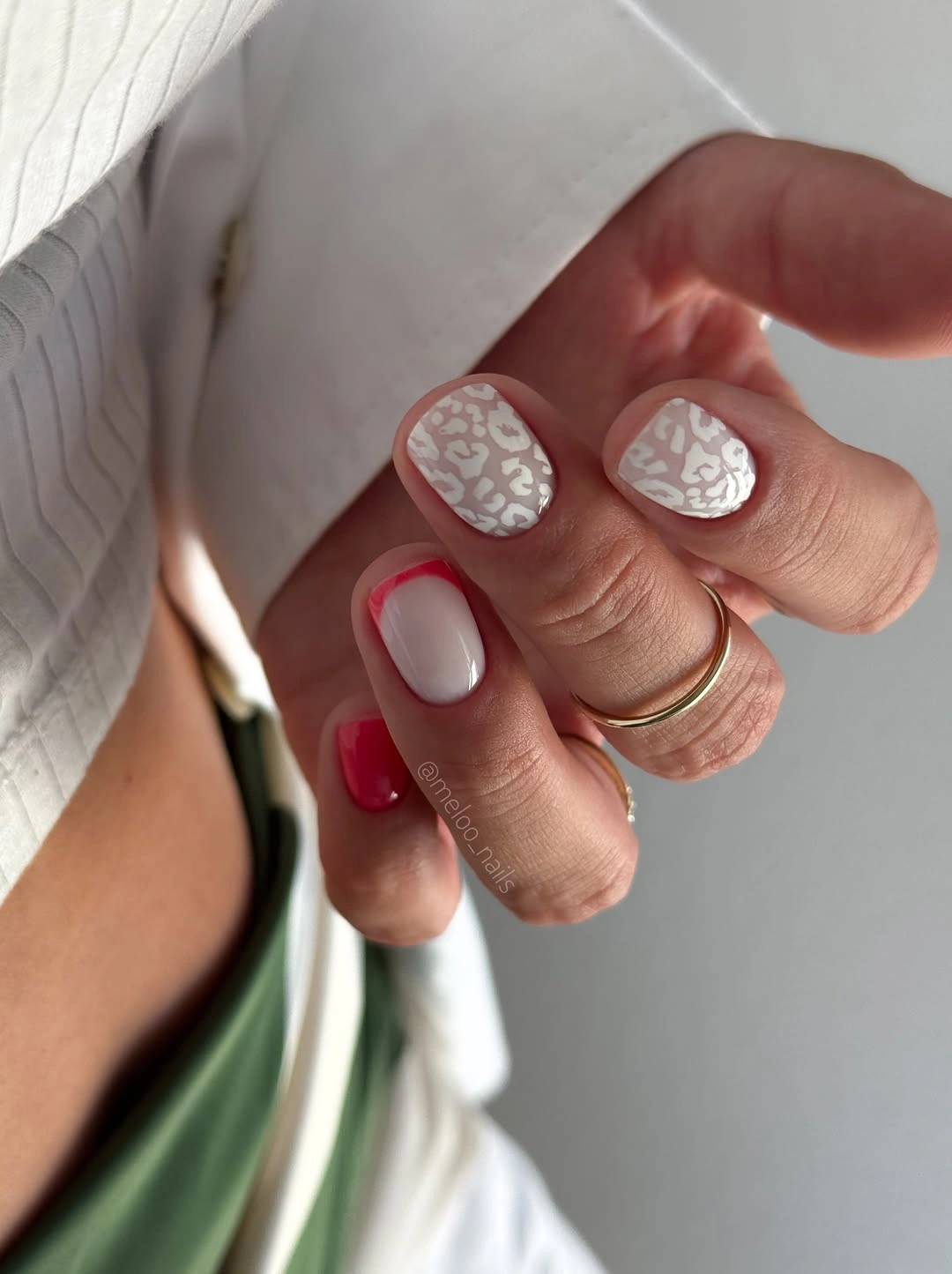
The red works best as a focal note rather than a full field. It draws attention to one finger, while white curves and dark outlines create a quieter rhythm around it, so the set has hierarchy instead of equal intensity everywhere. This is a useful way to add fall nail art to simple short nails when a deep full set would feel too heavy or too formal.
Keep the red on one nail and let the remaining fingers use only white or a fine dark outline if you want the cleanest adaptation. On a smaller canvas, too many curved elements can merge, so a single open line will often look more polished than several compressed marks. Preserve the pale base as the main field and the design will keep its soft visual breathing room.
Zebra Curves Turn Nude into a Graphic Base
Several short rounded nails carry black curved stripe patterns over a pale nude base, while other fingers remain mostly nude. The black lines are the only strong contrast, so the pattern reads immediately without needing extra color or glitter. Because the nude gaps remain visible between the stripes, the manicure feels graphic but not visually packed, even though the motif repeats across more than one nail.
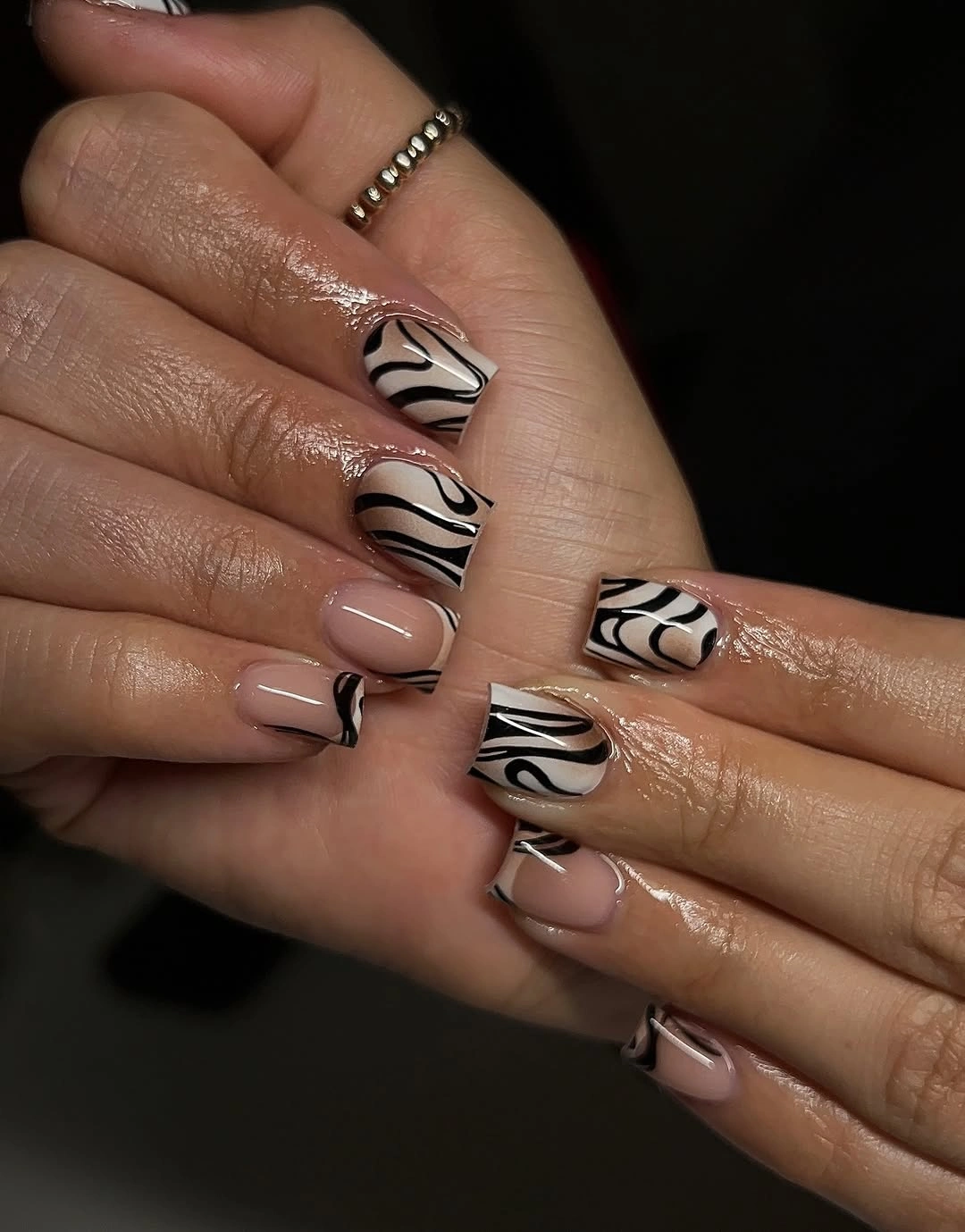
The curved stripe rhythm is what keeps the design from looking like random marks. Each line bends in the same general language, and the pale base gives it room to breathe, so the eye reads a coherent pattern rather than a dark patch. This is a strong reference for simple nail art because one motif and two tones can create a complete result when the spacing is deliberate.
If your nails are shorter, place the stripe pattern on one or two accent fingers and keep the rest nude. Fewer lines will preserve their curve and make the design easier to maintain as the nail grows, while a full set can become intense if every finger has high-contrast movement. The practical adjustment is to keep the motif recognizable, not to reproduce every visible line.
Pastel Yellow and Lavender Make Details Feel Light
This short set combines pale yellow sections, lavender or pink blocks, white dotted details, and small contrasting marks on compact nails. The colors share a soft brightness, so the manicure feels airy despite the variety of accents. The visual interest comes from changing the placement and finish between fingers, while the limited saturation keeps the design within a simple, approachable range.
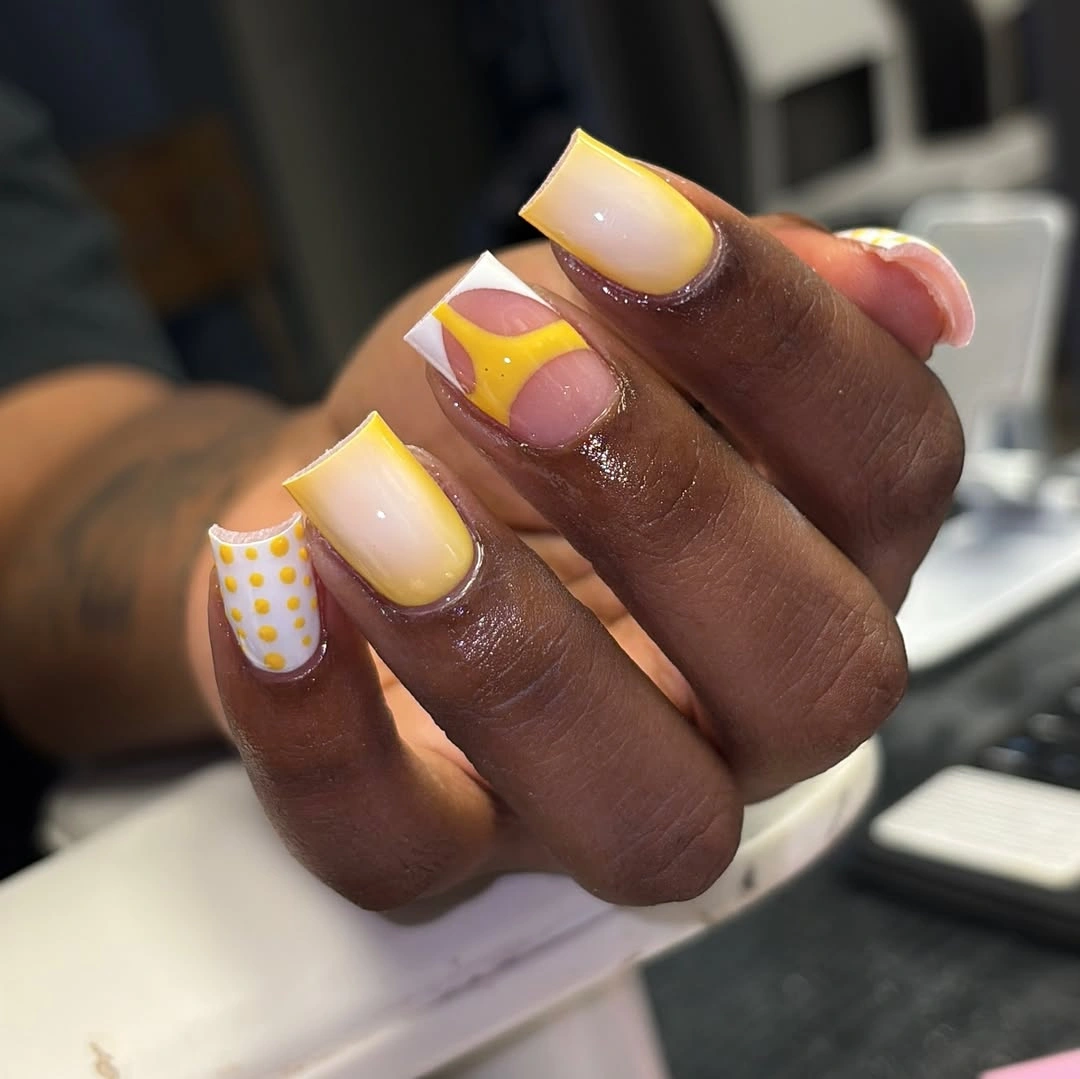
Soft colors need structure to avoid looking unfinished, and the small dots and graphic marks provide that structure here. Yellow supplies warmth, lavender cools the mix, and white gives the eye a clean pause between them. The result is more layered than a plain pastel set, but it remains calm because no single accent becomes dark or overly dense against the pale background.
For an even simpler fall interpretation, repeat the pale yellow on two nails and keep dots on one accent finger. Lavender can remain as a small block rather than a full additional pattern, which preserves the contrast without multiplying decisions. The main limitation is visibility: pale details can disappear in low light, so keeping the spacing and edge definition clear matters more than adding more decoration.
Burgundy Panels Lighten a Deep Color
Glossy burgundy sections alternate with nude or pink negative-space panels on these short rounded nails. The dark color is rich, but it does not cover every surface, so the open areas prevent the manicure from feeling dense. The compact shape benefits from that pause: a deep shade brings focus, while the nude panel keeps the outline and visual proportion easy to read.
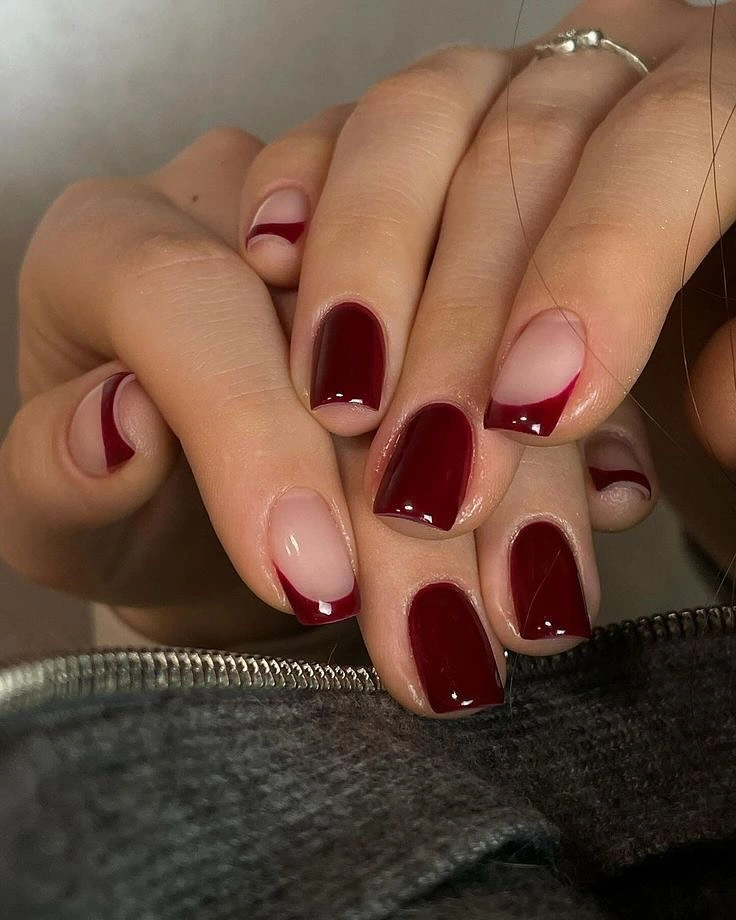
Negative space is doing a practical job as well as a decorative one. It breaks up the burgundy and creates a lighter center or side area, which visually extends the nail more than a full dark block might. The design is a useful bridge between simple and decorated: the color remains the hero, but the placement turns it into a clear choice rather than an ordinary solid set.
Use a half-moon or side panel if you want to adapt the idea to very short nails. A narrow open section will keep the dark red from taking over, while a wide or irregular panel may lose definition as the nail grows. The cleanest version repeats the same burgundy relationship across a few fingers and leaves the remaining nails solid nude or softly glossy.
Cream and White Waves Keep Contrast Gentle
These compact square nails use a soft cream or pale nude base with thin white looping lines. The decoration is sparse, and the colors are close, so the manicure feels quiet even though every nail is not completely plain. Shape and spacing do more work than saturation here: the short outline remains visible because the waves leave large areas of the base uncovered.
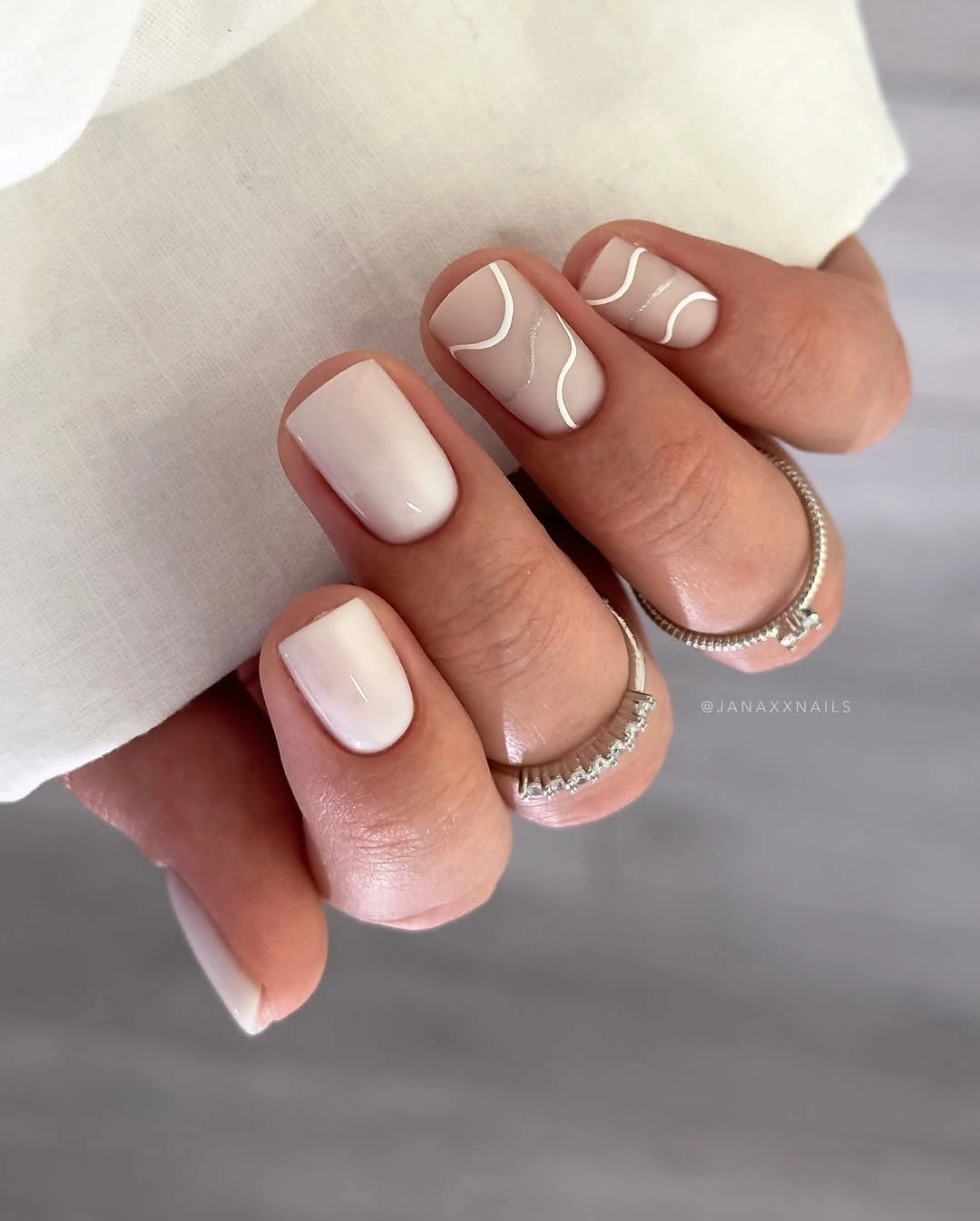
White-on-cream contrast is subtle enough to feel clean rather than graphic. The eye notices the curve when the light catches it, then returns to the pale base, creating a gentle rhythm across the set. This is a useful option when you want simple fall short nails with a little art but do not want a dark motif or a strong seasonal color on every finger.
Keep one continuous wave per nail and leave generous blank space around it. Extra lines could disappear into the pale field or make the compact surface look overly busy, especially if the white is close to the base. The limitation is visibility, but that is also the charm: the design rewards a closer look while remaining understated from a distance.
Pearly Swirls Use One Dark Accent
Most nails in this example are sheer pink or pearly lilac with glossy curved texture, while one visible accent carries a darker brown-black patterned detail. The nails are more tapered than the shortest examples, and the light surfaces give the set a dimensional look without requiring a broad color block. One dark accent supplies focus while the pale majority stays open and reflective.
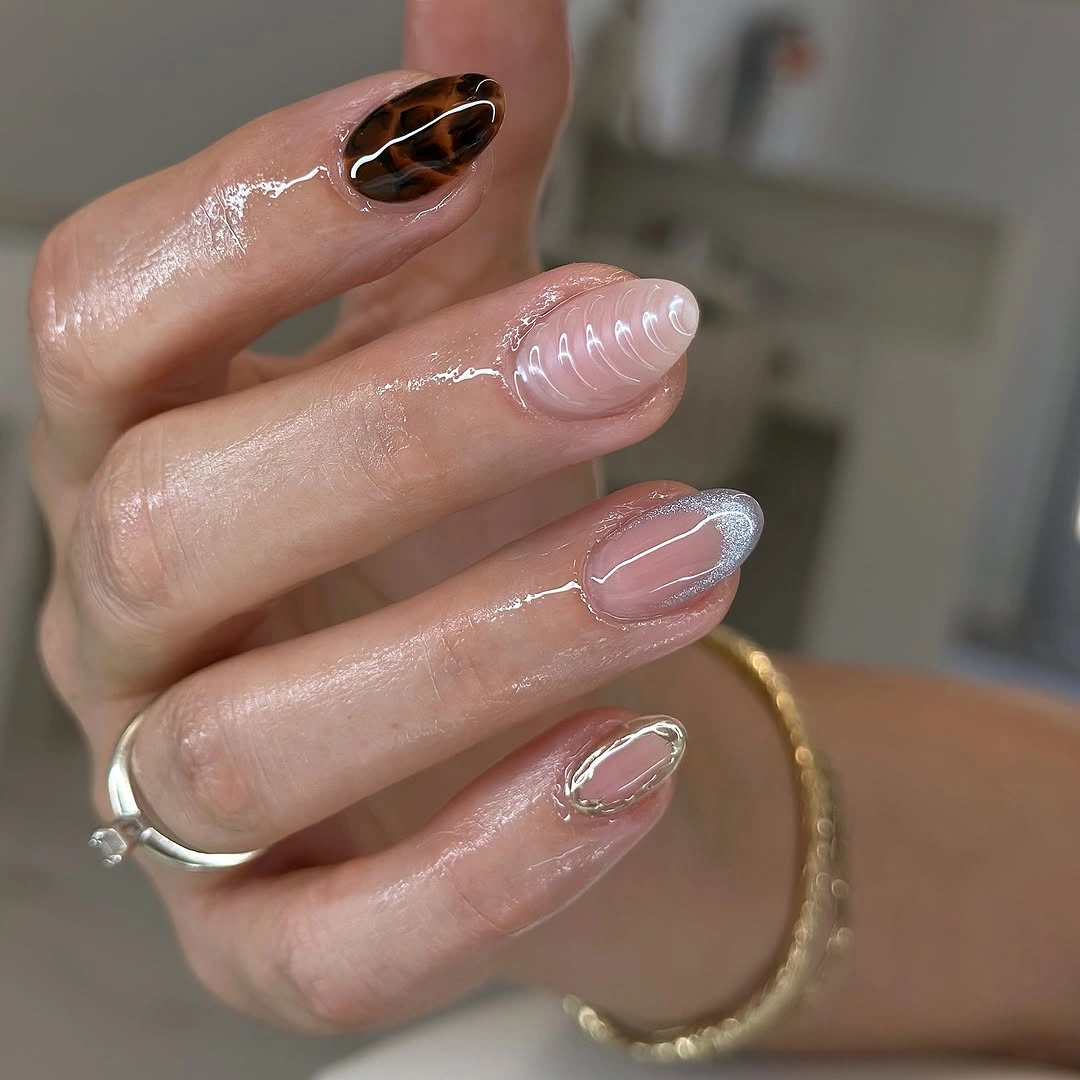
The contrast works because the dark nail is isolated. Its deeper pattern gives the eye somewhere to rest, while the pearly swirls on the other fingers create a softer repeated movement. This arrangement is more effective than placing dark detail everywhere, since the lighter nails provide the breathing room needed for the accent to feel intentional rather than simply heavier.
For a simpler version, keep the textured swirl on one nail and use a flat pearly finish on the rest. A dimensional-looking surface can show wear or unevenness more readily than a smooth glossy color, so reducing the number of textured nails also makes upkeep easier. The design still reads as fresh when the pale palette stays dominant and the dark accent remains specific.
Pink, Yellow, and Lilac Make Bright Blocks
Pink provides the main field in this compact manicure, while yellow and lilac appear as curved blocks or half-moon shapes on selected nails. The finish is glossy, and the shape stays short, so the colors create the interest without requiring a long silhouette. Warm yellow and cool lilac bring contrast from opposite directions, but pink keeps the collection visually connected.
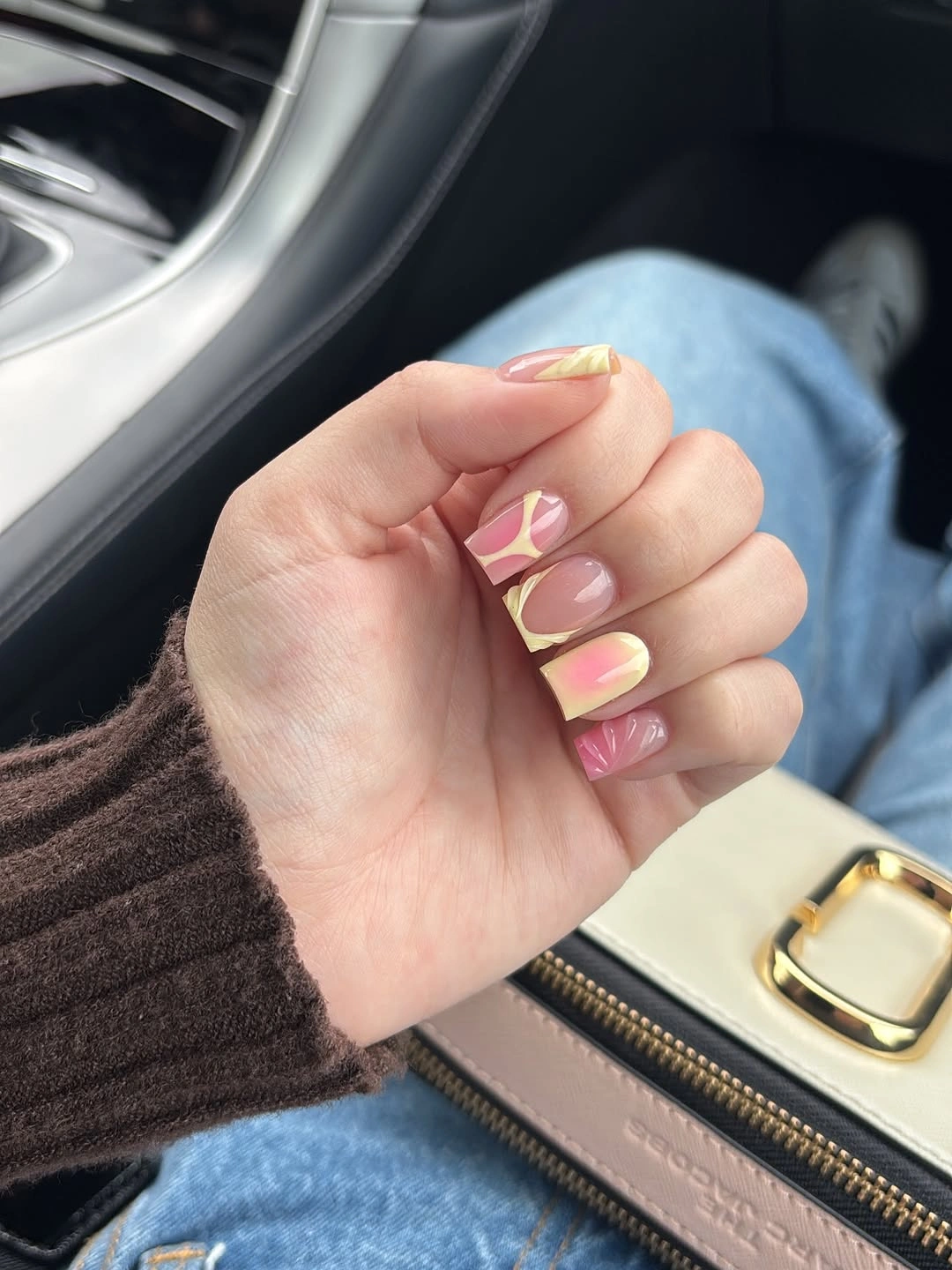
The rounded placement of the blocks keeps the palette from looking like hard geometry. Yellow catches the eye first, lilac cools the composition, and the pink base gives both accents room to sit without making the set feel crowded. This is a useful approach when simple nails need color variation but still need one dominant shade to hold the design together.
Repeat pink on most nails and use one yellow-lilac accent if you want the easiest adaptation. On a shorter surface, a full block can take up too much visual weight, so a half-moon or small curved section may preserve the idea better. The important decision is the color relationship, not the number of separate shapes, and keeping pink in control makes the result feel composed.
Thin Multicolor Stripes Create a Clear Rhythm
Several short nails show pink bases crossed by thin red, blue, and white horizontal bands. The shape is softly squared and the lines stay narrow, so the manicure feels graphic without losing the compact outline. The colors are more vivid than the cream examples, but the repeated stripe direction gives the set a clear rhythm that keeps the mixture from becoming scattered.
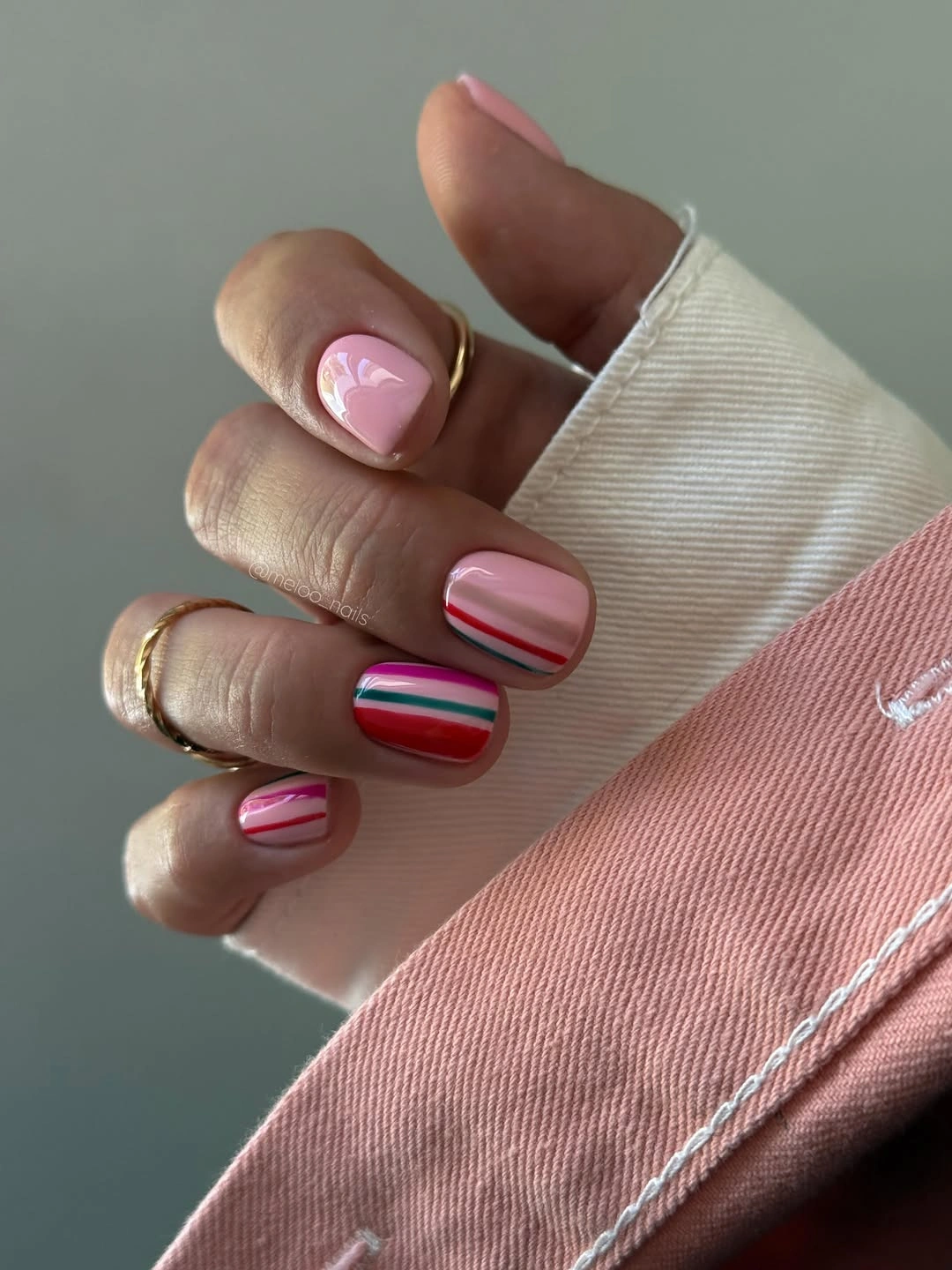
Horizontal stripes work here because the pink base remains visible between them. Red supplies warmth, blue adds a cool interruption, and white separates the colors so they do not blend into one dark band. The design is simple in structure even though it uses several shades, which makes it a useful reference for a short manicure that wants a little energy without a complex motif.
Use two stripes instead of three when the nail bed is especially short. Each color needs enough width to remain distinct, and compressed lines can turn the clean rhythm into a blur. A practical adaptation can also place the stripes on two accent nails while keeping the remaining fingers pink; that preserves the direction and color story while lowering the amount of detail to maintain.
Black Lines Give Bright Blocks Structure
This manicure mixes a white nail with black curved lines, a yellow block, a green solid nail, and other dark outlined geometric accents on short nails. The palette is bolder than the neutral sets, but the black line work repeats across the fingers and gives the different colors a common frame. Short length keeps the composition compact, while clean blocks prevent it from becoming visually muddy.
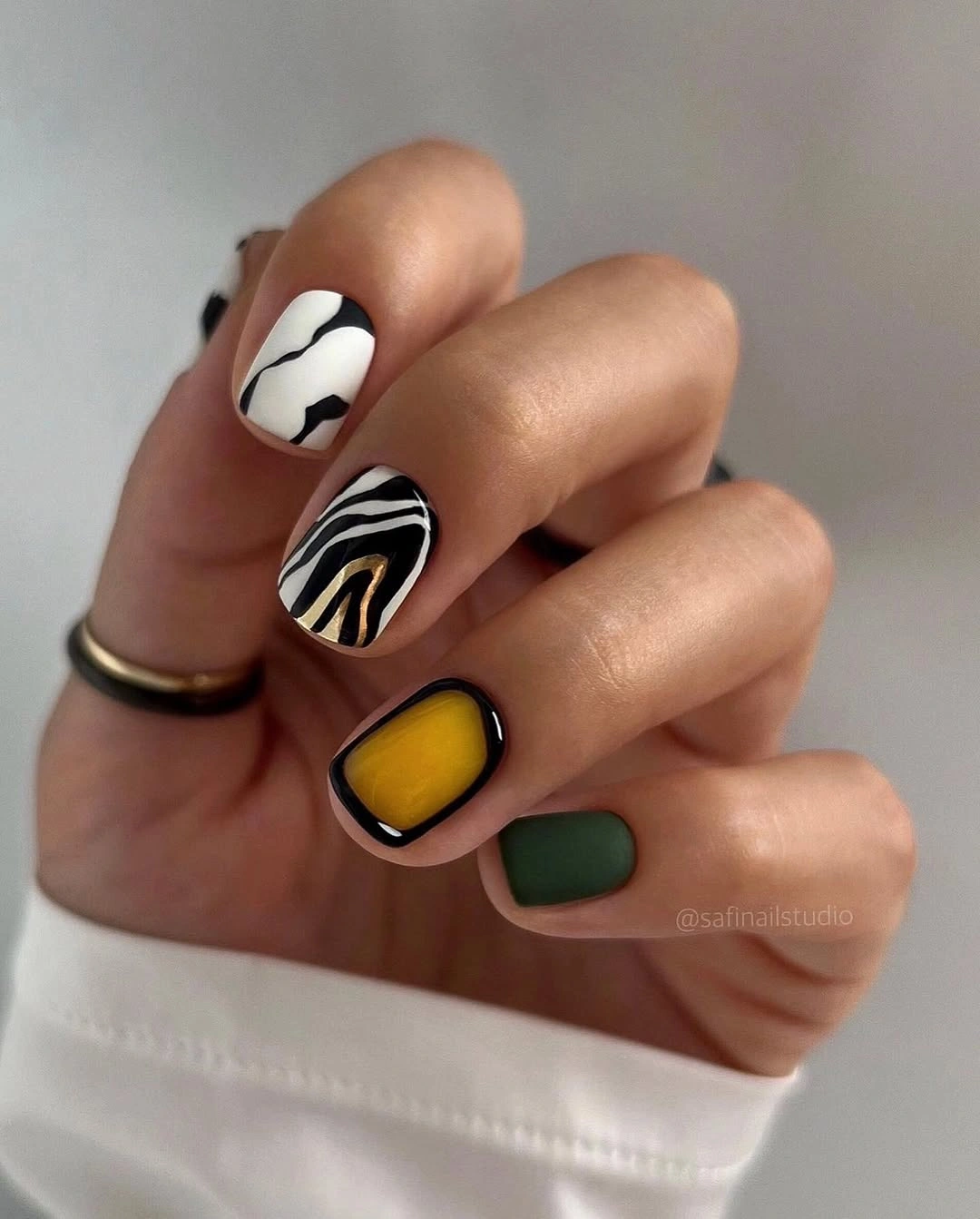
The strongest feature is the way black separates the brighter colors. White offers space, yellow and green provide distinct color signals, and the repeated dark outlines make the variety look deliberate rather than accidental. This is a more editorial version of simple fall nails: the idea is not minimal color, but selective color with enough clear structure to keep every accent legible.
Choose the black-and-white line nail plus one color block for a restrained adaptation. Trying to keep every geometric detail on a short surface can remove the open areas that make the palette work, while one clear contrast pairing will still feel purposeful. The limitation is visual intensity, so reducing the number of bright colors is more effective than making every block smaller.
Orange and Red Bands Warm a Nude Base
Warm orange and red glossy bands curve across nude or translucent short nails in offset rounded shapes. The colors sit in the same seasonal family, but their different intensity levels keep the set from looking like one flat red field. The compact nails give the bands a contained scale, and the nude base shows through enough to make the design feel light rather than fully saturated.
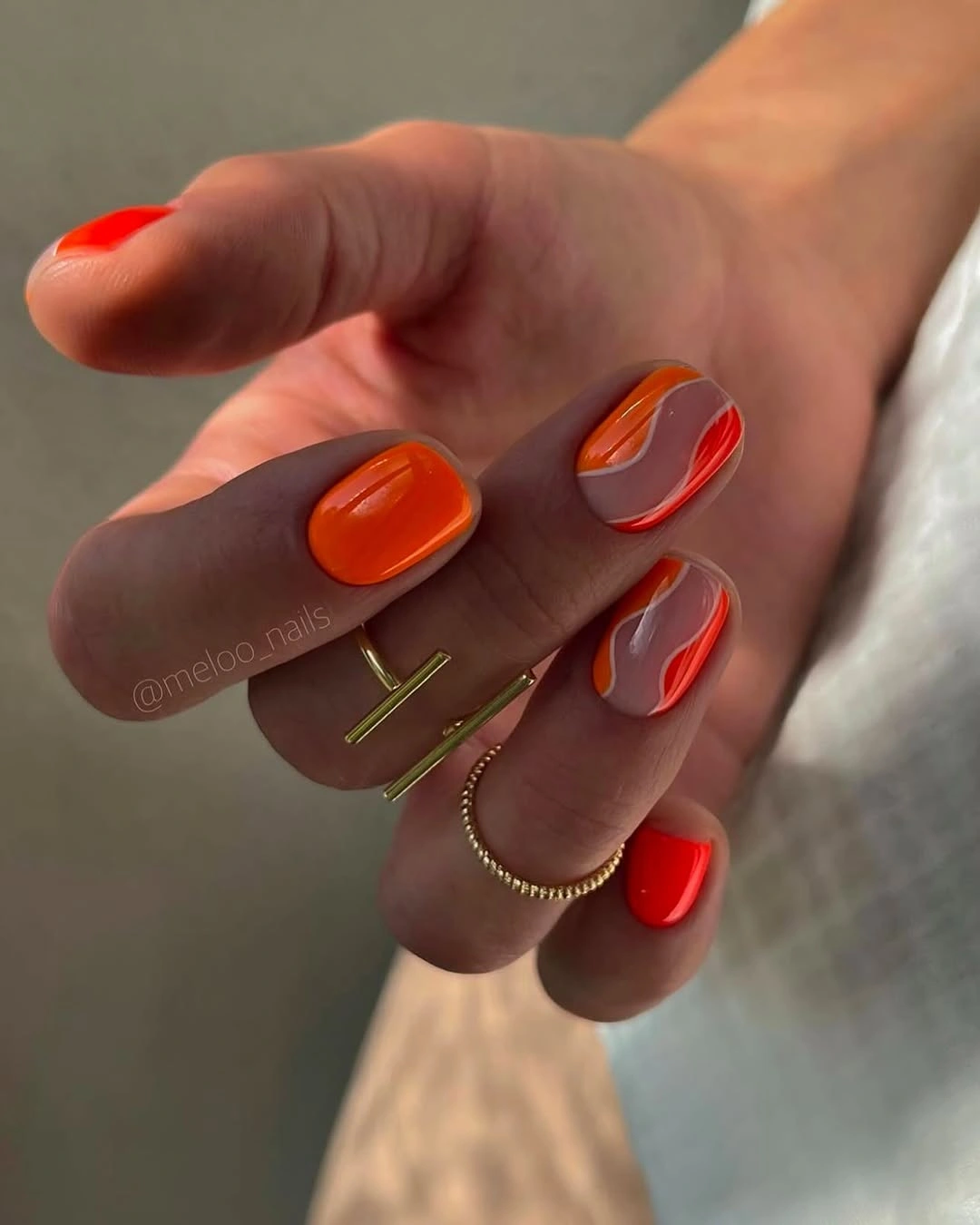
Curved bands create movement without requiring a detailed motif. Orange catches light and brings warmth, red gives the eye a stronger anchor, and the nude space keeps both shades separated. This is a simple way to create visual interest through placement alone, especially for someone who wants fall color but prefers a manicure that still feels open and easy to wear.
Use one orange band on a nude base if the full warm mix feels too vivid. A short nail benefits from broad, clean curves more than many narrow ones, so leaving out a second color can actually make the main shape easier to read. Keep the red as the supporting depth and let the nude space remain generous enough to show where each band begins and ends.
Speckles Add Warmth without Hard Edges
This quiet set combines a creamy pale yellow or nude solid with tiny yellow-orange speckles on a few short rounded nails. The marks are small and scattered rather than arranged into a strict pattern, so the manicure feels casual and softly seasonal. The simple base remains the majority, which gives the speckled accents enough contrast to be visible without turning the design into full coverage.
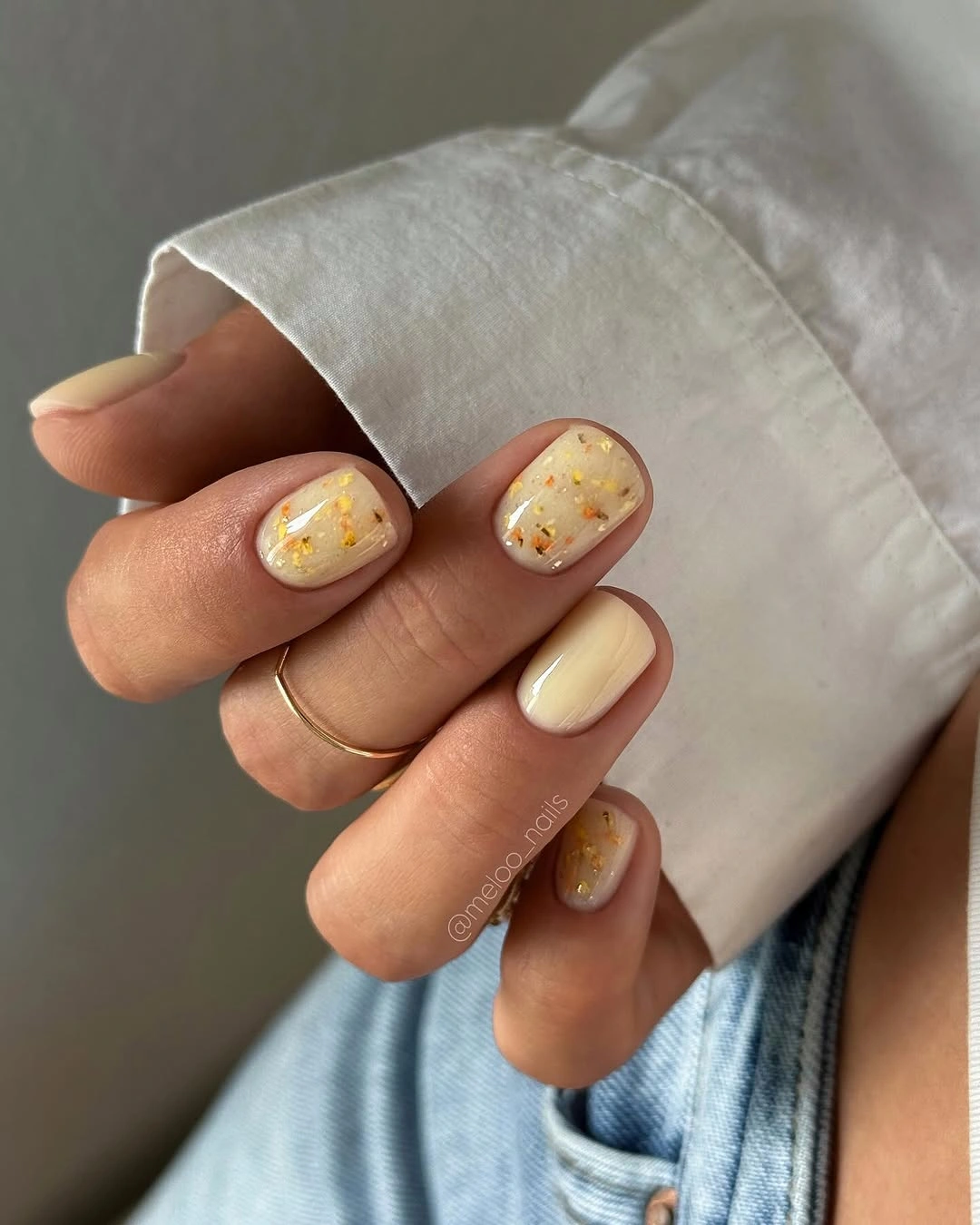
Speckles change the surface without changing the silhouette. They add warmth in small points, while the creamy base keeps the overall result light and easy to coordinate. This is a useful alternative to stripes or blocks when you want a simple fall detail that does not create a strong direction across the nail and does not require every accent to line up perfectly.
Concentrate the speckles near the tip or on one accent nail if your nails are very short. Even tiny marks can become visual noise when they cover every available space, and a clear area will make the cream base look more intentional. The practical advantage is forgiving placement, but the design still needs restraint; the charm comes from a few warm points, not a dense dotted layer.
Fine French Edges Keep Nude Nails Crisp
These short nude nails use a glossy sheer base with very fine pale or metallic-looking tips and tiny accents near the edges. The shape is compact and rounded, so the border follows the existing outline rather than adding a large graphic panel. The result is polished but quiet, using a small change in finish or color to give the neutral set a clear ending at the tip.
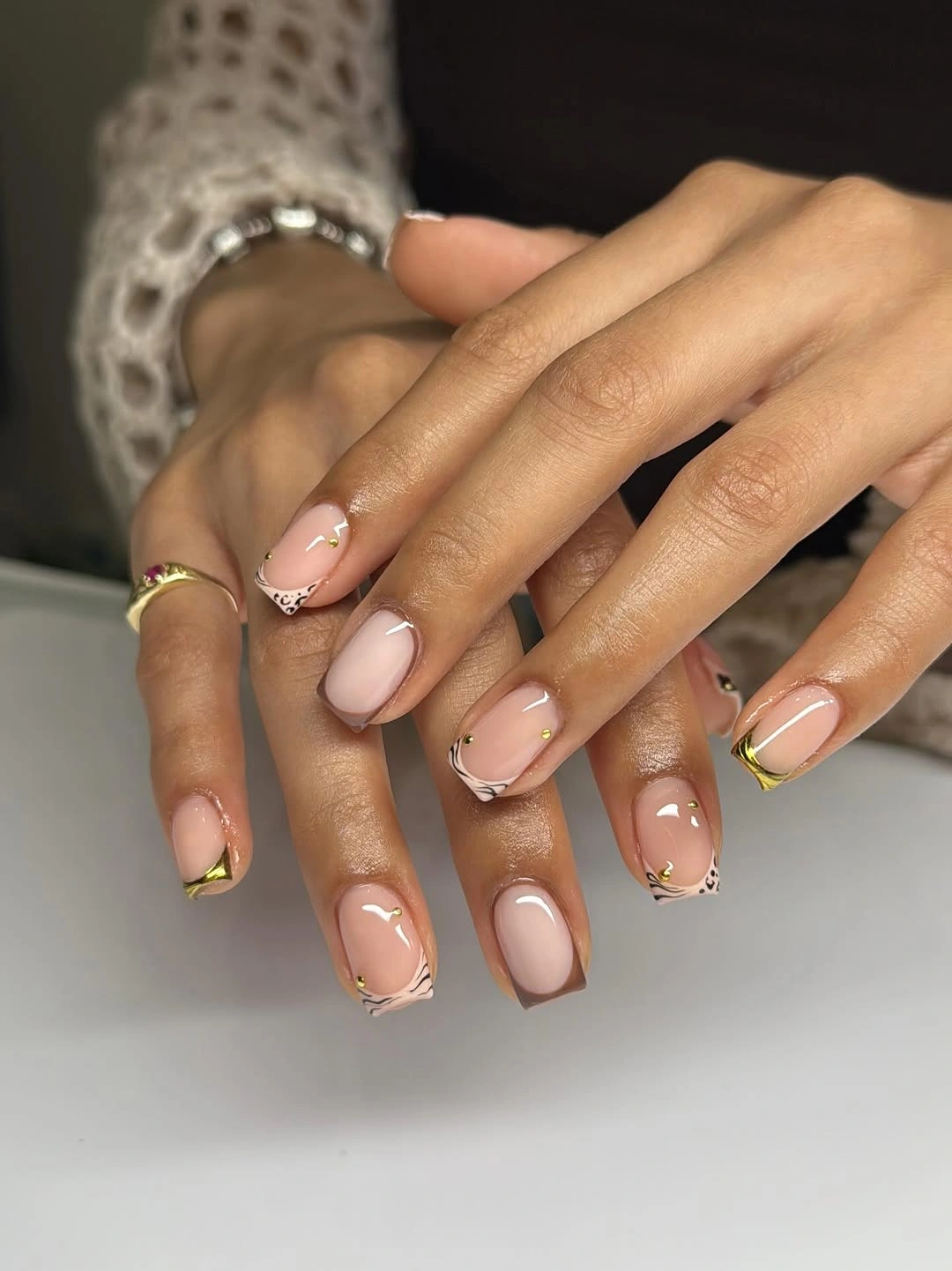
The fine edge works because it preserves negative space. The nail remains mostly nude, but the thin line makes the silhouette easier to see and gives the eye a reason to follow the tip. Small edge details add interest without competing with the base, which is a good model for simple nails when a full motif would feel too busy or too formal.
On a very short nail, one thin edge is enough. Adding dots, extra borders, and additional accents can compress the open center and make the manicure look less clean than the reference. Keep the line delicate and the base glossy if you want maximum clarity; the simplicity is not a lack of design, but a decision to let placement carry it.
Cool Dots Brighten a Deep Brown Base
Deep brown or near-black nails provide the background for small pale blue and white circular dots in this compact manicure. The rounded shape is short, and a dark glove-like setting surrounds the hand, making the light dots appear even more distinct. The motif is simple, but the color contrast gives it enough presence to feel playful without requiring stripes, checks, or layered artwork.
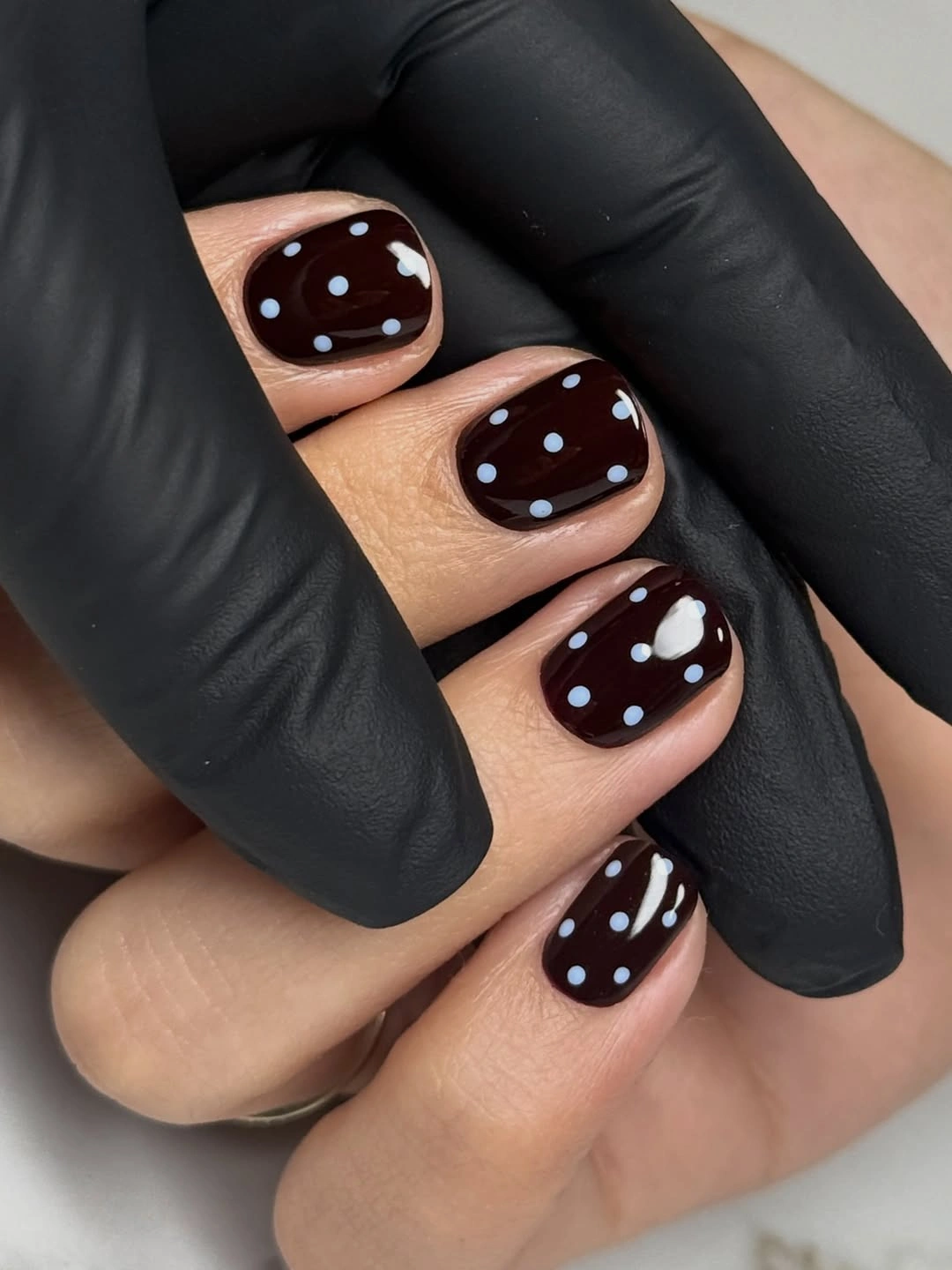
The dots function like small lights across a dark field. Pale blue introduces a cool note against the warmth of brown, while white keeps the points crisp and prevents the design from looking flat. Because the base occupies most of the nail, the set remains visually grounded even though the accent color is unexpectedly bright for a fall palette.
Use fewer dots and keep them away from the sidewalls when adapting the idea to an especially short nail. A dark base can make crowded points look like one irregular patch, while spaced circles preserve the clean motif. The practical strength of this design is repeatability, but the finish still depends on leaving enough brown visible for the contrast to remain the first thing you notice.
Pale Pink Lets Stripes and Dots Share Space
The closing manicure uses pale pink as the main color, then gives one finger striped bands and another dotted details in soft red or white. The nails are short and rounded, so the small motifs stay close to the surface instead of competing with a long silhouette. Repeating the pale base between the two accents makes the different marks feel connected and keeps the overall result calm.
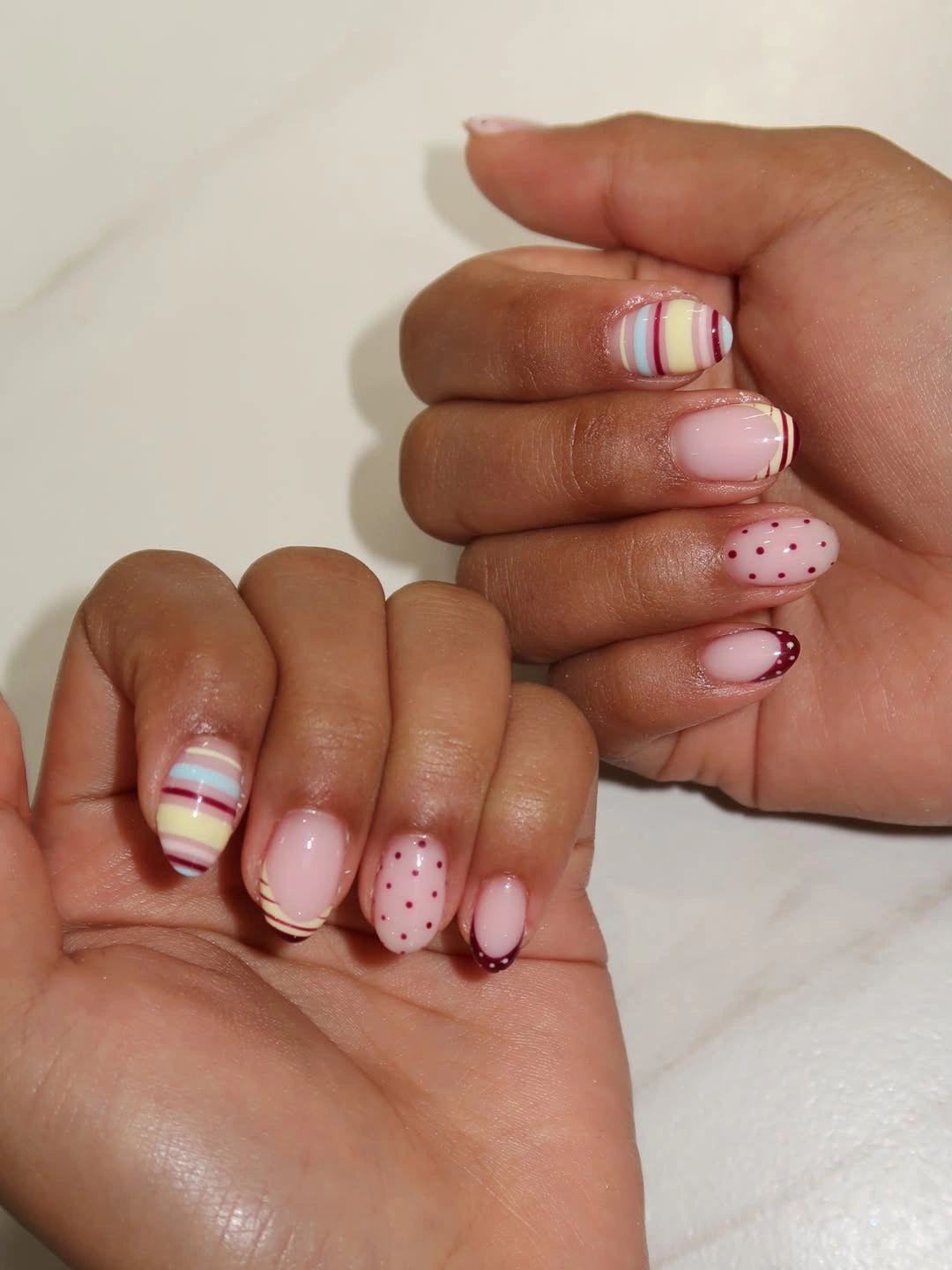
Stripes and dots create two different rhythms, but neither one dominates because each is isolated. The pale pink field acts as a visual reset between them, and the soft contrast prevents the set from feeling as graphic as the zebra or black-yellow designs earlier. This is a useful closing idea for simple fall short nails: personality can come from two small changes when the base remains clear.
Choose either stripes or dots if you want the most minimal version, then keep the remaining nails pale pink and glossy. The compact shape will show the chosen motif more clearly when the other accent is removed, and the set will remain easy to coordinate with neutral clothing or richer fall colors. The detail that keeps simplicity from feeling unfinished is the deliberate placement of that one accent, not extra decoration everywhere.