Fair skin can make a tiny mark look louder than expected. A narrow line may become the first thing the eye notices, while a quiet base can soften a stronger surface and keep the hand from looking visually crowded. The real challenge is not finding enough detail, but deciding which small decision deserves attention and which one should stay in the background.
The safest way to choose is to remove one element mentally and watch what changes. If the manicure loses its balance without the edge, the edge is doing structural work; if nothing changes when a mark disappears, it may be decoration without a job. That test leaves room for personality while keeping the final result readable, proportionate, and easier to maintain.
Pale dots make chocolate almond nails lighter
Long almond nails begin with a glossy chocolate-brown base and add small cream dots to several fingers. The marks are not large enough to compete with the rich color, but their repeated pale value breaks the dark surface into a softer rhythm and keeps the long almond shape from reading as one uninterrupted block of brown.
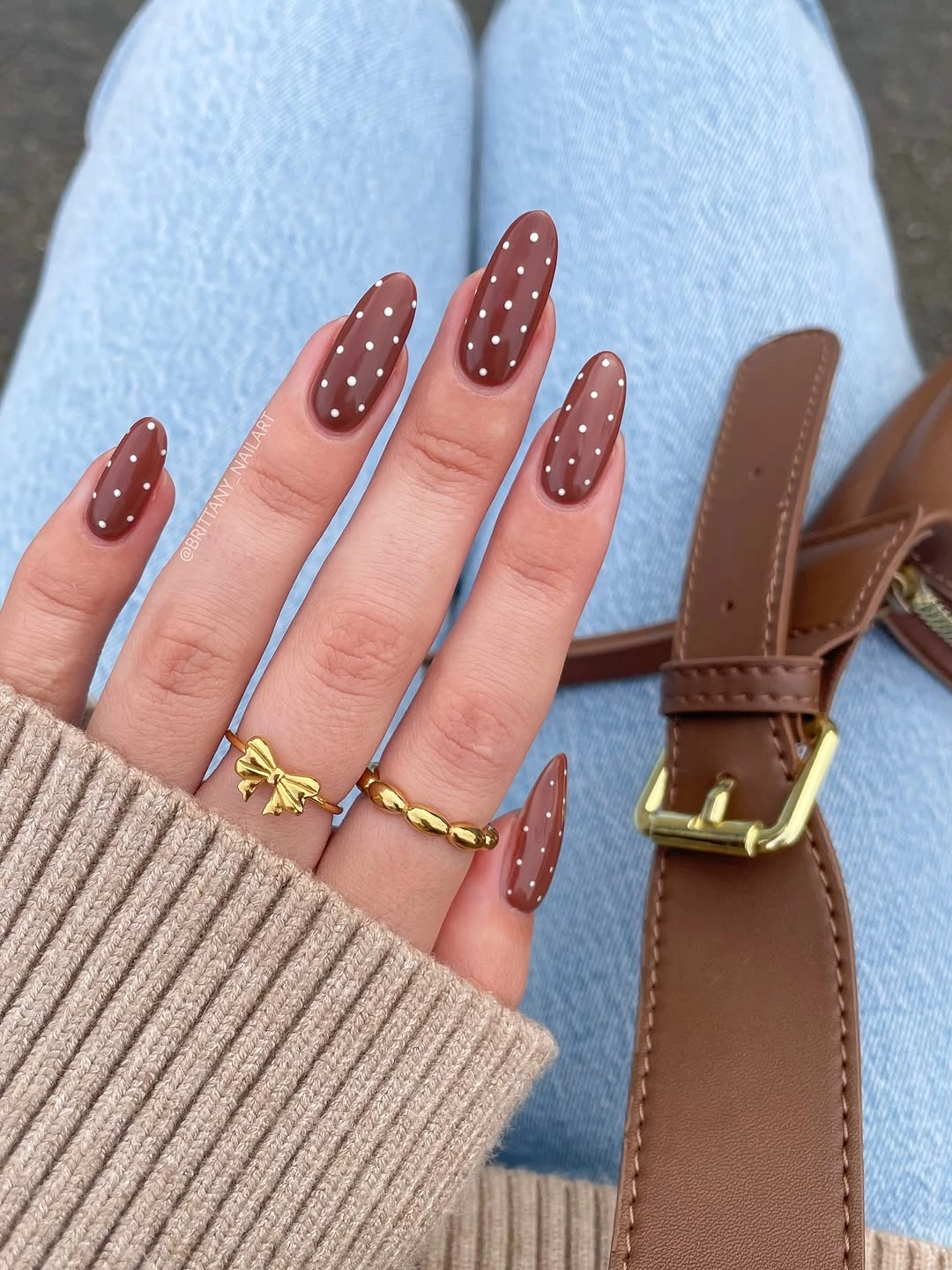
Placement is doing most of the work: the dots sit over the dark field rather than forming a separate border, so the eye notices the base first and the detail second. Use fewer dots on a shorter almond, or place them only near the tip, because shrinking every mark can make the pattern look crowded while a limited cluster will preserve the same contrast.
The simple repetition makes this design easier to adapt than a full illustration, although a glossy dark surface shows chips quickly. A medium almond keeps the length elegant with less practical pressure, and a warm cream dot will remain softer against fair skin than a stark white one. Keep the base rich and the accents sparse if the goal is depth with a light touch.
One fine curve breaks a solid brown set
Most of the medium almond nails are a smooth chocolate brown, while one translucent accent carries a delicate lighter-brown curved line. That tiny interruption changes the whole set because it introduces open space and direction without replacing the main color, giving the eye a detail to find after the solid nails establish the first impression.
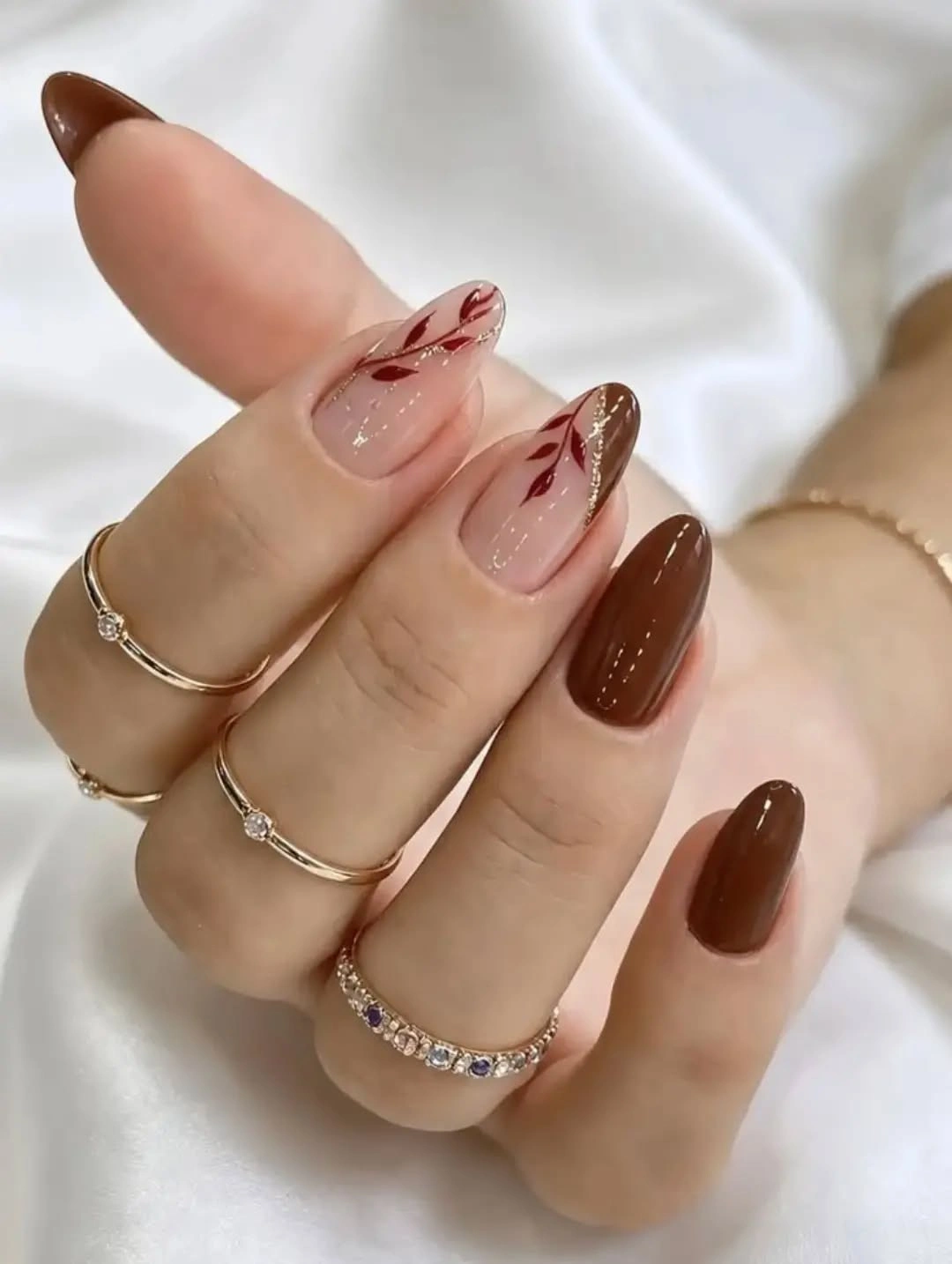
The accent works precisely because it is not repeated everywhere. Leave the line thin and slightly offset from the center so it reads as a placed mark rather than a second French tip, then keep the other nails glossy and plain. A shorter almond can use a small half-moon or side curve, but the background should stay sheer enough for the contrast to remain visible.
Nearly monochrome color also makes the surface finish important, since uneven shine can become more noticeable when there is no pattern to distract from it. If you want more autumn depth, shift the brown slightly warmer or darker instead of adding several new accents. The detail-first lesson is simple: one line has more effect when the surrounding nails give it room.
Plush red meets plaid and silver sparkle
A saturated set combines glossy burgundy, bright red, one silver-glitter nail, and a pale plaid accent. The plaid is the small detail that prevents the reds from merging into one continuous field, while the glitter catches light on a single finger and adds a different texture without turning the whole manicure into a sparkle statement.
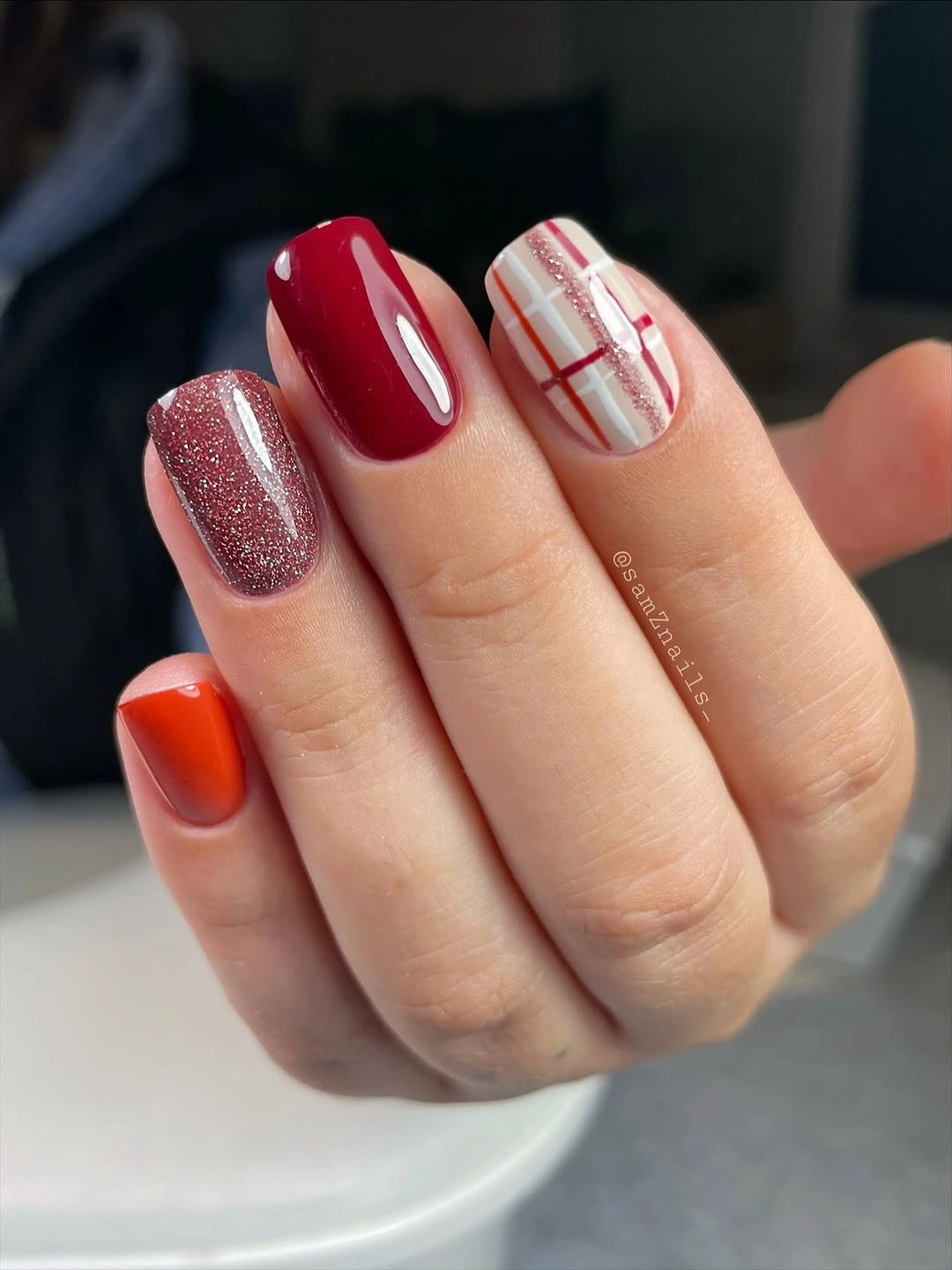
Color repetition keeps the mix coherent even though the finishes change. Keep the burgundy and red close in value, then let the plaid carry the lightest panel so its lines remain readable; if the nails are shorter, enlarge the plaid blocks and reduce the number of stripes rather than forcing fine lines into a small space.
The silver accent is most useful when it stays isolated, because a second glitter nail could compete with the plaid and make the set feel equally loud everywhere. A shorter coffin or soft square will retain the tailored color blocking, while a plain red finger can replace the most detailed accent for easier upkeep. Preserve the contrast between plush color, drawn lines, and one reflective surface.
Orange and olive details share a fall palette
Short-to-medium nails alternate metallic orange, olive green, glitter, and pale bases with small orange floral illustrations. The close detail is the warm palette repeated across different finishes: orange appears as a solid shimmer and in the flowers, while olive gives the brighter color a grounded counterpoint and the pale nails keep the mix from becoming visually dense.
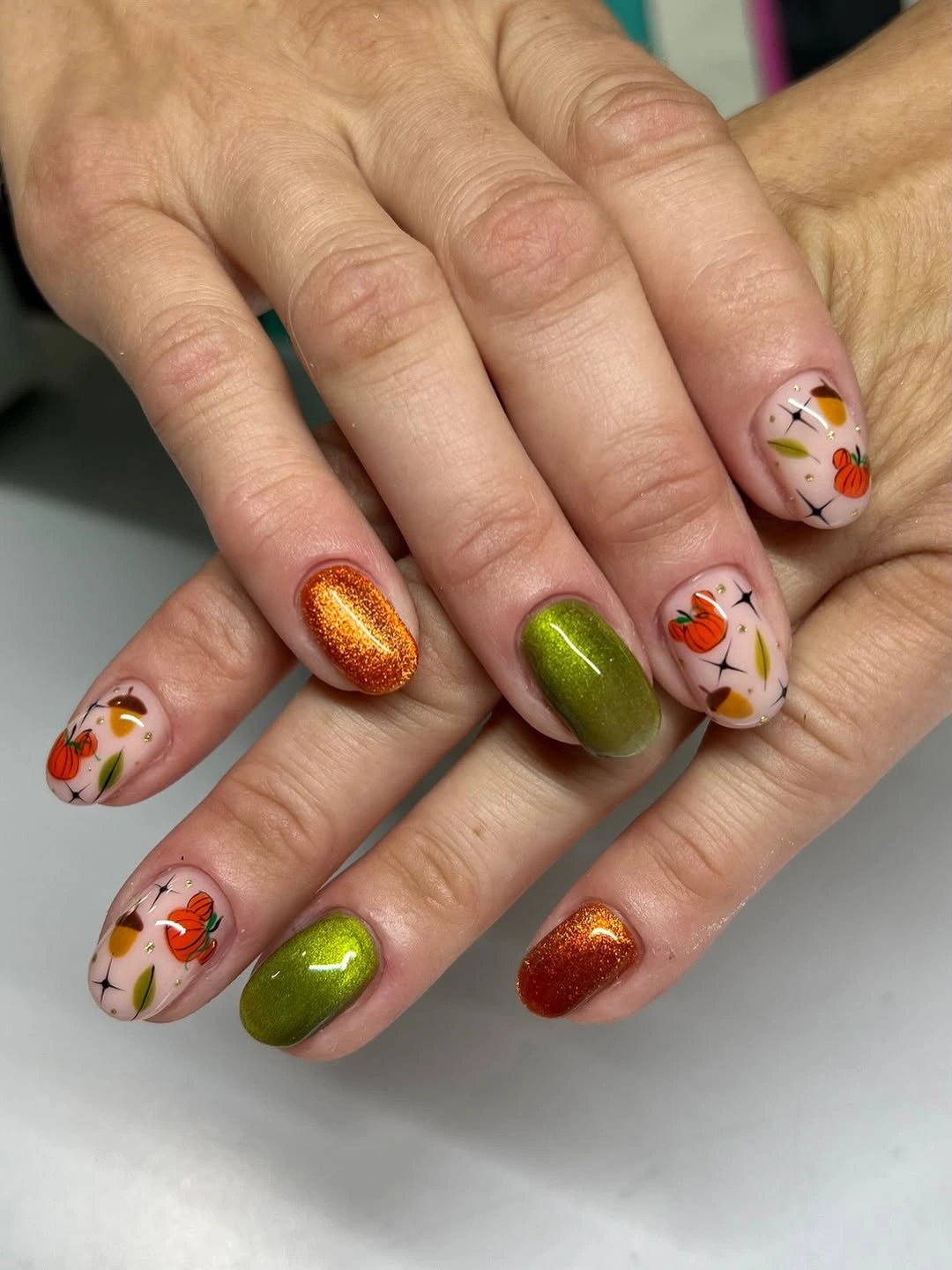
The illustrated nails need open space around each flower, so the light base is more than a background; it is the reason the small marks remain legible. Choose one metallic orange, one olive, and one floral accent for a shorter adaptation, then repeat the colors rather than adding another motif. A limited palette will make the differences in finish feel intentional.
Glitter changes the apparent weight of a color, which means a tiny glitter nail can balance a larger orange surface without matching its area. Keep that contrast in mind if you move to a softer square or short almond, where broad art can feel crowded. The set is strongest when orange is the seasonal signal, olive is the anchor, and floral detail supplies a quiet human touch.
Dark fragments interrupt smoky taupe chrome
Long almond nails use reflective taupe-gray bases, with a few translucent accent panels marked by dark brown and black irregular shapes. The small fragments are the decisive detail because they interrupt the chrome-like field without covering it, allowing the neutral surface to keep its depth while the accents suggest an animal-inspired edge rather than a full print.
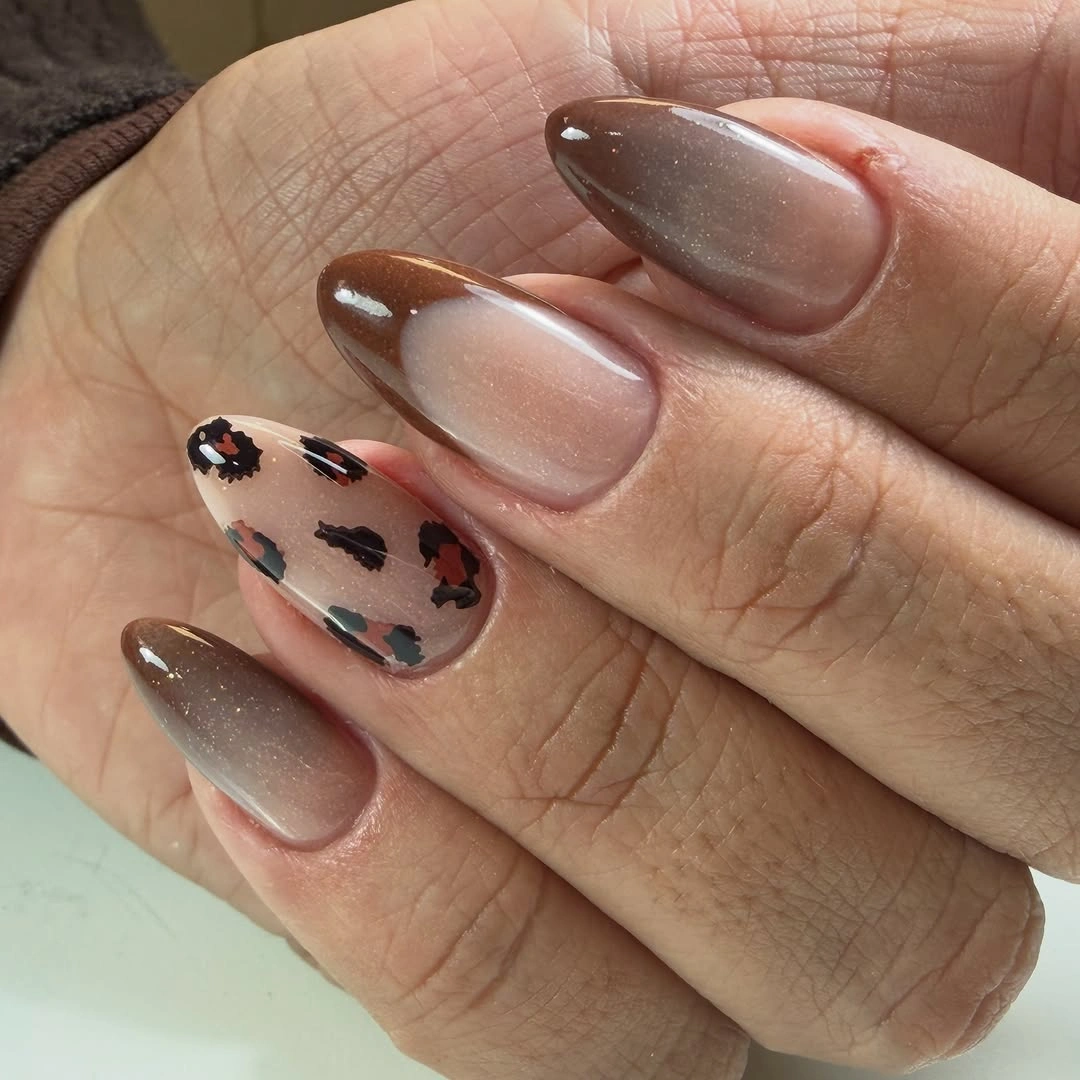
Keep the marks away from the brightest reflective area if you want the finish to remain the first read, or move one accent toward the tip to make the shape look sharper. On a shorter nail, plain taupe shimmer will carry most of the idea and one dark fragment will be enough. The contrast should feel placed, not scattered across every surface.
Reflective neutrals can suit fair skin because their value shifts as the hand moves, but that also means the smallest black detail may look stronger in some light than another. Use restrained line weight and avoid claiming a precise finish beyond what is visible. For related choices, autumn nails color can help you compare a smoky neutral with warmer seasonal values.
One tortoise nail warms glossy brown
Several medium rounded nails are a smooth dark brown, while one accent carries a warm tortoise pattern. The close-up detail is the difference in surface: the solid fingers establish a calm, repeated base and the mottled accent introduces variation without asking the whole set to become patterned, so the eye has one clear place to pause.
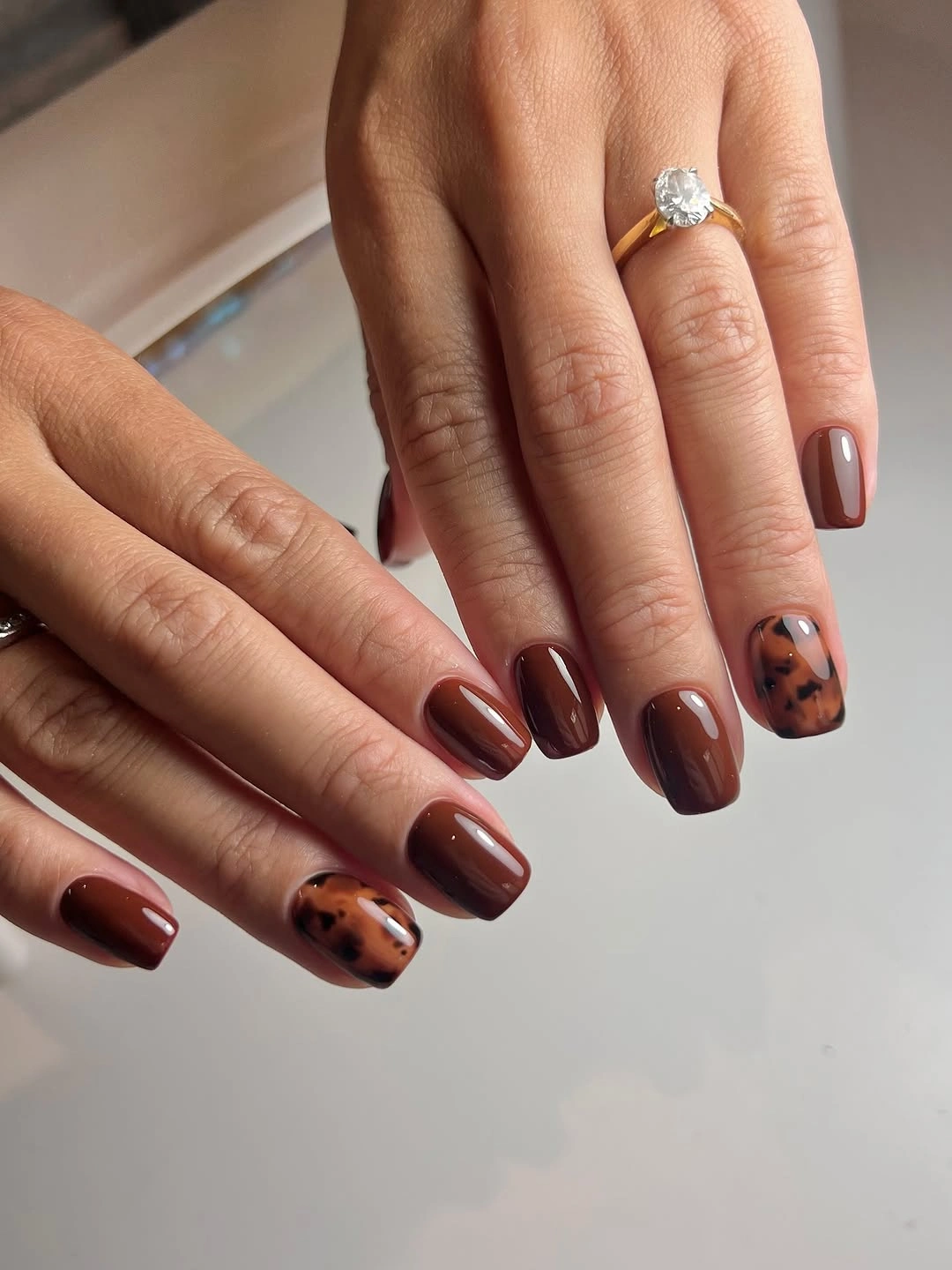
The accent works best when its browns stay close to the main color, because a very bright pattern would pull the set away from its tonal character. Use a single tortoise nail on a shorter shape and keep the rest plain, or move the pattern to the thumb if you want it to appear only in certain gestures. Repetition of the base color is what makes the difference feel controlled.
A rounded or soft square edge will keep the design practical, while a medium length gives the tortoise detail enough room to show its warmer shifts. The honest limitation is that the patterned accent will draw attention to any uneven edge, so maintain the outline consistently. A dark brown base with one lively interruption is often more wearable than a full animal set.
Color-shifting green makes short nails dimensional
Short rounded nails move between deep green, gray, and purple reflections under the light, with no visible motif to distract from the surface. The small but consequential detail is the color shift itself: the set changes as the hand moves, so the compact shape gains dimension from finish rather than from length, line work, or added decoration.
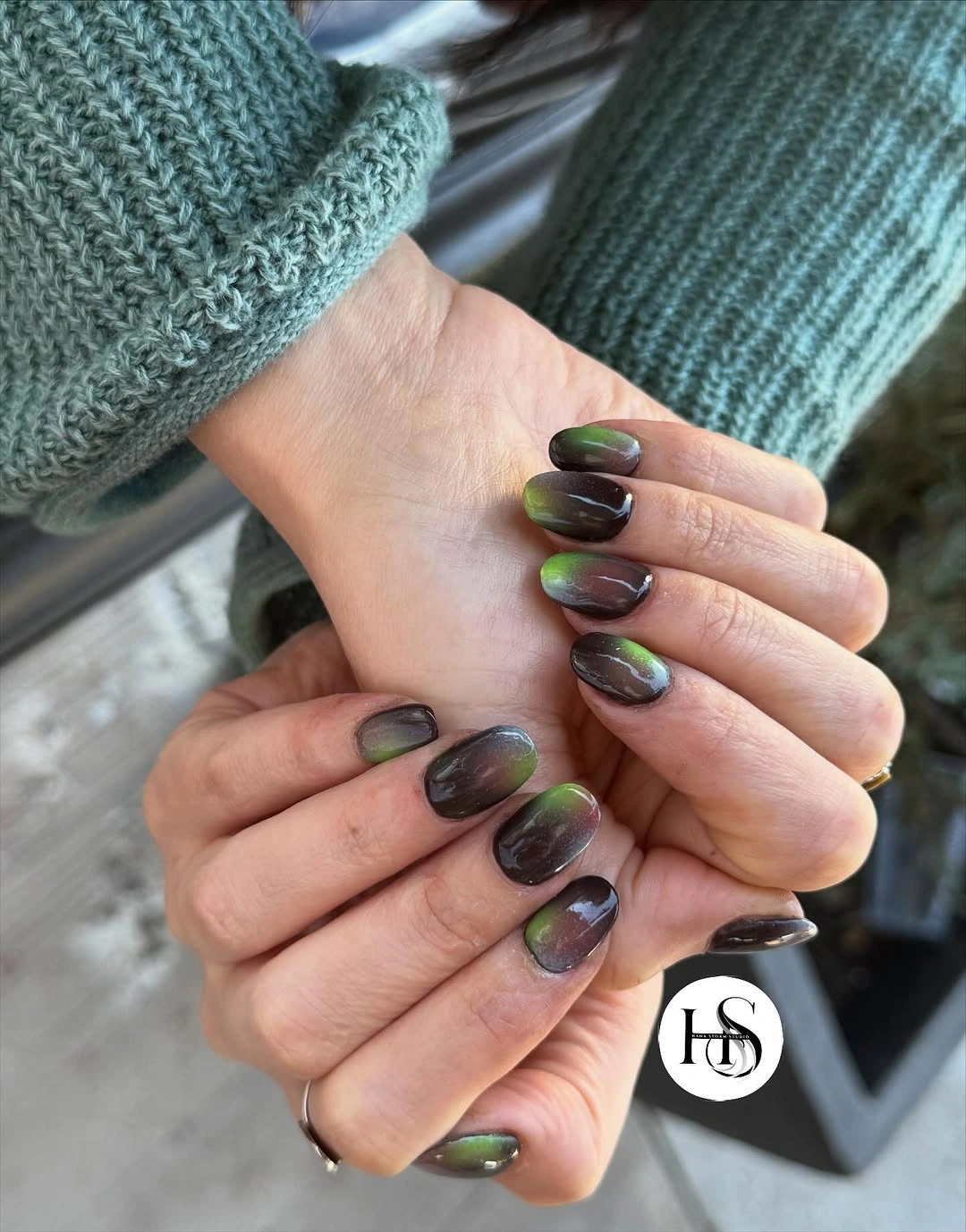
Because the finish carries the interest, keep the shape clean and avoid adding a competing accent unless the green needs visual relief. A short square or soft rounded edge will preserve the practical proportion, while a deeper forest value will make the purple reflection quieter. If the nails are very short, a concentrated reflective band will read more clearly than a busy motif.
This is a useful cooler alternative to the usual warm fall palette, and it pairs well with muted knit textures without relying on a seasonal illustration. Surface consistency matters more than exact color naming, because the visible appeal comes from the movement between tones. Choose one changing finish and let it remain the feature rather than adding glitter simply to make the set more noticeable.
Matte coral gives graphic panels more weight
Long almond nails are mostly matte coral-pink, while two accent nails carry crisp black-and-white illustrated blocks. The matte finish is the detail that changes the color’s behavior: it makes the coral look denser and gives the bright accent panels a cleaner edge, so the design reads as graphic structure rather than a glossy mix of unrelated marks.
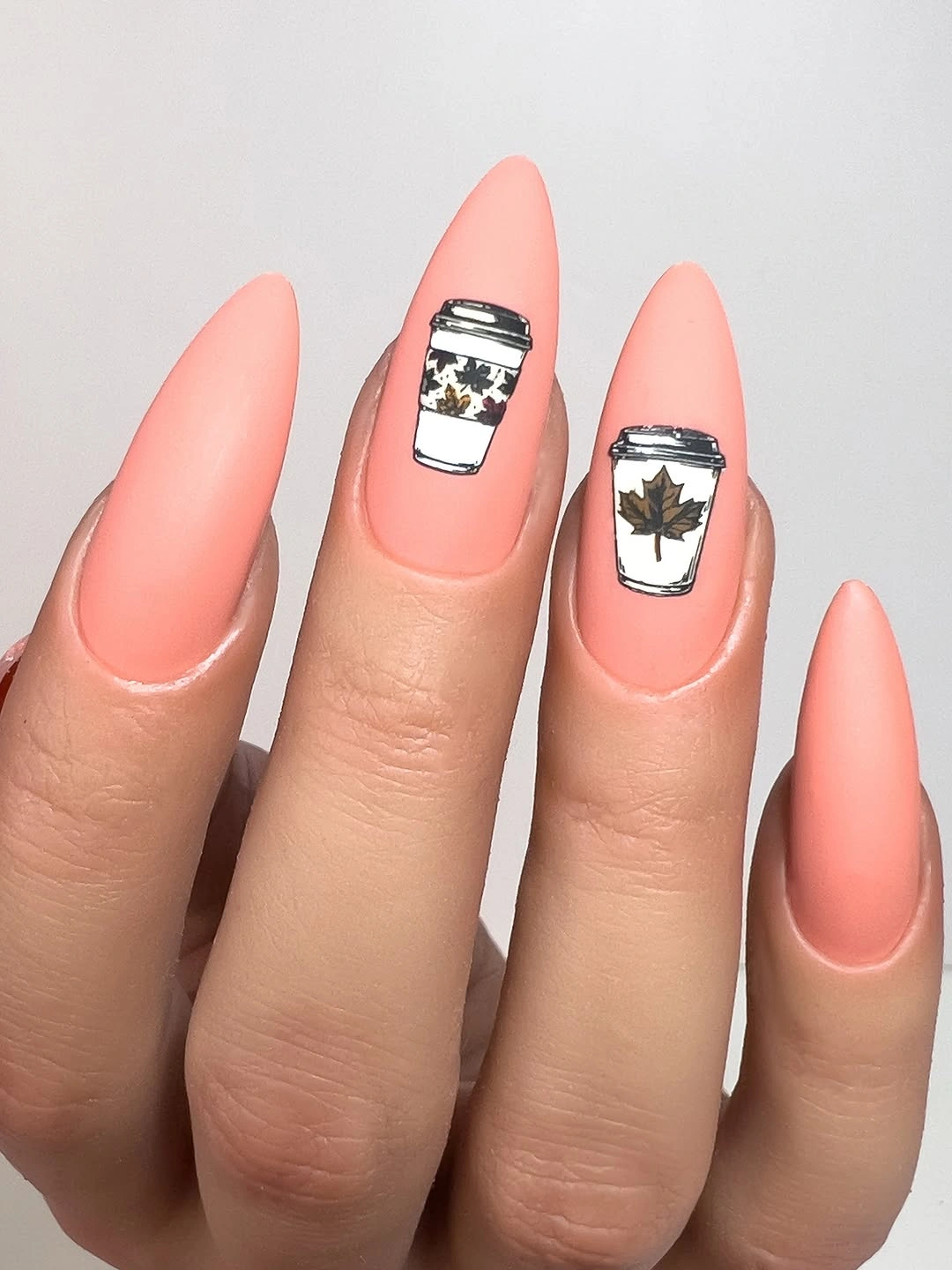
Keep the panels limited to one or two fingers because their sharp contrast already creates a focal point. On a shorter almond, use a single black-and-white block or reduce the drawing to one line, then leave the coral matte and even across the rest. The open coral surfaces will keep the accent legible and prevent the small shape from feeling overworked.
Matte color is honest about surface changes, so it can show wear or uneven texture more quickly than a reflective finish. A medium almond will reduce the practical pressure, and a softly muted coral can make the transition less abrupt if bright color feels strong against fair skin. Keep the black and white clear, because the success depends on that exact interruption of the matte field.
Orange tips anchor pink and slate blue
Long almond nails alternate blush pink and muted slate blue, with a small orange pumpkin-like mark and white detail on one accent finger. The orange is the consequential detail because it gives the cool and soft colors a seasonal anchor without taking over the set, while the pale base around it keeps the motif readable rather than theatrical.
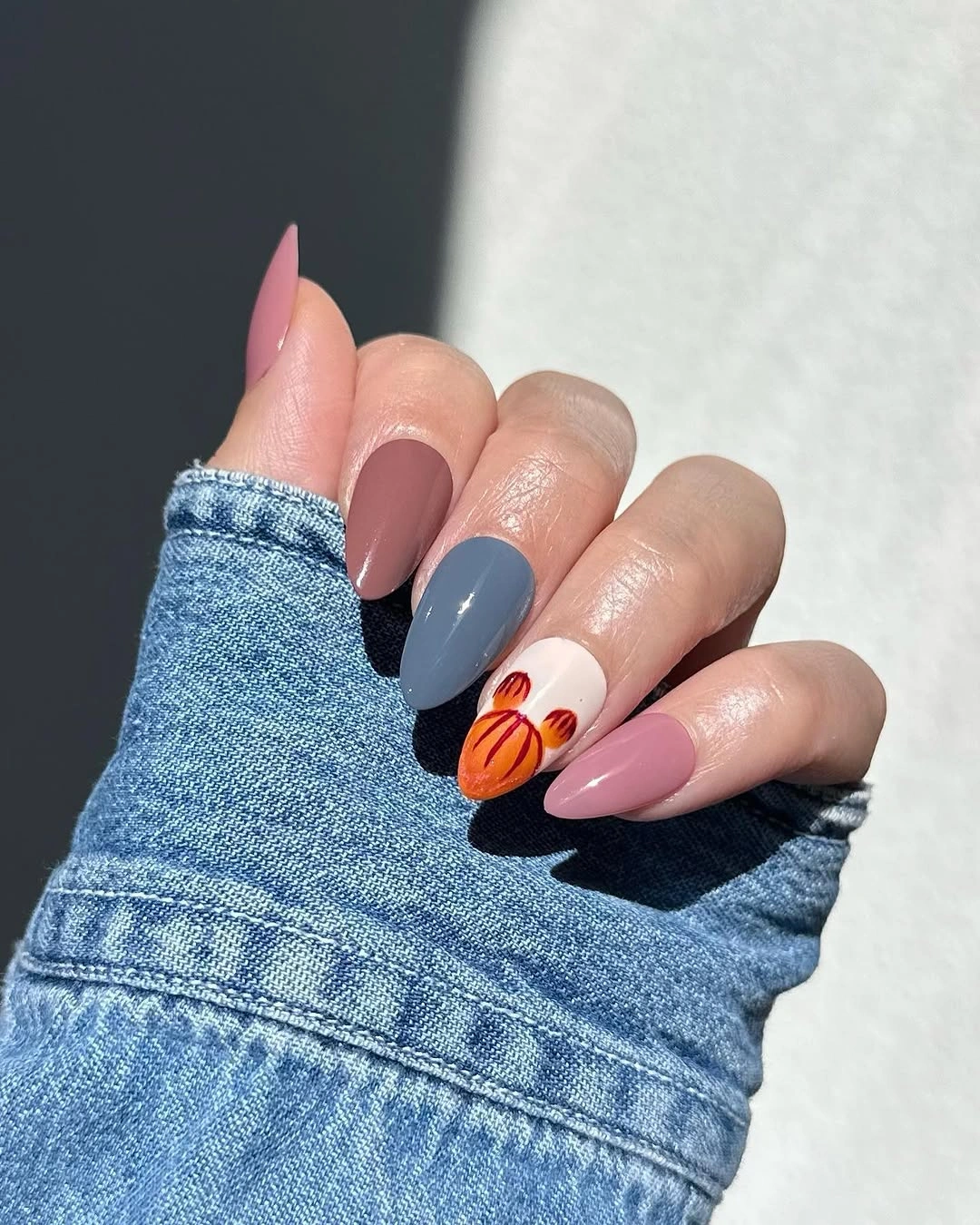
Color placement creates a quiet progression from warm to cool: pink softens the hand, blue supplies contrast, and orange appears only where the eye needs a point of focus. For a shorter version, keep two blue nails, one pink base, and one small orange mark; reducing the number of color changes will make the same relationships easier to see on less surface area.
A themed accent can become limiting if it is too literal, so let the orange shape remain small and pair it with a simple white line rather than adding more seasonal symbols. The rest of the set can move beyond autumn because pink and slate blue are not locked to one occasion. Preserve the one warm spark and the calmer surrounding colors for a more flexible result.
Dot clusters turn nude tips into a soft gradient
Light almond nails fade into clusters of orange and brown dots near the tips, leaving the centers mostly clear. The pattern is not a hard French line; its important detail is the gradual change in dot size and spacing, which gives the free edge warmth while keeping the long shape visually open and allowing the nude base to remain the first layer the eye notices.
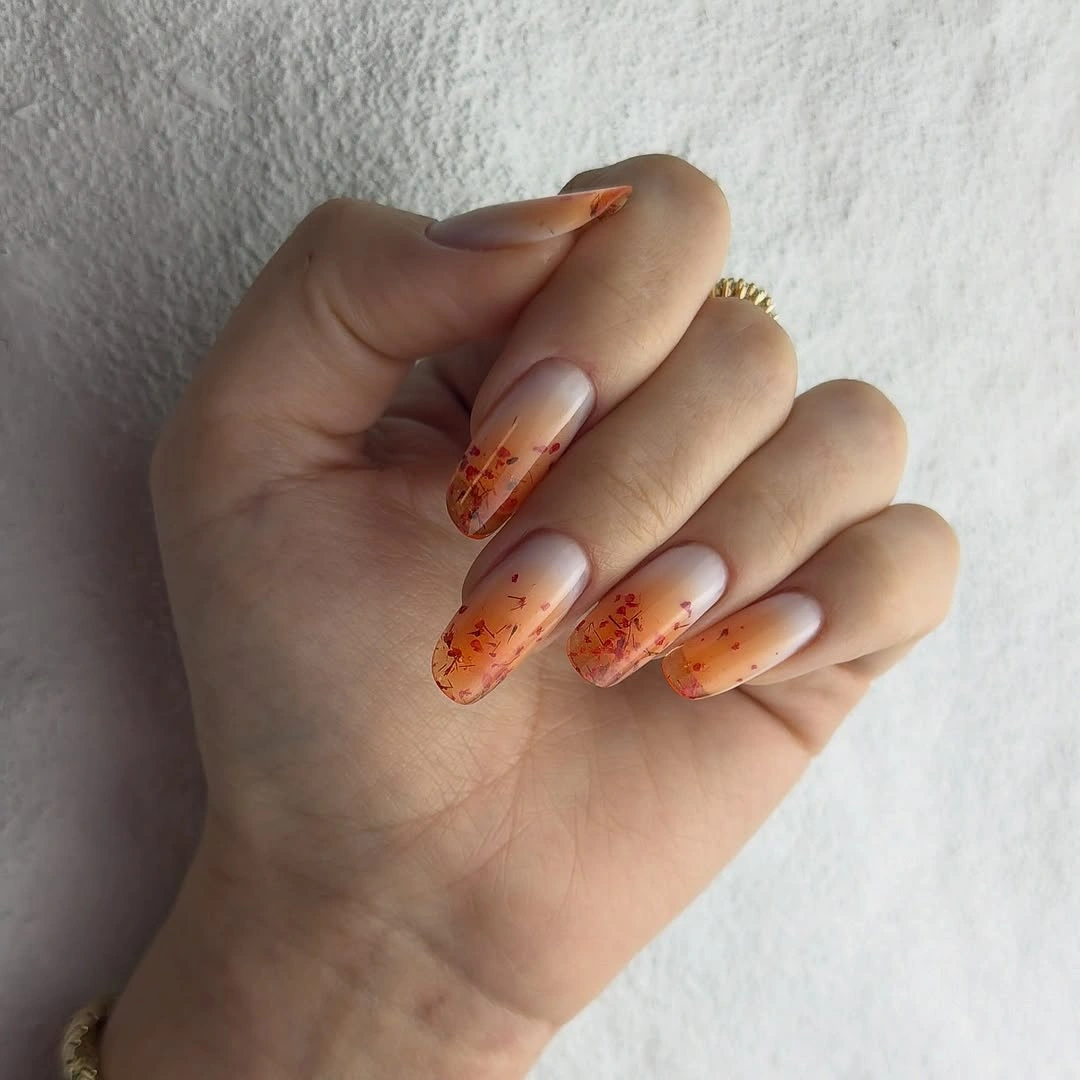
Start with the largest marks at the edge and use smaller dots as they move inward, but leave enough space between clusters to avoid a solid band. A shorter almond needs fewer dots and a slightly lower placement so the tip does not look heavy. Warm orange and brown should stay related in value, otherwise the gradient loses its softness and becomes a row of separate spots.
The open center makes grow-out less disruptive than a fully covered design, yet the free edge still needs a clean outline to keep the dot clusters intentional. Choose a muted orange if you want the set to feel quieter, or keep the brighter orange and reduce its area. The useful choice is whether warmth should arrive as a gentle fade or a sharper tip, not whether more colors are needed.
Fine botanical lines carry the floral accent
Sheer nude almond nails show orange flower shapes, thin green stems, and small burgundy dots, with the botanical drawing concentrated on selected fingers. The fine line is the feature that keeps the motif delicate: it connects the warm colors without filling the nail, while the translucent base gives each stem and petal enough negative space to remain visible.
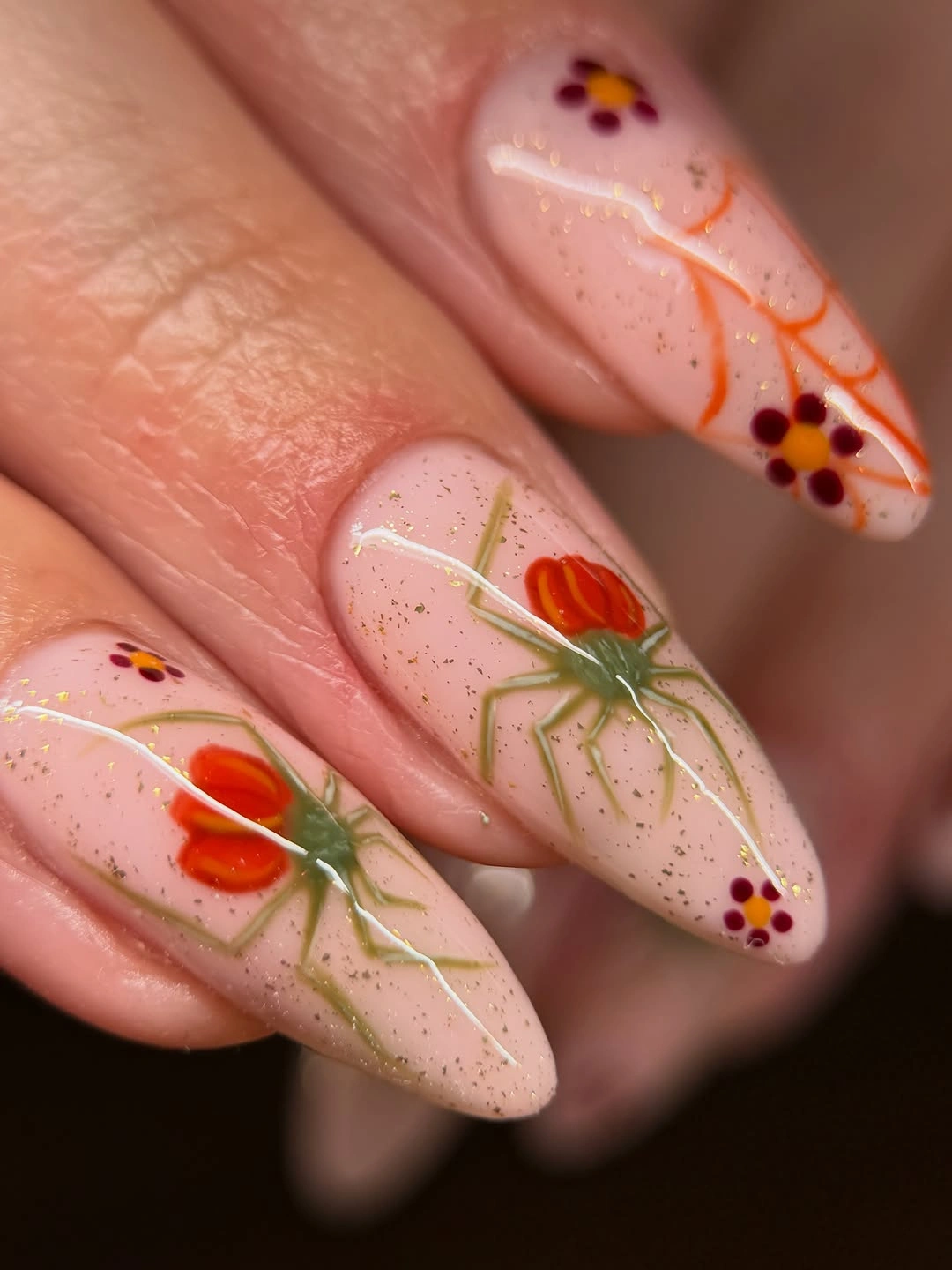
Keep the flowers slightly different in scale so the drawing feels organic, but repeat the same orange and green relationship to maintain continuity. If the nail is shorter, remove the extra burgundy dots before removing the main flower, because the floral silhouette will explain the design more clearly than several tiny marks. One detailed finger can be more effective than five crowded ones.
A pale base also makes the set easy to pair with warm clothing because it does not add another large block of color. The tradeoff is precision: thin stems need enough room and a clean surface, so a medium almond may be more practical than a very short nail. Keep the botanical detail concentrated and let the surrounding nude remain quiet.
Burgundy stripes add order to pale almond nails
Long almond nails use pale bases with burgundy bands, thin gold lines, and curling motifs. The small detail that controls the whole design is the placement of the stripes: they create a clear horizontal rhythm, while the gold curves soften the geometry and prevent the deep burgundy from looking like a heavy block on every finger.
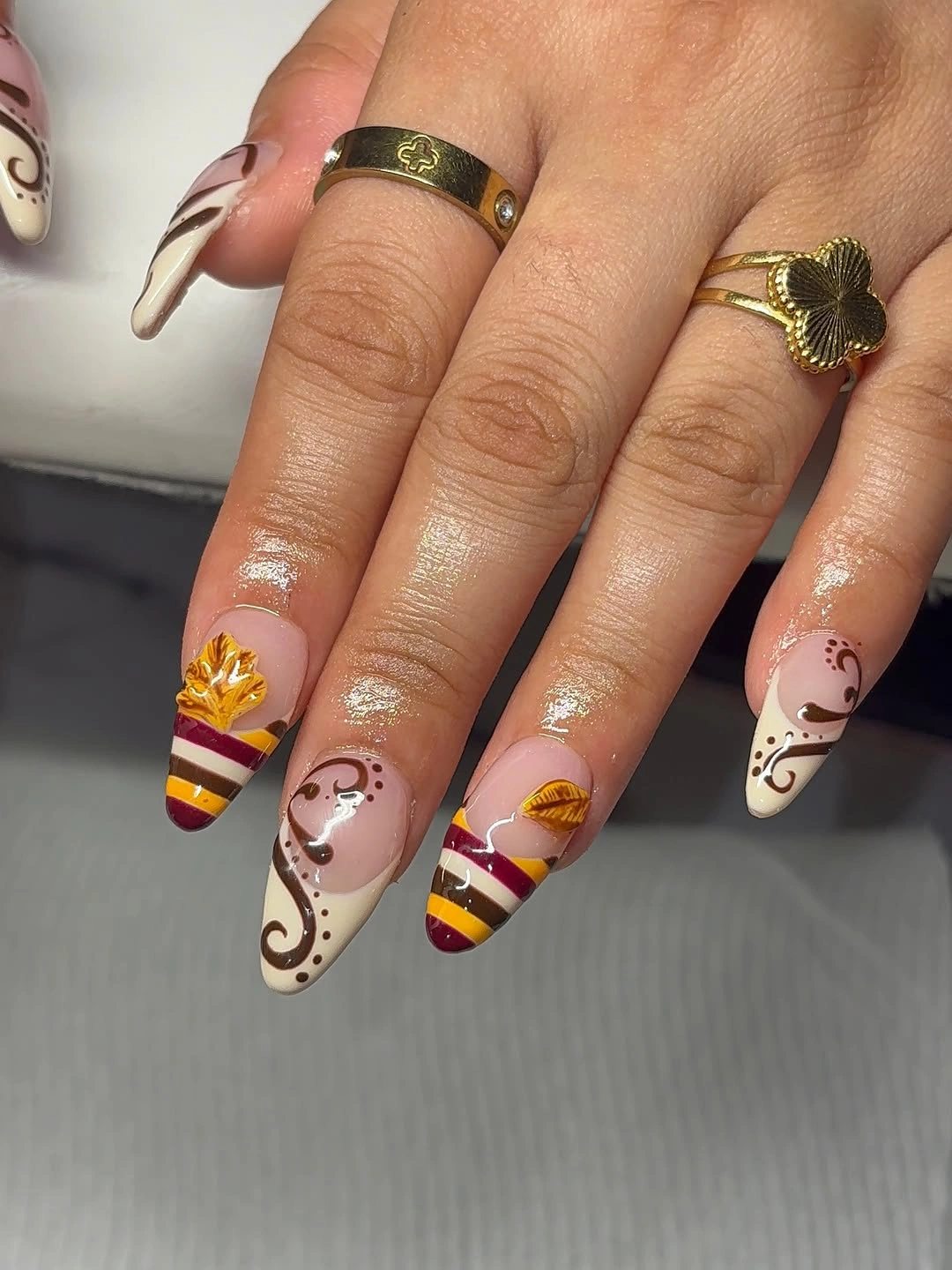
Keep the burgundy bands broad enough to read and the gold lines narrow enough to remain secondary. A shorter almond can use one band near the tip and a single curve on one accent nail, preserving the direction without trying to compress several layers into a small area. The pale base should remain visible between each dark mark.
Gold also changes the temperature of the burgundy, making the palette warmer and more autumnal without adding orange. If the design begins to feel too ornate, remove the smallest curl first and keep the stripe structure; the eye will still understand the balance. A neat edge matters because the graphic bands make small irregularities more noticeable as the manicure grows.
Gold foil gives white florals a warm pause
Milky white-to-pale nails carry small botanical illustrations and scattered gold foil, with the light base acting as a clean field for each detail. The close feature is the contrast between drawn floral marks and irregular metallic fragments: one is precise, the other is loose, so the set feels layered without needing a dark background or a large color change.
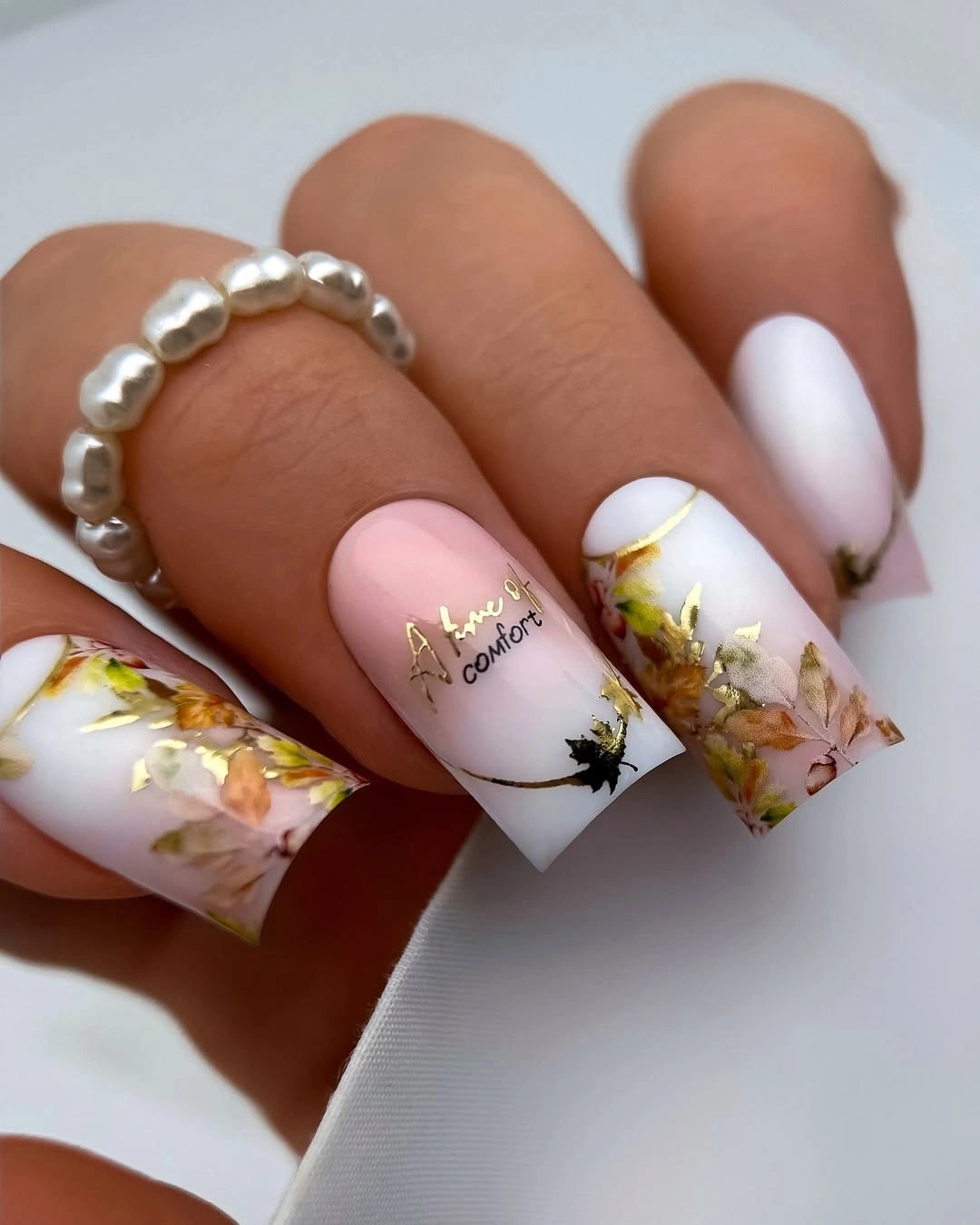
Leave enough blank space around the flowers so their shapes do not disappear into the foil. A single botanical accent and one gold fleck on another nail will translate better to a shorter square than a full repeat, while a warm white can soften the contrast if pure white feels stark against fair skin. The base should remain the visual pause between details.
Gold is easy to overuse because every fragment catches light, so keep it sparse and let the illustrations carry the personality. A medium square will provide room for readable marks without making the corners too demanding during grow-out. The design works when foil supports the warm seasonal mood and the floral lines still remain the detail the eye can inspect.
Galaxy shimmer changes the depth of blue-green
Medium coffin nails stay within a dark blue-green family, but multicolored reflective shimmer shifts across the surface and adds depth without visible motifs. The finish is the important detail because it prevents the jewel tone from becoming flat; each nail keeps the same base direction while small changes in reflected color give the set a moving, evening-like quality.
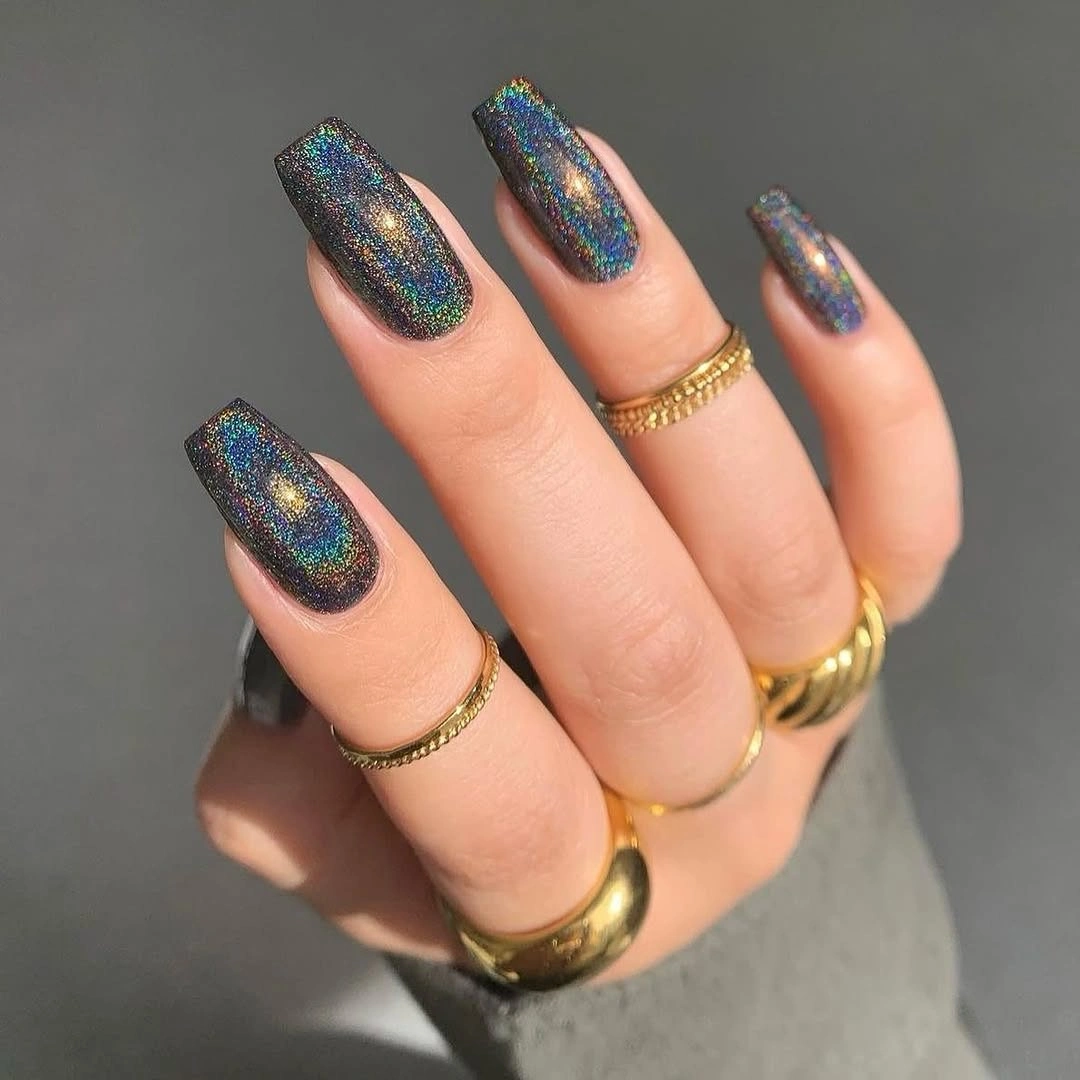
The coffin shape provides a clean frame for the shimmer, and the uniform palette makes the reflective variation feel intentional rather than noisy. A shorter soft square can preserve the same effect, while a narrow accent stripe would be unnecessary unless the color lacks enough movement. Keep the base deep and let the reflective particles remain the only shift.
Dark reflective color can read differently in bright daylight and low light, so avoid relying on a precise shade label when adapting the idea. The practical tradeoff is maintenance of an even surface, since chips break the continuous depth more visibly than on a patterned set. One controlled jewel tone is enough when the finish already supplies detail.
Red and blush alternate with one drawn accent
Glossy red nails alternate with pale pink, and one light accent carries fine black line art. The small drawing changes the rhythm by creating a visual pause between saturated blocks, while the repeated red supplies structure and the blush nails keep the color from becoming too dense across the whole hand.
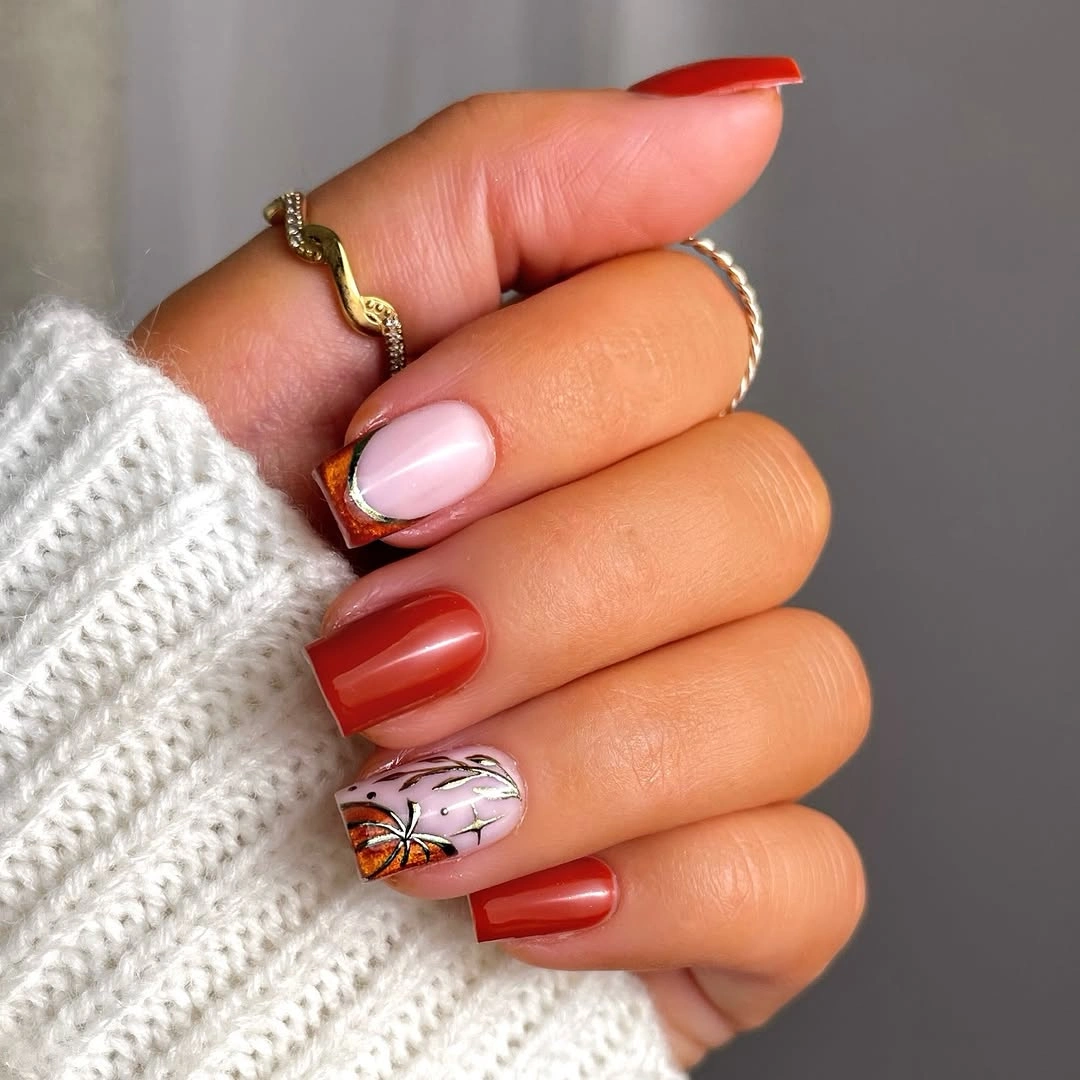
Place the drawing on the lightest nail so its lines remain visible, and keep the illustration thin enough to read as a detail rather than another major color field. On a shorter square, two red nails and one pale accent can retain the same sequence, while extra art can be removed without weakening the red-to-blush contrast.
The design is flexible because the line art does not need to describe a particular theme; it simply gives the solid colors a more personal interruption. A soft square will make the red feel less formal than a long coffin, and a warm blush can connect it to fall clothing. Let the red remain the strongest note and the drawing remain a quiet second look.
One reflective band makes navy feel deep
Long almond nails are a saturated navy blue with a narrow bright reflective band running through each surface. The band is the detail that supplies depth and direction, showing where the nail curves while keeping the set monochrome; without it, the dark color would read as a solid field, but with it, the shape gains movement and a small point of light.
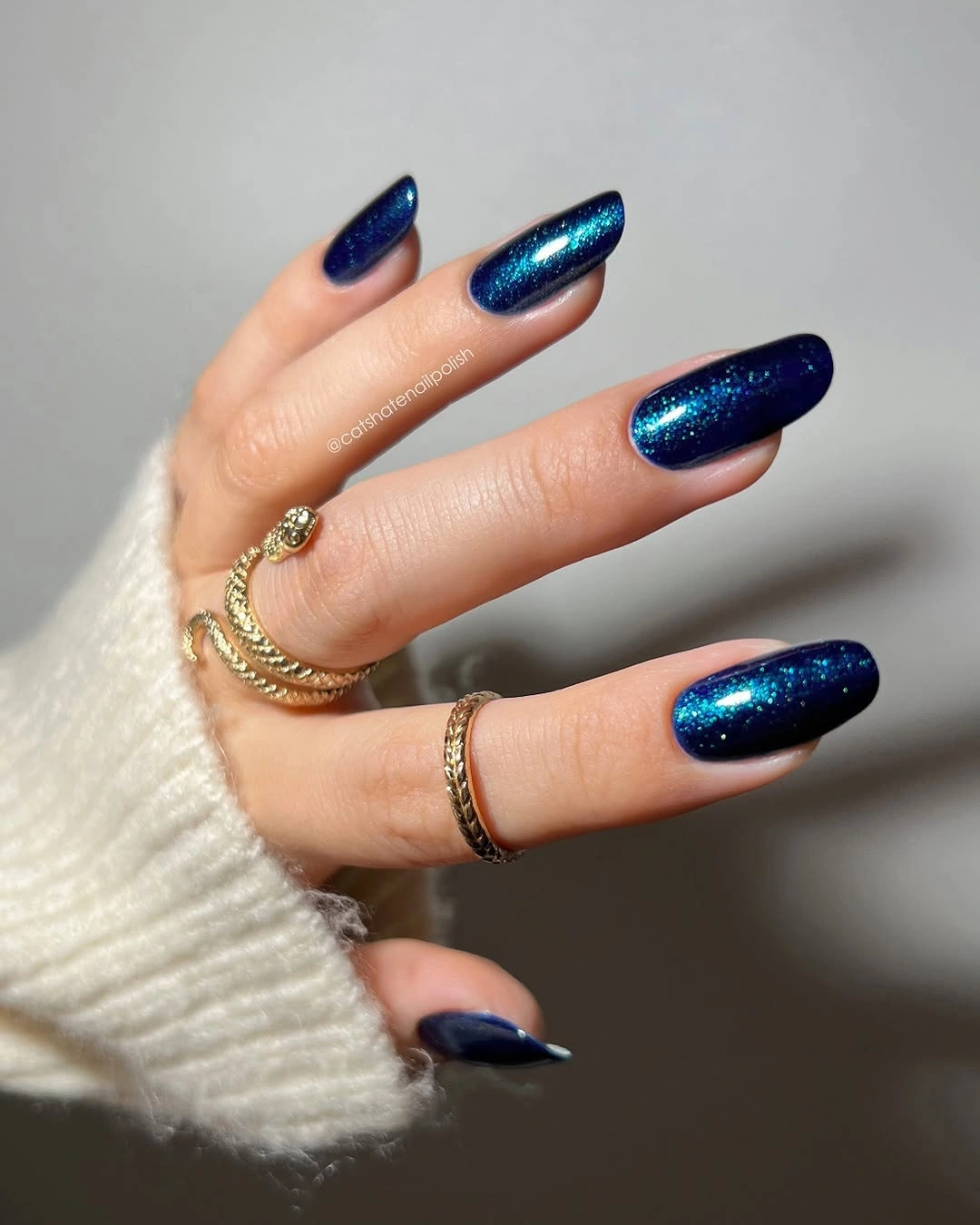
Keep the reflective line concentrated rather than adding glitter to the tip, because the current placement follows the length and makes the almond contour visible. A medium almond will keep the navy strong with less practical pressure, and a slightly softer blue can reduce the contrast if the dark value feels intense. The visible band should remain the reason the set feels dimensional.
Deep blue offers a cooler fall direction for fair skin, especially when the finish is smooth and the surrounding styling is textured or pale. The honest limitation is that a long almond puts more pressure on the edge and makes chips easy to notice, so a shorter shape may be the better adaptation. Change the length before changing the color story.
Purple sparkle needs a marbled place to rest
Long square nails combine saturated purple glitter with white nails carrying black-gray marble accents. The small but important decision is the use of a neutral resting point: the marbled nails interrupt the glitter so the sparkle has room to feel special, while the purple returns as the dominant color and keeps the mixed surfaces connected.
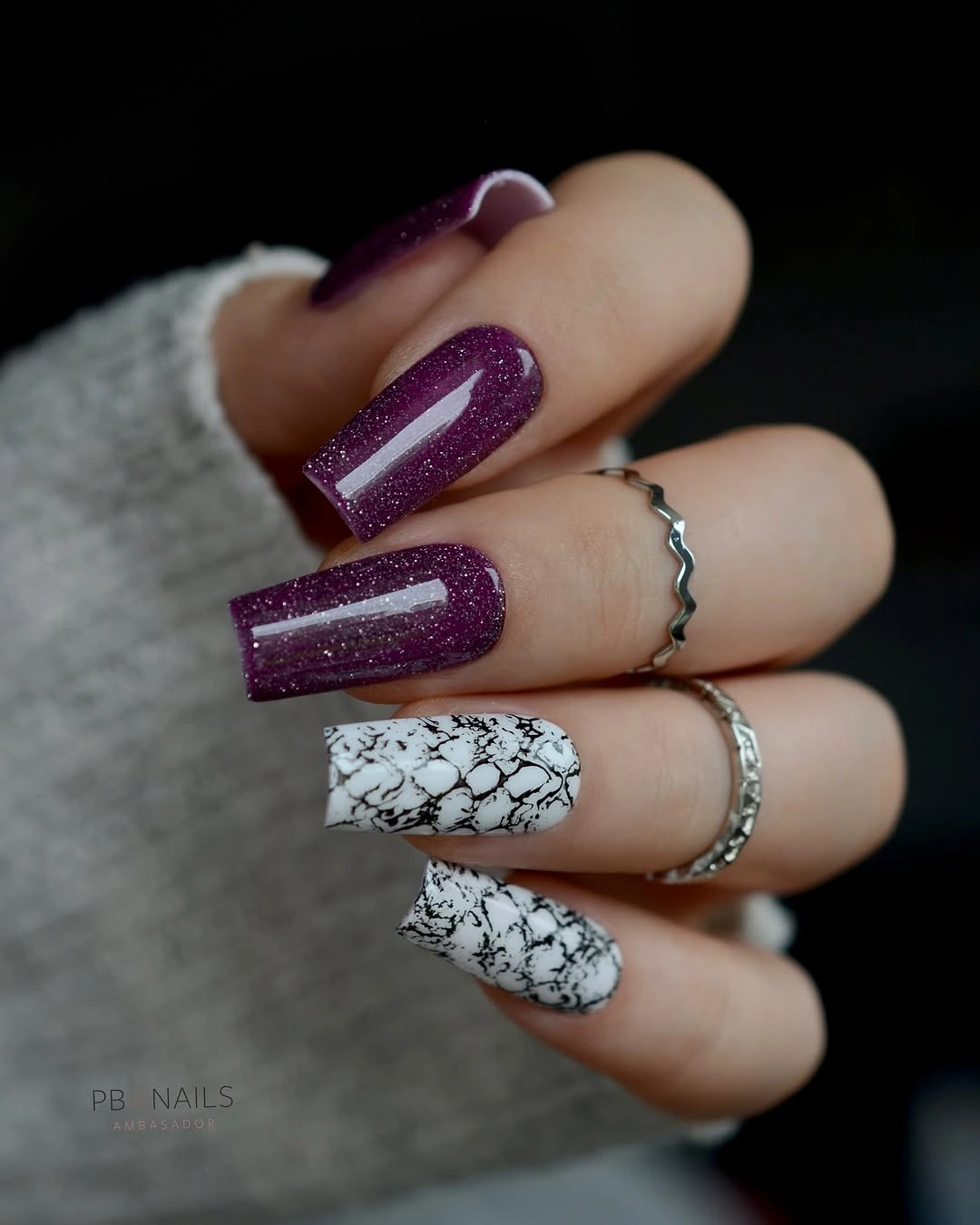
Keep the marble lines irregular and limited so they do not become a second loud pattern. A shorter square can use purple on two fingers and one white marbled accent, reducing the amount of glitter without losing the contrast between reflective color and quiet stone-like detail. The white base should stay open enough for the gray lines to remain readable.
Full glitter can feel heavy if every nail carries the same texture, especially as the manicure grows, so the neutral accents are practical as well as decorative. Choose a deeper plum if you want a softer fall value or preserve the brighter purple for an evening direction. The relationship to protect is sparkle against relief, not maximum decoration.
Milky ivory lets the short square stay clean
Short square nails use an even milky ivory color with minimal decoration, making surface neatness and proportion the only visible points of focus. The compact shape keeps the pale base practical, while the soft reflection prevents the color from looking chalky and gives the short edge a quiet finish that can stand alone or support one later accent.
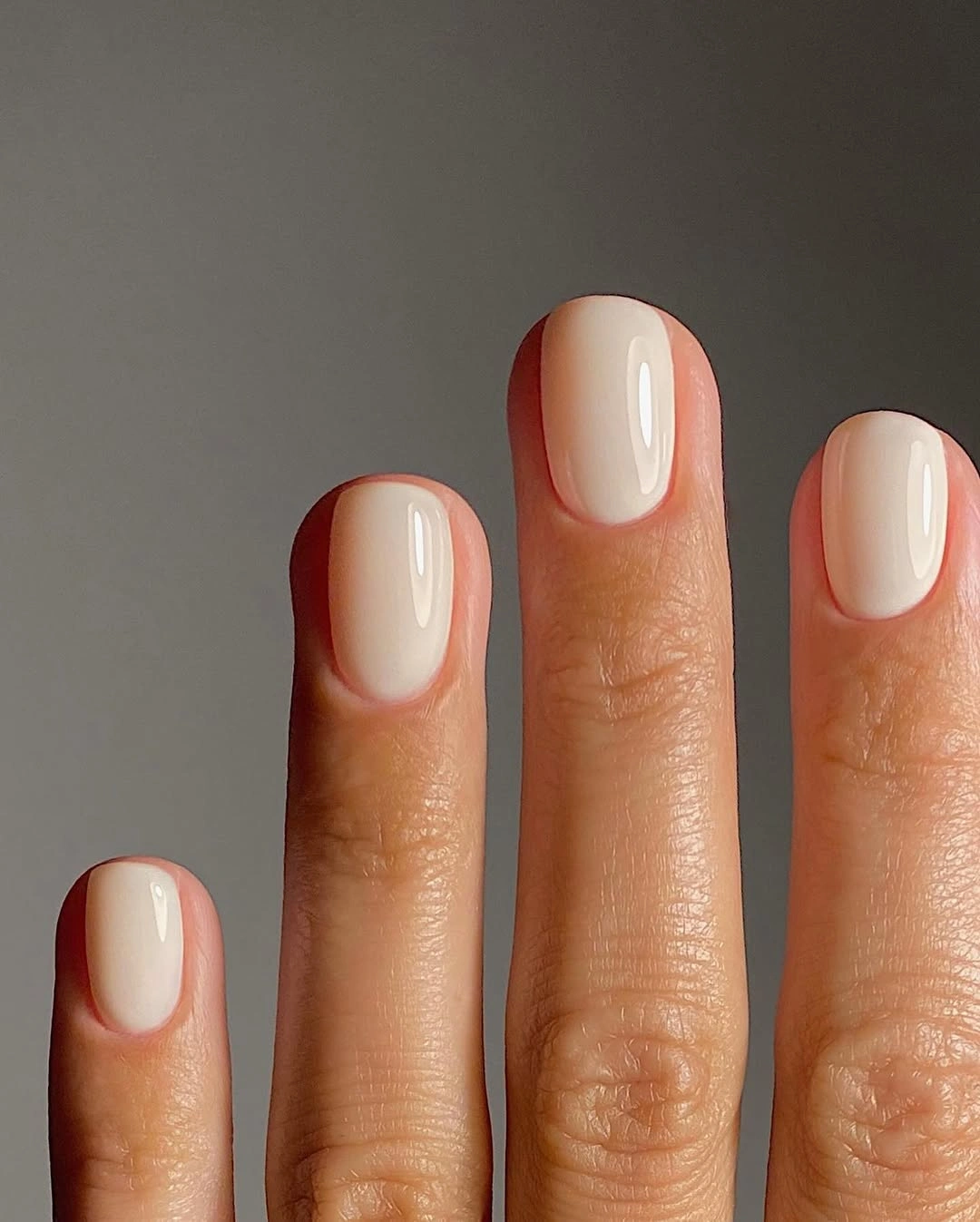
A clean solid base becomes more noticeable when there are no motifs to cover small inconsistencies, so the useful detail is consistency across every nail. Choose a warm ivory if a stark white would feel too bright, and keep the square corners softly filed to make the compact length look deliberate rather than unfinished.
This design works as a pause between more decorated choices because it does not compete for attention, but it also has a clear tradeoff: chips and uneven edges are easy to see. A single floral, metallic, or colored accent can be added later without rebuilding the base. Keep the color calm and let the short shape provide the practicality.
Mustard and pink need a black anchor
Long coffin nails mix mustard yellow, soft pink, black bands, and a pale accent carrying black and peach botanical lines. The black band is the small detail that organizes the bright palette, separating the warm blocks and giving the floral accent a visual connection to the darker nails instead of leaving mustard and pink to compete without structure.
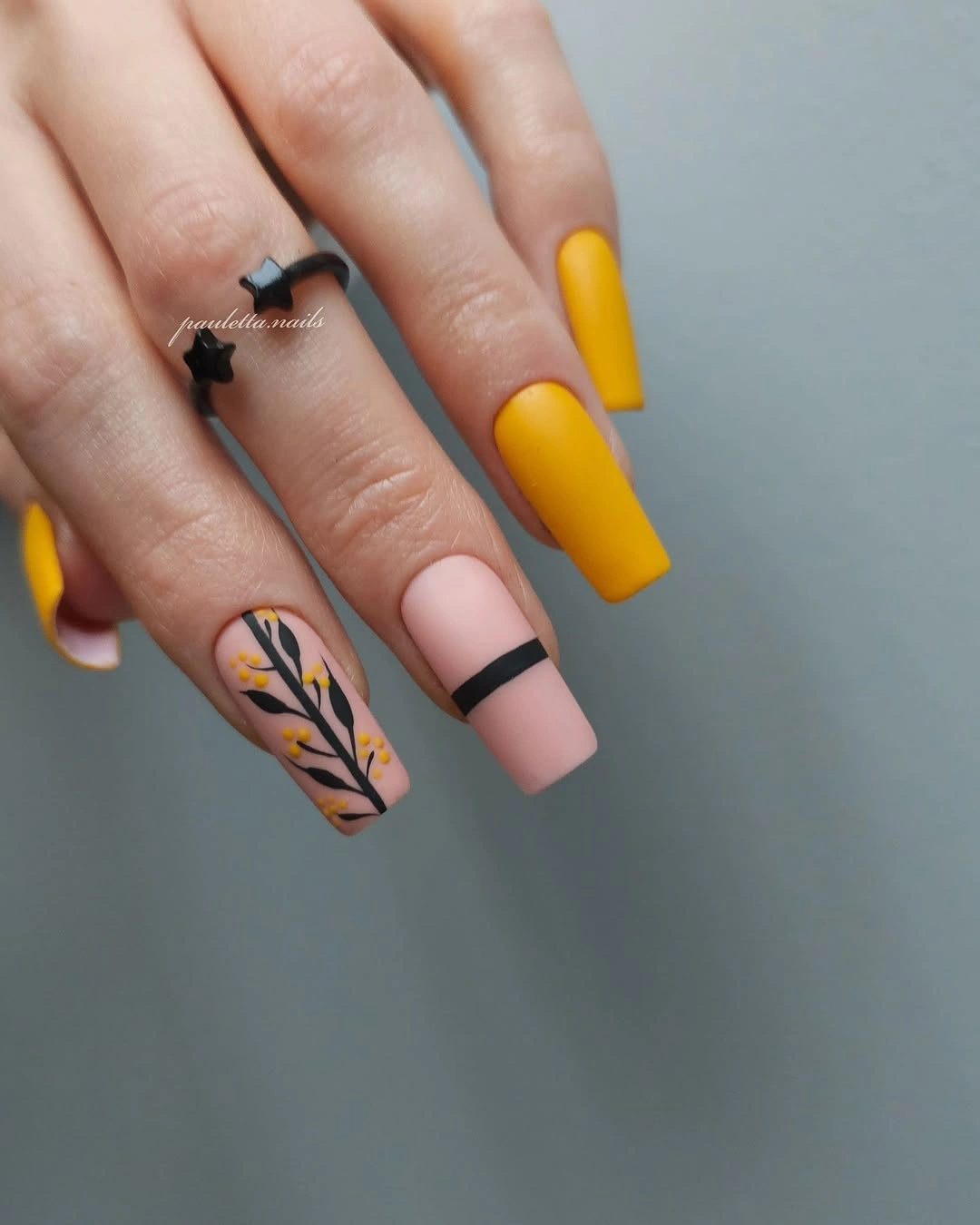
Keep the black limited to a band or narrow line so it anchors rather than dominates. On a shorter coffin or square, mustard and pink can remain the main pair while the floral drawing moves to one nail; removing a second black panel will create more open space and make the warm colors easier to distinguish.
The palette is lively, but the length and mixed details make it more demanding than a solid mustard manicure. A moderate shape will keep the color blocks clear and reduce the pressure on the coffin corners, while a muted mustard can soften the contrast if the bright value feels too sharp. Preserve one dark anchor and the rest can stay warm and playful.
Brown tips give pink nude a tailored edge
Long almond nails use pale pink bases with brown double French tips, thin white inner lines, and one small gold jeweled accent. The edge detail controls the look: the brown gives the pale base definition, the white line creates separation, and the gold adds a single point of light without turning the whole set into a metallic design.
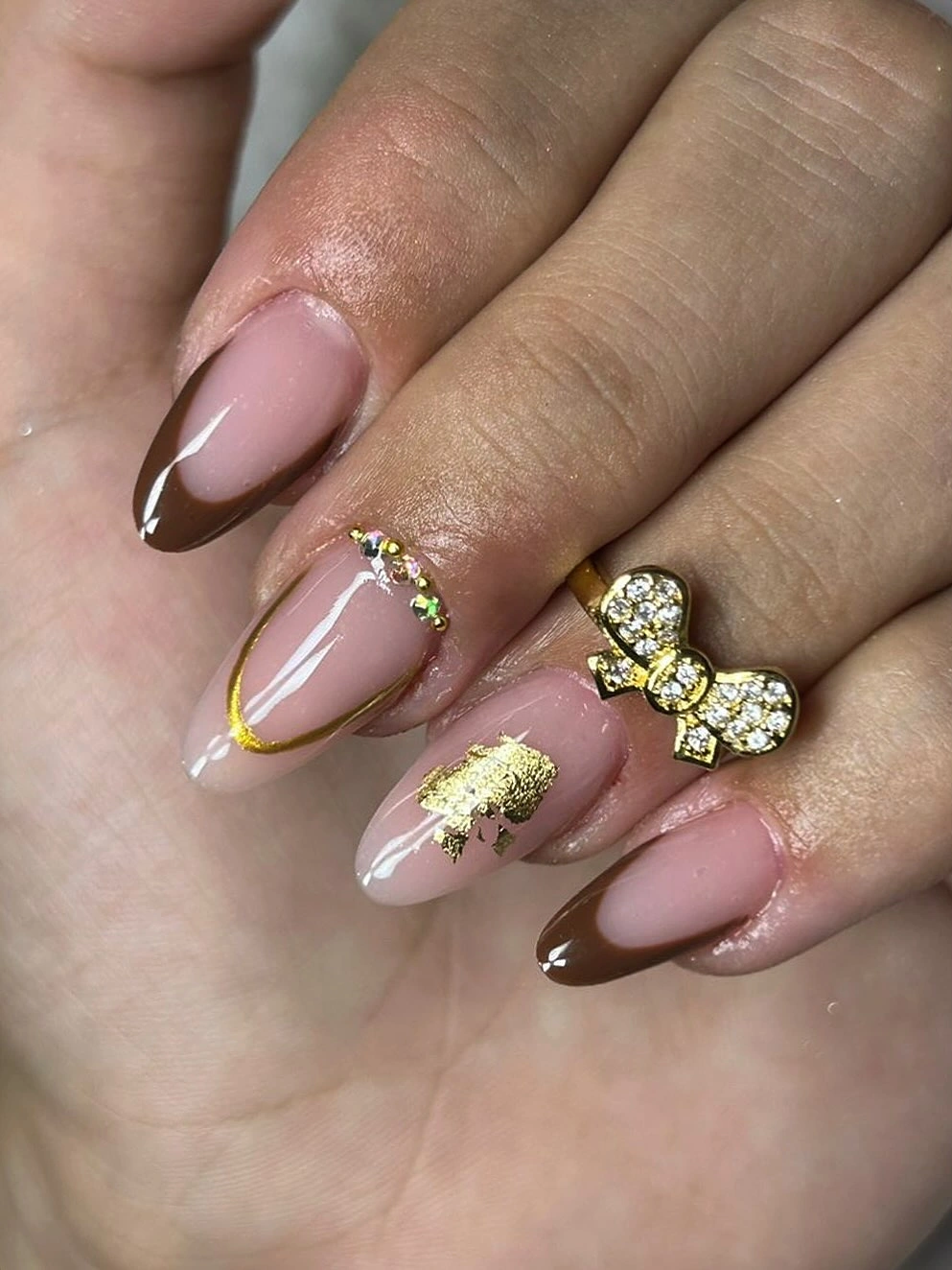
Layered tips need enough room to stay distinct, so keep the outer brown line wider than the inner white one and avoid adding extra marks near the cuticle. A shorter almond can use one brown tip with the gold accent on only one finger, preserving the tailored contrast while reducing the precision required for two parallel borders.
The warm brown edge also gives the pale base a softer seasonal direction than a stark black French, and it pairs naturally with gold jewelry without needing a matching motif. If grow-out makes the double line look crowded, remove the white layer first and keep the brown shape. The main relationship is pale center against a clearly framed warm edge.
Deep red alternates with a nearly bare nude
Glossy burgundy-red nails alternate with pale nude nails carrying tiny dark marks near the tip, creating a strong block rhythm with a small interruption. The sparse marks are important because they keep the nude fingers connected to the red ones, while the open base prevents the saturated color from occupying every visual space at once.
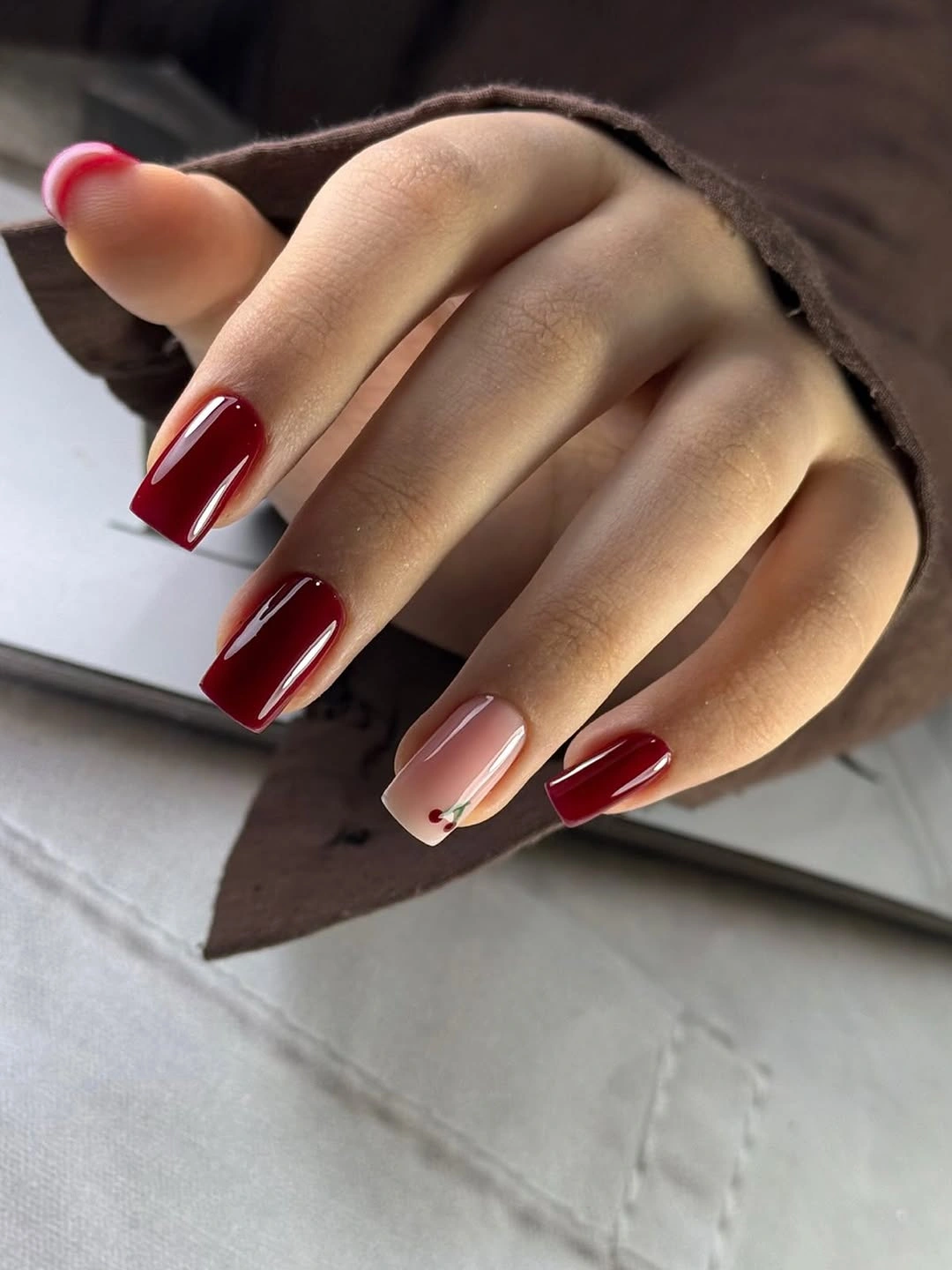
Keep the nude marks close to the tip and make them smaller than the red color blocks, so the sequence remains easy to read from a distance. A shorter square can use burgundy on two fingers and one nude accent with a single line, reducing the pattern while preserving the alternation that gives the set its structure.
Deep red and nude are direct fall partners, but the long square shape makes the contrast feel more formal and can require careful edge maintenance. A soft square will make the same palette more relaxed, while a warmer nude can keep the transition gentle against fair skin. Let the red remain saturated and the nude remain open; their difference is enough.
Graphic autumn tips keep the base light
Medium almond nails use pale bases with orange, black, and soft graphic shapes concentrated toward the tips. The close detail is the placement of the warm pattern: it gives the manicure an autumn direction without covering the nail bed, and the open center keeps the medium shape from looking heavy even when the tip includes more than one contrasting mark.
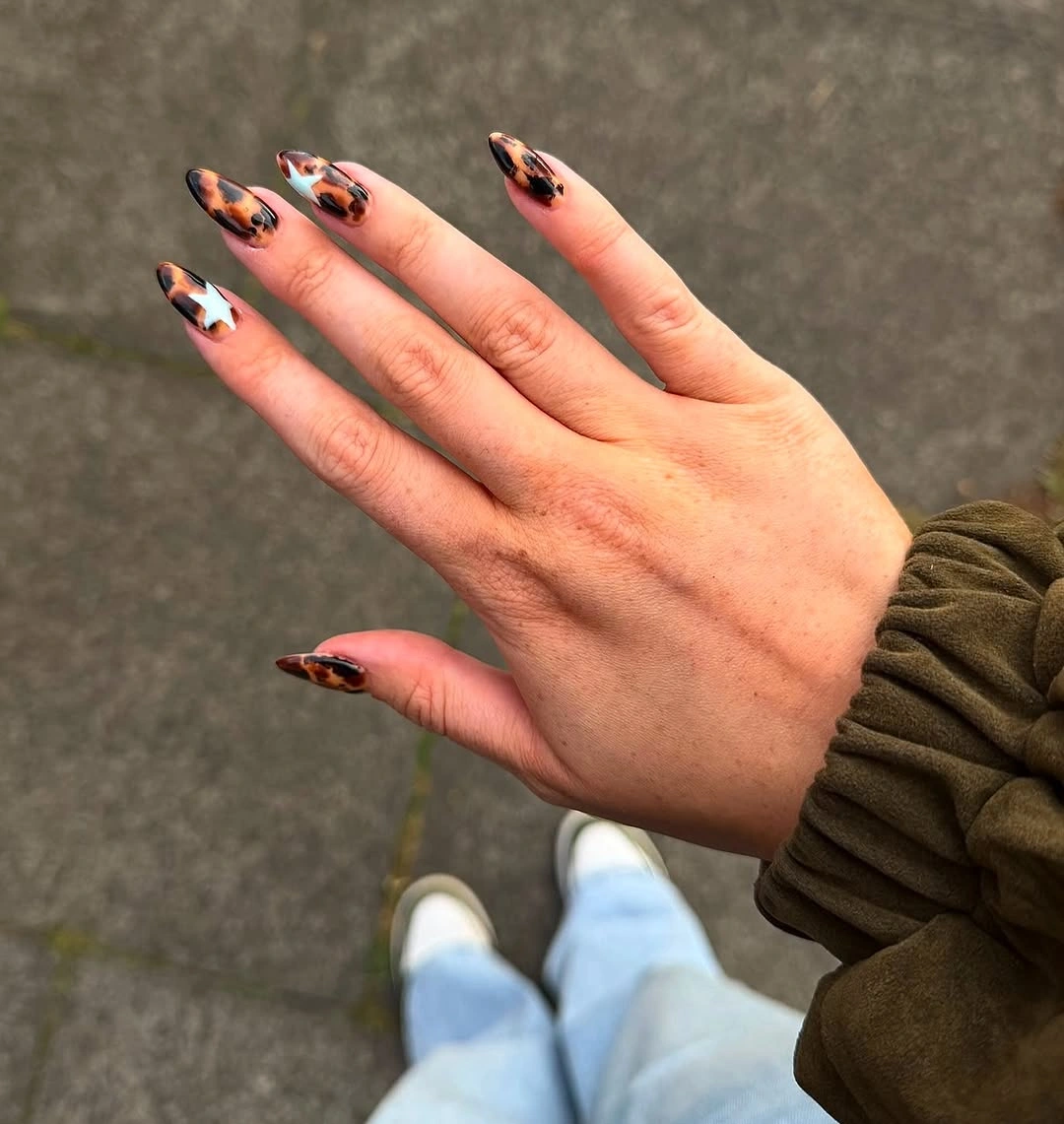
Use the tip as the visual boundary and keep the shapes large enough to remain clear at medium length. If you want a less themed adaptation, retain orange and black on two fingers, then replace the remaining graphics with a plain warm nude; the palette will still feel seasonal while the design becomes easier to pair with everyday clothing.
The light base also gives you room to change the orange from bright to muted without losing the structure. A short almond will make the edge more practical, but a very narrow tip may not support the graphic contrast, so keep enough width for the black and orange to remain separate. The final choice is about proportion: concentrated detail, open center, and a clean edge.