Fall nail trends 2026 do not have to mean covering every nail with a heavy seasonal color. The strongest ideas in this edit use a small decision – an olive edge, a brown curve, a blue grid, or one reflective accent – and let the shape of the nail keep that decision readable. The result is a collection that moves between quiet everyday color and expressive art without pretending every design has the same level of upkeep.
There is also a useful contrast in the proportions. Short rounded nails make dark lines and pastel details feel approachable, while long almond, square, coffin, and stiletto shapes give stripes, flowers, dots, and layered color enough room to breathe. Read each section as a separate styling idea, then adjust the length, number of accents, or tip width so the visual logic still works for your own nails.
Olive French Edges on a Sheer Base
A sheer warm nude base and slim olive-green tips keep this manicure focused on one clean boundary. The short almond shape softens the edge, while the green sits only at the free end instead of taking over the whole nail. That restraint makes the design feel seasonal through placement rather than through a complicated pattern, and the glossy surface helps the curved tips remain crisp.
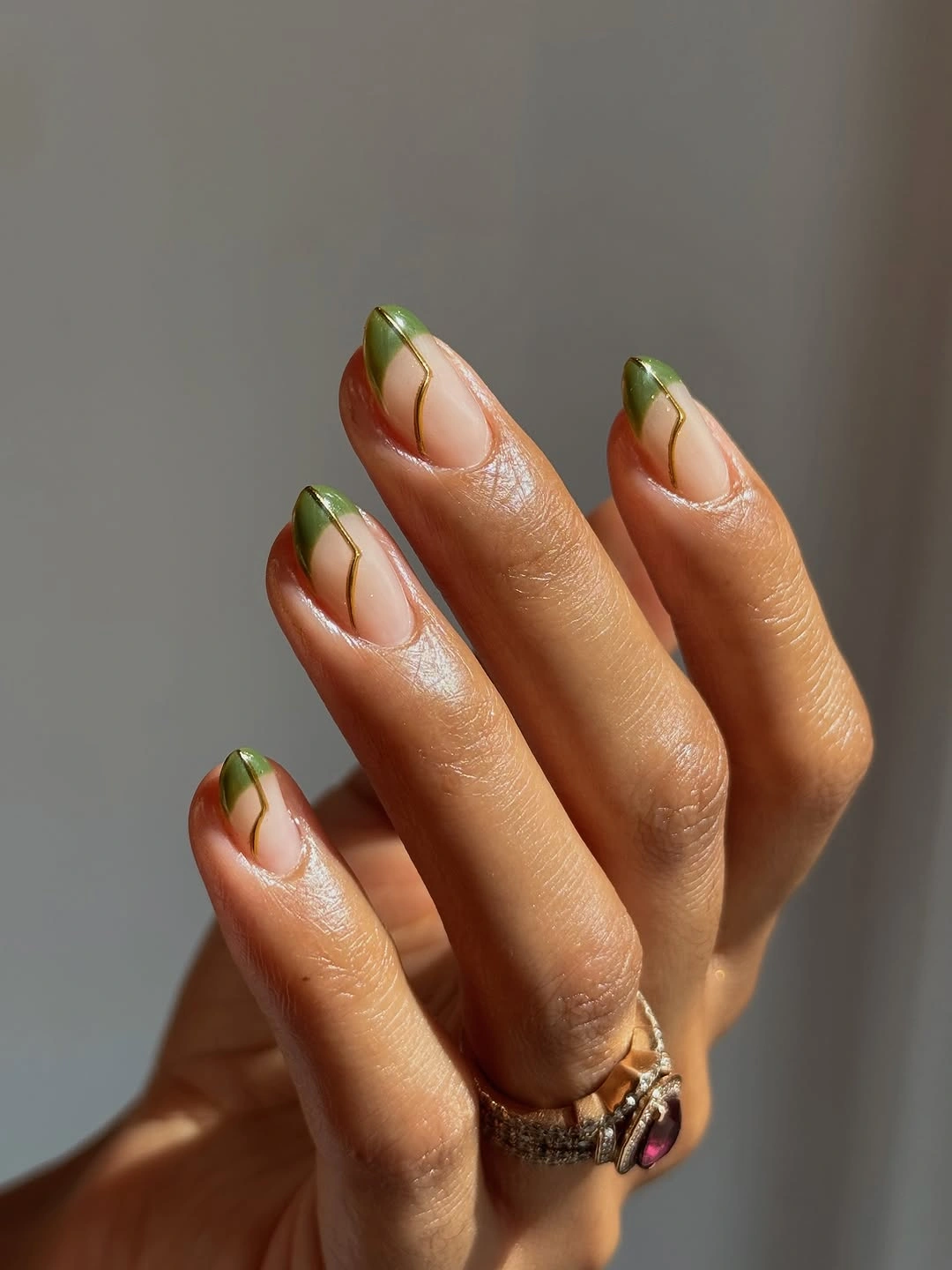
The open center is what makes the color feel light. Because most of the nail remains translucent and quiet, the olive reads as a deliberate line that frames the fingertip, not as a block that shortens the visual length. It is a useful approach when you want fall color but still wear rings, knitwear, or other details without creating too many competing focal points.
For a lower-maintenance version, keep the short almond outline and move the green onto two accent nails, leaving the others neutral. A slightly wider edge will make the color easier to see on a shorter canvas, while a thinner edge will preserve the airy effect. Expect the curved boundary to show growth sooner than a full-color manicure, so the appeal depends on clean edges and simple placement.
Chocolate Lines Framing Short Nude Nails
These compact rounded nails use a muted nude-pink base with deep brown strokes placed near the sidewalls or center edges. The dark marks are narrow enough to frame the nail without turning it into a full chocolate block, and the glossy finish keeps the small contrast visible. Short proportions make the idea feel practical, while the vertical placement gives the fingers a little extra definition.
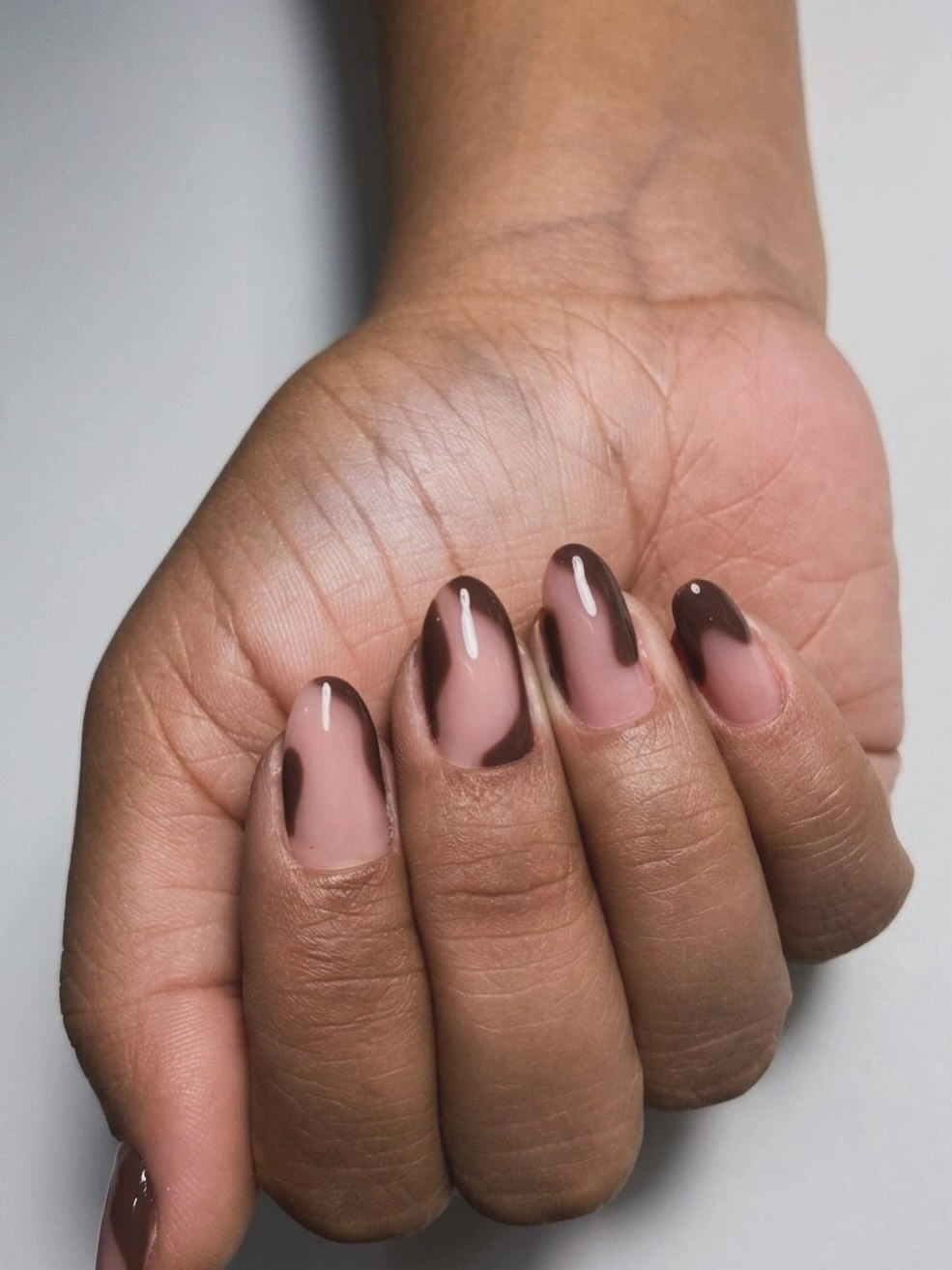
The placement matters more than the amount of brown. A slim vertical panel creates a visual pause that draws attention along the length of each nail, while the pale base prevents the set from becoming visually dense. Since the marks are not identical blocks on every nail, the manicure has a hand-drawn rhythm that feels more relaxed than a perfectly repeated border.
If the nails are very short, reduce the brown to one side line or repeat it only on the ring and middle fingers. A rounded shape will keep the dark accent softer, while a squarer edge will make it look more graphic. The main limitation is precision around the sidewalls, because even a small uneven patch can change the balance of a design that relies on such narrow lines.
Pink Almonds with Spotted Dark Tips
Long almond nails give this pale pink manicure a clear direction, while small dark spots at several tips prevent the length from reading as plain. One accent also carries a curved black-and-pink movement, so the set balances a repeated tip detail with a single more expressive gesture. The pink center stays open, which keeps the pointed silhouette visible instead of burying it under decoration.
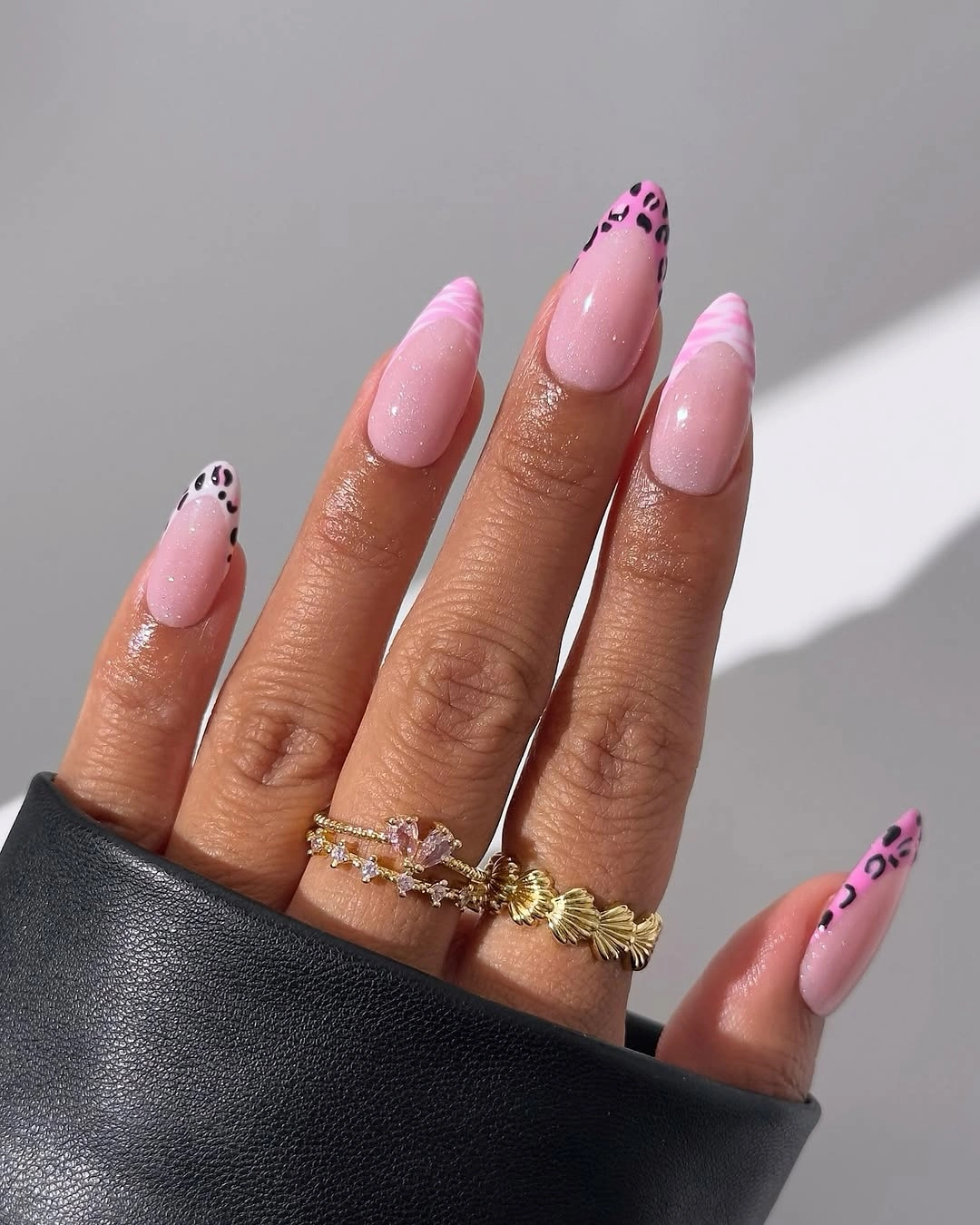
The darker marks work because they are concentrated at the edge. Leaving the middle of each nail pale creates contrast without making every finger equally busy, and the almond shape gives the spots a tapered path toward the point. The design feels graphic from a distance but still has enough small variation to reward a closer look at the tip placement.
To adapt the idea for shorter nails, keep the pale pink base and use the dark spots on two accent nails rather than every tip. A soft oval or short almond shape can preserve the gentle curve, but a very short square canvas may need larger marks and fewer of them. The pointed length is the honest tradeoff here: it makes the design dramatic, yet it asks for more care around snags and edge wear.
Olive Solids Paired with Brown Marbling
Glossy olive-green nails sit beside translucent brown and cream marbled accents in a manicure that alternates solid color with softer movement. The green gives the set a grounded center, while the cloudy accents keep it from feeling like a single flat shade. The medium almond length is long enough for the swirls to read, but still restrained compared with the more dramatic shapes later in the collection.
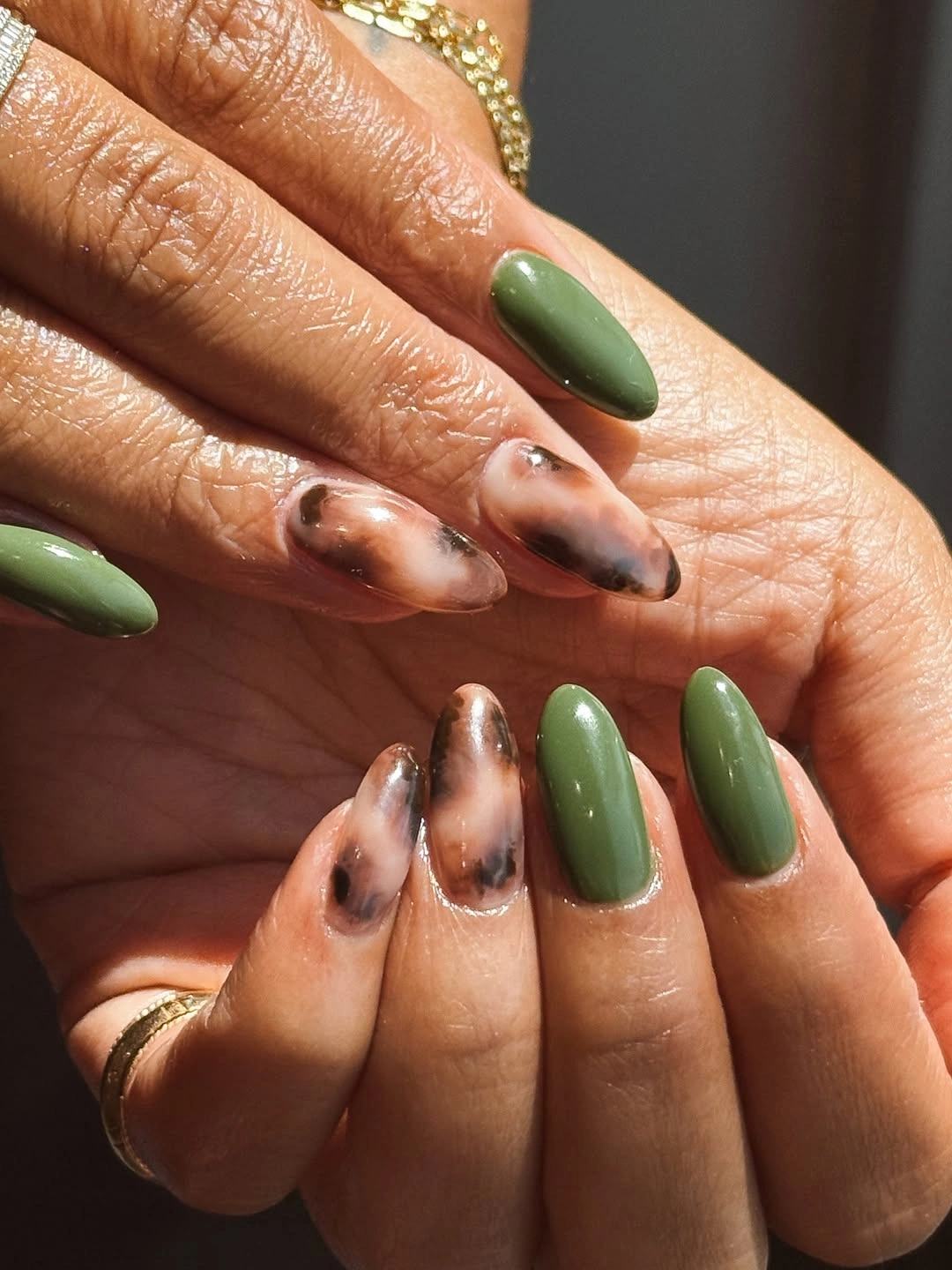
The balance comes from repetition without uniformity. Solid olive nails provide visual rest, then the brown-and-cream accents bring the eye back with irregular movement and a translucent depth. That contrast is useful for fall styling because the palette feels earthy without relying on a literal leaf or seasonal illustration, and the hand setting shows how the colors can sit comfortably beside warm jewelry.
Keep three nails solid and reserve the marbled treatment for one or two fingers if you want the idea to feel calmer. A shorter almond or rounded shape will make the olive more practical, while the translucent accents should stay simple enough that their edges do not look crowded. The pale areas may reveal grow-out or uneven lines more quickly, so the design rewards careful maintenance even though the color story is easy to wear.
Graphic Curves in Green, Black, and White
This long almond set combines green and black fields with white curves, small dots, and flowing black-and-white stripes. Each nail has a different job, yet the repeated graphic movement keeps the collection from looking random. The contrast is strong enough to read immediately, while the mix of solid nails and open curved sections gives the eye places to rest between the bolder motifs.
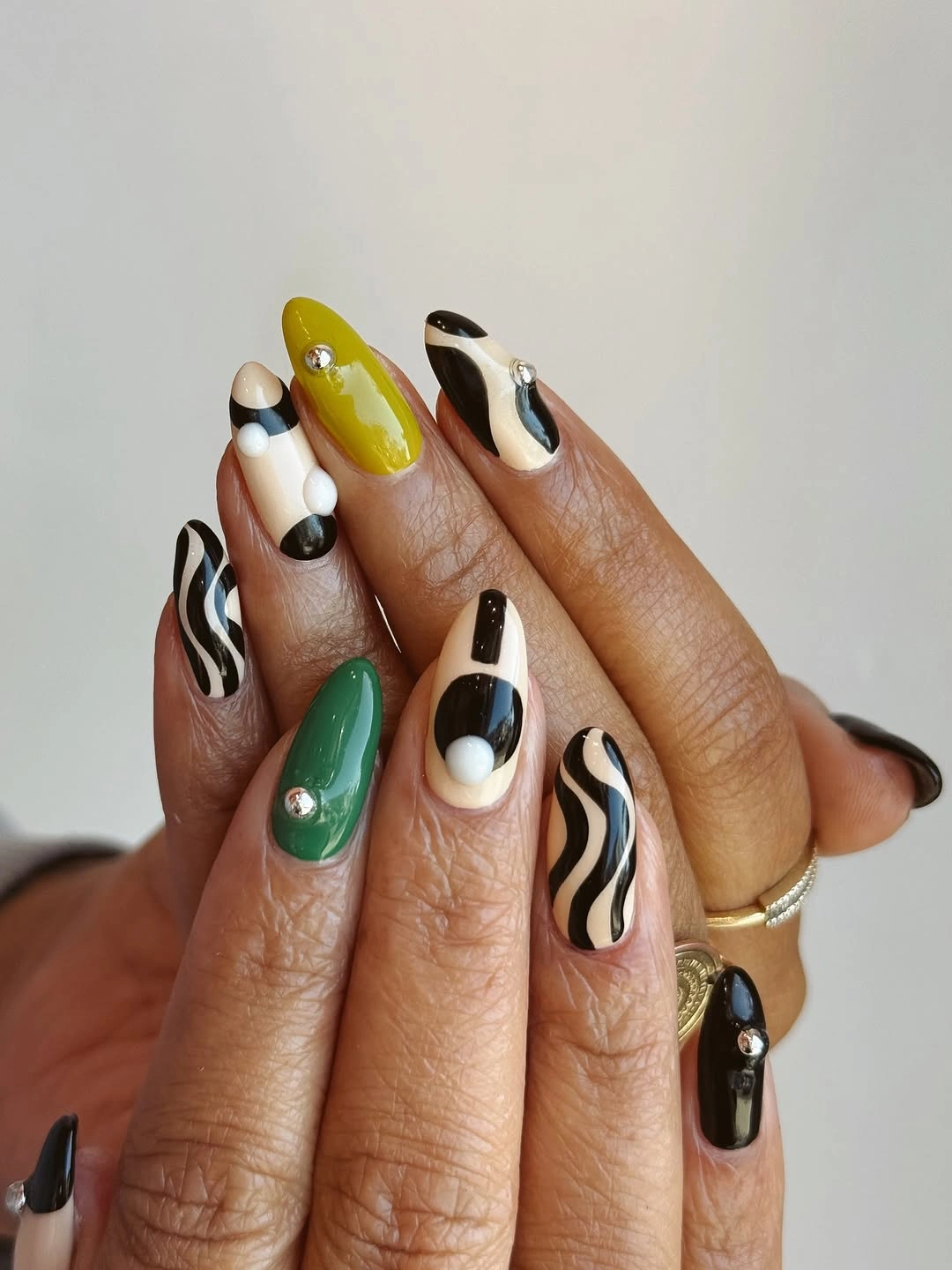
The best way to understand the design is as a small family of related gestures rather than one pattern copied across every finger. Curves soften the black and white contrast, dots add a compact beat, and green brings the otherwise monochrome accents into a seasonal palette. The long almond shape is doing real editorial work because it gives each line room to travel without colliding with the next one.
For daily wear, choose one swirl, one dotted accent, and one solid green nail instead of reproducing every visible role. A medium almond shape can carry that edit well, while a shorter square version should use broader curves and fewer details. The tradeoff is clear: the original has the strongest inspiration-board impact, but reducing the motif count will make the manicure easier to keep legible as the edges grow.
Deep Teal with One Reflective Accent
Deep teal covers most of these long coffin nails, creating a saturated jewel-toned field that needs very little extra decoration. One nail adds a reflective or glittering teal accent, and that small change is enough to interrupt the solid color without weakening it. The result feels confident because the accent is concentrated, while the repeated color keeps the whole hand visually coherent.
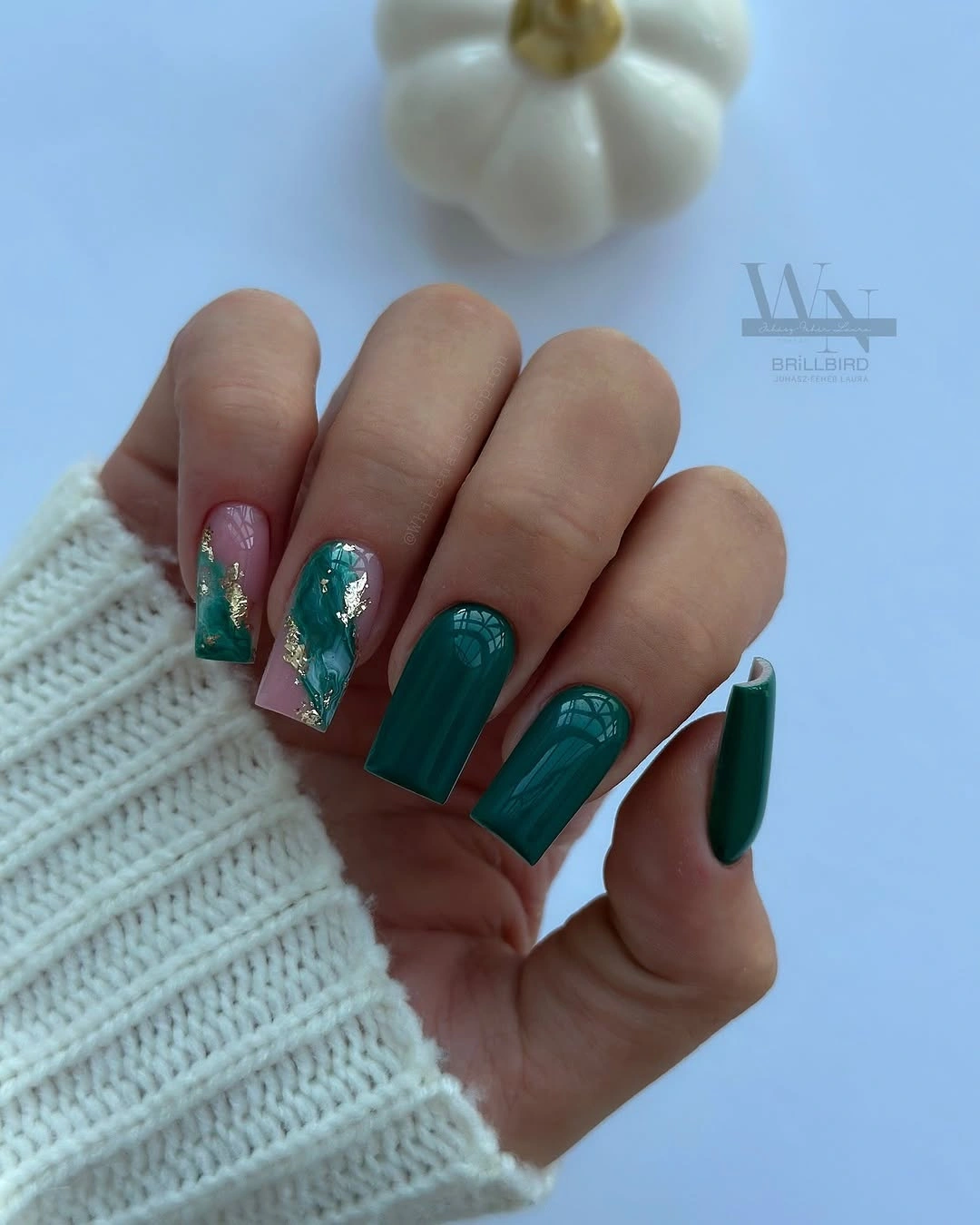
The shape and color are closely linked here. A long coffin silhouette gives the dark blue-green shade a broad, clean surface, and the glossy finish lets the color shift slightly as the hand moves. The single reflective nail works as a punctuation mark rather than a second theme, so the manicure remains easy to pair with a sweater, denim, or simple metal jewelry.
If long coffin nails are not practical, keep the teal and shorten the shape to a medium square or soft almond. The reflective accent can stay on one finger, or it can be replaced with the same glossy color for an even simpler set. Saturated dark color has one visible limitation: chips and worn tips stand out quickly, so the clean appeal depends on keeping the edge fresh.
Pastel Pink and Blue with Wine Tips
Soft pink and pale blue share the base of this long almond manicure, while burgundy or wine-colored tips add a darker edge. The contrast is appealing because the deep tone behaves like a border instead of covering the entire nail, so the pastels remain the first impression. Alternating the light colors across the hand also gives the set variety without introducing a separate motif on every finger.
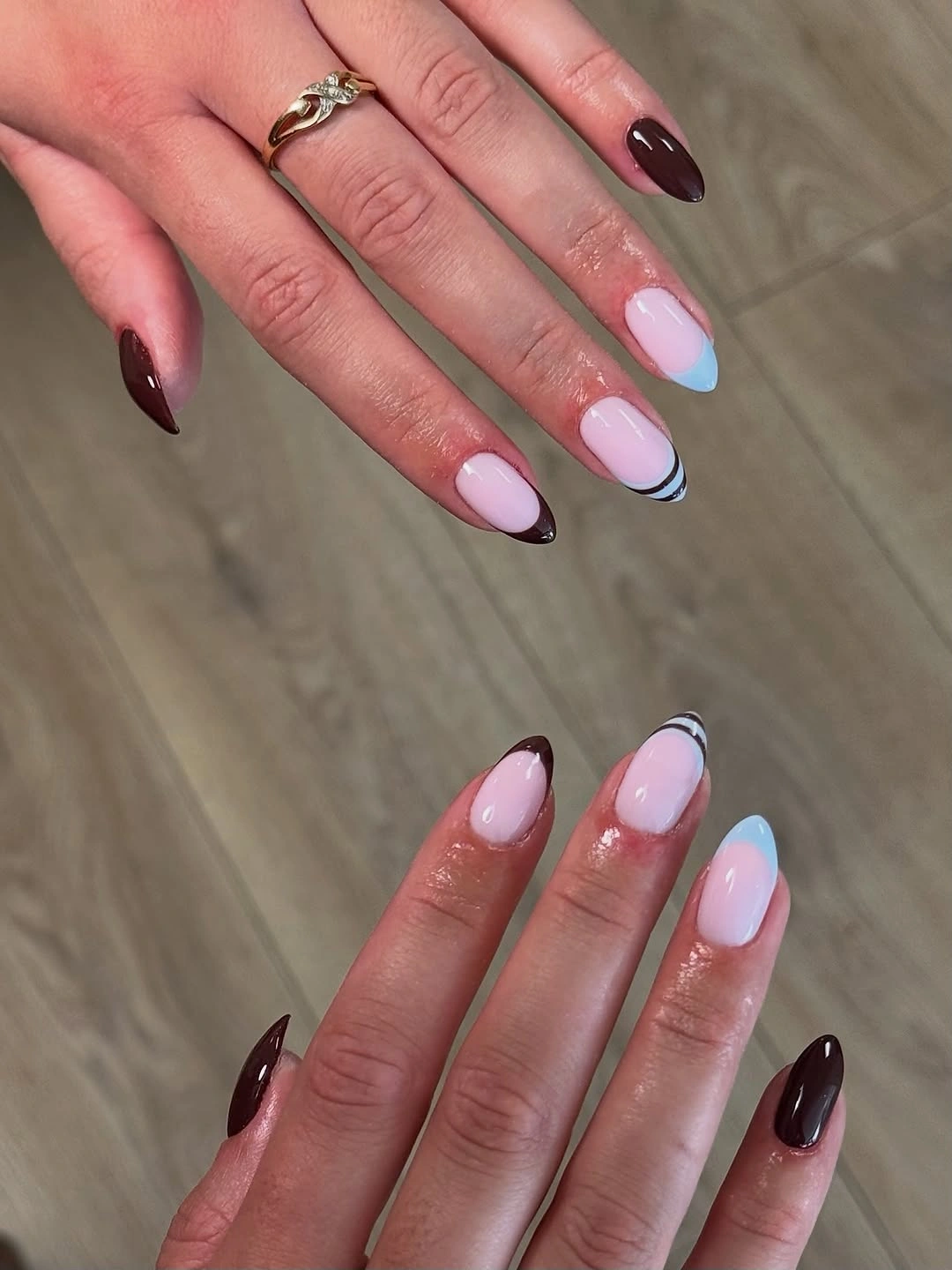
The wine edge sharpens the otherwise airy palette. It repeats enough to create rhythm, but the dark color is visually contained, which prevents the manicure from drifting into a heavy monochrome look. The long almond shape lets each pastel body remain visible before the eye reaches the tip, and that separation is what makes the unusual color pairing feel organized rather than accidental.
Use one pastel base and a thin burgundy line if you want a more neutral version, or keep the two pastels only on alternating accent nails. A shorter almond shape will still support the idea, although the dark edge may need to be slightly wider for clarity. The main maintenance note is the tip boundary, because growth will shift the proportion between the soft base and the wine-colored edge.
Dots, Stripes, and Solids in One Palette
Here the nails mix a spotted white accent, green and pink solids, fine black lines, and a cool reflective detail. The collection feels lively, but the colors remain muted enough that the different motifs can share one hand. Long lengths provide the space for each idea to stay distinct, while the repeated black line work quietly ties the dots and stripes together.
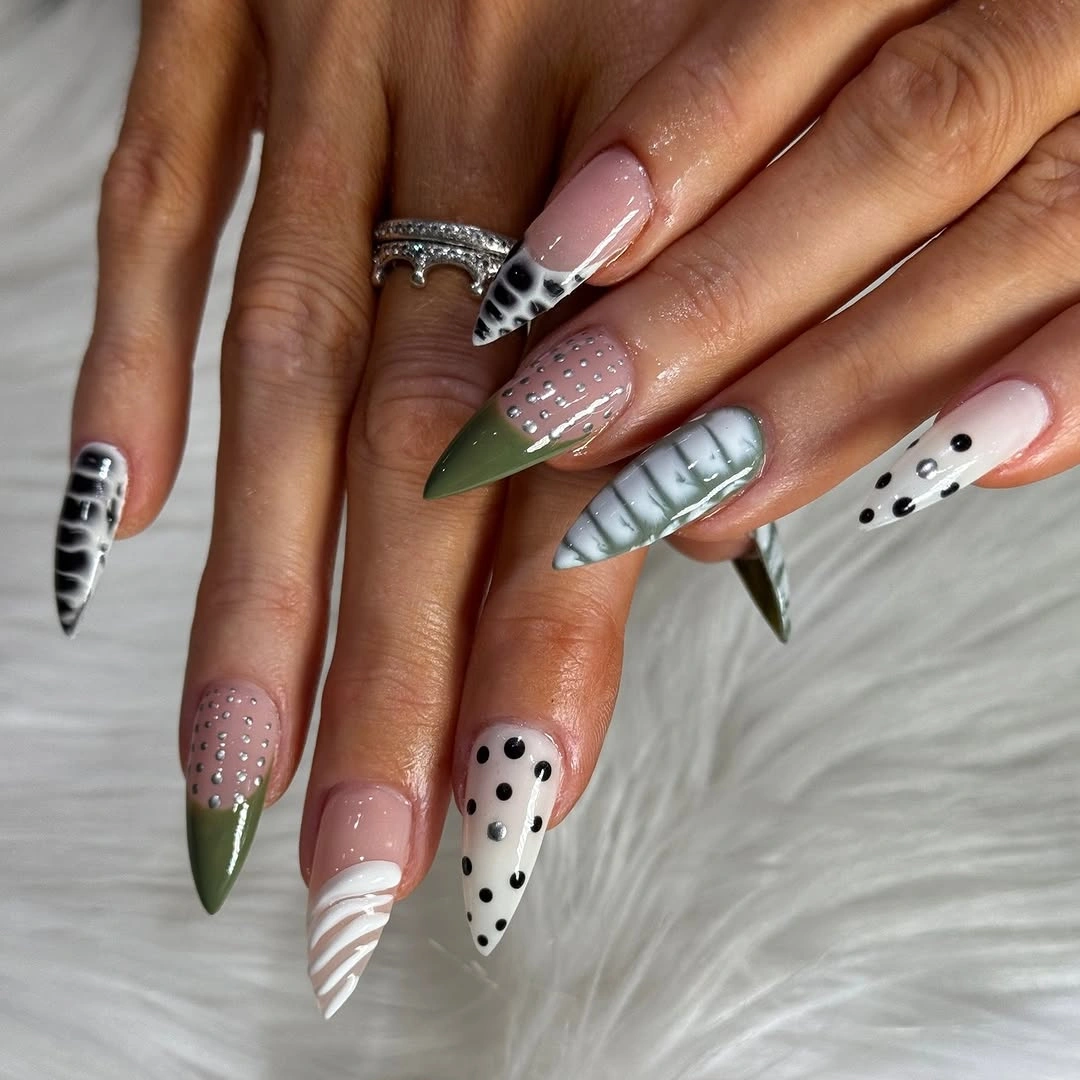
The useful lesson is not to copy every visible pattern at once. The set works because some nails are quiet fields and others carry a single motif, so the eye alternates between rest and detail. White makes the dark marks readable, green adds an earthy note, and pink prevents the palette from becoming too stark. The variety is editorial, but the underlying balance is simple.
Choose two motifs and one solid color when translating this into an everyday manicure. A medium length can still hold a spotted white accent and one striped nail, while a shorter shape needs larger marks and more empty space. Tiny details can blur as the manicure grows, so the strongest adaptation protects the contrast and removes anything that does not have a clear role.
Glossy Espresso on Medium Almonds
Deep espresso brown does most of the work on these medium almond nails. The set is largely smooth and reflective, with a few lighter neutral nails breaking up the dark field without introducing a complicated motif. Because the color is rich and the shape is balanced, the manicure feels finished through proportion and shine rather than through extra decoration or a busy seasonal illustration.
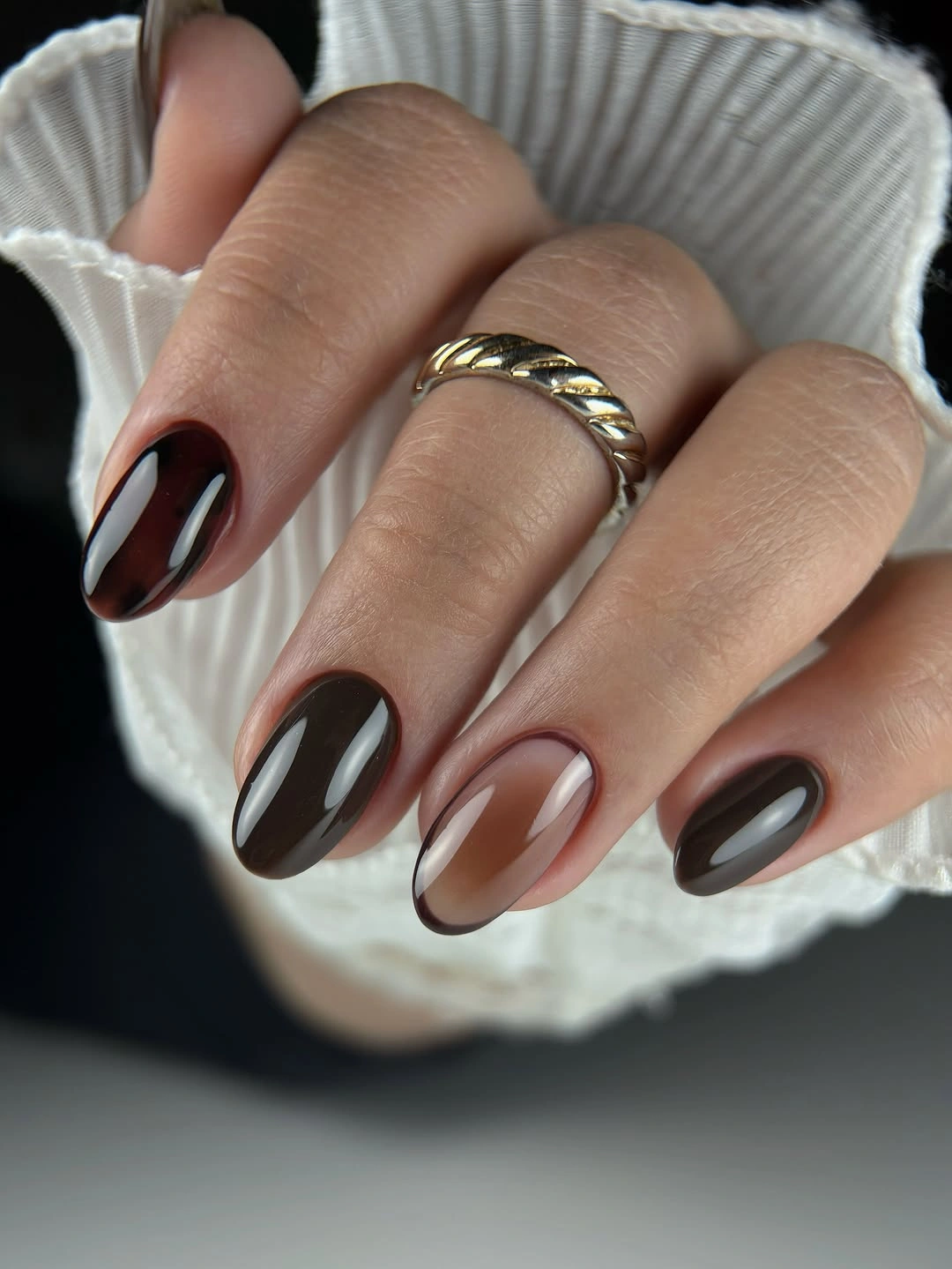
The lighter nails create a small visual pause that makes the brown look even deeper beside them. That contrast is useful when you want the warmth of a dark fall shade but do not want every finger to have identical visual weight. The almond shape keeps the dark color elegant, while the reflective surface draws attention to the clean contour of each nail.
Use the espresso on short round, oval, or square nails if the medium almond length is not convenient. You can also replace the lighter accents with a sheer nude to keep the palette close to the original. Dark solid color has a practical limitation: any chip at the tip contrasts with the deep base, so the manicure benefits from regular edge checks even though the design itself is simple.
Soft Pink with a Tiny Yellow Flower
Soft pink remains the main color in this long almond set, while white sections, warm brown curves, and one small yellow flower create a more personal focal point. The flower is not large enough to dominate the hand, so it reads as a detail discovered after the pale base and almond shape. That scale keeps the manicure delicate while giving the seasonal palette one warm point of contrast.
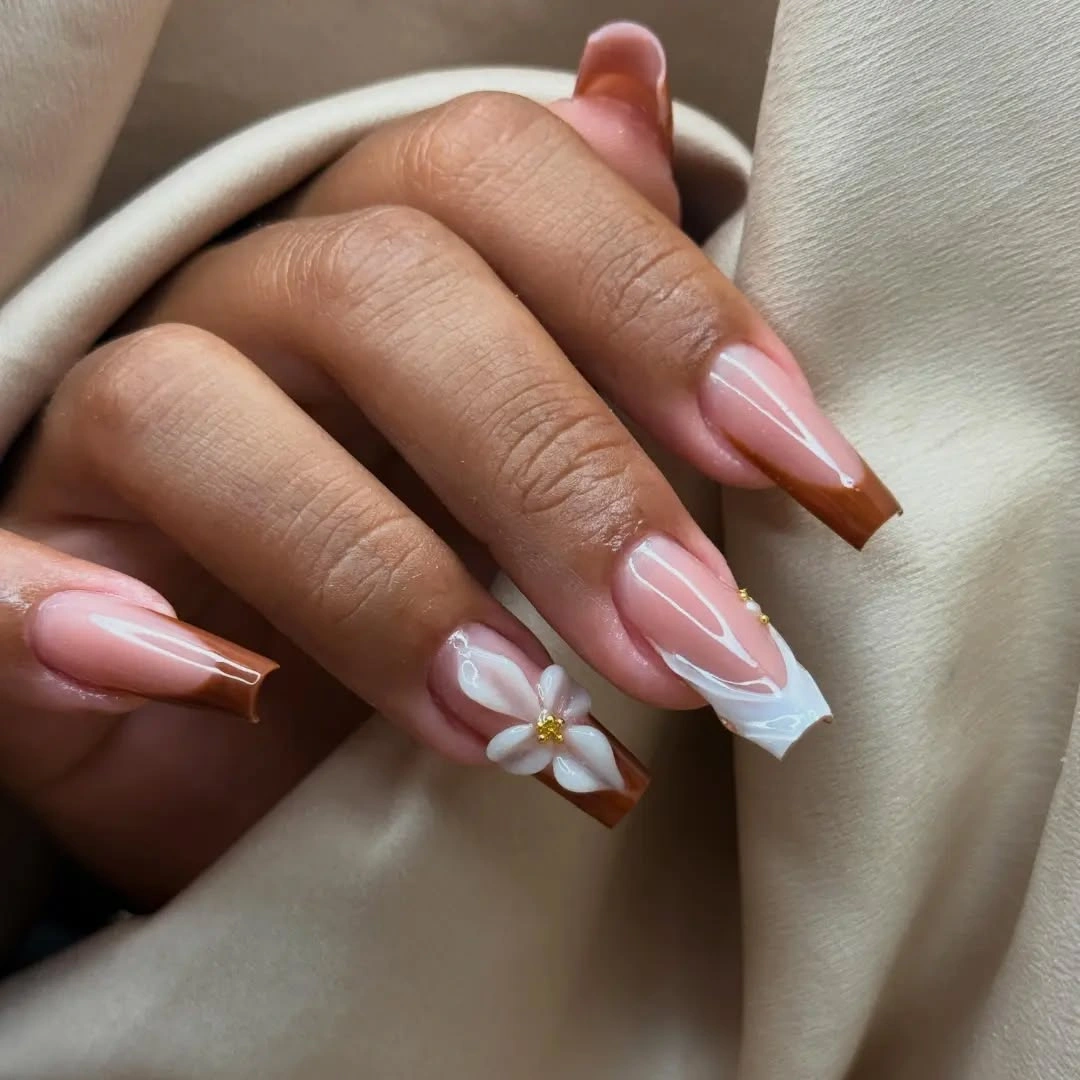
The composition works because the flower is supported by the other colors. White keeps the accent light, brown gives it an outline-like counterweight, and pink provides the calm field around it. The long almond canvas leaves enough room for the curved lines to remain separate from the tiny floral mark, which is important when a small detail is meant to look intentional rather than crowded.
Place the flower on one nail and repeat only the brown curve if you prefer a simpler set. A shorter almond or oval shape can keep the idea readable, but tiny petals may need to become a larger single floral mark. Avoid relying on the flower alone to carry the design; the surrounding negative space and quiet pink base are what make the small yellow detail visible.
Plum and Pale Pink Stiletto Drama
Very long stiletto nails alternate dark plum and pale pink, with curved outlines and small reflective-looking embellishments adding extra drama. The pointed silhouette is not a background detail here; it is the main design decision, making the color blocks appear sharper and more theatrical. Pale sections keep the hand from becoming one dark mass, while the plum anchors the strongest visual moments.
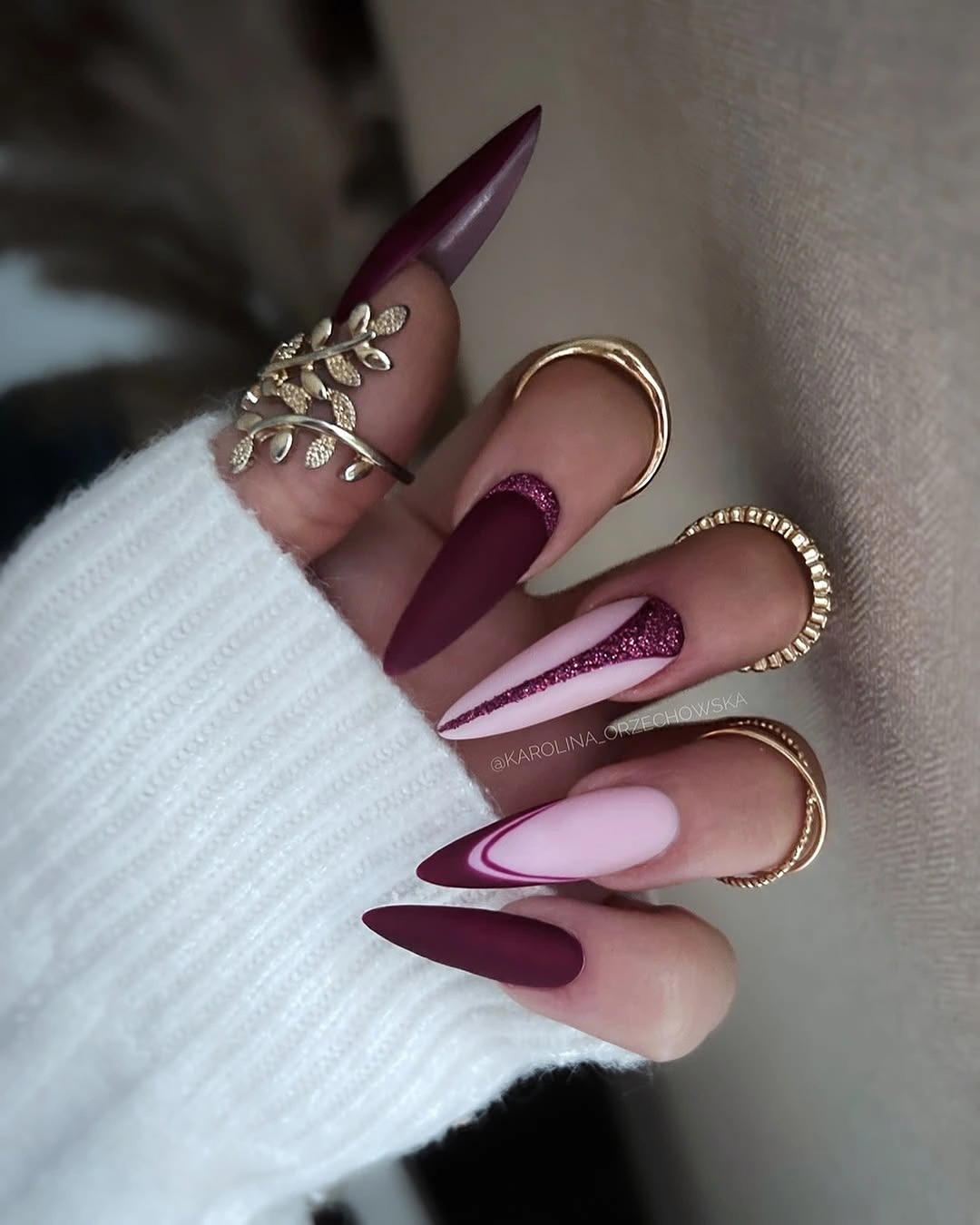
The decorative borders are most effective when they sit beside quiet nails. A fully embellished set would lose the contrast that makes the plum and pink relationship readable, but these accents are spaced so the eye can move from a bold point to a lighter open area. The long shape also provides room for the curved details to follow the nail rather than stopping abruptly at the edge.
For a wearable adaptation, keep the plum and pale pink pairing on a medium almond shape and reserve the ornate border for one accent nail. The pointed length can be difficult around clothing and daily tasks, and small reflective details may need more attention than solid color. Simplifying the decoration preserves the theatrical color story while making the silhouette and upkeep less demanding.
Olive and Black with Gold Bands
Black, deep green, and muted olive form the base of this medium almond manicure, while thin gold bands bring visible structure to the darker colors. The gold is not scattered everywhere; it appears as planned lines or blocks that organize the set. That placement makes the manicure feel graphic and deliberate, while the green keeps the black from reading as a single flat field.
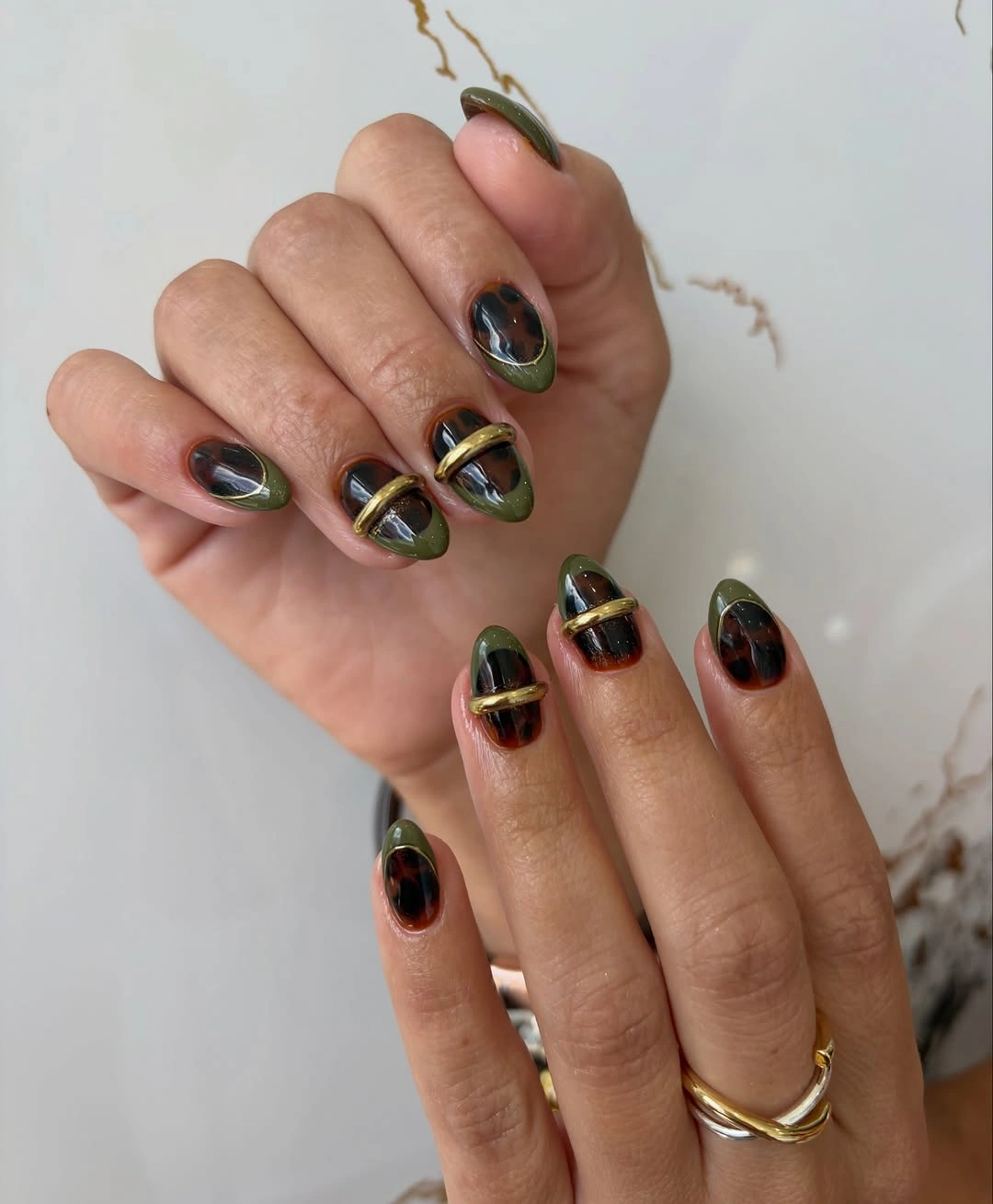
The repeated bands create rhythm because they share a direction and scale. Solid dark nails act as pauses, then the eye returns to a gold line or olive section that changes the balance without introducing a new palette. The medium almond shape supports the geometry while keeping the overall proportions less dramatic than the very long sets surrounding it.
Repeat one gold stripe on a single accent nail if you want the color relationship without the full amount of line work. A shorter square or rounded shape can still carry the olive and black, but the bands should be spaced generously so they do not look crowded. The practical limitation is alignment: as the nails grow unevenly, repeated geometric lines can lose their shared rhythm.
Smoky Cool Tones with Copper Light
Long square nails in this set combine pale and smoky blue-gray areas with translucent sections and warm copper-orange reflective accents. The cool background makes the warm detail appear brighter, so the manicure feels dimensional even without a large decorative motif. The square silhouette gives the color blocks a firm edge, which balances the softer, hazier quality of the translucent areas.
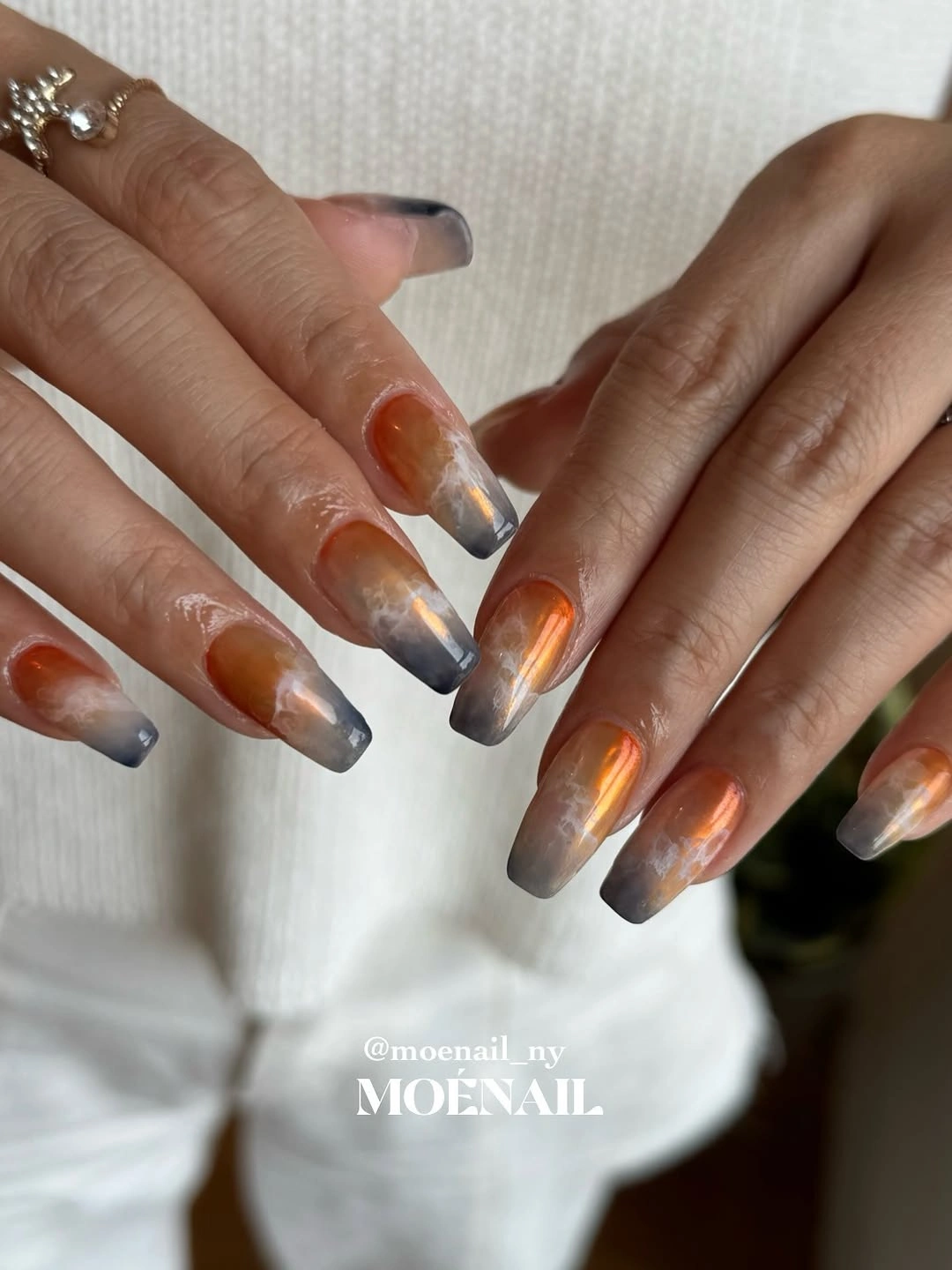
The strongest relationship is temperature rather than pattern. Gray and blue create a calm base, then the orange-copper light arrives as a focused interruption that draws attention to selected nails. Because the warm color is not repeated as a full solid across every finger, it feels like a highlight inside the palette rather than a competing seasonal theme.
Use a nude-gray base and place the warm reflective accent on two nails when adapting the idea to a shorter square shape. Keep the translucent areas simple so they do not compete with the color contrast, and avoid adding extra motifs that would make the hand harder to read. Pale open sections can reveal growth or uneven edges, so the design rewards clean preparation even when the visual story is understated.
Navy Tips on Milky Pink Almonds
Milky pink bases fade into deep navy tips on these long almond nails, with small gold star-like accents placed on selected fingers. The dark edge is bold, yet the pale center remains visible, so the manicure keeps a light middle and a stronger perimeter. That balance makes the set feel evening-ready without requiring dark color on every nail or a fully decorative surface.
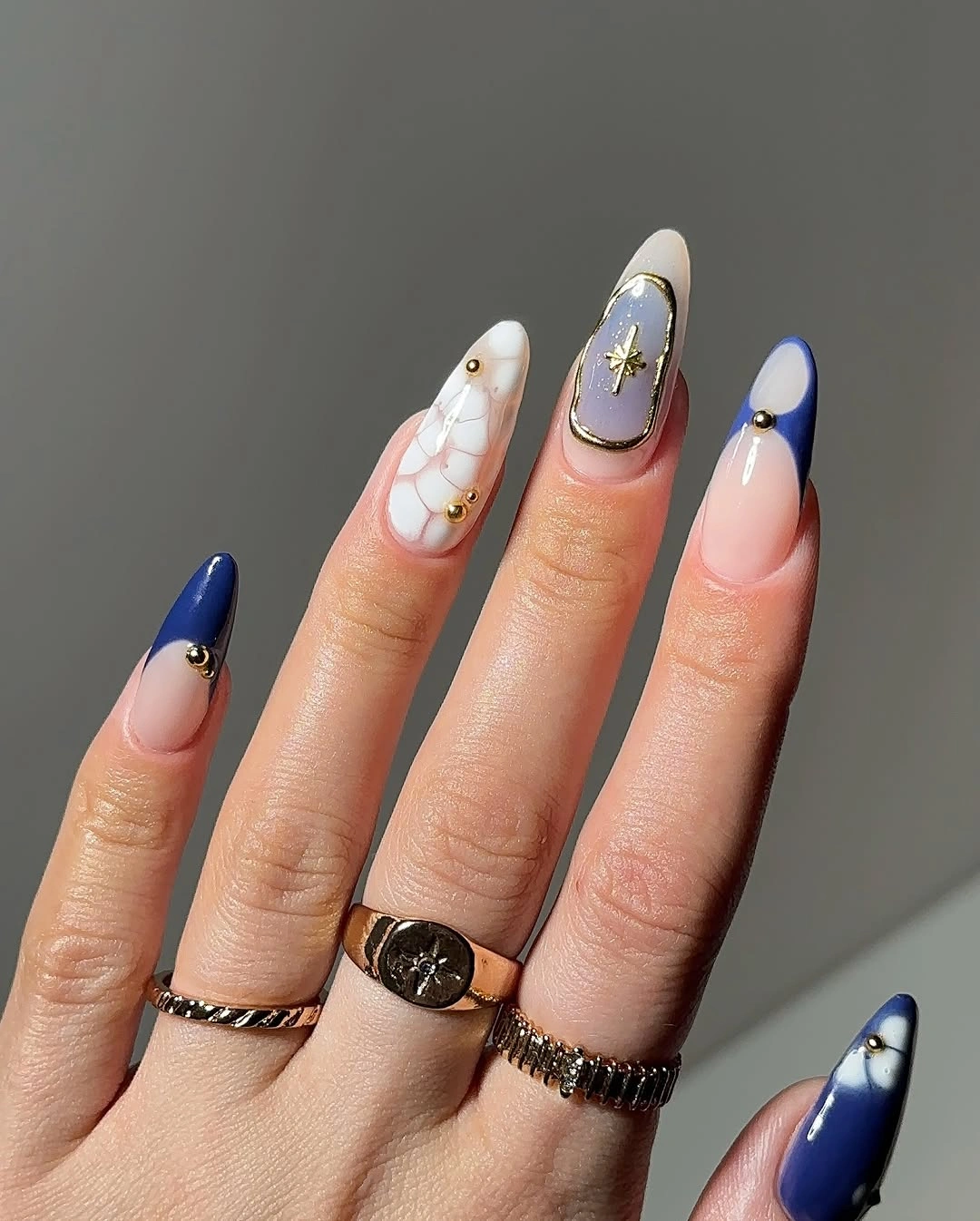
The navy works as a visual frame for the almond shape. It emphasizes the taper while the pale center preserves length, and the small gold details add a warm point that keeps the cool palette from feeling severe. The accents are most effective because they are limited; repeating too much gold would compete with the clear pink-to-navy transition.
Keep the base sheer and place the navy on one or two tips for a softer adaptation, especially on a medium almond or oval shape. A single gold mark can be enough to echo the original mood, while removing the extra accents will make maintenance easier. The tip boundary will be the first area to change with growth, so the design depends on keeping that curve even.
Turquoise Curves over a Neutral Base
Long almond nails stay warm and translucent underneath bright turquoise bands and dark curved outlines. The lines travel around the nail instead of filling it, creating a sense of movement while preserving the neutral center. This is one of the more graphic ideas in the edit, but the open space keeps it from becoming visually heavy, especially when the hand is paired with simple accessories.
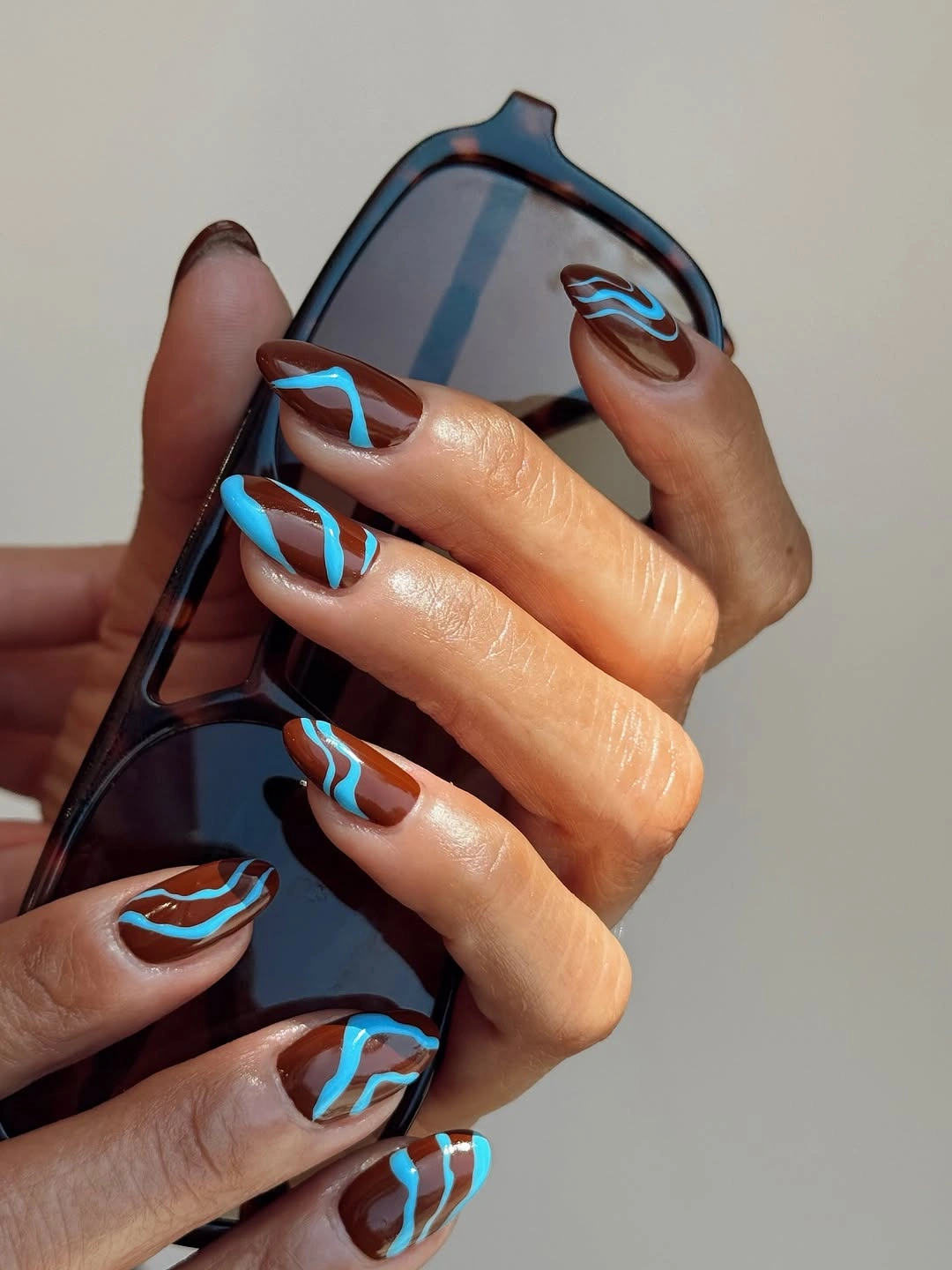
The repeated arcs give the set its rhythm. Turquoise supplies the unexpected color, dark outlines sharpen its shape, and the neutral base keeps the contrast wearable outside a full statement look. Long almond nails help the curves travel cleanly from side to side, so the silhouette becomes part of the graphic composition rather than a neutral frame around it.
Try one turquoise arc on two nails if you want a shorter or quieter version. On a short square canvas, broad curves will read more clearly than several thin lines, and the warm base can remain sheer to preserve the open effect. The tradeoff is precision: curved line work can look uneven quickly, so the design is best when the number of arcs matches the time available for upkeep.
Sunflowers over Black and White Dots
White nails covered with black dots provide the ground for bold yellow sunflower motifs on this long almond set. The flowers are large enough to become the clear focal point, while the dotted nails create a patterned rhythm that keeps the hand from looking like a single illustration repeated everywhere. The contrast is cheerful and strong, with the almond shape giving the petals room around the fingertip.
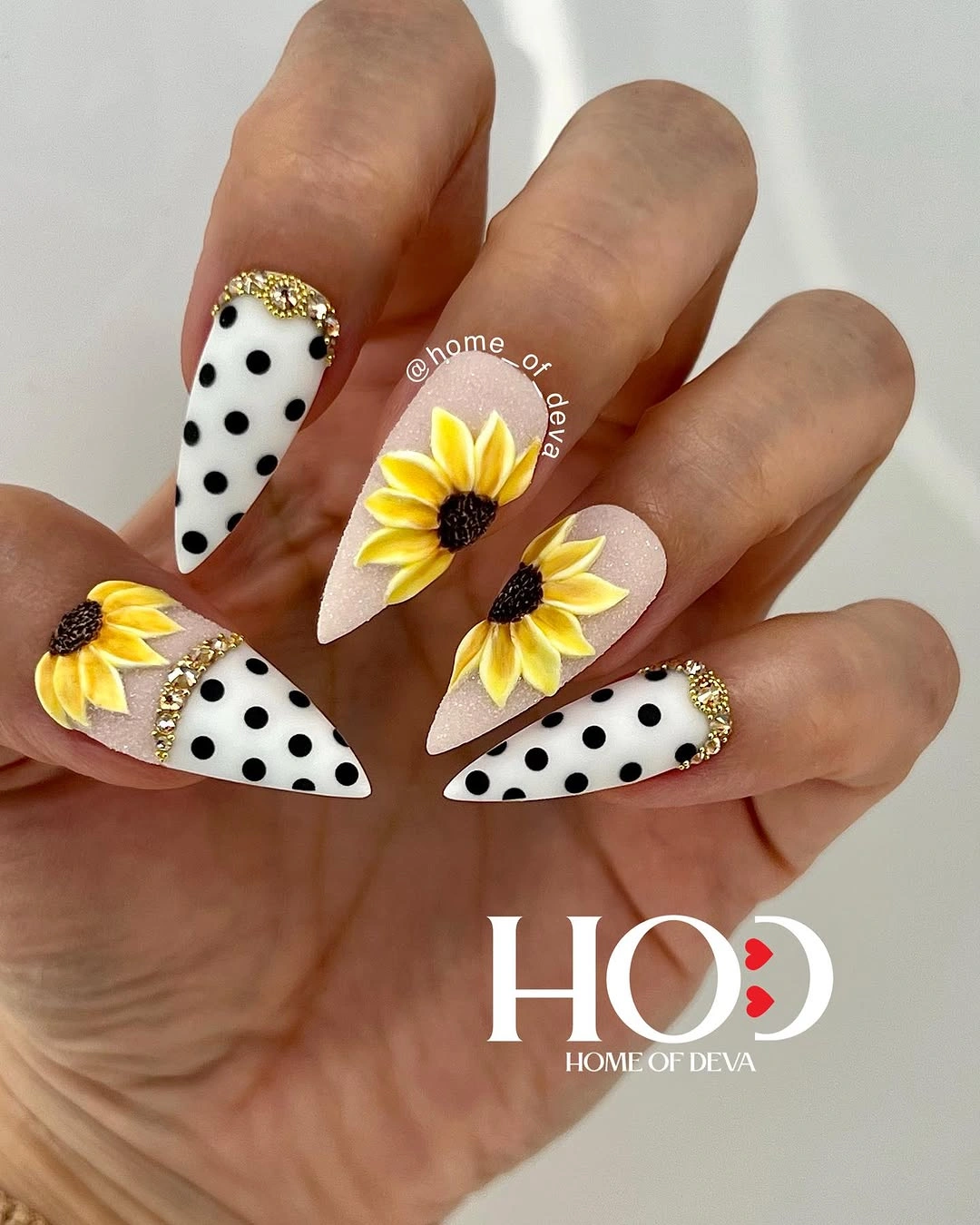
The design succeeds through scale. The dots are small and repeated, while the flowers are larger and more concentrated, so the eye knows which detail to notice first. White leaves enough negative space around the yellow shapes, and the dark centers connect the flowers to the black pattern without introducing another unrelated color.
Use one sunflower accent and plain dotted tips when translating the idea to shorter nails. The flower can be simplified into a larger yellow center with fewer petals, while the dots should stay sparse enough to remain individual. Long almond length is part of the drama, but it also makes the set more demanding, so a medium oval can preserve the cheerful contrast with less daily interference.
Pastel Mix with Small Playful Accents
Short-to-medium nails carry a light mix of pink, green, yellow, blue, stripes, dots, and small decorative marks. The pastel values keep the many colors gentle, and the compact length prevents the set from feeling like a collection of unrelated statement nails. Instead of one large focal point, the manicure builds interest through several small moments that remain connected by their softness.
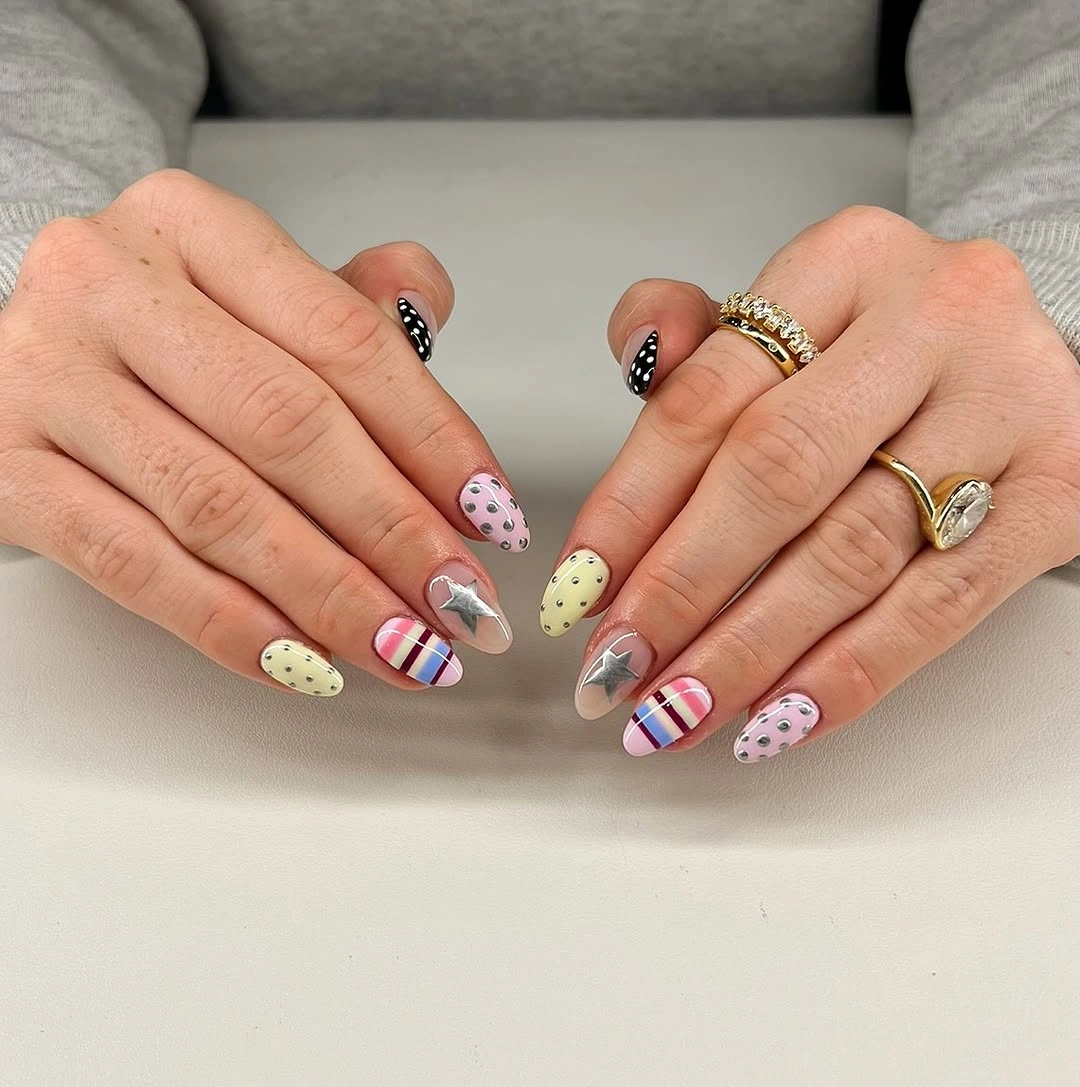
The color variety feels intentional because the accents are scaled down. A stripe gives direction, a dot adds a small pause, and a pastel solid provides breathing room before the eye moves to the next nail. This is a useful example of how a busy palette can stay wearable when the contrast between colors is moderated and no single motif is allowed to fill every surface.
Choose three pastels and repeat one stripe or dot motif across two nails for a cleaner version. Short square, oval, or rounded shapes can all support the idea, but tiny marks may blur as the edge grows, so larger simple accents are more reliable. The design is forgiving in color choice, yet it still needs a clear limit on the number of motifs to avoid visual noise.
Brown and Cream with One Patterned Nail
Short rounded nails alternate glossy chocolate brown and milky cream, with one lighter nail carrying a small brown pattern. The palette is narrow, so the patterned accent reads clearly without demanding a dramatic length or a large collection of colors. It is a calm way to bring fall depth into a practical manicure while keeping the visual focus on one chosen finger.
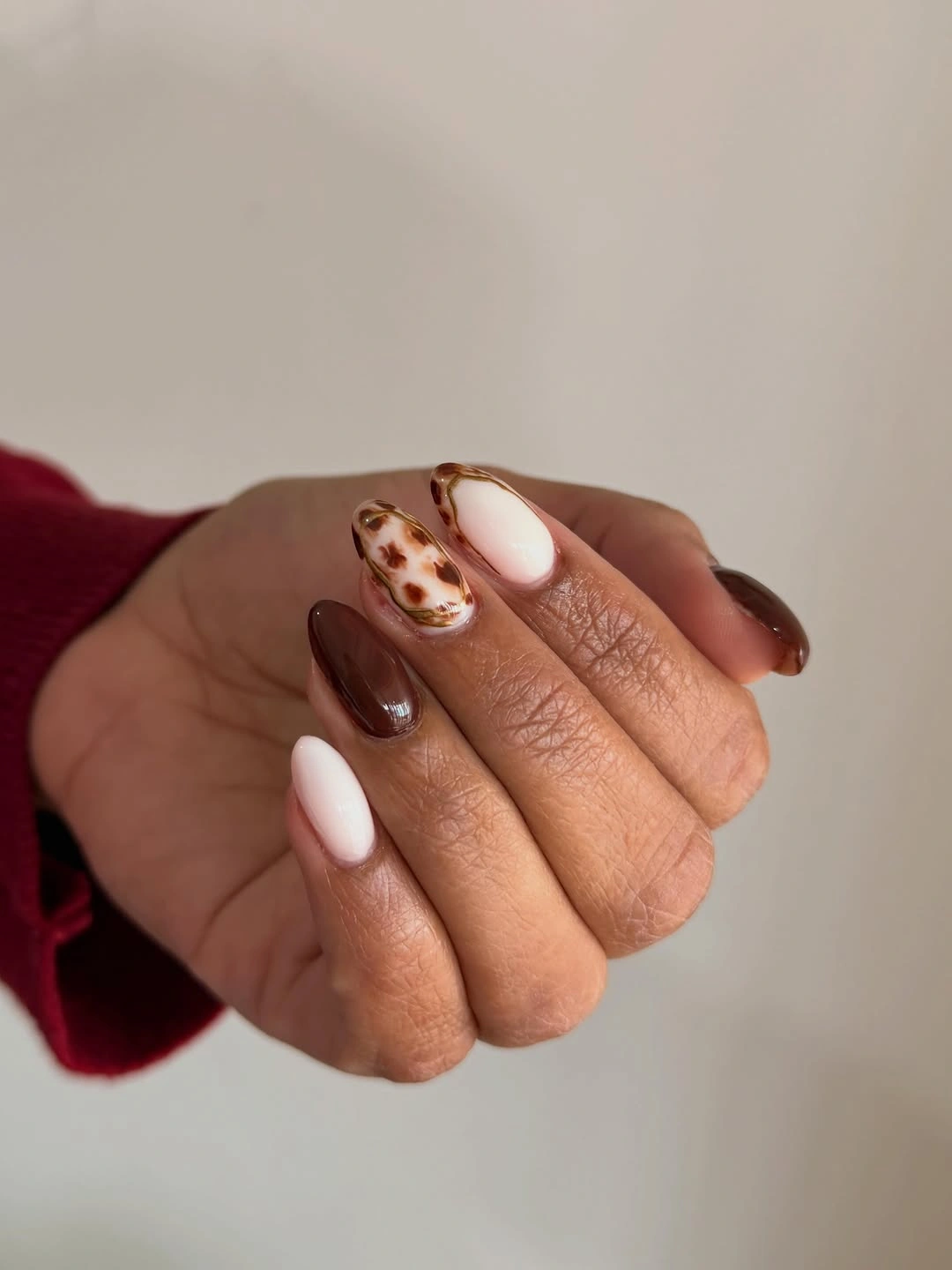
The accent works because the solid brown nails create a quiet frame around it. Cream opens the composition, the brown pattern echoes the darker fingers, and the rounded shape keeps the contrast friendly rather than sharp. The pale nail also gives the eye a place to pause, which makes the set feel considered even though most of the surface is simply one glossy color.
Place the pattern on the ring finger and use one brown tone on the others if you want the easiest version to maintain. A short square shape will make the idea more graphic, while a rounded shape will keep it softer. Pale accents can show edge wear more readily than brown, so a simple pattern with generous open space will remain cleaner as the manicure grows.
Blue Plaid Lines on a Neutral Ground
Medium almond nails use a translucent beige or pink base with bright blue lines crossing selected fingers in a narrow check pattern. The neutral ground keeps the blue from becoming overpowering, while the grid adds a clear fall-ready structure without filling the whole nail. The manicure feels crisp because the lines are repeated, but the open base keeps it lighter than a full dark pattern.
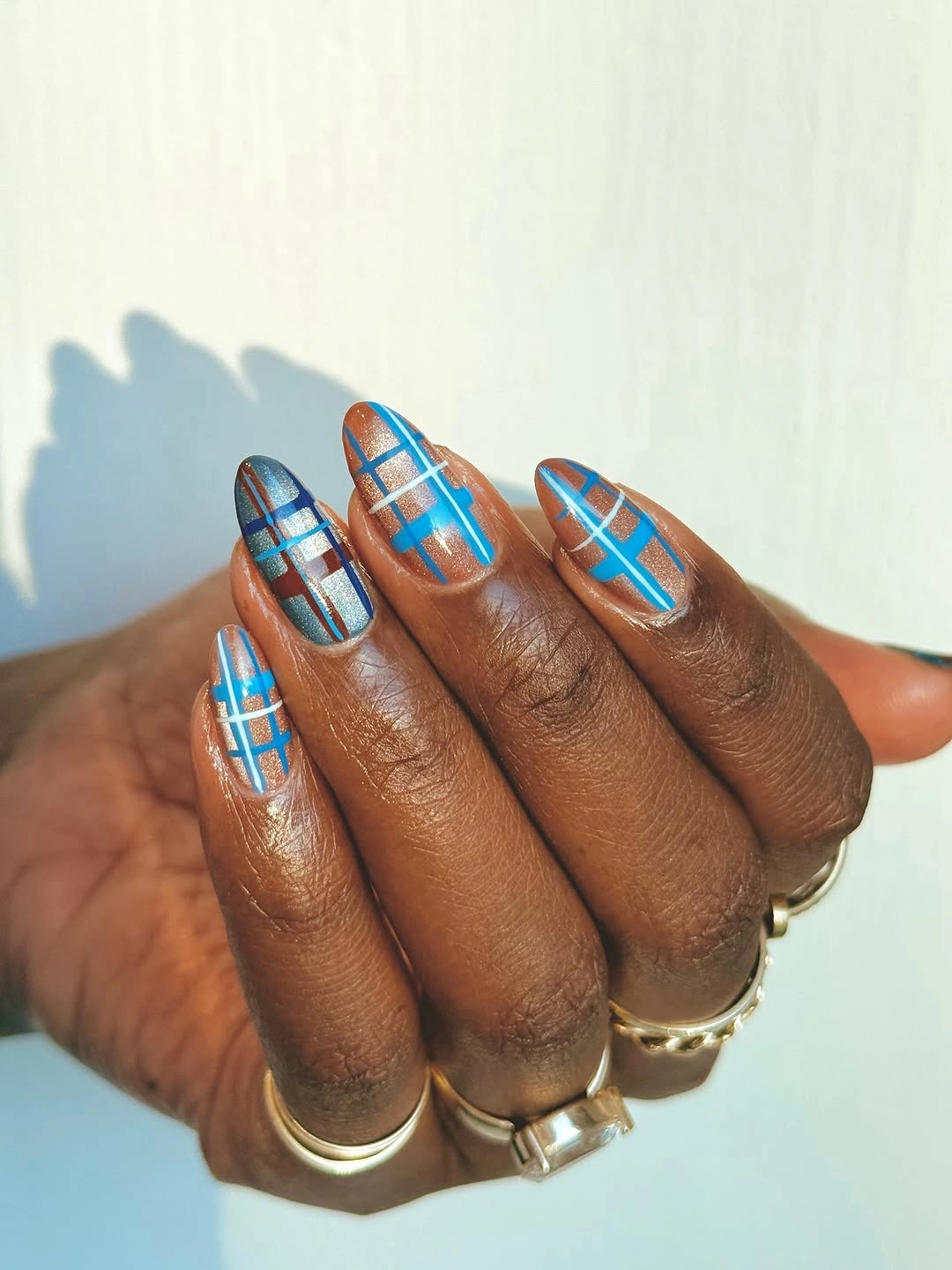
The checked detail works through contrast between order and air. Intersecting lines create a small geometric focal point, then the unpainted-looking center lets the eye reset before moving to the next nail. The almond shape gives the grid a tapered direction, so the pattern feels connected to the hand instead of floating as a square sticker on top.
Use one checked accent and keep the rest of the nails neutral if you want to reduce detail. A short oval can carry a single diagonal or two intersecting lines more reliably than a full grid, and navy will make the palette quieter than bright blue. Thin lines also require careful upkeep, because uneven growth can interrupt the clean spacing that makes the pattern read as plaid.
Sheer Almonds with Fine Black Edges
A sheer nude base and very fine black tips give these long almond nails a minimal but recognizable fall direction. The black follows the pointed free edge rather than forming a broad band, so the pale center stays open and the shape remains the main visual feature. There is no competing motif, which lets the manicure work with knitwear, denim, jewelry, or a more decorated outfit.
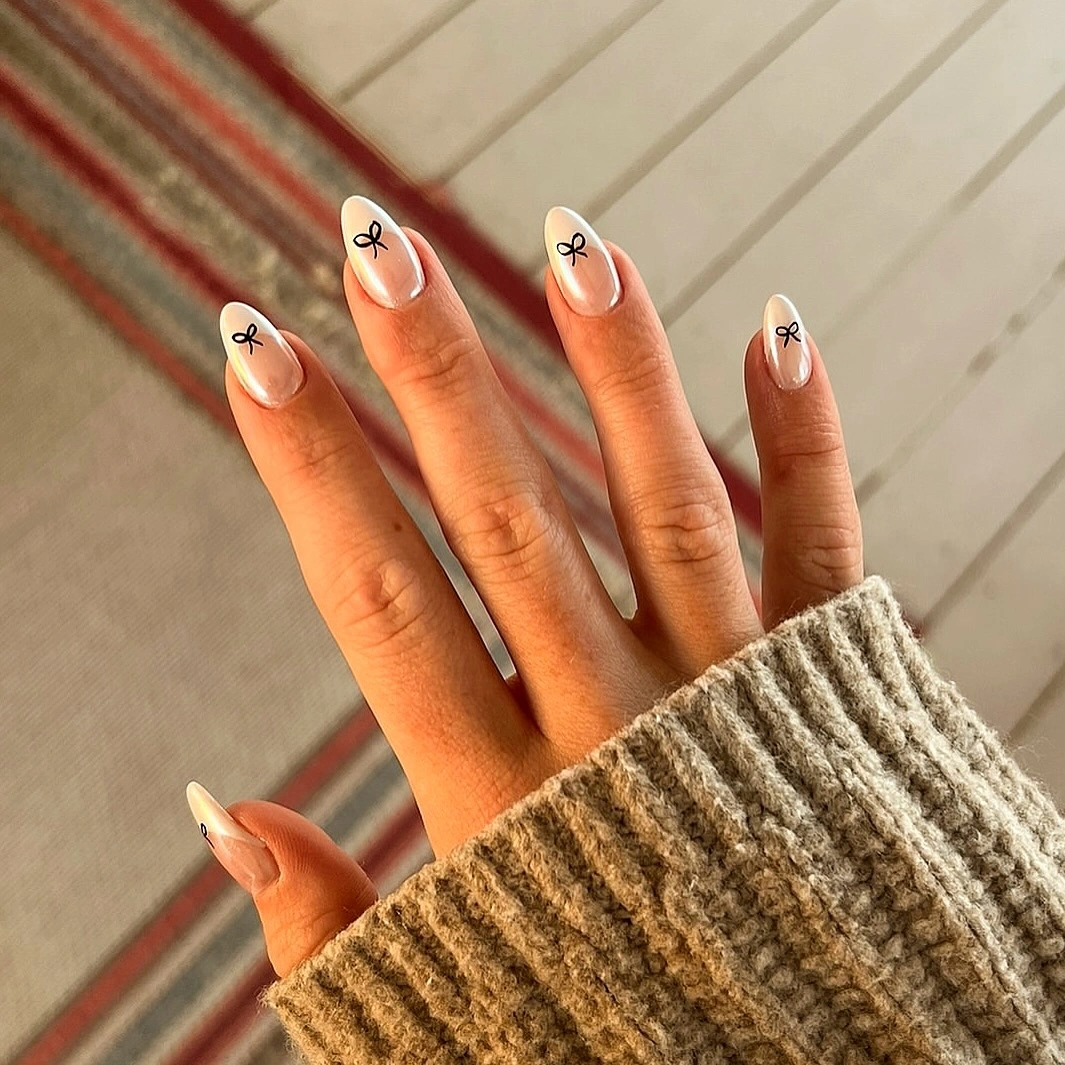
The appeal is in the proportion between line and length. A narrow edge gives the almond silhouette definition, while the transparent-looking center keeps the design from becoming too graphic. Because every nail repeats the same quiet decision, even small differences in the curve can change the overall rhythm, so the simple appearance still depends on careful placement.
Use a shorter oval or soft almond shape and make the black edge slightly wider if the original line would disappear on a small canvas. A thin border is elegant, but growth changes its distance from the tip quickly, so it will need attention sooner than a full neutral color. Keeping the base light and the line consistent is more important than adding any extra decoration.
Neon Diagonals on Very Long Stilettos
Hot pink, orange, black, and pale diagonal stripes run along very long stiletto nails, turning the pointed silhouette into a directional graphic. The bands travel with the length, so the eye moves toward each sharp tip instead of settling on a single center detail. The color contrast is energetic and unmistakably expressive, which makes this a statement idea rather than a quiet everyday edit.
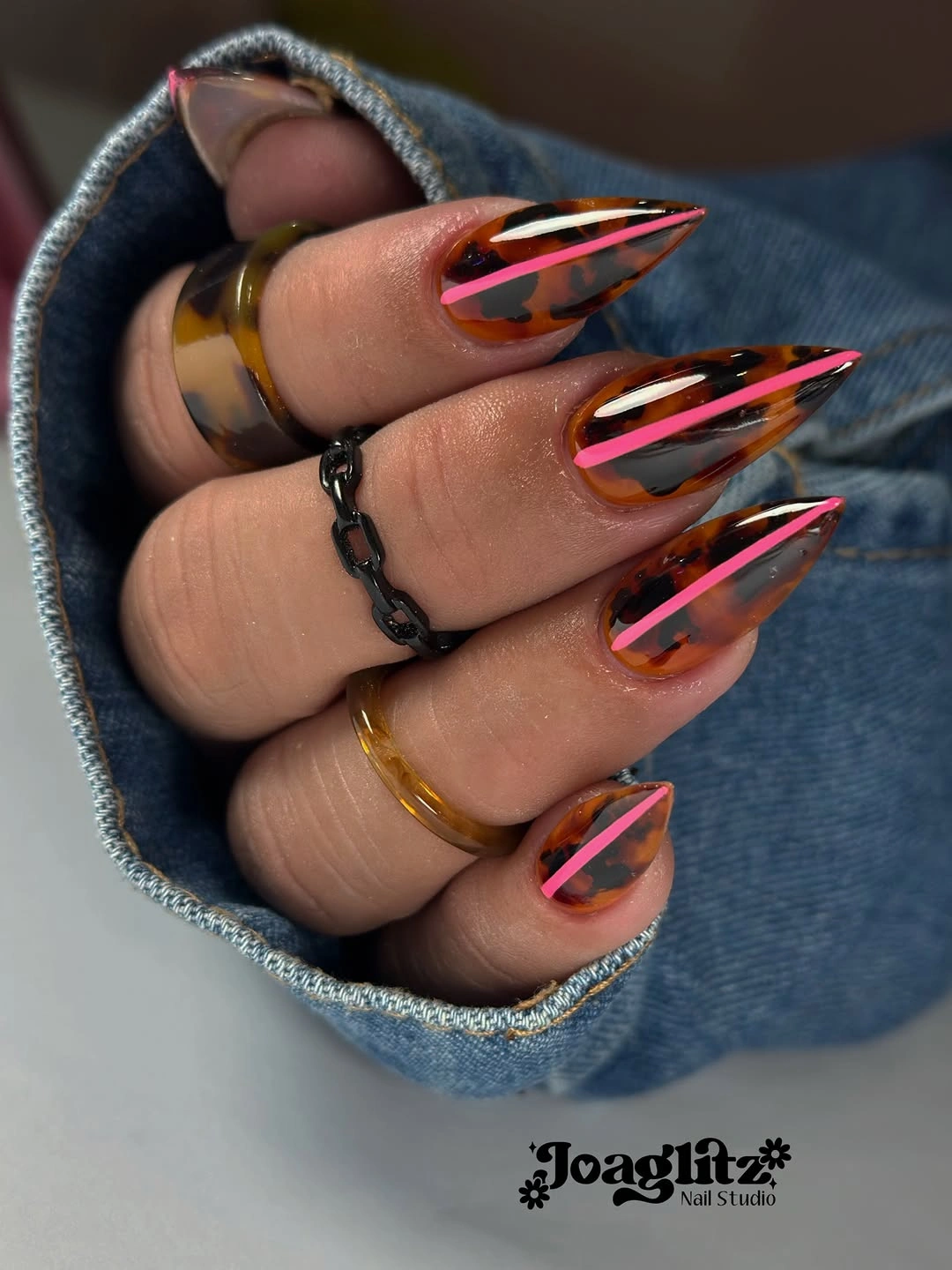
The stripes work because their angles repeat the architecture of the nail. Pale separators keep the bright colors distinct, black adds definition, and the long point gives every band enough room to remain visible. If the same number of stripes were placed on a shorter square nail, they would compete for space, but here the elongated surface turns them into a visual path.
For a more wearable version, keep two broad diagonal colors on a medium almond nail and remove the thinner separators. The original stiletto length is visually powerful but can interfere with clothing, typing, and everyday handling, while multiple narrow lines need more frequent touch-up. Preserving the direction of the stripes matters more than preserving every color, so simplify the palette before sacrificing the movement.
Royal Blue Dots with Open Space
Translucent-looking almond nails finish the collection with royal-blue tips and small blue dot clusters gathered near the edges. The open centers keep the design airy, while the repeated blue marks add enough pattern to make the set feel intentional. Because the dots echo the tip color, the manicure has one clear palette relationship rather than a collection of unrelated accents.
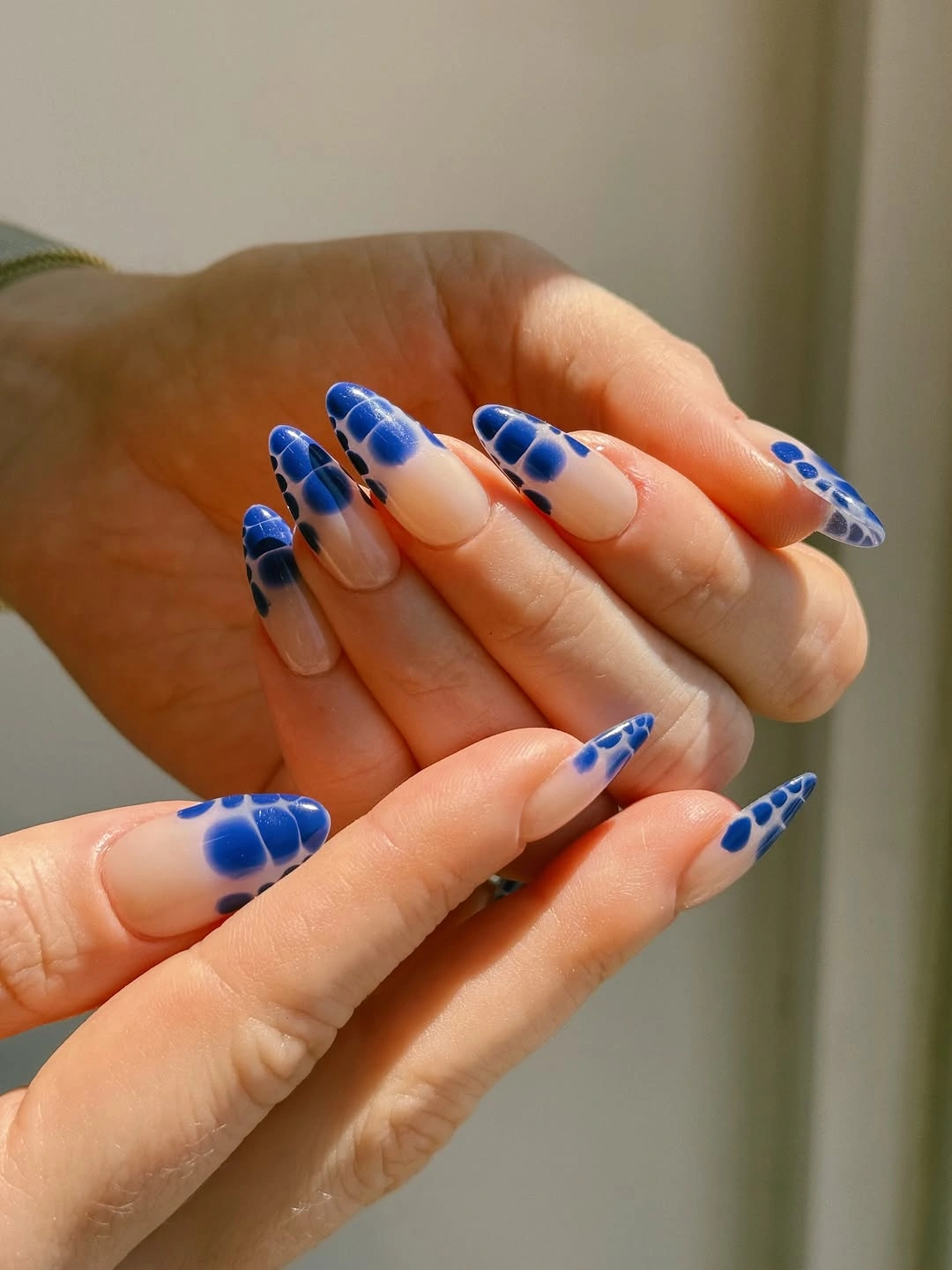
The placement gives the dots a tapered direction. They are not scattered across the entire nail, so the eye moves from the pale center toward the colored edge and back again. The almond silhouette supports that movement, and the royal blue provides contrast without requiring a dark full-nail base, which makes the design feel graphic but still light beside neutral clothing.
Reduce the clusters to one accent nail or replace the royal tip with a quieter navy if you want less contrast. A medium almond shape will preserve the open center, while a short oval may need fewer dots and a slightly wider edge. The pattern should remain sparse enough that each mark is readable, since crowded dots would remove the negative space that gives the manicure its freshness.