Early fall is the awkward little space between wanting color and wanting depth. A bright summer manicure can suddenly feel too loud, yet a full wine-and-black palette may be more commitment than the moment calls for. The sweet spot is a nail choice that warms the hand without making it look as if the season arrived all at once.
Start with the detail you notice first when your hand rests against a sleeve, a keyboard, or a phone: the temperature of the color, the shine on the surface, or the line of the tip. Once that decision feels right, keep everything else quiet. That is how early fall nails 2026 can look intentional while still leaving room for lighter clothes, changing plans, and a shorter grow-out.
Burgundy, Olive, and Mustard in One Short Palette
The opening set uses short-to-medium almond nails as a small color study: wine red, olive green, mustard yellow, and deep brown each occupy their own nail. The surfaces look glossy and mostly solid, so the palette order does the visual work. Moving from a deeper red into a muted green and then a brighter yellow keeps the hand from becoming one dark block.
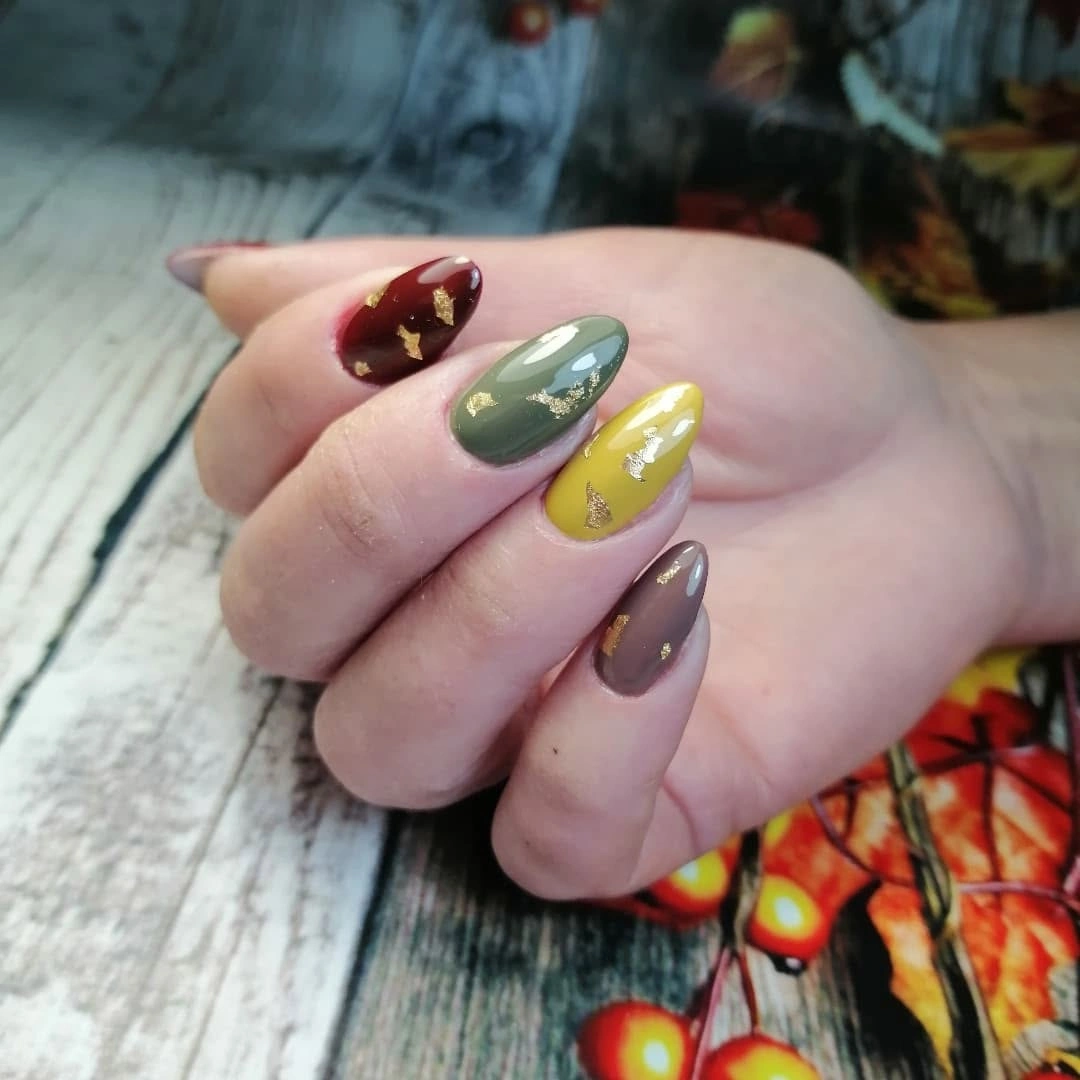
What makes this combination feel ready for the season is the balance between grounded and lifted tones. Burgundy and brown supply depth, olive softens the transition, and mustard gives the eye a warmer point to land on. The nails do not need matching art because the sequence already creates rhythm across the fingers.
If you want the same idea on shorter nails, keep the four-color family but repeat only two shades on the smallest tips. A cream sweater, denim layer, or simple gold detail can sit beside the manicure without competing with it. The practical advantage is easy editing: remove mustard for a quieter version, or make it the single accent when you want more light.
Olive Nails with Two Cream Speckled Accents
Short square olive nails form the base of this design, while two cream nails interrupt the green with scattered dark speckles and tiny warm marks. The dots are irregular rather than arranged in a strict grid, which keeps the accent closer to a hand-drawn detail than a repeated stamp. The compact shape makes every contrast easy to see.
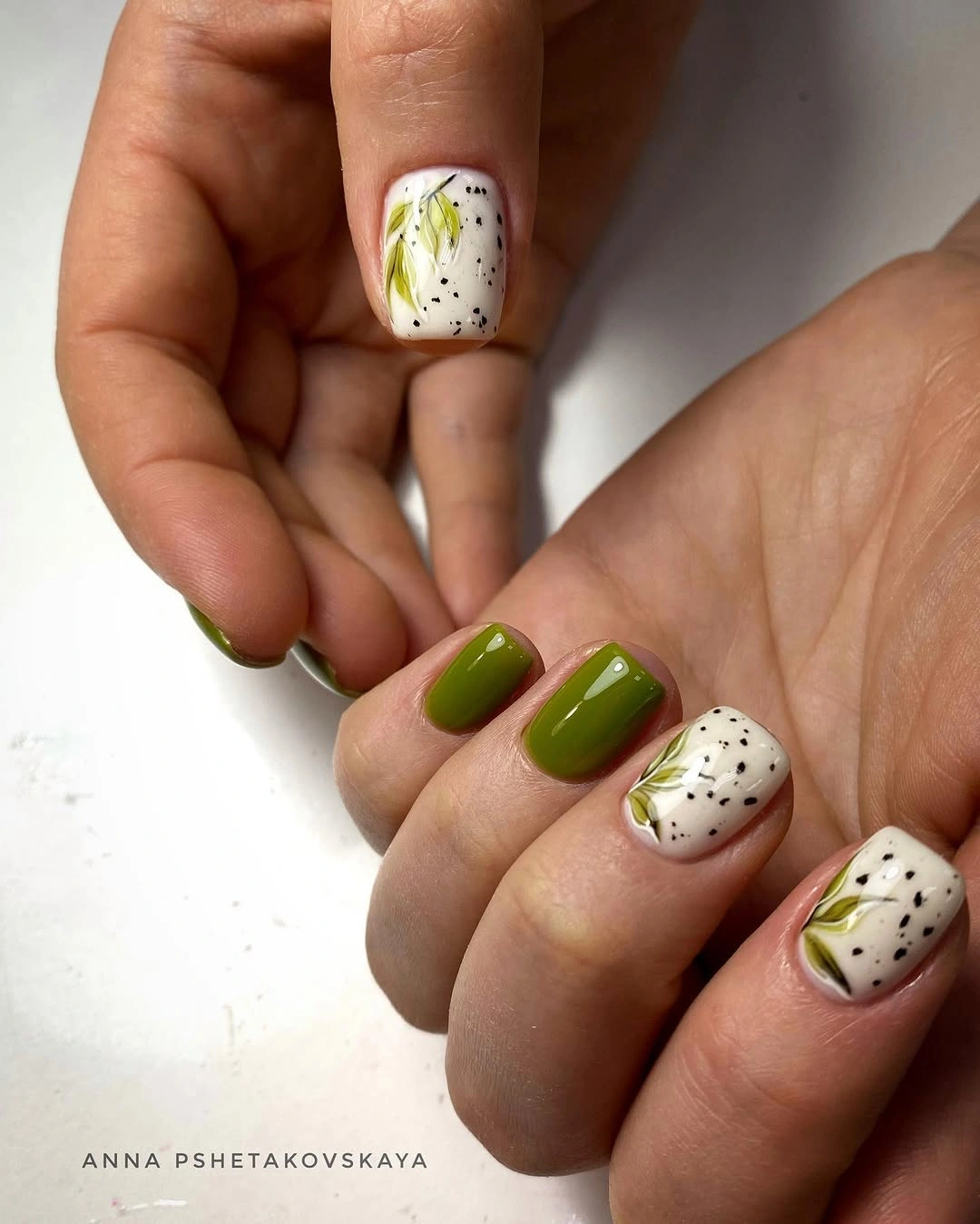
The light nails matter because they create breathing room between the olive solids. Without them, the green would read as one continuous block; with them, the hand gains a pale pause and a small pattern that does not overwhelm the base. This is a useful way to add fall nail designs while keeping the overall color story muted.
For a shorter version, place the speckles on one accent nail and leave the other cream. That change keeps the layout readable if there is less surface area, and it also lowers the amount of detail that needs to stay crisp as the nails grow. Readers who prefer more warmth can exchange the cream for a soft beige while keeping the same olive-and-dot structure.
Red Almond Tips with Loose White Accents
Medium almond nails give this set a strong red foundation, but the decorated nails leave white space around loose red curves, black dots, and small dark marks. The solid red tips are glossy and direct, while the lighter accents introduce a lighter surface that lets the eye slow down. Repeating red inside the accents keeps the two sides of the design connected.
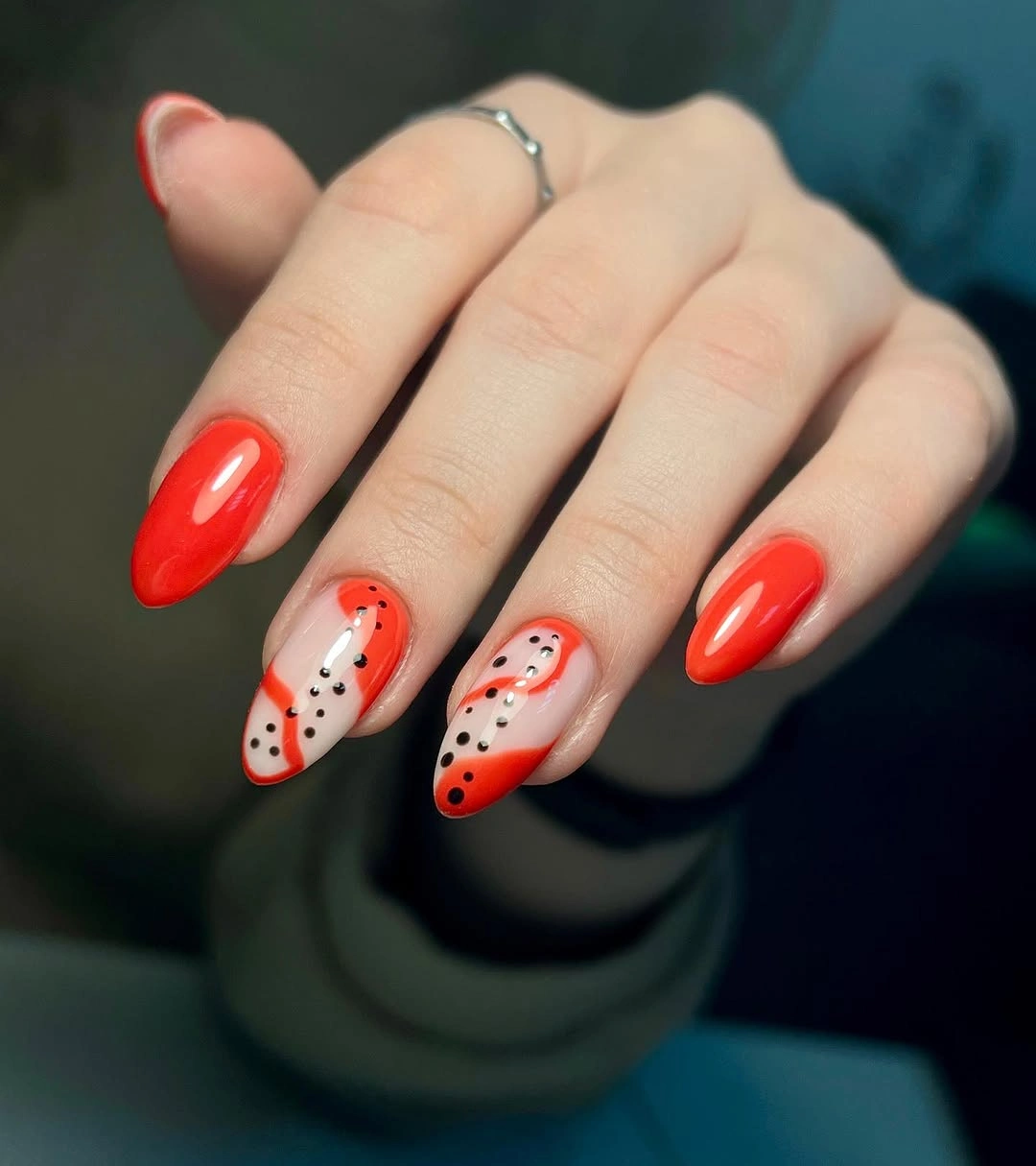
The contrast works because the white nails are not treated as unrelated decoration. They echo the main shade, yet their open space changes the pace from one finger to the next. The almond shape adds a graceful line, but the design can still read on a moderate length if the accent marks are made larger and fewer.
A practical adaptation would keep the red on three nails, use one white accent, and turn the last nail into a soft nude. That version preserves the color contrast without asking every decorated surface to match. If you choose a shorter oval instead of almond, focus on one red curve or a few dots so the white ground remains clear rather than crowded.
Warm Taupe with One Gold-Fleck Detail
Here the manicure narrows the palette to warm beige, taupe, and one accent that catches fine gold light. The nails are medium and softly rounded, with glossy solids doing most of the work. Because the base colors sit close together, the metallic detail reads as a small glint instead of a separate statement, which keeps the look quiet while still giving it a seasonal edge.
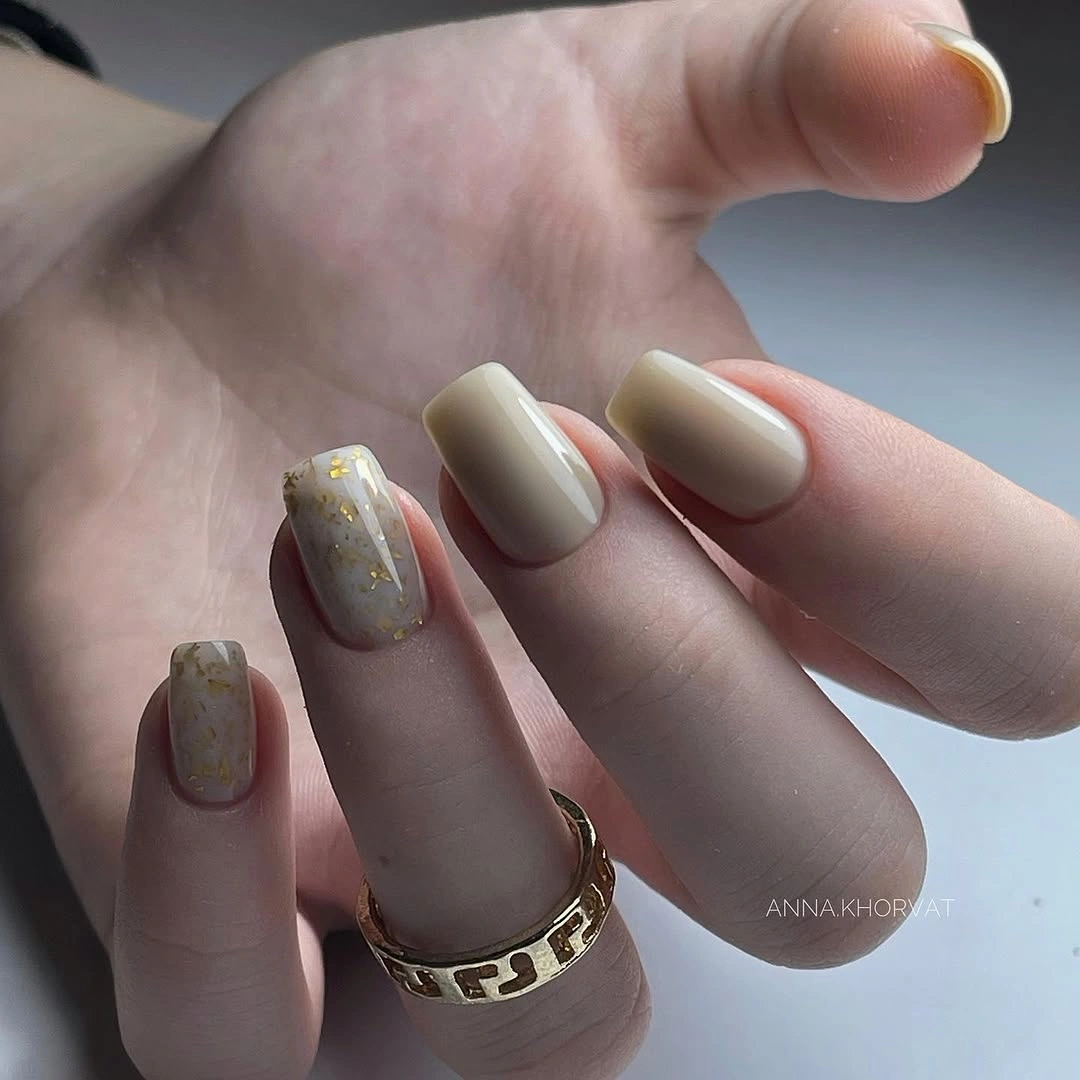
This kind of early-fall choice is useful when you want richer color without committing to orange or burgundy. The taupe supplies depth, the lighter nude prevents the hand from feeling heavy, and the gold accent gives the neutral group a point of focus. Jewelry may echo that warmth, but the polish remains readable on its own.
The gold is easiest to wear when it stays limited to one nail, especially if you prefer a low-detail routine. On a shorter shape, use a few larger flecks rather than many fine ones so the accent does not disappear. A matte neutral would change the balance completely, so keep the smooth finish if the goal is a soft, light-catching transition manicure.
Pale Pink with Dots and Tiny Raised Accents
Short rounded nails start with a pale pink base, then add scattered black or purple dots and a few small pearl-like details near the hand. The light foundation leaves plenty of open space, while the dark marks create a gentle seasonal contrast. The raised elements are separate from the painted pattern, so the design has a small change in texture as well as color.
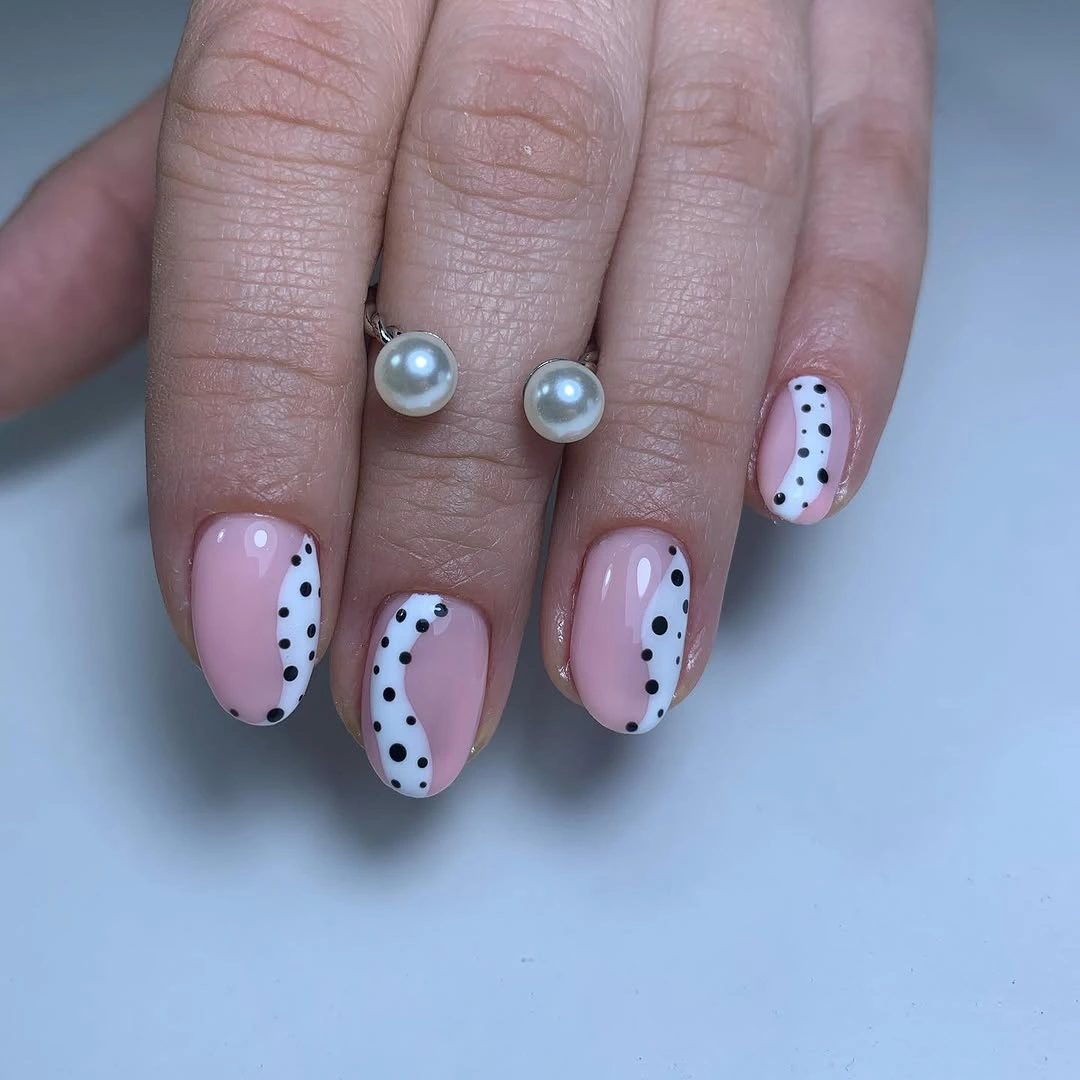
The combination works because the dots are not placed with perfect symmetry. Their uneven spacing keeps the pale base lively, and the tiny raised points give a minimal manicure a focal detail without covering the full nail. It feels lighter than a brown set, but the dark marks stop it from drifting into an entirely spring-like direction.
Keep the raised accents to one or two nails if everyday clothing or knit textures are part of your routine. A short oval can carry the same idea with larger dots, while a very short tip may look cleaner with one dot cluster instead of several scattered marks. The pale pink base is also easy to warm up with a beige undertone if you want less contrast.
Nude Space and Loose Brown Line Work
Short nails with a light nude base use white and warm brown lines to create open abstract or botanical shapes. The marks are airy and slightly irregular, and the orange fabric nearby only reinforces the season visually; the manicure itself stays centered on the pale ground and the loose drawing. That restraint gives the accents room to breathe.
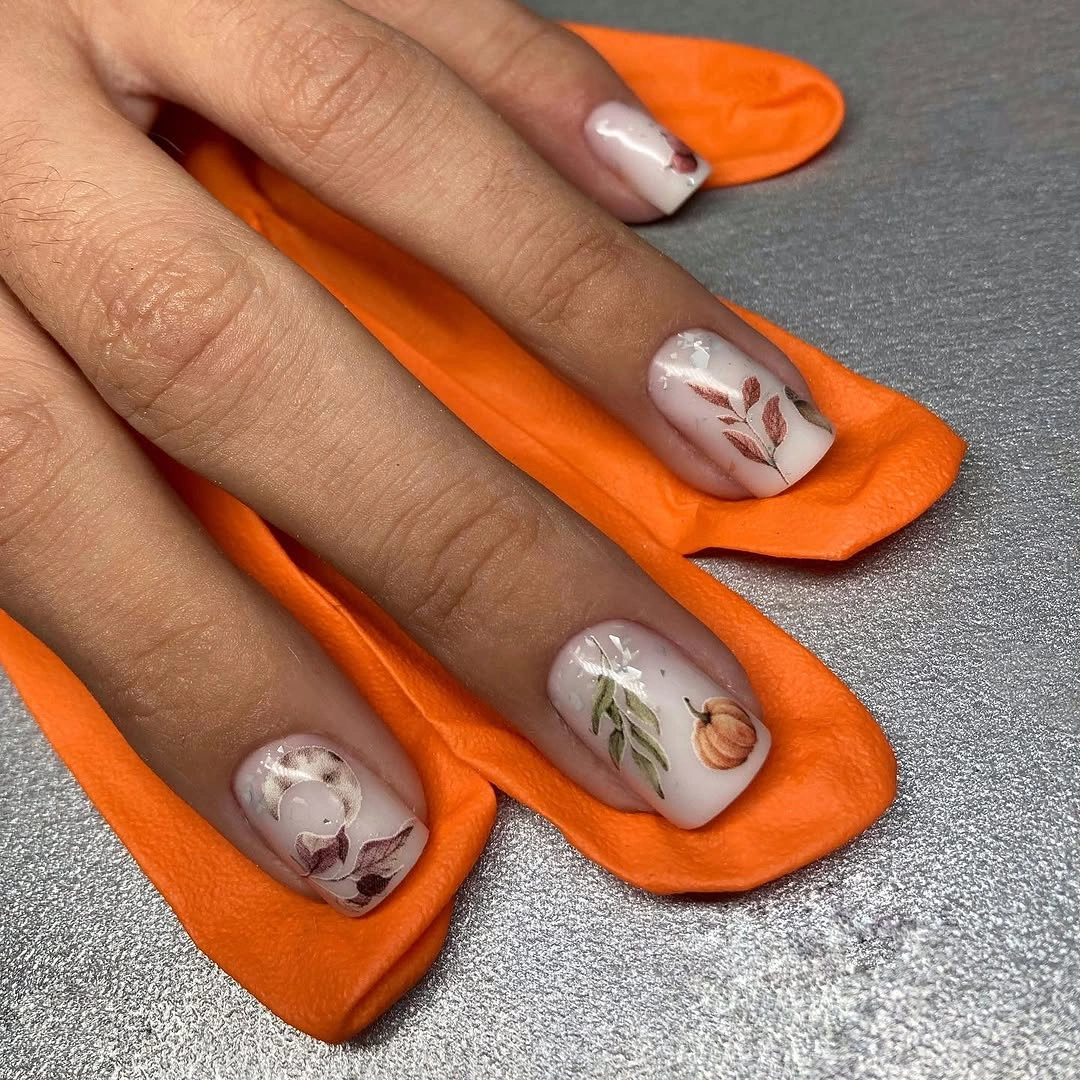
The design feels considered because it leaves more base visible than it covers. Brown lines provide a seasonal cue without turning the whole hand into a dense print, while the short shape keeps the idea practical. Negative space also lets the same manicure move between late summer and early fall as clothing colors deepen.
When the nail plate is even shorter, replace several thin strokes with one larger curve or leaf-like mark. That change makes the drawing easier to read and reduces the chance that fine edges blur during wear. A warm beige base can replace nude, but keep the accent lines dark enough to maintain the contrast that makes this set work.
Glossy Cobalt on a Compact Rounded Shape
Every visible nail in this set is a saturated cobalt or royal blue with a short rounded-square tip. There is no print, glitter, or alternating accent to distract from the color, so the manicure reads as one clear block of cool intensity. The green knit behind the hand adds seasonal contrast, but the blue remains the actual design decision.
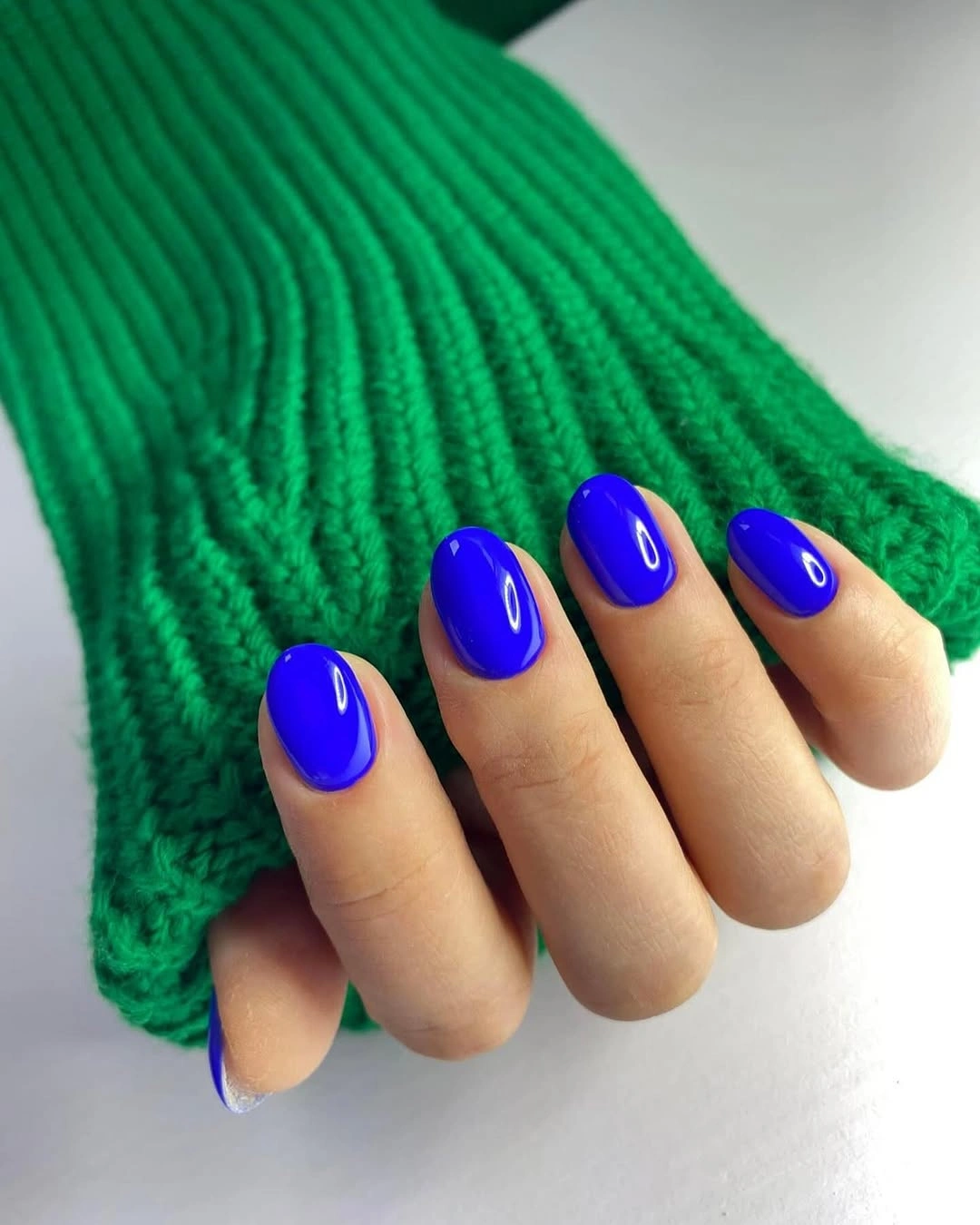
A cool shade can sit comfortably in an early-fall wardrobe when its silhouette is simple and its finish is glossy. The short shape keeps the color approachable, while the high saturation prevents it from feeling too delicate. This is a useful reminder that seasonal styling can come from contrast with clothing rather than from repeating the expected rust and brown palette.
If a full cobalt set feels strong, use it on three nails and pair it with a muted olive or soft nude. Shorter nails can keep the same color without needing any change in design, which makes this one of the easiest ideas to adapt. The main limitation is visual intensity: the shade will remain the focal point, so keep nearby accessories uncomplicated.
Berry Purple with Warm Abstract Accents
Several nails carry a glossy berry-purple shade, while two pale accents use warm red, yellow, and curved marks to break up the darker color. The tips are softly rounded, and the decorated nails vary slightly in scale so the hand does not look mechanically mirrored. Purple establishes the mood, but the warm accents keep it connected to an early-fall palette.
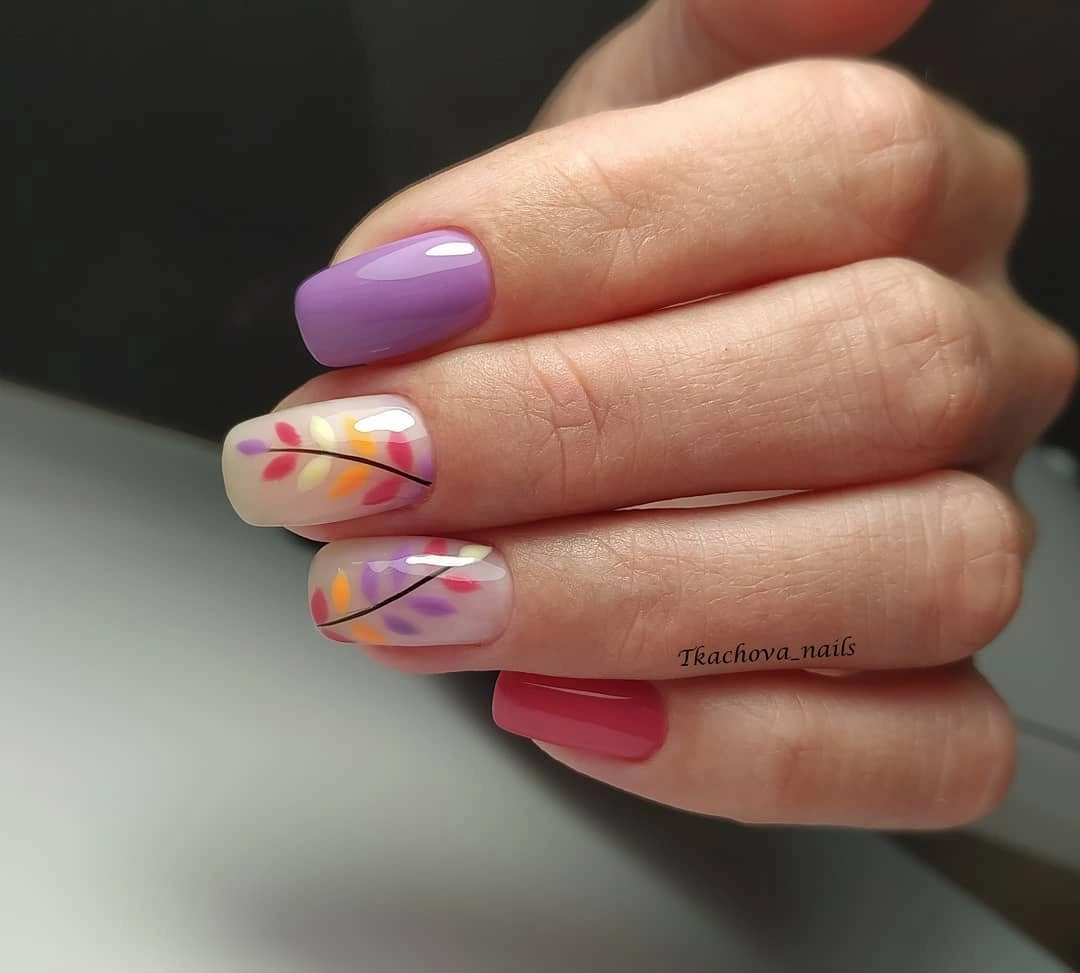
The contrast works through temperature as much as value. The cool berry base feels deeper when it sits beside a light accent, and the red or yellow marks bring warmth back into the composition. Because the details remain concentrated on selected nails, the set can feel playful without becoming a full pattern from cuticle to tip.
For a quieter version, leave one accent nail pale and turn the other into a solid berry shade. That edit is helpful on a shorter shape, where too many marks can compress the design. You can also shift the purple toward plum or muted mauve, but keep one warm accent color so the palette retains the same seasonal conversation.
Red Shimmer with One Small Floral Accent
The main nails use a short rounded red shade with fine shimmer, while one lighter nail carries a compact motif in orange, yellow, and pink. The shimmer gives the solid fingers extra depth without adding a second pattern, and the floral detail becomes the focal point because it is the only illustrated surface. The warm colors repeat the energy of the red base.
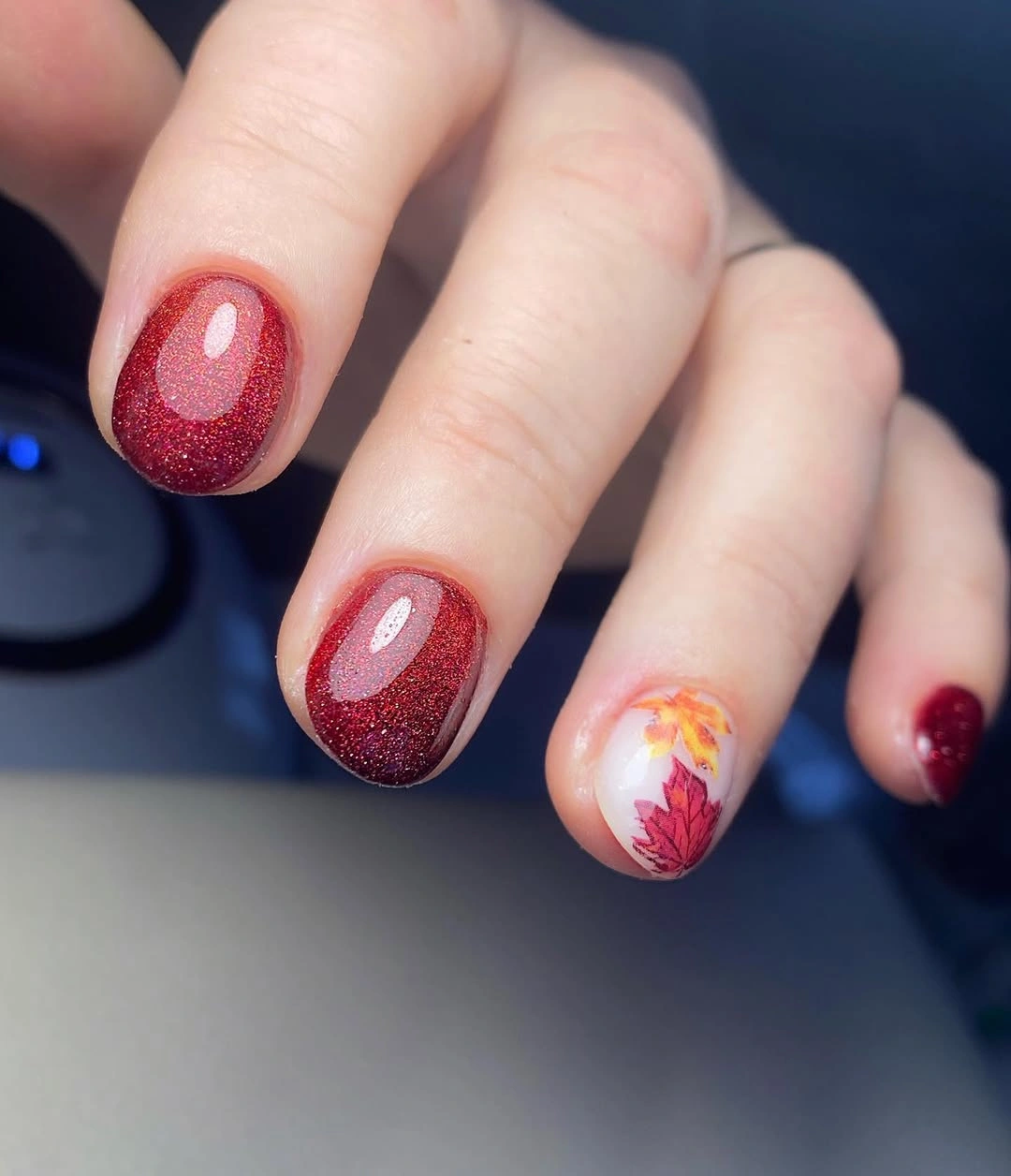
This layout is effective when you want a manicure that looks finished from a distance but rewards a closer look. The shimmer supplies movement across the hand, while the single accent prevents the floral mark from taking over. Keeping the motif to one nail also makes the design easier to edit if a very detailed surface is not practical for you.
A shorter nail can use one larger flower or a simple warm dot cluster instead of several tiny petals. If you prefer less shine, keep the accent glossy and switch the red to a softly reflective finish rather than a flat matte. The small painted details may show grow-out sooner than the solid shimmer, so one focal nail is a sensible maintenance limit.
Glossy Chocolate Brown on Short Nails
This manicure uses a short-to-medium square shape and one deep chocolate-brown color across every visible nail. The finish is smooth and glossy, with no art or alternating accent, so the richness of the shade carries the entire look. Against a light knit sleeve, the brown reads warm and concentrated rather than black.
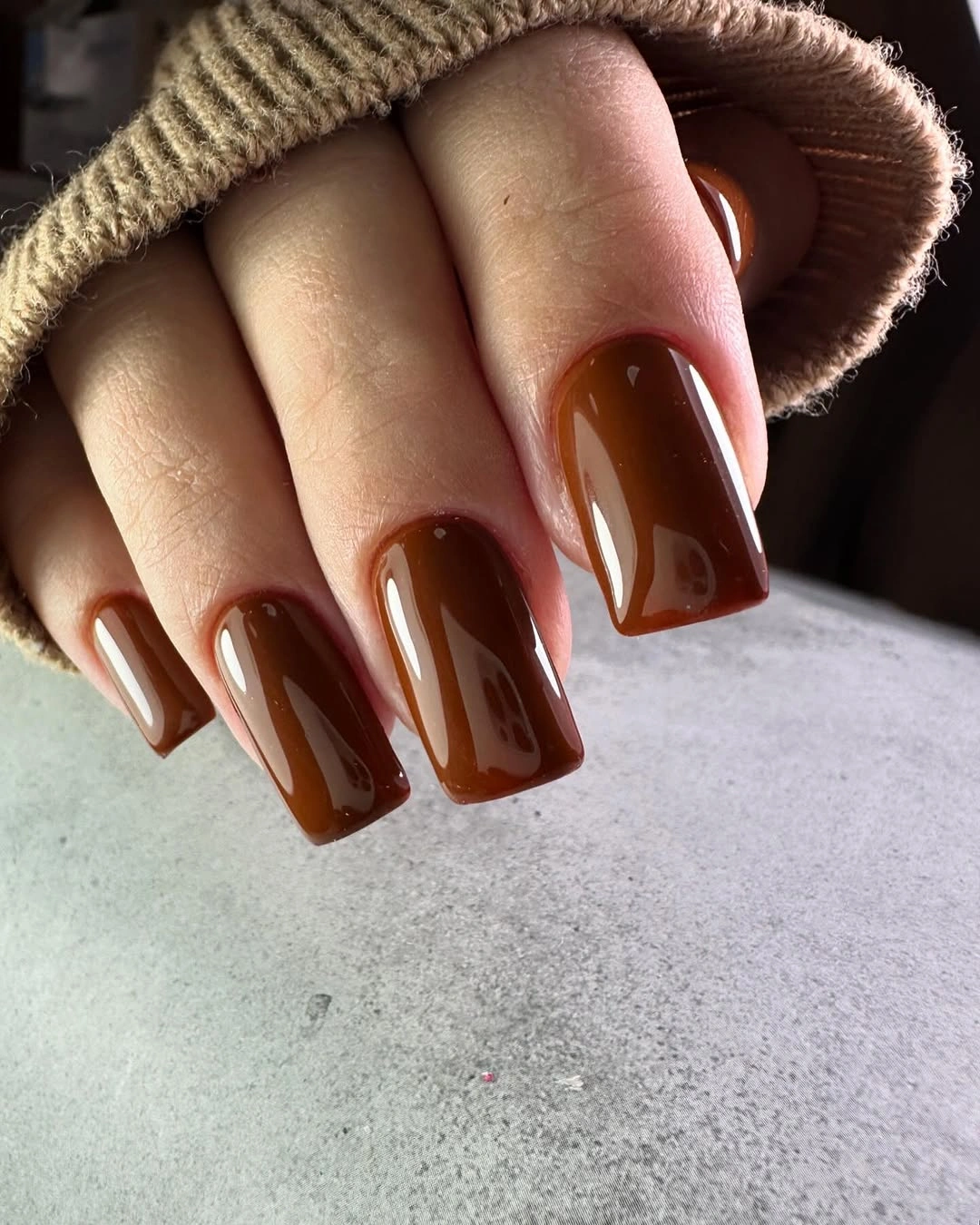
The strength of the design is its editing. A dark color can look intentional when the silhouette stays compact and the surface remains clean, and the absence of extra detail makes the result easy to pair with layered fall clothing. It is also a useful baseline for comparing the more decorated ideas that follow.
If you like the color but not the square edge, a short oval will soften it without changing the palette. Gloss makes surface marks and growth more visible, so even coverage matters more here than in a textured finish. You can add one caramel accent, but the plain brown is what gives this option its low-decision, everyday character.
Marigold Orange with a Dark Framing Edge
Short square nails carry a bright marigold or mustard-orange base, with a deeper brown edge creating a narrow two-tone frame on selected tips. The orange is more vivid than the surrounding neutrals, but the dark side detail keeps it from looking flat. Because the rest of the nails stay compact, the color remains the focus rather than the shape.
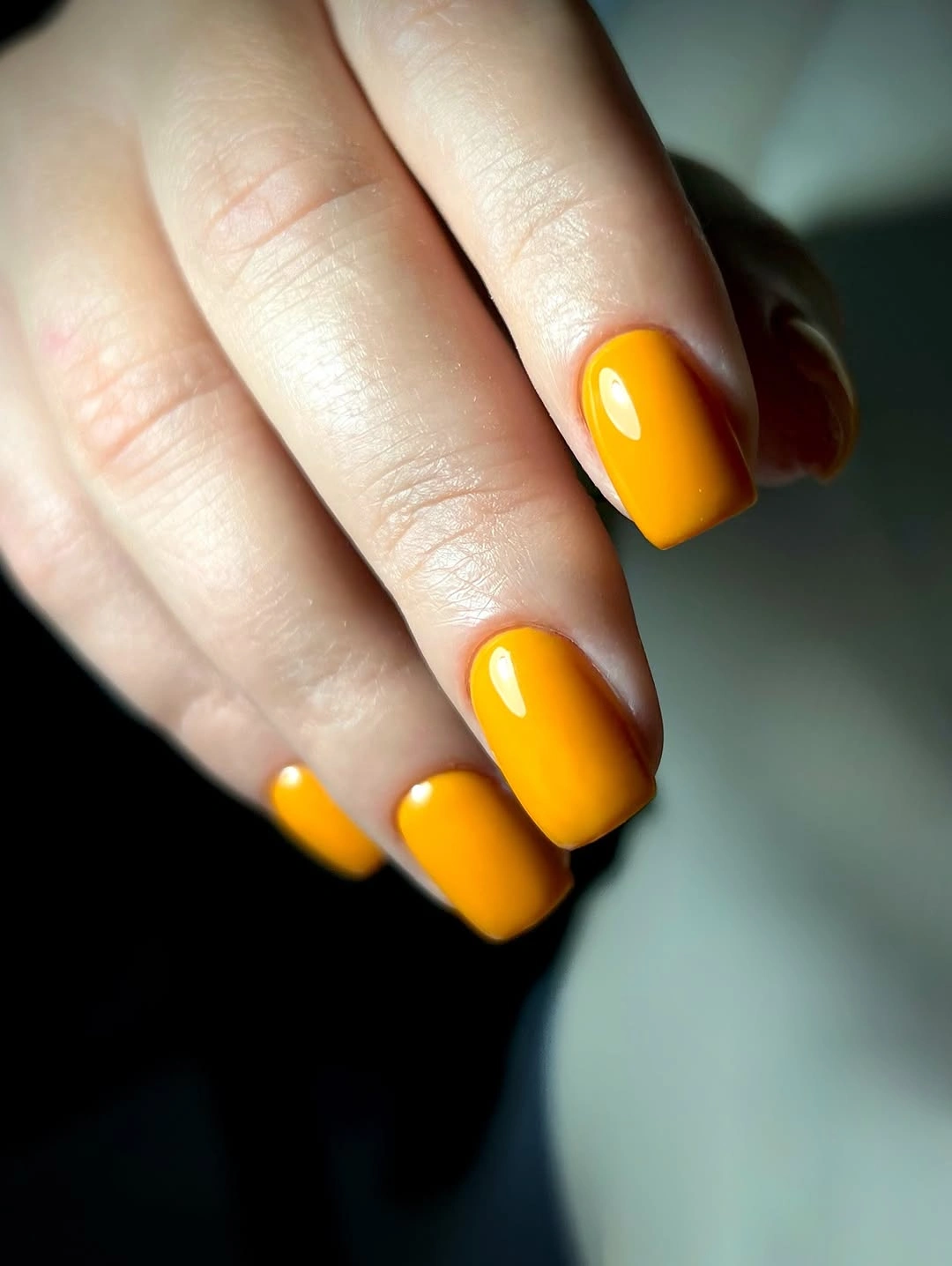
That small darker line changes the balance without requiring a full graphic motif. It gives the warm shade an outline, which makes the orange feel more grounded and connected to fall. The idea is especially useful when a single saturated color needs a little structure but you do not want dots, flowers, or multiple accent nails.
For shorter nails, keep the dark frame on two fingers and let the remaining nails stay orange. A steady side stripe will read more clearly than several tiny lines, and the simplified layout is easier to repeat. If marigold feels too bright for your wardrobe, substitute a burnt orange while preserving the same orange-and-brown relationship.
Pale Pink Lines with One Green Accent
Long almond nails begin with a pale pink surface, then use black and white curved lines to draw the eye along the length. One nail is solid green, giving the collection a seasonal color anchor without repeating the entire graphic pattern. The line work varies across the fingers, so the design feels directional rather than like a uniform set of bands.
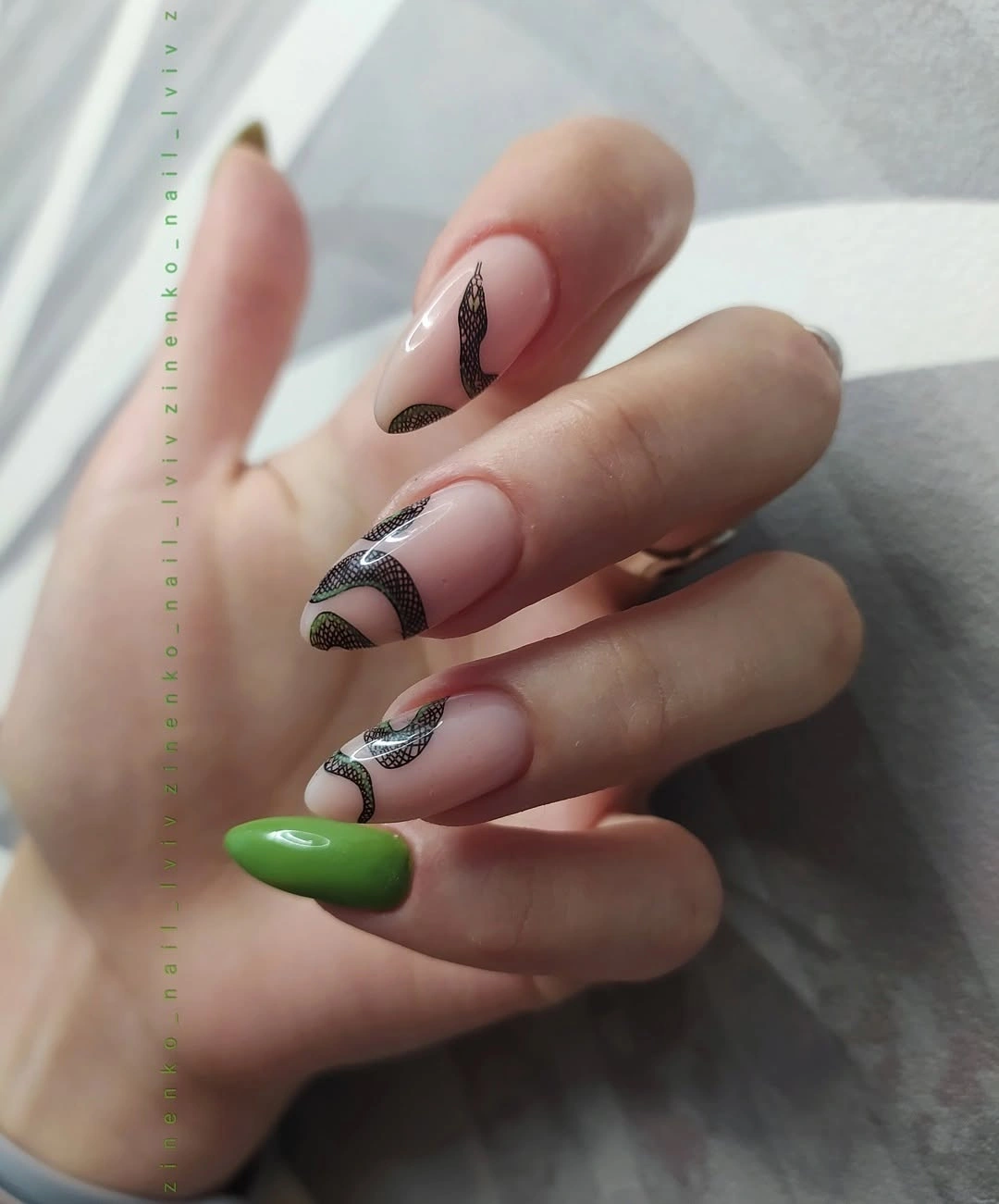
The curves work with the almond silhouette because they travel in the same direction as the tapered tip. Black provides definition, white keeps the pale base open, and green interrupts the otherwise soft palette with a grounded note. The long length is part of the effect, but the visual logic can be transferred to a shorter shape by reducing the number of lines.
If you need a more practical version, keep one large curved stripe on each accent nail and use green only on the thumb or ring finger. That change protects the negative space and makes grow-out less noticeable. The detailed edges may require a steadier maintenance routine, so the shorter adaptation is not just a style change but a realistic way to keep the design readable.
Dark Green and Cream Leaf-Like Accents
Medium almond nails mix a deep green or near-black solid with light accent nails carrying cream, black, and warm leaf-like shapes. The dark color supplies the base, while the decorated nails use several small marks that resemble branches or abstract leaves without needing a literal label. The warmer accents stand out clearly against the cooler green.
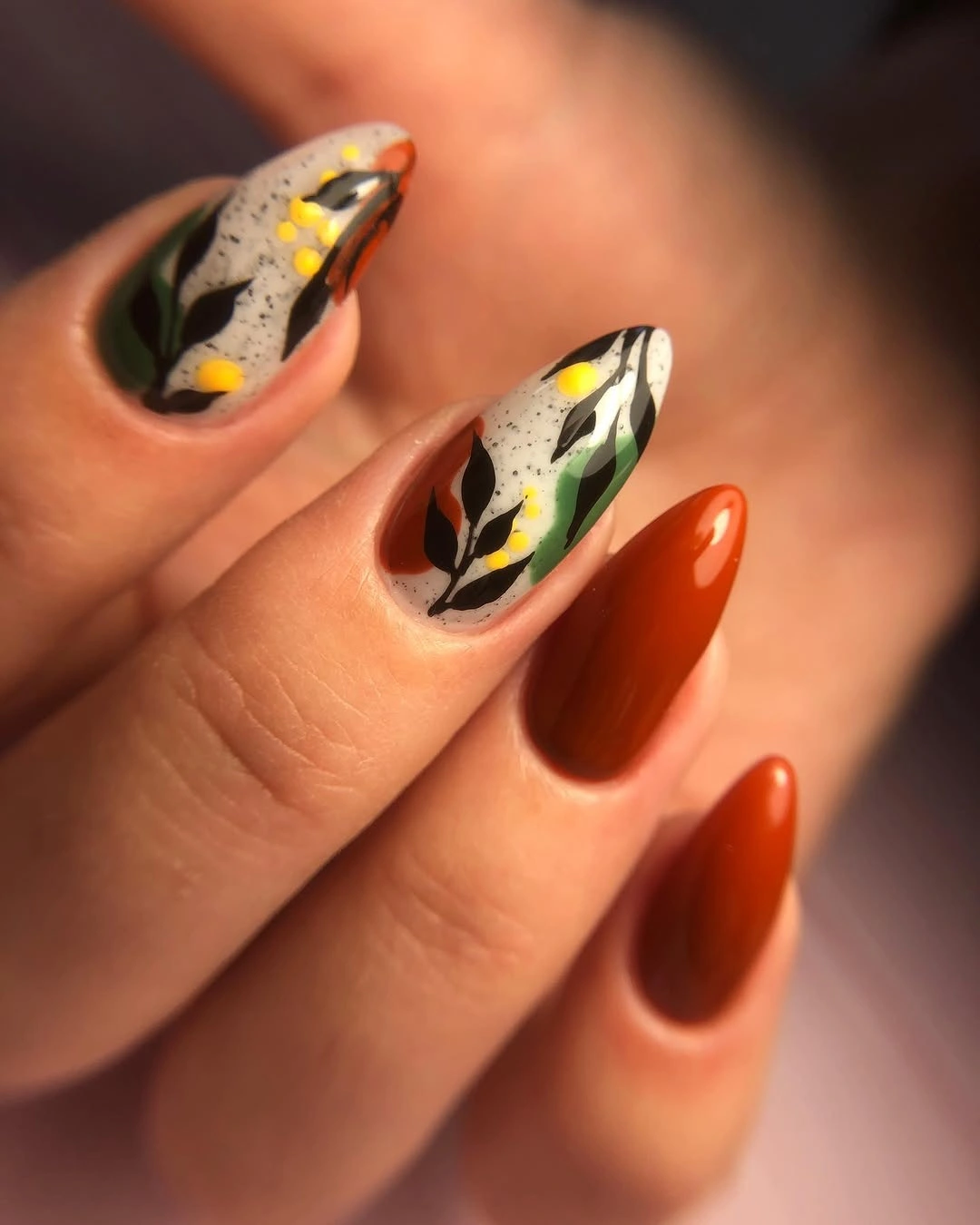
The design gains depth by limiting the dense detail to two nails. A full pattern on every finger would compete with the dark base, but selective placement creates one clear focal area and leaves the rest visually quiet. Almond length gives the marks room, although one larger motif can work on a shorter oval.
To adapt the look, keep the dark green on three or four nails and move the full botanical detail to the ring finger. A cream base can be replaced by soft beige if you prefer a warmer contrast, but the light ground should remain noticeably lighter than the green. That difference is what keeps the leaf-like marks from disappearing into the palette.
Warm Brown with Delicate Botanical Lines
Most nails here are glossy warm brown with a medium-short almond shape, while two light nails carry thin black botanical outlines. The lines are delicate and mostly monochrome, so the accents feel quieter than a filled leaf print. The brown solids repeat the warmth across the hand and give the fine drawing a grounded frame.
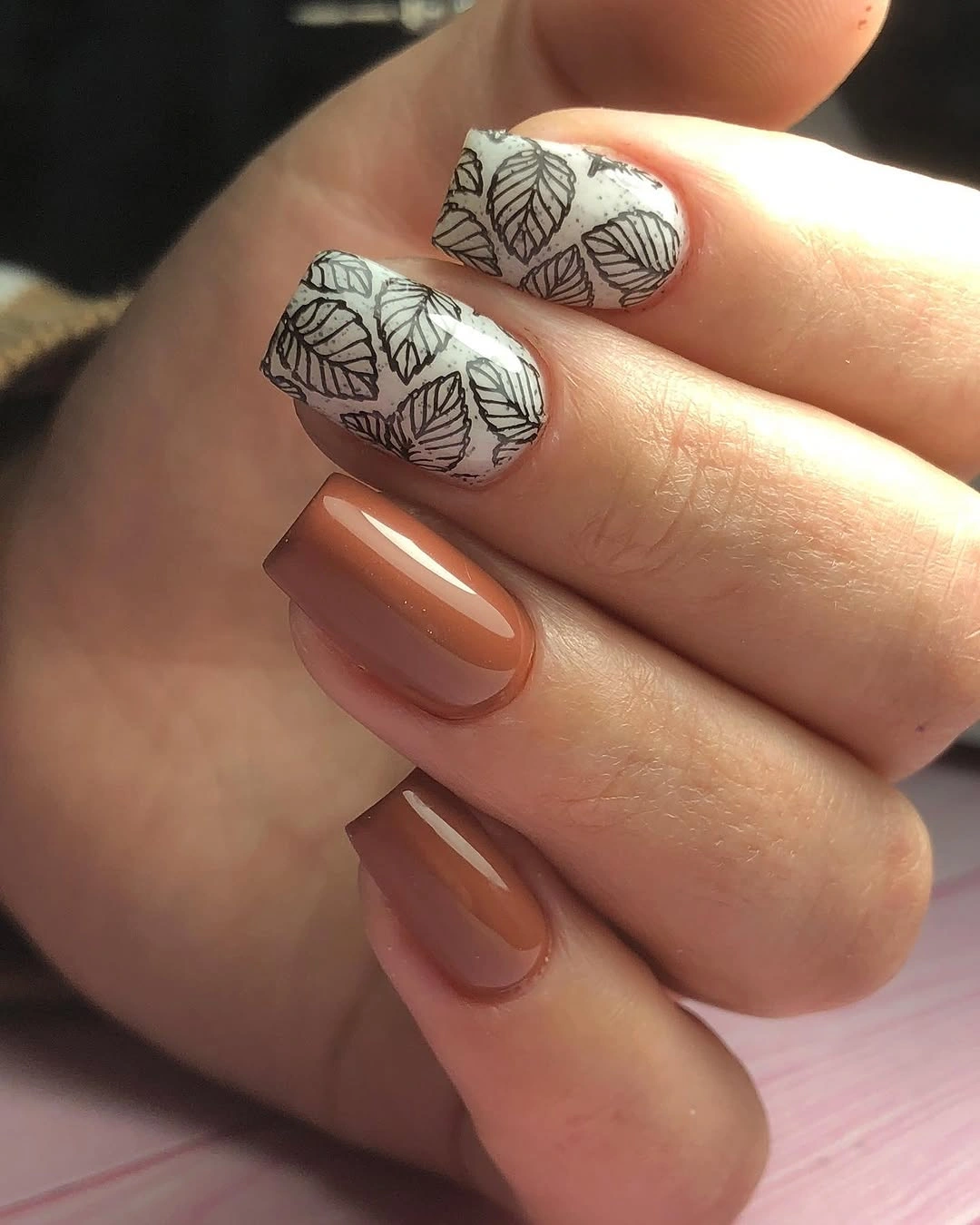
This is a good example of how line weight changes the mood of seasonal nail art. The empty space inside the outlines keeps the manicure refined and prevents the hand from becoming visually dense, while the brown base does the seasonal work in a simple way. Short almond length also keeps the design connected to everyday wear.
If you like the drawing but need less upkeep, place the full botanical line on one nail and make the second accent a plain beige. Fine edges can show wear quickly, so reducing the number of detailed surfaces is a realistic tradeoff. A darker brown or a muted green can replace the base as long as the accent remains light enough to read.
Soft Pink with One Warm Floral Nail
Glossy soft pink covers most of these medium almond nails, while one accent carries a compact floral or leaf illustration in red, purple, and warm tones. The decorated nail is the only strong contrast, which keeps the overall set light and lets the small picture-like marks act as a focused detail. The pink base connects the accent to the rest of the hand.
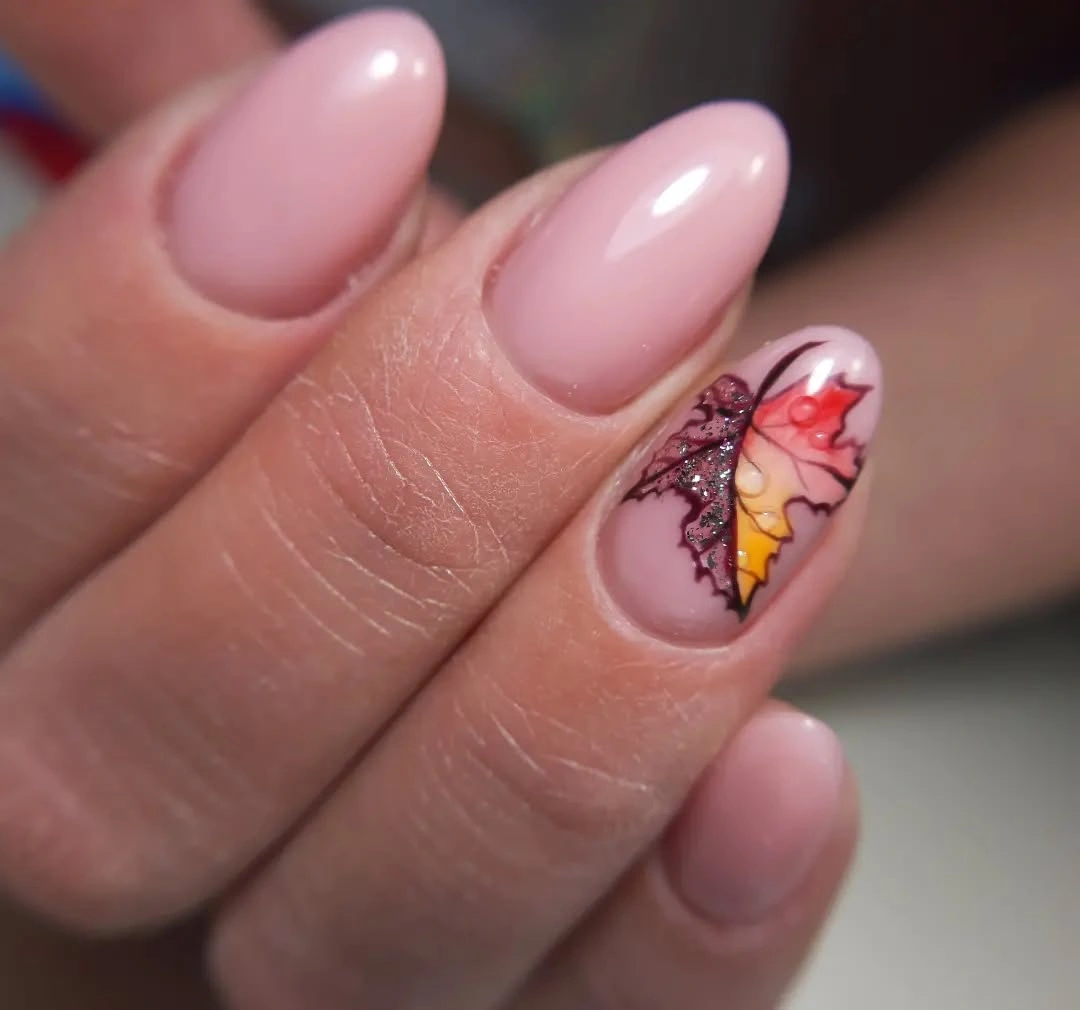
The balance comes from concentration rather than repetition. One detailed nail supplies the seasonal cue, and the plain pink fingers provide visual rest so the accent does not look busy. Medium almond length gives the illustration enough room without making the whole manicure depend on a long silhouette.
Readers who prefer a simpler routine can keep the accent on the ring finger and use a single berry dot on the thumb. A short oval will preserve the soft mood, but the motif should be enlarged if the surface is smaller. The main practical advantage is that most nails remain plain and easy to coordinate with different clothing colors.
Long Glossy Burgundy Stiletto Nail Tips
Every visible nail is a deep burgundy or wine color, and the long stiletto silhouette supplies the drama without any extra art. The glossy surface reflects along the sharp taper, making the shape as important as the shade. Because the color stays uniform, the hand reads as one deliberate line from the base to each pointed tip.
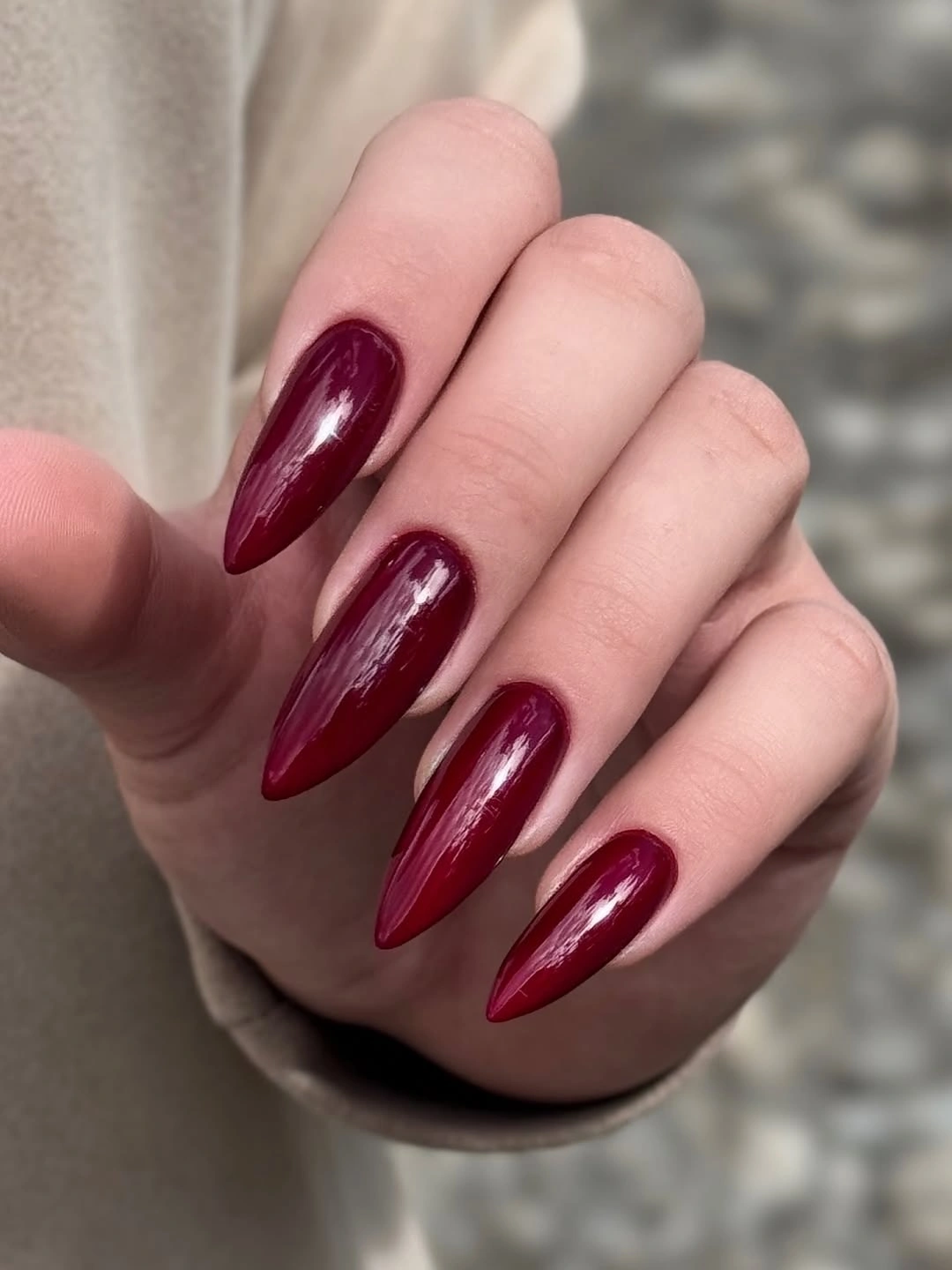
This is a color-first idea for someone who wants a strong autumn mood without making decisions about accents or motifs. Burgundy feels rich against a neutral background, while the stiletto length adds a sharper direction than a short square would. The absence of decoration also makes the shade easier to judge on its own.
The limitation is the length itself. A medium almond in the same wine family will keep the depth and reduce the practical demands of a sharp tip, especially if you type or work with textured fabrics. If you keep the stiletto shape, a clean glossy surface matters because every uneven edge becomes part of the visual statement.
Burgundy, Burnt Orange, Cream, and Nude
Medium almond nails alternate burgundy, burnt orange, cream, and nude solids in a warm edited palette. There are no large motifs, so the interest comes from the order of the colors and the pauses created by the lighter fingers. The shapes stay consistent, allowing the varied shades to feel like one collection rather than unrelated choices.
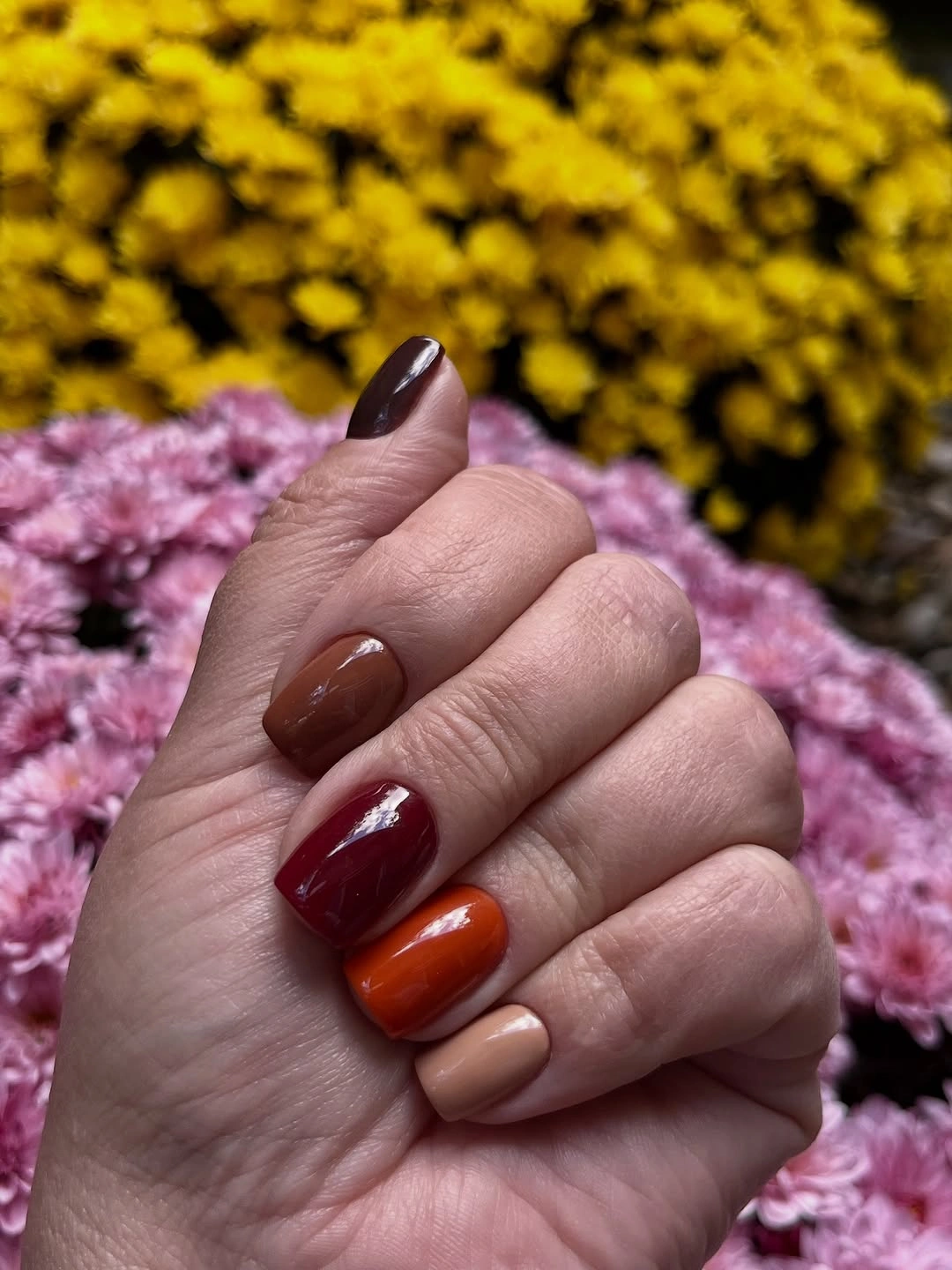
Cream and nude do important work here: they separate the stronger burgundy and orange so neither shade dominates the hand. That balance makes the combination easier to wear with denim, beige, or dark brown layers. Medium length keeps the color changes visible while avoiding the sharper statement of a long stiletto.
You can reduce the palette to burgundy, cream, and one orange accent if four shades feel too active. On shorter nails, repeat the two lighter tones strategically so the warm colors do not crowd each other. The best part of the design is its editability – the structure stays intact even when one color is removed.
Short Square Pink with Graphic Red Blocks
Short-to-medium square nails use pale pink or nude as a base, then add white sections, rounded red blocks, and tiny black marks. Several nails share the same visual language, but the shapes shift in placement so the set is coordinated without being identical. The light base keeps the red accents clear on a compact tip.
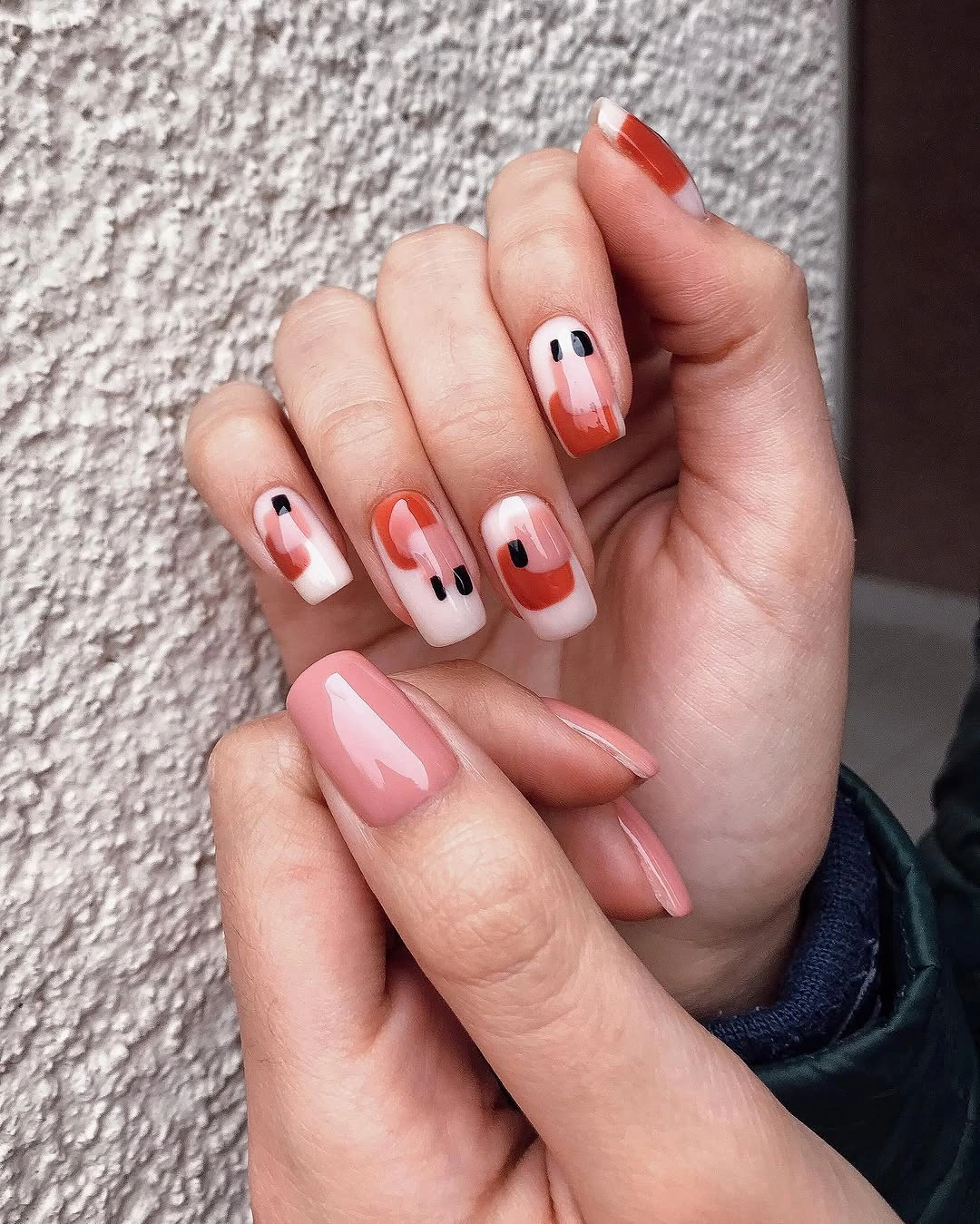
The graphic forms suit square edges because broad blocks and short curves remain legible where fine line work might compress. White creates pauses between the red details, while black adds just enough definition to keep the pattern from looking soft. This gives the manicure a playful fall direction without requiring a literal leaf or pumpkin.
For an even shorter shape, choose one red block and one black mark per accent nail. Larger forms will hold their outline better than several tiny details, and the pale ground will remain visible as the manicure grows. If red feels too bright, switch to berry or rust while keeping the pink and white framework.
Layered Olive and Forest Green with One Botanical Nail
Medium almond nails combine forest green, olive, and one cream accent with a small botanical or leaf print. The two greens create depth before the light nail enters, so the palette feels layered rather than simply alternating dark and light. The glossy solids keep the patterned nail from becoming the only thing the eye sees.
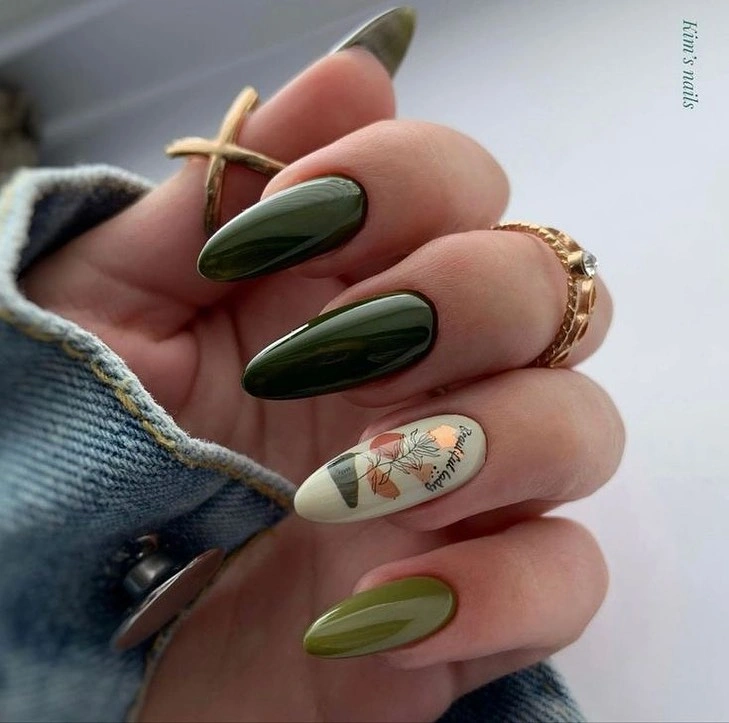
The design works because the colors stay in one family while the accent supplies contrast. Olive softens the deeper green, and the cream surface gives the botanical mark a clean stage. Medium almond is long enough to show the print but still moderate, which makes the look easier to imagine beyond a styled close-up.
A shorter oval can use forest green as the main color, olive on one accent, and one larger leaf on the light nail. Keeping the print to one finger reduces upkeep and lets the tonal greens do more of the work. This is also a flexible palette for readers who want a fall manicure that sits comfortably beside denim or neutral clothing.
Bright Orange with One Botanical Break
Short square nails are mostly vivid orange, with one lighter nail carrying a black and olive botanical detail. The orange forms the dominant block across the hand, while the patterned nail acts as a small pause rather than a second full palette. The compact shape keeps the color clean and prevents the bright shade from looking overly elongated.
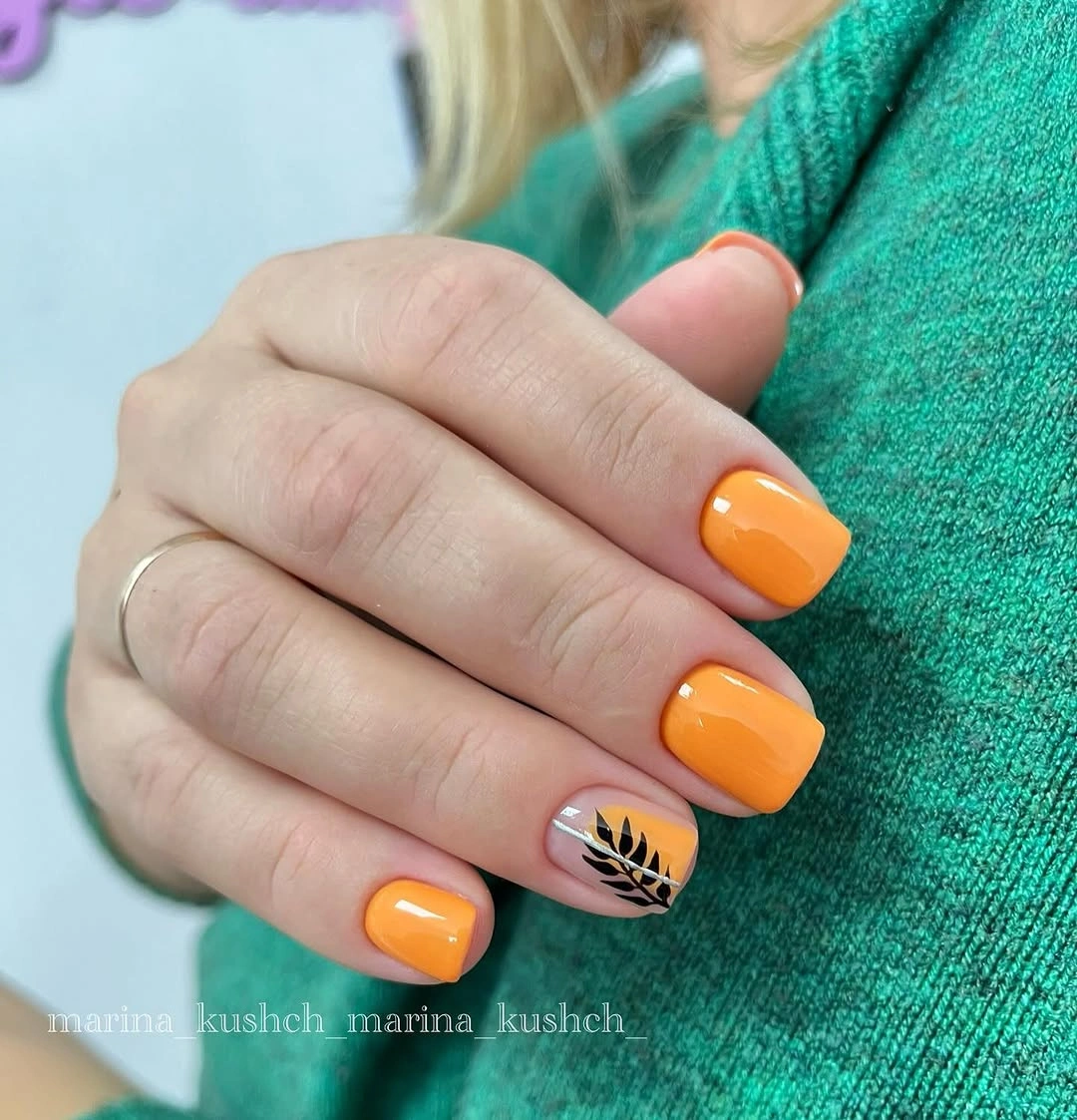
A simple accent is enough to keep bright orange from feeling flat. The botanical mark adds a darker, more organic note, but because it appears on only one nail, the manicure remains easy to read and easier to adapt. The seasonal impression comes from the relationship between orange and the small leaf-like detail, not from the background.
If the full orange set feels too strong, use the shade on three nails and pair it with a soft nude on the remaining fingers. Move the botanical accent to the ring finger or thumb so it sits where you naturally want the focal point. A burnt orange can soften the contrast while preserving the same bright-and-grounded structure.
Sheer Nude with Burgundy and White Curved French Lines
Long square nails use a sheer nude base and irregular burgundy, black, and white curves that trace the tips and sides. The open ground keeps the design light, while the layered lines create a French-like rhythm without filling the whole nail. The curves vary slightly, so the hand feels drawn rather than mechanically repeated.
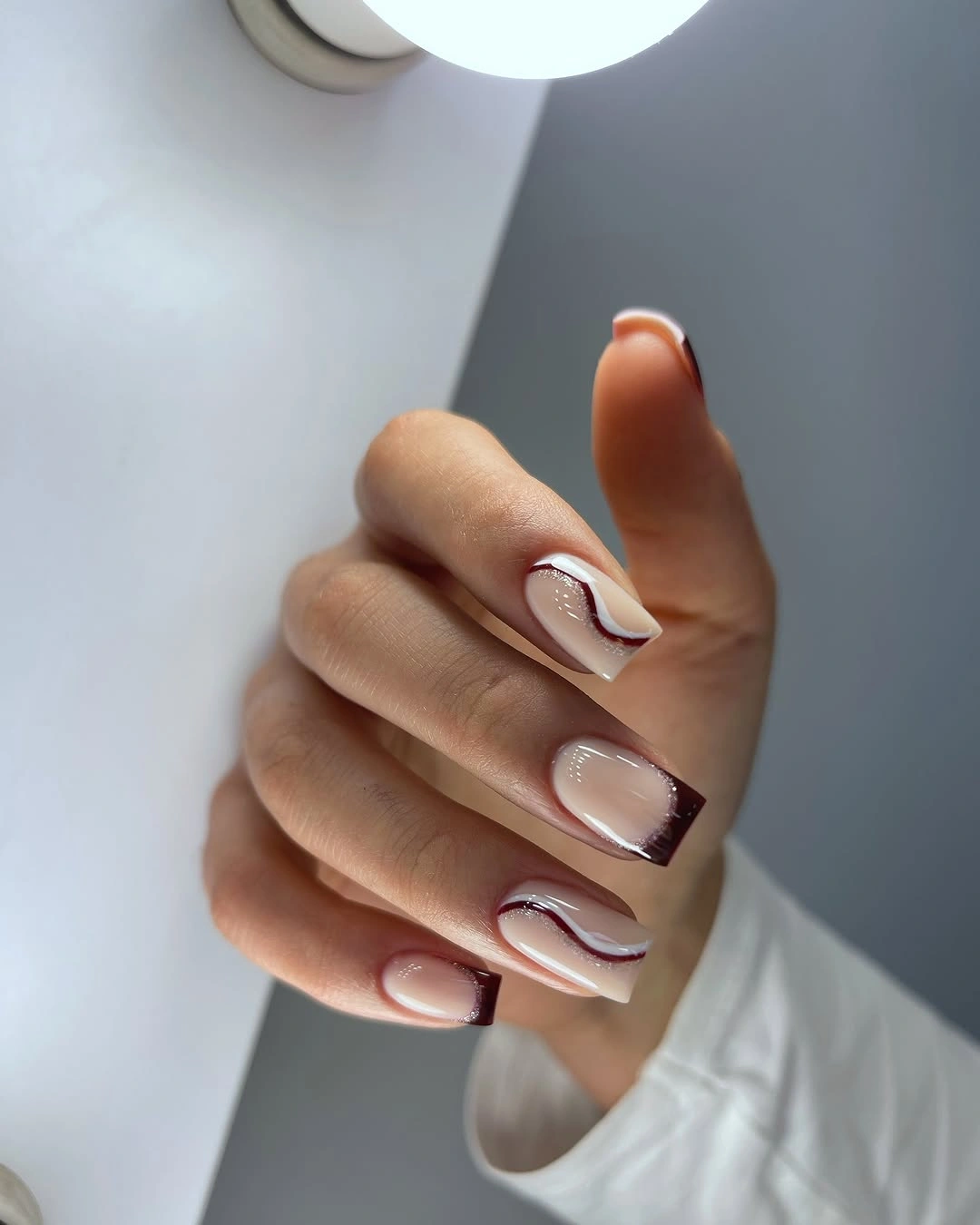
Negative space is the key decision here. The burgundy supplies the fall color, black adds a crisp outline, and white keeps the lines from merging into one dark band. Long square length gives the shapes room, but the concept is adaptable because a shorter nail can use one outlined curve instead of several.
The main limitation is that sheer bases make grow-out visible sooner, especially when the lines sit near the cuticle. If that is a concern, keep the design farther toward the tip or use a softly tinted nude. Readers who want less length can move to a medium square and make the curves wider so the structure stays readable.